Rated 5 star on

What a Full-Funnel Growth Engine Looks Like
Quick answer
A growth engine has four stages: demand that brings the right people, conversion that turns them into leads and customers, retention that makes each one worth more, and measurement that shows which part is failing. Most businesses over-invest in demand and under-invest in the three stages after it, which is why the engine leaks.
Most businesses do not have a growth engine. They have a collection of parts bought at different times from different vendors: an ad account here, a website from 2019, a front desk that answers when it can, a spreadsheet someone calls a CRM. Each part works, more or less. Together, they leak.
Key Takeaways
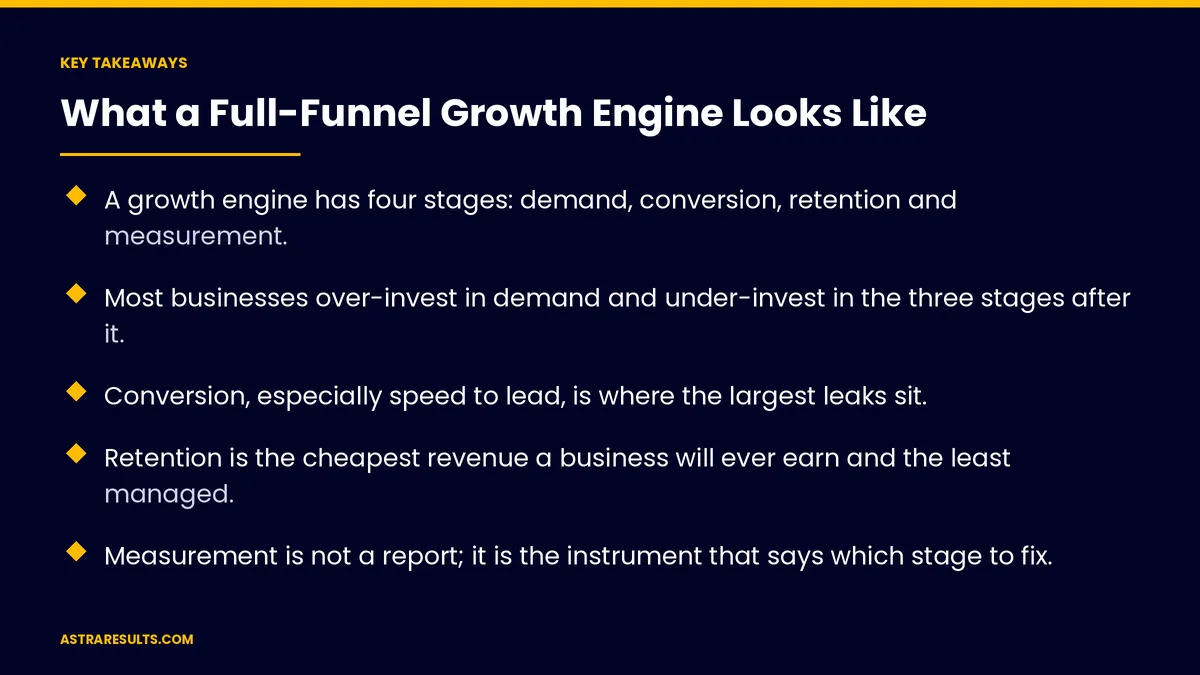
- A growth engine has four stages: demand, conversion, retention and measurement.
- Most businesses over-invest in demand and under-invest in the three stages after it.
- Conversion, especially speed to lead, is where the largest leaks sit.
- Retention is the cheapest revenue a business will ever earn and the least managed.
- Measurement is not a report; it is the instrument that says which stage to fix.
- Fix the binding constraint first. Sometimes that means fewer channels, not more.
Published: September 28, 2026 | Reading Time: ~13 minutes | Category: Strategy
A growth engine is the same parts arranged so each one feeds the next and nothing falls through. This piece describes what that looks like in practice: four stages, what each does, where each breaks, and the order to fix them in.
If you remember one thing: more traffic into a leaking engine buys more leaks.
Guidance for business owners and operators. Nothing here is financial, legal or tax advice. Figures are illustrative; the right sequence for a specific company depends on where its own engine is breaking.
In This Playbook
- The four stages
- Why most businesses over-invest in demand
- Stage one: demand, done properly
- Stage two: conversion, where the leaks live
- Stage three: why is retention the cheapest revenue?
- Stage four: measurement, the instrument panel
- The binding constraint
- How do fast wins fund the slow compounding work?
- What this looks like at three sizes
- The common failure modes
- The first 90 days
The four stages
- Demand is everything that makes a stranger aware of the business and interested enough to act. Search ads, SEO, social, video, connected TV, referrals, reputation.
- Conversion is everything that happens between "interested" and "customer." The call, the form, the chat, the quote, the follow-up, the close.
- Retention is everything that turns one customer into a repeat customer, a larger customer, or a referring customer.
- Measurement is the instrument layer. It tells the business which of the other three is leaking, and by how much.
Every business has all four, whether or not anyone manages them. The difference between a collection of parts and an engine is whether the four are designed to work together and measured as one system.
Why most businesses over-invest in demand
Demand is visible. An ad account has a dashboard. A ranking can be checked. A new post has likes. Everything about demand produces a number quickly, and numbers feel like progress.
Conversion and retention are quiet. Nobody sees the lead that called at 6:15 PM and got voicemail. Nobody sees the quote that went out Tuesday and never got a follow-up. Nobody sees the customer who would have bought again if anyone had asked.
So budgets drift toward demand. Ad spend rises, leads rise, and revenue rises less than either, because the same fraction of leads keeps falling through the same holes.
The pattern is common enough to state as a rule: if demand is up and revenue is flat, the leak is downstream.
Stage one: demand, done properly
Demand's job is not to produce leads. Its job is to produce leads the business can close profitably. Those are different targets.
- The channel mix follows the buyer. A service business whose customers search when something breaks lives on search ads and local SEO. A brand whose customers need reminding lives on social and connected TV. A B2B company lives on outbound and referrals. Most businesses need two or three channels, not eight.
- Intent is the sorting variable. Search captures existing demand. Social, video and CTV create it. Outbound goes and gets it. Each has a different cost per lead and a different close rate, and mixing the numbers hides which one is working.
- Reputation is a demand channel. Reviews, referrals and word of mouth produce the highest-closing leads any business gets. They deserve a system, not luck.
- The negative signal. Demand that produces leads the business cannot serve costs money twice: once to acquire, once in the time spent declining it.
Stage two: conversion, where the leaks live
This is the stage most businesses have never measured, and it is usually where the money goes.
- Speed to lead. A lead that waits an hour for a callback is often closed by whoever answered first. The businesses that win are not the ones with the best pitch. They are the ones that responded in five minutes, examined in the intake standard.
- After hours. A meaningful share of leads arrive when the business is closed. Voicemail is a leak. An answering service that takes a message is a slower leak. Booking the appointment in the moment is the fix.
- The follow-up cadence. Most quotes get one follow-up or none. The second, third and fourth close a disproportionate share of deals, because the buyer was busy, not uninterested.
- The handoff. Marketing hands to sales, sales hands to operations, and something is lost at each seam. The fix is a shared definition of "lead," "qualified," and "closed" that everyone uses.
- What good looks like. Every inbound contact answered in minutes, around the clock, in the customer's language, with the next step booked before the conversation ends. That is achievable now with AI intake and a human escalation path, and it typically moves revenue faster than any demand change.
Stage three: why is retention the cheapest revenue?
Acquiring a new customer costs several times what keeping one does. Every owner knows this. Almost none have a retention system.
- The repeat purchase. Where customers can buy again, the question is whether anyone asks them to. A reminder at the right interval, a maintenance plan, a reorder prompt. These are not campaigns. They are operations.
- The expansion. The existing customer who buys a second service is the easiest sale the business will ever make. It requires knowing what they bought and what they have not, which requires data that connects.
- The referral. Satisfied customers refer when asked, when it is easy, and when the business remembers to thank them. Each of those is a small system.
- The review. Reviews are retention's public face and demand's raw material. Requested after every job, without filtering, and answered every time.
- The number that matters here is twelve-month customer value by cohort and by source. It almost always shows that the "expensive" channel produced the customers who stayed.
Stage four: measurement, the instrument panel
Measurement is not the monthly report. It is the set of numbers that tells the business which stage to fix this month.
- One definition of each stage. What counts as a lead, a qualified lead, a booked appointment, a closed customer and a retained one, written once and used by everyone, laid out in the attribution standard.
- Cost per closed customer by source, not cost per lead. Cost per lead rewards channels that produce unqualified volume.
- Conversion rate at each seam. Lead to contact, contact to appointment, appointment to close. The seam with the worst rate is the constraint.
- Speed to lead as a first-class metric. The clock starts when the contact arrives and stops when a human or AI replies, tracked by hour. Almost no business tracks it, and it is the single largest lever.
- The dashboard test. If the dashboard does not tell the owner what to fix next, it is a report, not an instrument.
The binding constraint
An engine runs at the speed of its slowest part. Growth works the same way.
- Diagnosing it. Walk the four stages with real numbers. Where does the largest share of value disappear? If half the leads never get a response, that is the constraint. If leads convert but nobody comes back, retention is. If nobody knows, measurement is.
- Fixing it first. Every dollar spent on a non-binding stage is partly wasted until the constraint is addressed. This is why a serious diagnosis sometimes recommends reducing demand spend and fixing intake.
- Re-diagnosing after. Once the constraint moves, the next-slowest stage becomes the constraint. The engine is never done. It is tuned.
- The uncomfortable version. A business spending $20,000 a month on ads with a 40% lead-response rate does not have an ad problem. It has a $12,000-a-month intake problem wearing an ad account.
How do fast wins fund the slow compounding work?
Some fixes move in weeks. Others compound over months. The order matters.
- Weeks: speed to lead, after-hours coverage, follow-up cadence, negative keywords, landing page fixes, review requests. These change what happens to demand that already exists.
- Months: SEO, content, AI search visibility, brand awareness, referral systems. These build assets that compound.
- The sequence. Fast work first, because it produces cash and proof. That cash funds the slow work. The proof earns the patience the slow work needs.
- The trap. Starting with the slow work because it is more interesting, then running out of money or faith before it compounds.
What this looks like at three sizes
- Under $1M revenue. The owner is the engine. One demand channel done well, intake answered every time, reviews requested, a spreadsheet that tracks source to close. Everything else waits.
- $1M to $10M. Two or three demand channels, AI intake with human escalation, a real CRM, a retention cadence by customer type, and monthly measurement by source. This is where most of the engine gets built.
- Above $10M. Multiple locations or lines, centralized measurement definitions, a clear split between what the center owns and what locations own, according to the centralization question, and data infrastructure connecting operations to marketing.
The stages are the same at every size. What changes is how much system each one needs.
The common failure modes
- The channel collector. Eight channels, none with enough budget or attention to work, and no way to tell which is producing.
- The traffic buyer. Demand keeps rising, revenue stays flat, and the answer is always more demand.
- The report reader. A 40-page monthly report nobody acts on, because it reports everything and prioritizes nothing.
- The vendor patchwork. Five vendors, five definitions of a lead, five reports that cannot be reconciled, and nobody accountable for revenue.
- The retention orphan. A business that has never once contacted a past customer to ask them back.
Each of these is a stage problem disguised as something else.
The first 90 days
Days 1–30: diagnose
The four stages walked with real numbers. Speed to lead measured for the first time. Cost per closed customer by source calculated. The binding constraint named in one sentence.
Days 31–60: fix the constraint
Usually conversion: intake answered in minutes around the clock, follow-up cadence installed, definitions written and shared. Demand spend held or trimmed while the leak closes.
Days 61–90: measure and re-diagnose
Conversion rates at each seam compared to Day 1. The next constraint identified. Slow-compounding work started with the cash and proof the fast work produced.
How Astra builds the engine
Astra Results Marketing reverse-engineers the revenue model before touching a channel: what a customer is worth, how many the business closes, and where the pipeline leaks. Then it builds only what fixes the binding constraint.
That is why the first recommendation is sometimes fewer channels, not more. Strategy, execution and measurement sit under one accountable team, priced transparently, with the client's accounts, content and data remaining theirs. Engagements begin with a diagnostic across all four stages through our business consulting team.
Related reading
Frequently asked questions
What is a full-funnel growth engine?
The four stages every business has — demand, conversion, retention and measurement — designed to work together and measured as one system. Most businesses have all four as disconnected parts bought from different vendors at different times. The engine is the same parts arranged so each feeds the next and nothing falls through.
Why do most businesses over-invest in demand?
Because demand is visible and produces numbers quickly, while conversion and retention are quiet. Nobody sees the lead that reached voicemail or the customer who would have bought again if asked. Budgets drift toward what has a dashboard. The tell is demand rising while revenue stays flat, which means the leak is downstream.
Where do the biggest leaks usually sit?
In conversion, and specifically in speed to lead. A lead that waits an hour is often closed by whoever answered first. After-hours contacts hitting voicemail, quotes with one follow-up or none, and handoffs between marketing, sales and operations are the other common leaks. Fixing these typically moves revenue faster than any demand change.
What is the binding constraint?
The stage where the largest share of value disappears. An engine runs at the speed of its slowest part, so every dollar spent on a non-binding stage is partly wasted until the constraint is fixed. That is why a serious diagnosis sometimes recommends reducing ad spend to fix intake first. Once the constraint moves, the next-slowest stage becomes the new one.
How should the fixes be sequenced?
Fast work first — speed to lead, after-hours coverage, follow-ups, negative keywords, review requests — because it changes what happens to demand that already exists and produces cash and proof within weeks. That funds the slow compounding work: SEO, content, AI search visibility, brand, referral systems. The trap is starting with the slow work and running out of money or faith before it compounds.
What should the dashboard show?
Cost per closed customer by source rather than cost per lead, conversion rate at each seam so the weakest is visible, speed to lead by hour of day, and twelve-month customer value by cohort and source. The test is simple: if the dashboard does not tell the owner what to fix next, it is a report, not an instrument.
READY TO FIND OUT WHICH STAGE IS LEAKING? Astra Results Marketing diagnoses all four stages of the growth engine, names the binding constraint, and builds only what fixes it, under one accountable team. Astra Results Marketing · 1101 Brickell Ave, Miami, FL 33131 · +1 (786) 321-2866 · [email protected] Find us on Google · Yelp ▸ CALL (786) 321-2866 · ▸ REQUEST YOUR CONSULTATION