Rated 5 star on


Building an Internal Marketing Team vs Partnering
Quick answer
The usual comparison, salary against retainer, is the wrong one. Compare total employment cost, capability breadth, coverage, ramp time and what happens when someone leaves. One marketing hire covers one or two disciplines well and the rest badly, which is why most businesses above a certain size land on a hybrid rather than either extreme.
An agency writing about whether to hire internally has an obvious conflict, so here is the position stated at the start: for some businesses the right answer is to hire, for some it is to partner, and for most of a certain size it is a combination.
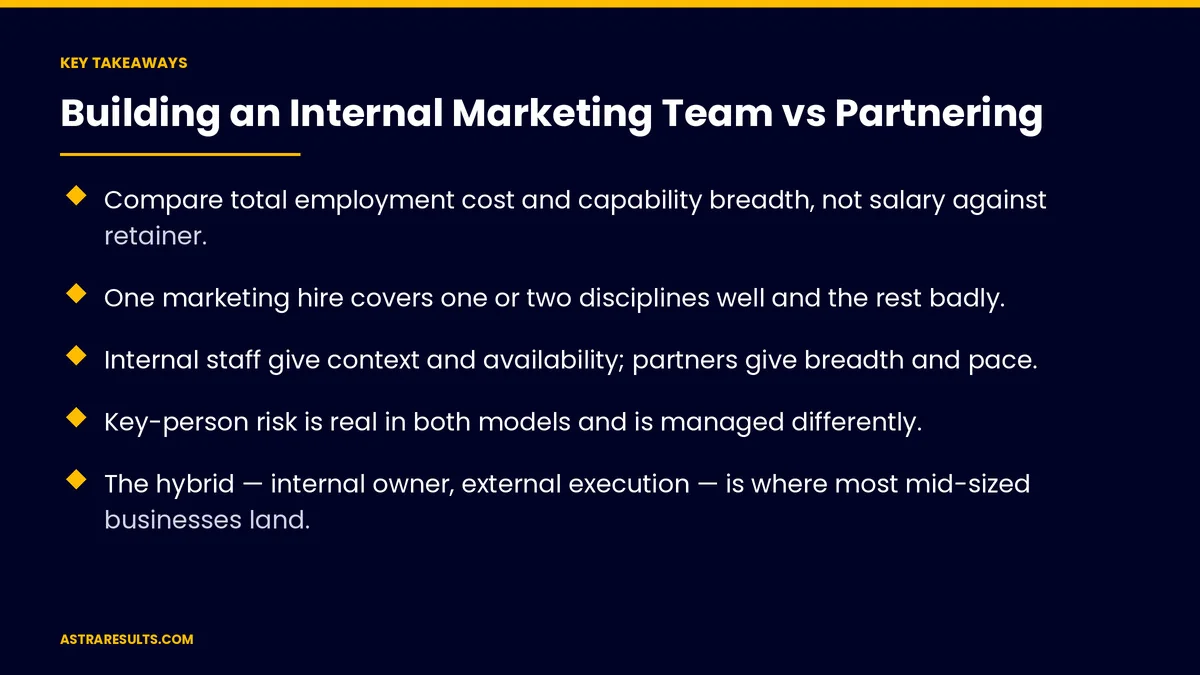
Key Takeaways
- Compare total employment cost and capability breadth, not salary against retainer.
- One marketing hire covers one or two disciplines well and the rest badly.
- Internal staff give context and availability; partners give breadth and pace.
- Key-person risk is real in both models and is managed differently.
- The hybrid — internal owner, external execution — is where most mid-sized businesses land.
- Whoever does the work, the accounts and data belong to the business.
Published: September 7, 2026 | Reading Time: ~12 minutes | Category: Team
The decision usually gets made on salary versus retainer, which is the wrong comparison. The right one includes coverage, capability breadth, ramp time, management load and what happens when someone leaves. This piece works through each. Stated simply: you are not comparing a salary to a fee; you are comparing two different sets of risks.
Guidance for owners and operators. Nothing here is employment, tax or legal advice. Classification, contracts and employment obligations vary by jurisdiction and require the relevant professionals.
In This Playbook
- The comparison people make, and why it misleads
- Strengths of an internal hire
- Strengths a partner brings
- Key-person risk in both models
- The hybrid, and why most businesses land there
- Thresholds worth knowing
- Questions that decide it for a specific business
- Requirements common to both models
- A 90-day sequence
- How does Astra fit either model?
The comparison people make, and why it misleads
- The usual framing. A marketer's salary against an agency retainer, with the salary looking better or worse depending on the numbers.
- What it omits on the employment side. Payroll taxes, benefits, equipment, software licenses, recruitment cost, ramp time before productivity, management time, and the cost of a bad hire.
- What it omits on the agency side. The management load of briefing and reviewing, which is real, and the fact that a retainer buys a share of several people rather than all of one.
- The capability question nobody costs. A single hire cannot be strong at paid media, technical SEO, content, design, video, analytics and AI systems. Nobody is. The gap gets filled by freelancers, tools or nothing.
- The better comparison. Total cost against total capability coverage, on the specific disciplines the plan needs, as set out in what the plan requires.
Strengths of an internal hire
- Context. They know the products, the customers, the seasonal quirks and the internal politics. Context compounds and cannot be briefed quickly.
- Availability. In the building, in the meeting, able to answer a question in a minute rather than a ticket.
- Institutional memory. Why something was tried in 2024 and abandoned.
- Coordination with operations. Marketing that depends on sales, service or fulfillment cooperating works better when the marketer eats lunch with those people.
- Small, frequent work. The daily social post, the quick landing page edit, the urgent customer email. Agencies are structurally slow at small things.
- Culture and voice. Someone who has absorbed how the business talks produces more on-voice work than any document can transmit, though the document still matters, as covered in brand voice.
Strengths a partner brings
- Breadth. Access to specialists across disciplines without hiring each one.
- Pace on new capabilities. A partner running twenty accounts sees what works across all of them and adapts faster than a single person learning alone.
- Tooling. Enterprise platforms and data that would be uneconomic for one business to license.
- Cover. Holidays, illness and departures do not stop the work.
- Objectivity. An outsider can say the pricing is wrong or the product is the problem, which an employee reporting to the owner cannot.
- Scale up and down. A campaign season needs more capacity for two months, not a permanent hire.
- The limit. None of that helps if the partner is inattentive, and a disengaged agency is worse than a junior employee who cares.
Key-person risk in both models
- In-house. The marketer leaves and takes the passwords, the context and the relationships. The business discovers what was undocumented in the worst week.
- At an agency. The account lead leaves and the replacement does not know the business, or the agency reassigns the good people to a bigger client.
- The mitigations are the same. Documentation, accounts in the business's name, data that lives in the business's systems, and a written record of what was tried and why, as explored in documentation that transfers.
- The question to ask an agency. Who specifically does the work, and what happens if they leave.
- The question to ask before hiring. If this person left in six months, what would we lose that is not written down.
The hybrid, and why most businesses land there
- The shape. One internal person who owns the outcome, understands the business and coordinates, with external specialists executing the disciplines that need depth.
- Why it works. The internal owner supplies context, availability and accountability. The partner supplies breadth, tools and pace. Neither is asked to be what it is not.
- The internal role that fits. A marketing manager or coordinator who can brief well, judge work, run the calendar and hold partners to account — not someone expected to personally build campaigns across six disciplines.
- The failure mode of the hybrid. An internal hire whose actual job is unclear, who ends up duplicating the partner's work or blocking it. The split should be written down.
- When it becomes a full team. As volume grows, disciplines move in-house one at a time, usually starting with the one with the most daily work.
Thresholds worth knowing
These are patterns, not rules.
- Under roughly one million in revenue. Usually neither a full hire nor a large retainer. The owner does marketing with focused outside help on specific projects.
- One to five million. A partner plus the owner, or a first coordinator hire plus a partner. A single generalist hire expected to do everything is the common mistake here.
- Five to twenty million. The hybrid, with an internal marketing owner and external execution across several disciplines.
- Above twenty million. An internal team for the disciplines with daily volume, partners for the specialized and the variable, and internal capacity to manage both.
- The variable that moves the thresholds. How marketing-dependent the business is. A business whose growth is entirely marketing-driven builds capability earlier than one growing on relationships.
Questions that decide it for a specific business
- How many disciplines does the plan need? One or two points to a hire; five points to a partner.
- Is the work steady or lumpy? Steady favors internal; seasonal or project-based favors external.
- Who will manage the marketer or the partner? An unmanaged hire and an unmanaged agency fail the same way.
- Can the business attract a good hire? Location, salary and the appeal of being a department of one all matter.
- What happens in month one? A hire takes weeks to ramp; a partner should produce inside the first month.
- Is objectivity needed? If the direct answer involves telling the owner something uncomfortable, an employee is in a harder position.
Requirements common to both models
- Accounts in the business's name. Ad accounts, analytics, domains, profiles, with the marketer or agency as a manager who can be removed.
- Data in the business's systems. The CRM and its records, not a spreadsheet on someone's laptop.
- Documentation. What runs, why, and how, updated as it changes.
- A single definition of a lead and a customer, so nobody can report a different number, as detailed in one set of definitions.
- A monthly review against revenue, whoever attends it.
- An exit that is uneventful. If ending the relationship — employment or agency — would be a crisis, that is a finding worth acting on now.
A 90-day sequence
Days 1–30: define the need
The disciplines the plan requires, listed. Total employment cost modeled properly against the equivalent partner scope. Who will manage whichever is chosen, named.
Days 31–60: decide and contract
The model chosen with the split written down if hybrid. Accounts and data moved into the business's name regardless. Definitions agreed. The management cadence set.
Days 61–90: measure the decision
Output against the plan. Where capability gaps remain. Whether the management load is what was expected. One adjustment made on that evidence rather than on feeling.
How does Astra fit either model?
Astra Results Marketing works alongside internal marketers rather than around them, and says when a business would be better served by hiring than by expanding a retainer — when the work is steady, narrow and high-volume enough to keep one person busy.
Where the hybrid applies, the split between internal ownership and external execution is written down so nobody duplicates or blocks the other. Accounts, data and documentation stay in the client's name whoever does the work, so ending the relationship is uneventful by design. Engagements begin with a capability and scope assessment through our business consulting team.
Related reading
Frequently asked questions
Why is salary versus retainer the wrong comparison?
Because it omits most of the cost and all of the capability question. The employment side carries payroll taxes, benefits, equipment, software, recruitment, ramp time, management time and the cost of a bad hire. The agency side carries a real briefing and review load. And neither figure captures the fact that one hire cannot be strong across paid media, SEO, content, design, video, analytics and AI systems.
What are internal staff better at?
Context that compounds and cannot be briefed quickly, availability in the building, institutional memory of what was tried and abandoned, coordination with sales and operations, and small frequent work like a quick page edit or an urgent customer email — agencies are structurally slow at small things. They also absorb the business's voice more completely than any document transmits it.
What are partners better at?
Breadth across disciplines without hiring each specialist, pace on new capabilities because they see what works across many accounts, tooling that would be uneconomic for one business, cover during holidays and departures, objectivity to say the pricing or the product is the problem, and scaling up for a season without a permanent hire. None of which helps if the partner is inattentive.
How is key-person risk managed?
The same way in both models: documentation, accounts in the business's name, data in the business's systems, and a written record of what was tried and why. Ask an agency who specifically does the work and what happens if they leave. Ask before hiring what would be lost that is not written down if the person left in six months.
What does the hybrid model look like?
One internal person who owns the outcome, knows the business and coordinates, with external specialists executing the disciplines that need depth. The internal role is a manager or coordinator who briefs well, judges work and holds partners accountable — not a generalist expected to personally build campaigns across six disciplines. The failure mode is an unclear split, so it should be written down.
What should be true regardless of the model?
Accounts in the business's name with the marketer or agency as a removable manager, data in the business's own systems rather than a laptop spreadsheet, documentation of what runs and why, a single definition of a lead and a customer so nobody reports a different number, and a monthly review against revenue. If ending the relationship would be a crisis, that is a finding to act on now.
READY TO COMPARE THE REAL COSTS? Astra Results Marketing models total employment cost against equivalent partner scope, says when hiring is the better answer, and keeps accounts, data and documentation in your name whoever does the work. Astra Results Marketing · 1101 Brickell Ave, Miami, FL 33131 · +1 (786) 321-2866 · [email protected] Find us on Google · Yelp ▸ CALL (786) 321-2866 · ▸ REQUEST YOUR CONSULTATION