Rated 5 star on

Marketing Services Explained in One Page
Quick answer
Search advertising captures demand that already exists; almost every other service creates it, which takes longer and costs less per unit over time. Before buying more demand of any kind, fix answering and conversion, because an unanswered call wastes whatever was spent to produce it. The right service follows from where the business is losing customers.
Marketing services are sold with vocabulary that obscures what is actually being bought. An owner is offered SEO, PPC, CTV, social, content, GEO and a funnel audit, and has no straightforward way to tell which of those would produce customers for their particular business, or in what order.
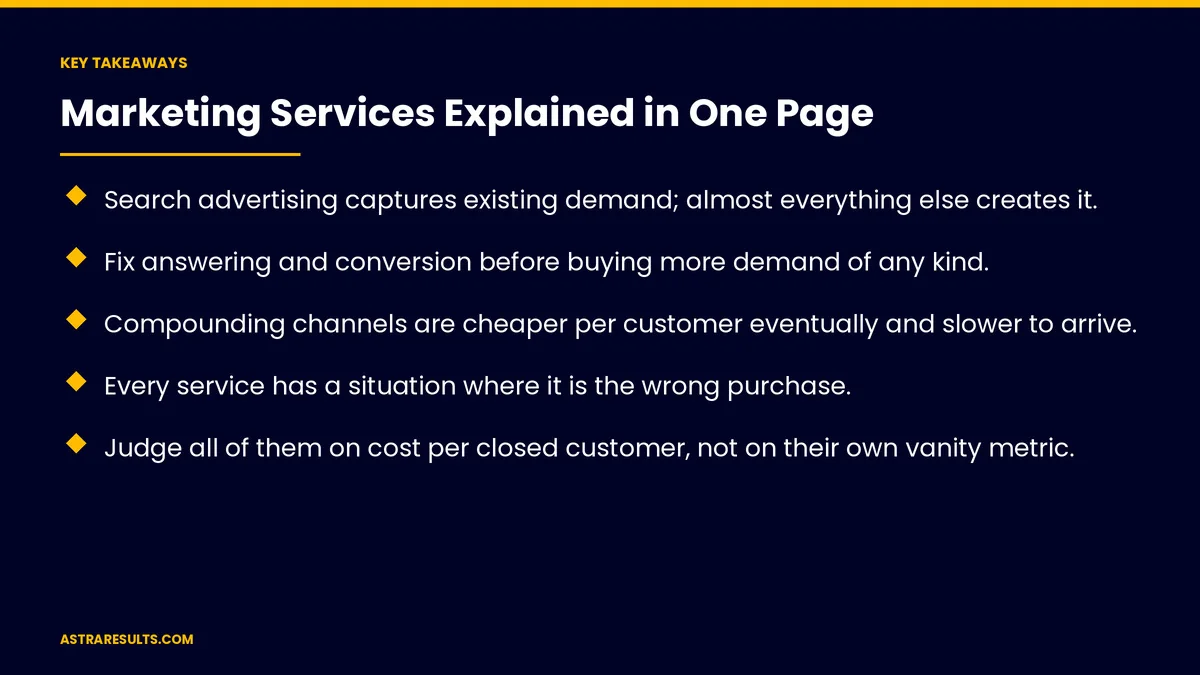
Key Takeaways
- Search advertising captures existing demand; almost everything else creates it.
- Fix answering and conversion before buying more demand of any kind.
- Compounding channels are cheaper per customer eventually and slower to arrive.
- Every service has a situation where it is the wrong purchase.
- Judge all of them on cost per closed customer, not on their own vanity metric.
- Most businesses need two or three services done properly, not eight done thinly.
Published: September 18, 2026 | Reading Time: ~12 minutes | Category: Overview
This page is the plain version. Each service in a paragraph: what it does, roughly what it costs, how quickly it works, and — the part left out — when it is the wrong thing to buy. It is written to be read once by an owner deciding where to start. If you remember one thing: the right service is determined by where your business is losing customers, not by which one is fashionable.
Guidance for owners and operators. Nothing here is financial advice. Cost ranges are indicative and vary widely by market, competition and scope.
In This Playbook
- Search advertising
- Search engine optimization
- AI search visibility
- Paid social
- Organic social
- Connected TV
- Website design and development
- Video production
- Creative and brand
- E-commerce marketing
- AI intake and customer engagement
- Business consulting
- How to choose between them
Search advertising
- What it does. Puts the business in front of someone at the moment they search for what it sells.
- How fast. Days. It is the fastest channel to produce leads.
- Cost shape. Media spend plus management. Scales with how many people search and how competitive the terms are.
- What it is good for. Businesses whose customers search when a need arises — repairs, urgent services, specific products, professional help.
- When it is the wrong purchase. When nobody is searching for the category yet, when the business cannot answer the leads it already gets, or when impression share on buying terms is already high and more budget only buys worse traffic, as detailed in the paid search playbook.
Search engine optimization
- What it does. Earns visibility in search results without paying per click, and makes the business findable for the questions its buyers ask.
- How fast. Technical fixes in weeks, competitive terms in six to twelve months, compounding beyond a year.
- Cost shape. A monthly investment in technical work, content and authority, with no media spend.
- What it is good for. Businesses that will still exist in three years and want acquisition cost to fall over time.
- When it is the wrong purchase. When the business needs customers this month and has nothing else running, when the site is about to be rebuilt, or when a new domain faces entrenched competitors in a dense market, as covered in honest SEO timelines.
AI search visibility
- What it does. Makes the business a source that AI assistants name when someone asks for a recommendation.
- How fast. Quarters, and partly dependent on the same work as organic search.
- Cost shape. Largely overlapping with SEO — content structure, entity consistency, authority — so the marginal cost is lower than it appears.
- What it is good for. Categories where buyers ask assistants for recommendations, which is increasingly most of them.
- When it is the wrong purchase. As a separate line item priced as a new service, when most of the work is the SEO the business should be doing anyway, as explored in getting cited.
Paid social
- What it does. Reaches people who are not searching, based on who they are and what they have done, and re-reaches people who visited.
- How fast. Days to deliver, weeks to judge.
- Cost shape. Media spend, management, and a continuous appetite for creative, which fatigues faster here than anywhere else.
- What it is good for. Creating demand, retargeting site visitors, and categories people do not actively search for.
- When it is the wrong purchase. When the business has urgent-need customers who search, when there is no creative capacity to feed it, or when the offer has not been tested anywhere cheaper.
Organic social
- What it does. Provides proof the business is real and active, builds community, and supports recruiting.
- How fast. Slow, and no longer a distribution channel for most businesses.
- Cost shape. Time rather than media, plus content production.
- What it is good for. The check-the-profile moment, when someone who found the business elsewhere looks before contacting.
- When it is the wrong purchase. When bought as a lead generation service. Organic reach collapsed, and paying for volume of posts to generate leads is the most commonly mis-sold service in marketing, as set out in what organic social does now.
Connected TV
- What it does. Runs full-screen television advertising to defined households in defined areas.
- How fast. Weeks to see lift, and only measurable indirectly.
- Cost shape. Media plus production. Entry is far lower than broadcast but production is a real line.
- What it is good for. Local businesses wanting to be recognized before the need arises, launches, and looking larger than competitors who only run search.
- When it is the wrong purchase. When intake cannot handle the demand it creates, when the budget is too thin to reach a household more than once, or as a replacement for a capture channel rather than an addition, as detailed in connected TV for local brands.
Website design and development
- What it does. Turns traffic into enquiries, and is where every other channel sends people.
- How fast. Conversion improvements are immediate on existing traffic.
- Cost shape. A project cost, plus maintenance.
- What it is good for. Businesses whose traffic is not converting, whose site is slow on phones, or whose pages do not match what people searched for.
- When it is the wrong purchase. When the site is fine and the problem is upstream or downstream — no traffic, or no one answering the enquiries the site produces. A redesign is also the wrong purchase when nobody has measured which pages currently convert, as covered in design for conversion.
Video production
- What it does. Produces footage that makes every other channel work better and that proves the business does the work.
- How fast. Immediate once assets exist; the production itself takes weeks.
- Cost shape. Per production day, with the economics decided by how many usable assets come from each day.
- What it is good for. Businesses with visible work, people worth putting on camera, or a process worth showing.
- When it is the wrong purchase. As a single brand film with no distribution plan, which is the most common way video budgets are wasted, as explored in brief to broadcast.
Creative and brand
- What it does. Determines whether the work says something specific or something interchangeable.
- How fast. Affects everything immediately and compounds through recognition.
- Cost shape. Project-based for identity, ongoing for campaign creative.
- What it is good for. Categories where every competitor sounds the same, and businesses whose materials could carry a competitor's logo unchanged.
- When it is the wrong purchase. A rebrand undertaken because growth stalled, when the actual constraint is conversion or intake. Rebranding a business with a lead response problem changes the color of the missed call.
E-commerce marketing
- What it does. Drives and converts online sales, and increases repeat purchase.
- How fast. Feed and conversion fixes in weeks; retention flows compound.
- Cost shape. Media, plus platform and flow work.
- What it is good for. Stores whose contribution margin supports acquisition.
- When it is the wrong purchase. When contribution margin is negative or thin, since scaling that loses money faster, as set out in the e-commerce playbook.
AI intake and customer engagement
- What it does. Answers every enquiry in seconds, qualifies, books, and escalates to a person.
- How fast. Immediate, and the fastest revenue improvement available.
- Cost shape. A monthly fee comparable to a fraction of a front-desk salary.
- What it is good for. Any business already spending on demand it cannot answer — which is most of them.
- When it is the wrong purchase. Very low lead volume with a person who answers everything in minutes, as explored in intake in seconds.
Business consulting
- What it does. Diagnoses where the business is losing customers and names the constraint before any channel is bought.
- How fast. The diagnosis takes weeks; acting on it takes as long as the constraint requires.
- Cost shape. A defined project fee for the diagnosis.
- What it is good for. Businesses that do not know which of the above they need, which is the common case.
- When it is the wrong purchase. When the owner already knows the constraint and needs execution rather than analysis.
How to choose between them
Step one: where are customers being lost?
If half of leads go unanswered, no service on this page beats fixing that.
Step two: why buy capture before creation?
A channel that catches existing demand pays back faster than one that creates new demand.
Step three: when do the compounding channels start?
Once capture works, the slow channels justify their patience, as detailed in sequencing.
Step four: two or three services, funded properly
Eight services thinly funded produce eight sets of weak data and no conclusions.
Step five: one number for all of them
Cost per closed customer, computed with the business's own data.
How Astra handles it
Astra Results Marketing diagnoses before recommending, which regularly means proposing fewer services than a business arrived expecting to buy, and occasionally means recommending none until intake or pricing is fixed.
Every service is judged on cost per closed customer from the client's own numbers rather than its own vanity metric, and the client's accounts, content and data remain theirs throughout. Engagements begin with a diagnostic through our business consulting team.
Related reading
Frequently asked questions
Which marketing service should a business buy first?
Whichever addresses where customers are currently being lost. If half of enquiries go unanswered, intake beats every channel on this list, because more demand into an unanswered phone produces nothing. After that, buy capture before creation: a channel that catches existing demand pays back faster than one that creates new demand.
What is the difference between search advertising and SEO?
Search advertising buys position immediately and stops when the budget does, producing leads within days. SEO earns position without paying per click, taking weeks for technical fixes, six to twelve months for competitive terms and beyond a year to compound. One is a tap and one is an asset, and most businesses need both at different weights.
Is AI search visibility a separate service?
Largely not. The work — content structure, entity consistency, authority — overlaps heavily with the SEO a business should be doing anyway, so the marginal cost is lower than it appears. It is the wrong purchase when priced as a distinct new service on top of an SEO retainer that already covers most of the same work.
What is the most commonly mis-sold service?
Organic social sold as lead generation. Reach collapsed, so organic social now provides proof that a business is real and active, supports community and helps recruiting — but paying for volume of posts expecting enquiries misunderstands what the channel does. Distribution moved to paid social and search.
When is a website redesign the wrong purchase?
When the site is fine and the problem is upstream or downstream — no traffic arriving, or nobody answering the enquiries it already produces. It is also wrong when nobody has measured which pages currently convert, because replacing unmeasured pages is a guess that performs worse than what it replaced.
How many services should a business run at once?
Two or three, properly funded. Eight thinly funded services produce eight sets of weak data and no conclusions, and none gets enough budget or attention to work. All of them should be judged on the same number: cost per closed customer, computed with the business's own data rather than each platform's report.
NOT SURE WHICH OF THESE YOU NEED? Astra Results Marketing diagnoses where customers are being lost before recommending anything, which often means proposing fewer services than expected — and sometimes none until intake or pricing is fixed. Astra Results Marketing · 1101 Brickell Ave, Miami, FL 33131 · +1 (786) 321-2866 · [email protected] Find us on Google · Yelp ▸ CALL (786) 321-2866 · ▸ REQUEST YOUR CONSULTATION