Rated 5 star on


Reading Competitors Without Copying Them
Quick answer
Visible competitor activity shows decisions, not results, so presence should never be read as proof that something works. Persistence is the strongest signal available: a campaign still running after a year is usually paying. Use the research to find gaps nobody is serving rather than to match moves, because copying converges a category and erases the difference.
Competitive research produces one of two bad outcomes. Either the business panics about everything a competitor is doing and tries to match all of it on a smaller budget, or it dismisses the exercise entirely and operates blind. Both come from the same mistake: treating competitor activity as a scoreboard rather than as evidence.
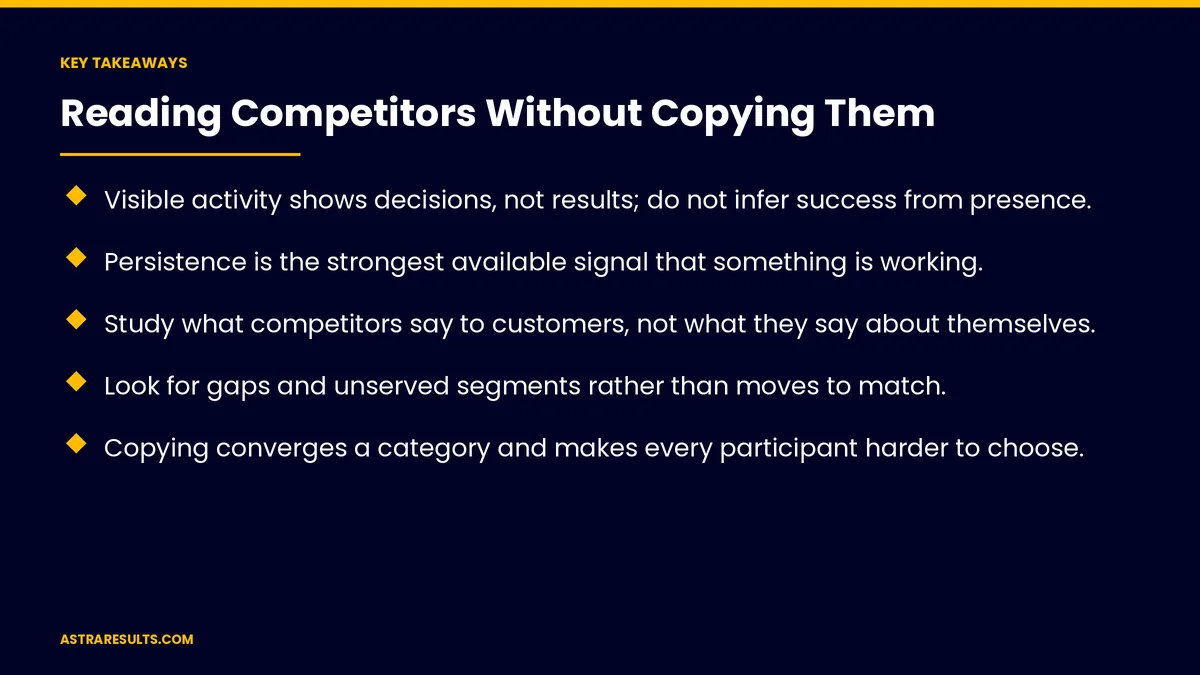
Key Takeaways
- Visible activity shows decisions, not results; do not infer success from presence.
- Persistence is the strongest available signal that something is working.
- Study what competitors say to customers, not what they say about themselves.
- Look for gaps and unserved segments rather than moves to match.
- Copying converges a category and makes every participant harder to choose.
- Review competitors on a schedule, not reactively when one does something loud.
Published: September 21, 2026 | Reading Time: ~12 minutes | Category: Strategy
Competitor marketing is evidence about a market, and like all evidence it needs interpretation. Some of it reveals what works. Some of it reveals what a competitor's agency sold them. Telling those apart is the skill.
This piece is about that: what to look at, what it tells you, where the useful gaps hide, and why the instinct to copy makes an entire category invisible. The sentence to carry out of this: a competitor's activity tells you what they decided, not what worked.
Guidance for owners and operators. Nothing here is legal advice. Comparative advertising, use of competitor trademarks and claims about other businesses carry requirements that vary by jurisdiction and should be reviewed with counsel.
In This Playbook
- What competitor activity does and does not tell you
- What is worth looking at
- What to ignore
- Finding gaps instead of matching moves
- Why copying converges a category
- Doing it on a schedule
- Ethics and legal lines
- The first three months
- The Astra approach
What competitor activity does and does not tell you
- What it shows. What a competitor chose to spend money on, what they want to be known for, which segments they are addressing, and roughly how sophisticated their operation is.
- What it does not show. Whether any of it is working. A competitor running ads on twelve keywords may be profitable on two and wasting money on ten.
- The inference trap. Seeing a big campaign and concluding the category demands one. Sometimes it means a competitor has a budget and an agency with a quota.
- The one reliable signal. Persistence. A campaign, a page or an offer that has run continuously for a year is probably working, because businesses stop things that lose money.
- The corollary. A competitor's short-lived experiment is not evidence of anything, and reacting to it wastes a quarter.
What is worth looking at
- Their customer-facing language. How they describe the problem and the solution, which reveals what they believe customers respond to.
- Their pricing posture. Whether prices are published, ranges given, or nothing shown — and what that implies about their sales process.
- Their proof. What they use to build trust: reviews, credentials, case studies, guarantees. Gaps here are opportunities.
- Their offers. What they lead with, and whether it has persisted.
- Their reviews, closely. Not the ratings — the complaints. Competitor reviews are the cheapest customer research available, and they name unmet needs in the customers' own words, as explored in concepts from customer language.
- Their job postings. What they are hiring for reveals where they are investing months before it shows in marketing.
- Their response time. Contact three competitors as a customer and record how long each takes to reply. This one test often reveals the largest available advantage, as covered in speed to lead.
What to ignore
- Follower counts. Easily bought, weakly correlated with revenue.
- Volume of content. A competitor publishing daily may be filling a calendar rather than earning anything.
- Awards and badges. Many are paid placements.
- Website redesigns. Frequently taste-driven and occasionally a downgrade.
- Loud campaigns from a much larger competitor. Their economics are not yours, and matching a national budget locally is how small businesses waste a year.
- Anything you cannot connect to a customer decision. If you cannot say how it would change someone's choice, it is noise.
Finding gaps instead of matching moves
This is where the exercise earns its time.
- Segments nobody addresses. A category where every competitor targets the same customer leaves whole segments unserved — a different size of client, a different language, a different urgency level.
- Objections nobody answers. The thing every customer worries about that no competitor addresses directly on their site.
- Proof nobody provides. If no competitor shows pricing, showing it is differentiation. If none show the process, showing it is differentiation.
- Service failures visible in reviews. The complaint that recurs across every competitor's reviews is a market-wide weakness and the clearest opening available.
- Channels nobody uses. If competitors are all on search and none on connected TV or AI citation presence, the cost of being first is low, as detailed in budgeting across surfaces.
- Response speed. Almost always a gap, almost never addressed.
Why copying converges a category
- The mechanism. Each business studies the others and adopts the conventions. Over a few years, everyone sounds identical.
- The customer's experience of it. Five providers with the same claims and the same stock photography, from which the customer picks on price or proximity because nothing else distinguishes them.
- The commercial consequence. Convergence pushes a category toward price competition, which nobody in it wants.
- The escape. Deliberate difference in something customers value — not novelty for its own sake, but a genuine choice about what this business does differently.
- The question to ask. Cover the logos on five competitors' homepages and yours. If nobody could sort them, the category has converged and the first to break out has an advantage, as set out in creative that earns attention.
Doing it on a schedule
- Why reactive research fails. Research triggered by a competitor doing something loud produces a panicked response to their least considered decision.
- The cadence. Quarterly is enough for most businesses. Monthly if the category moves fast.
- The format. A short document, not a deck: what changed, what it suggests, what we are doing about it, and explicitly what we are not doing about it.
- Who does it. Someone who talks to customers, because the interpretation matters more than the collection.
- The standing questions. Has anyone's persistent activity changed? Have new complaints appeared in their reviews? Has anyone entered or left? Have prices moved?
- The discipline. Most quarters the answer is that nothing important changed, and recording that is a valid outcome.
Ethics and legal lines
- Public information is fair. Websites, ads, reviews, job postings, published pricing.
- Misrepresentation is not. Posing as a customer to extract confidential information, or using deception to obtain what is not public.
- Contacting competitors as a customer to test response time sits in a grey area that each business should consider deliberately rather than casually.
- Bidding on competitor brand terms is permitted in many places and restricted in some, and using a competitor's trademark in ad copy is a different question from bidding on it. Counsel should confirm both for the relevant jurisdiction.
- Claims about competitors in advertising carry specific requirements and are the fastest route to a complaint. The safer posture is to describe what this business does rather than what others do not.
The first three months
Days 1–30: gather
Three to five real competitors identified — the ones customers consider, not the ones the owner thinks about. Their customer-facing language, pricing posture, proof and persistent offers recorded. Their reviews read for recurring complaints. Response time tested.
Days 31–60: interpret
Persistent activity separated from experiments. Gaps listed: unserved segments, unanswered objections, absent proof, market-wide service failures, unused channels. One or two chosen to act on.
Days 61–90: act and schedule
The chosen gap addressed in the business's own marketing. The cover-the-logo test run against the category. The quarterly review scheduled with an owner and a standing question list.
The Astra approach
Astra Results Marketing separates persistent competitor activity from experiments before drawing conclusions, because a competitor's presence in a channel is a decision rather than a result. Competitor reviews are read for recurring complaints, which is the cheapest customer research available and usually names the market-wide gap.
The output is a short document listing what changed and what the business is deliberately not doing in response, reviewed quarterly rather than reactively. Where the recommendation is to diverge from the category rather than match it, that is said plainly. Engagements begin with a competitive and gap analysis through our business consulting team.
Related reading
Frequently asked questions
What can competitor marketing tell you?
What they chose to spend money on, what they want to be known for, which segments they address and how sophisticated their operation is. What it cannot tell you is whether any of it works — a competitor running ads on twelve keywords may be profitable on two. The one reliable signal is persistence: activity that has run continuously for a year is probably working, because businesses stop things that lose money.
What is worth studying most closely?
Their reviews, specifically the complaints rather than the ratings, because they are the cheapest customer research available and name unmet needs in customers' own words. Also their customer-facing language, pricing posture, proof, persistent offers, and job postings, which reveal investment months before it shows in marketing. And response time, tested by contacting three competitors as a customer.
What should be ignored?
Follower counts, which are easily bought and weakly correlated with revenue. Volume of content, which may be calendar-filling. Awards and badges, many of which are paid placements. Website redesigns, which are often taste-driven. And loud campaigns from much larger competitors, whose economics are not yours — matching a national budget locally is how small businesses waste a year.
How do you find gaps instead of matching moves?
Look for segments nobody addresses, objections nobody answers on their site, proof nobody provides — if no competitor shows pricing or process, showing it is differentiation — service failures that recur across every competitor's reviews, and channels nobody uses. Response speed is almost always a gap and almost never addressed.
Why is copying competitors dangerous?
Because each business adopts the others' conventions until everyone sounds identical, and the customer, unable to distinguish five providers making the same claims, picks on price or proximity. Convergence pushes a category toward price competition nobody wants. The test is covering the logos on five competitors' homepages and yours: if nobody could sort them, the first to break out has an advantage.
How should competitors be reviewed?
Quarterly for most businesses, monthly if the category moves fast, and on a schedule rather than reactively — research triggered by a competitor doing something loud produces a panicked response to their least considered decision. The output is a short document: what changed, what it suggests, what we are doing, and explicitly what we are not doing. Most quarters, nothing important changed, and recording that is a valid outcome.
READY TO READ THE CATEGORY INSTEAD OF CHASING IT? Astra Results Marketing separates persistent competitor activity from experiments, reads their reviews for the market-wide gap, and recommends divergence over imitation when that is the real answer. Astra Results Marketing · 1101 Brickell Ave, Miami, FL 33131 · +1 (786) 321-2866 · [email protected] Find us on Google · Yelp ▸ CALL (786) 321-2866 · ▸ REQUEST YOUR CONSULTATION