Rated 5 star on


Concierge & Membership Medicine Marketing
Quick answer
Concierge medicine sells a relationship, not amenities. A practice should publish its panel cap as proof of access. It should state plainly what membership includes and how insurance interacts before enrollment. Content must address the hard step of leaving a trusted physician. Referrals are the main channel. Astra measures renewals and member tenure above all.
Concierge medicine asks a patient to do something no other healthcare model requires: pay a recurring fee for a relationship with a physician she has not met yet. That makes this the hardest trust sale in the healthcare marketing Astra has mapped.
Key Takeaways
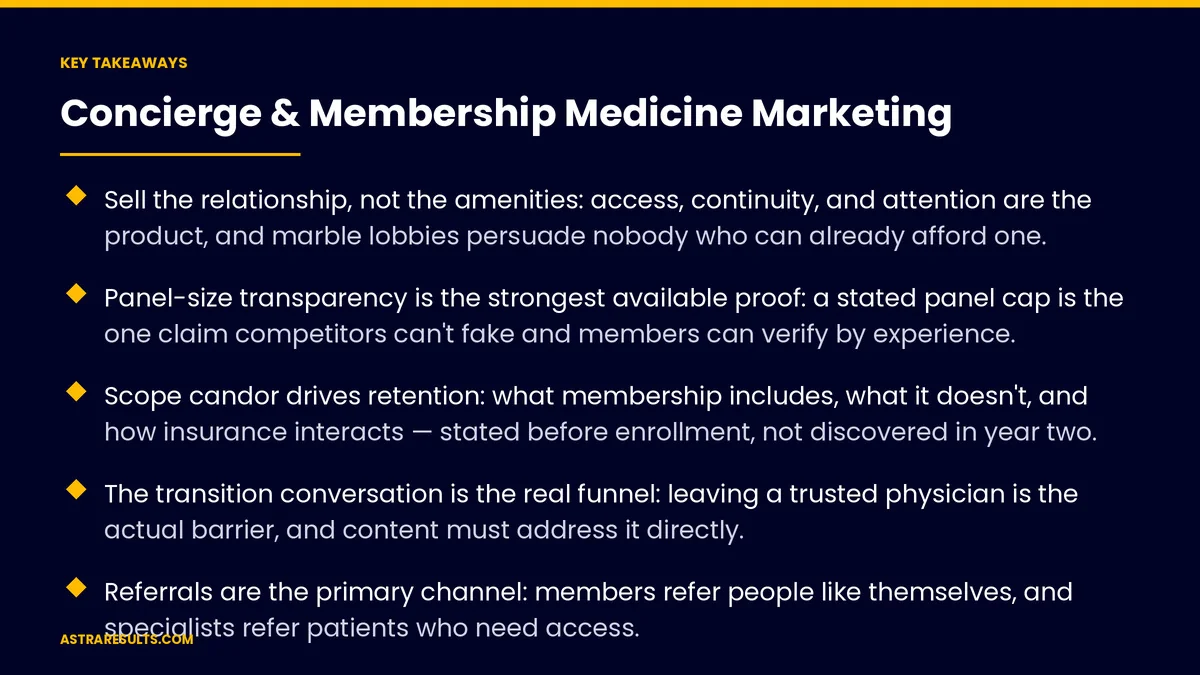
- Sell the relationship, not the amenities: access, continuity, and attention are the product, and marble lobbies persuade nobody who can already afford one.
- Panel-size transparency is the strongest available proof: a stated panel cap is the one claim competitors can't fake and members can verify by experience.
- Scope candor drives retention: what membership includes, what it doesn't, and how insurance interacts — stated before enrollment, not discovered in year two.
- The transition conversation is the real funnel: leaving a trusted physician is the actual barrier, and content must address it directly.
- Referrals are the primary channel: members refer people like themselves, and specialists refer patients who need access.
- Measure retention above all: renewal rates, member tenure, and referral-per-member — because this is a subscription business wearing a stethoscope.
Published: October 3, 2026 | Reading Time: ~13 minutes | Category: Medical · Concierge
She is not paying for a procedure with a defined outcome, or for a treatment she can research. She is paying for access, attention, and continuity: three things that are invisible until experienced and impossible to show in an advertisement.
It explains why so much concierge marketing defaults to the two things that are easy to photograph: amenities and exclusivity. Both are strategic errors. The kicker states the alternative: sell the relationship.
The distinction matters because the model's economics are entirely retention-driven. A membership practice with excellent acquisition and mediocre retention fails. One with modest acquisition and exceptional retention compounds indefinitely. Retention follows from expectation accuracy, members who understood exactly what they were buying stay, and members sold on vague promises of unlimited everything leave in year two feeling misled.
So the whole playbook resolves into one discipline. Describe the relationship precisely, price it transparently, bound its scope plainly, and let the accuracy do the converting. Marketing guidance for licensed practices only. Nothing here is medical advice or legal advice. Membership structures, fee arrangements, insurance interactions, and regulatory compliance are matters for your counsel and clinicians.
State and federal rules including insurance and fee-arrangement requirements govern these models. Compliance review precedes publication of every asset.
In This Playbook
- Why Amenities Marketing Fails
- Panel Size Is the Proof
- Scope Honesty Drives Retention
- The Transition Conversation
- The Cohorts
- Referrals Are the Primary Channel
- Content, Channels, and the Quiet Register
- What should a concierge medicine practice measure?
- A 90-Day Build
Why Amenities Marketing Fails
The category's default, and its most expensive habit.
The logic error. Concierge practices photograph what's photographable (the waiting room that looks like a hotel lobby, the espresso machine, the tablet check-in) and market those, because access and continuity resist imagery. But the prospective member is, almost by definition, someone whose life already contains comfortable rooms. The amenity is not the scarce good.
What she's buying. A physician who knows her history, answers her call personally, has time in the visit, and can be reached when something is wrong.
The exclusivity error, close behind: marketing that leans on prestige signals attracts people shopping for status and repels the far larger cohort of pragmatic professionals and families who want functional healthcare and are willing to pay for it. This mirrors the luxury-import failure Astra documented in the Midwest capital. Borrowed prestige tone reads as an attempt to be somewhere else.
The correction. Describe the mechanics of the relationship in concrete, verifiable terms, per the demonstration-over-declaration doctrine that governs every premium vertical here.
Panel Size Is the Proof
The single most persuasive disclosure available to this model.
The mechanic. Concierge practices work because the physician's panel is smaller than a conventional practice's: which is why the appointments are longer, the access is real, and the physician remembers the history.
The marketing move. State the panel cap plainly, explain what it means operationally (typical visit length, same-day availability expectations, how many patients a physician is responsible for), and note whether the practice is currently at or near capacity.
Why it converts. It converts the abstract into the arithmetic, the prospective member can reason about it. It's the one claim a competitor with a large panel cannot plainly copy, per the verifiable-specificity standard Astra holds in every premium market.
The waitlist candor. If the practice is full, saying so builds more demand than any campaign. It makes the cap credible rather than decorative.
The integrity requirement. A stated cap is a promise members experience monthly, a practice that quietly exceeds it has broken the only claim its whole model rests on.
Scope Honesty Drives Retention
The section that determines whether year-two renewals happen.
What must be stated before enrollment.
- Exactly what the membership fee covers and what it does not
- How insurance interacts with the arrangement in general terms per your counsel's guidance
- What happens with specialist care, hospitalization, imaging, labs, and prescriptions
- Whether the fee is separate from per-visit charges
- What the cancellation and refund terms are
Why this is marketing rather than fine print. The expectation-accuracy principle Astra proves across verticals applies with unusual force to subscriptions. A member who discovers a scope limit in month fourteen doesn't just decline renewal, she tells the referral network why.
The insurance-question page. Prospective members are confused about how membership and coverage coexist. The practice that explains it plainly (in general terms, hedged to counsel and to each person's plan) removes the largest single objection in the category.
The what-this-isn't paragraph. Naming plainly what membership does not do (it doesn't replace specialists, doesn't guarantee outcomes, doesn't eliminate the need for insurance) reads as confidence and filters the mismatched prospect before she becomes a churned member.
The Transition Conversation
The real barrier, addressed directly.
What stops enrollment. Not price, usually. But the prospect's existing physician, whom she may like, may have seen for a decade, and feels disloyal leaving. Almost no concierge marketing addresses this, which leaves the strongest objection unanswered.
The content that works. A candid walkthrough of what changing physicians involves (records transfer, how the first visit differs (the long intake, the history review, the plan-building conversation), what continuity of ongoing prescriptions and referrals looks like) plus the tone that makes it permissible. Choosing more time with a physician is a reasonable decision, not a betrayal.
The reverse case, stated plainly. For some patients, an existing relationship with a good physician who is available enough is the better arrangement, and the practice that says so is the practice believed about everything else, the steelman discipline at its highest-leverage application.
The trial problem. Memberships resist trial by design, so the substitute is a consultative enrollment conversation, a real meeting with the physician before commitment, which is both the plain way to sell a relationship and the most effective one.
The Cohorts
Who buys, and how each one reads the offer.
The time-poor executive and professional. Values access and efficiency, evaluates the model like a service-level agreement, and responds to concrete operational commitments, the tower-professional logic Astra maps in every business district.
The complex-condition patient. Values continuity and coordination above everything, and needs to understand exactly how the practice coordinates with specialists, a lane where clear scope description matters most.
The proactive-wellness member. Wants prevention, screening, and a physician who has time to discuss it, served with the evidence-honest register Astra requires, because this cohort brings questions from a wellness culture that deserves engagement rather than dismissal.
The family membership. Parents enrolling a household, which triggers the household ledger economics and the pediatric-scope questions that must be answered plainly.
The seasonal resident. Significant in this region. The member who is here part of the year needs candid continuity-of-care description, including what the practice can and cannot do while she's away.
Referrals Are the Primary Channel
How this model grows.
Member referrals. Members refer people like themselves. A satisfied member is the only marketing asset that shows the invisible product. That makes retention and referral the same program. The ask is warm, never transactional: no incentives that convert a relationship into a sales channel, per the never-purchase-the-whisper rule Astra holds everywhere.
Specialist and professional referrals. Specialists refer patients who need coordination and access. Wealth managers, attorneys, and CPAs refer clients whose health is part of their planning. The professional-web discipline served with communication-back and zero steering economics.
Employer and executive-health channels. Organizations purchasing memberships for leadership teams are a legitimate B2B lane requiring its own tone per the advisory-vertical standard.
The discretion layer. This clientele expects privacy per the society line. No implied member identities, ever, and the confidentiality structure described calmly as the service feature it is.
Content, Channels, and the Quiet Register
The content that carries this model. The panel-and-access explainer, the scope-and-insurance page, the transition guide, the enrollment-process walkthrough, the physician's own clinical philosophy in her own words, and the prevention-and-longevity education that shows how a longer visit gets used, all under named-physician authorship with the E-E-A-T disciplines intact.
Search and AI answers. This category generates high-intent research questions ("is concierge medicine worth it," "how does concierge medicine work with insurance," "what happens if I need a specialist") and the practice that answers them plainly earns the citations through the entity work our AI SEO service builds.
Paid, narrow and unhurried. Behind the negatives fortress with direct-primary-care comparison shoppers served by education, telehealth-subscription confusion routed. Jobs excluded, and never with urgency creative, which in a relationship sale reads as desperation.
Reviews and privacy. never-gated but never solicited in a way that pressures a member to disclose a health relationship she considers private. Language capability per the chain rule. In this region, a membership practice serving Spanish-speaking families natively, including the enrollment conversation and the after-hours line, has an advantage almost nobody in the category has built.
What should a concierge medicine practice measure?
The dashboard, because this is a subscription business:
- Renewal rate and member tenure as the flagship metrics, read annually and by cohort
- Referrals per member per year, the single best proxy for whether the relationship is delivering
- Panel utilization against the stated cap, audited as the integrity metric it is
- Enrollment-conversation-to-membership conversion, and the plain count of prospects the practice declined or advised against joining
- Scope-related cancellations tracked specifically, since they diagnose expectation-accuracy failures in the marketing rather than the medicine
- The access promises measured (same-day availability, after-hours response, visit length actuals versus stated)
- Professional-referral ledger by relationship
- Language cohorts where the chain is real
- Member lifetime value against acquisition cost on the ledger standard — reported on tenure years, because a membership practice's value is measured in how long people stay
A 90-Day Build
Days 1–30: Describe the product precisely
- The panel cap decided, documented, and prepared for publication with its operational meaning explained
- The scope-and-insurance page drafted with counsel review
- The what-this-isn't paragraph written
- The transition guide outlined
- The enrollment-conversation format designed as a real physician meeting
- Measurement instrumented for renewal, tenure, referrals-per-member, and panel use
Days 31–60: Publish the honest version
- Panel, access, scope, insurance, and transition content live under physician authorship in English and native Spanish
- The physician's clinical philosophy published in her own voice
- Prevention-and-longevity education showing how visit time is used
- Waitlist candor live if the practice is at capacity
- Narrow paid live behind the fortress with no urgency creative
Days 61–90: Referral and reads
- The member-referral program running as warm and non-transactional
- Specialist and professional-advisor relationships engaged with communication-back
- Executive-health lane assessed if relevant
- AI-answer accuracy checked on the worth-it and insurance questions in both languages
- First clear reads — renewal cohort behavior, referrals per member, panel use, scope-related cancellations, access actuals — and next quarter set on tenure years
How Astra Builds Membership Practices
Astra Results Marketing builds concierge and membership medicine on the relationship rather than the amenities. Panel-size transparency as the proof competitors can't fake, scope candor published before enrollment because it drives renewal, the transition conversation addressed directly, referrals cultivated warmly and never purchased, and everything measured on retention and referrals-per-member.
Engagements begin with a scope, panel, and retention audit through our business consulting team.
Related reading
Frequently asked questions
Why not market our facilities and amenities?
Because your prospective member's life already contains comfortable rooms. The amenity isn't the scarce good, and photographing it competes on the one dimension that doesn't distinguish you. What she can't get elsewhere is a physician with a small enough panel to know her history and answer her call. Describe that mechanically and verifiably. The amenities can be visible on the site without being the argument.
Should we publish our panel cap?
It's the strongest disclosure available to this model. It turns an abstract promise into arithmetic a prospect can reason about. It's the one claim a large-panel competitor cannot plainly copy. Publish the number, explain what it means operationally, and say plainly when you're at capacity, then hold it, because a quietly exceeded cap breaks the single claim your entire model rests on.
How much scope detail belongs in marketing versus the agreement?
More in marketing than most practices are comfortable with: what the fee covers and doesn't, how insurance interacts in general terms, what happens with specialists and hospitalization, and the cancellation terms, because scope surprises in year two produce cancellations and negative word of mouth in exactly the referral network you depend on. Expectation accuracy is a retention strategy, and retention is this business model.
What's the biggest objection we're not addressing?
Loyalty to an existing physician. Price is usually secondary. The prospect feels disloyal leaving someone she's seen for years, and almost no concierge marketing acknowledges it. Publish a candid transition guide (records, first-visit differences, prescription and referral continuity) plus the permission-giving tone, and include the plain reverse case that some patients are better served staying where they are.
Can we offer a trial membership?
The model resists trials structurally, so the substitute is better: a real consultative meeting with the physician before commitment. It's the only candid way to sample a relationship, it converts much better than any brochure. It lets the practice decline mismatched prospects, which protects the renewal rate the whole business depends on.
Should we pay members for referrals?
No: incentives convert a relationship into a sales channel and cheapen exactly the trust that makes member referrals persuasive. Ask warmly, make it easy, thank people genuinely, and let satisfaction do the work, while tracking referrals per member per year as your best available signal that the relationship is delivering what the marketing promised.
Ready to Sell the Relationship Instead of the Lobby? Astra Results Marketing builds membership medicine on panel transparency, scope candor, the transition conversation, and warm referral cultivation. Measured on renewal, tenure, and referrals per member. Start with a scope, panel, and retention audit for your practice. ▸ CALL (786) 321-2866 · ▸ REQUEST YOUR CONSULTATION