Rated 5 star on


Miami Seasonal-Resident Marketing
Quick answer
A Miami practice should market to seasonal residents as part-time residents, not visitors. Coordinating her two providers and their records is the real deliverable. October through December is the arrival window that decides the season. Treatment plans are built around a six-month presence. Departure planning drives retention. Astra measures return rate across the annual cycle.
The seasonal resident occupies a category most practices don't have a plan for. She isn't a visitor. She owns or leases here, holds a Florida address, has neighbors, and spends four to six months in the market. She isn't a year-round patient either. Her chart goes quiet in May, her specialists are split between two states.
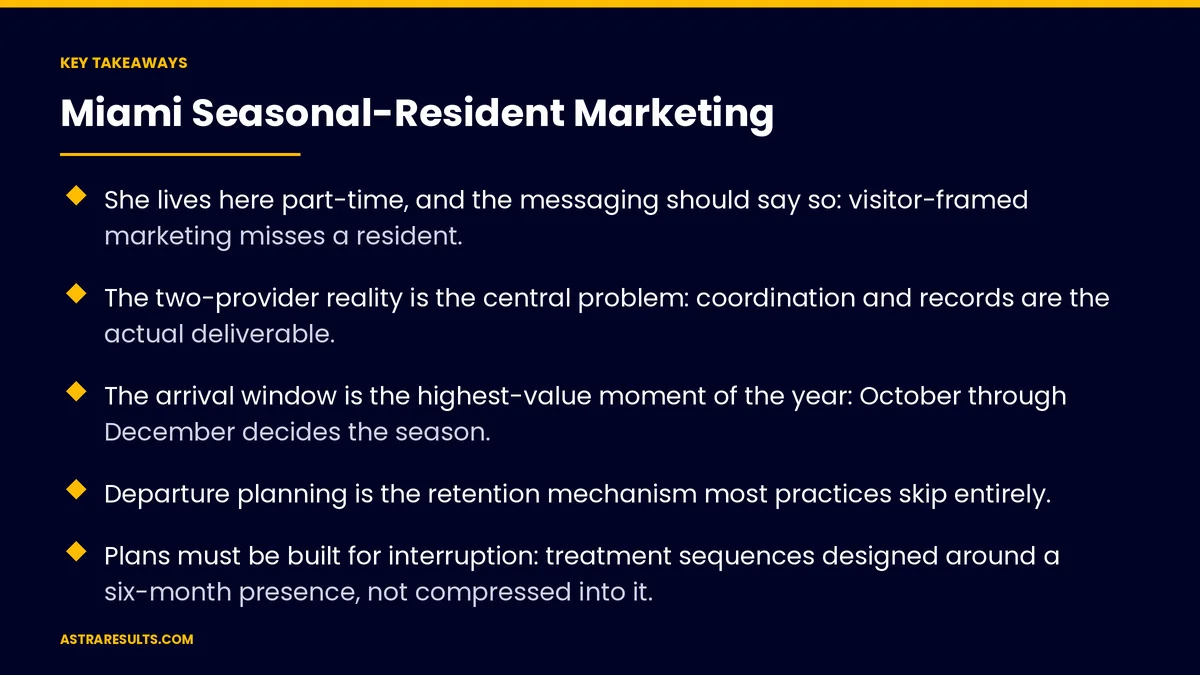
Key Takeaways
- She lives here part-time, and the messaging should say so: visitor-framed marketing misses a resident.
- The two-provider reality is the central problem: coordination and records are the actual deliverable.
- The arrival window is the highest-value moment of the year: October through December decides the season.
- Departure planning is the retention mechanism most practices skip entirely.
- Plans must be built for interruption: treatment sequences designed around a six-month presence, not compressed into it.
- Measure across the annual cycle: return rate, multi-season retention, and eventual conversion to year-round.
Published: October 17, 2026 | Reading Time: ~11 minutes | Category: Strategy · Miami
Her treatment plans have to survive a geographic interruption. Practices default to treating her as one or the other. Both errors cost the same thing: a relationship that could run fifteen years gets managed like a single season. The kicker states the correction: six months is a relationship.
The cohort is also systematically undervalued. Seasonal residents skew older and more affluent, carry more complex care needs, decide within tight residential and social networks, and, the part practices miss, frequently become year-round residents. The household that arrives for winters at sixty-two often stays at seventy. The practice that served her well through the split years inherits the whole relationship.
Meanwhile the practices competing for her attention are mostly running high-season campaigns aimed at visitors, which is the wrong message to a woman who lives here. Marketing guidance for licensed practices and firms only. Nothing here is medical, dental, legal, or financial advice. Clinical and professional judgments belong to your licensed practitioners. Compliance review precedes publication of every asset.
In This Playbook
- She Lives Here, Part-Time
- The Two-Provider Reality
- The Arrival Window
- Plans Built for Interruption
- Departure Planning Is Retention
- Why the Cohort Is Undervalued
- Channels
- Measurement
- An Annual Build
She Lives Here, Part-Time
The positioning correction.
What visitor-framed marketing gets wrong. Language about "while you're in town," short-stay packages, and vacation-adjacent imagery all signal that the practice doesn't understand who it's talking to: a person with a residence, a car, a routine, and a local network.
What resident-framed marketing does. Addresses her the way it addresses any established patient, with the single candid adjustment that her year has two halves and the practice knows it.
The tone. No urgency built on her departure date, which is the manufactured-urgency failure in its seasonal form. "Before you leave" pressure reads as transactional to exactly the patient who is deciding whether this practice is hers for the next decade.
The corridor reality. This cohort concentrates in specific buildings, communities, and neighborhoods (Aventura and the north corridors, Coral Gables, Miami Beach and the island communities, and the coastal towns north) which makes corridor-level presence and building-network reputation more productive than broad campaigns.
The Two-Provider Reality
The problem that defines the cohort, and the opening it creates.
The situation. Most seasonal residents maintain physicians, dentists, and advisors in both locations: which produces duplicated records, conflicting recommendations, gaps in monitoring, prescription and refill complications, and the specific frustration of explaining the same history twice a year.
What almost nobody offers. An explicit, published approach to coordination: how the practice communicates with her northern providers, what records it requests and sends, how it avoids duplicating imaging or labs unnecessarily. How it handles the handoff at both ends of the season.
Why this is the whole differentiator. The cohort's actual pain point is fragmentation, and the practice that solves it becomes the one she keeps, which is scope-and-process transparency applied to a geographic problem.
The clinical candor. Coordination requires her authorization and the other provider's cooperation, neither of which is automatic, and saying so plainly beats implying a seamlessness that doesn't exist.
The advisory parallel. financial, legal, and insurance practices face the same two-jurisdiction fragmentation: with residency, estate, and coverage questions that differ between states and that only counsel can resolve for a specific household.
The Arrival Window
October through December, and the highest-leverage weeks in this cohort's year.
What happens then. Households arrive, unpack a list of things they postponed, schedule the appointments they deferred in the spring, and make provider decisions that persist. That means the practice's outreach in early fall reaches her while the year's decisions are still open.
The mechanics.
- A pre-arrival communication to returning patients confirming availability and inviting scheduling before the calendar compresses
- Recall that fires on her cycle rather than a generic twelve-month interval, which is a real configuration task most practice systems handle badly
- An intake process that recognizes a returning seasonal patient rather than treating her as new
The deferred-care reality. She postponed things in April to handle at home and often didn't. That makes early-season the right moment for the surveillance and recall conversation, sun-damage screening in particular, given this cohort's age profile and outdoor season.
The new-arrival cohort. Households in their first Florida season are choosing every provider at once, which is the relocation moment Astra maps in every inbound market. The practice that shows up with orientation content rather than a promotion wins a fifteen-year relationship.
Plans Built for Interruption
The clinical and operational discipline.
The rule. Treatment sequences get designed around a six-month presence rather than compressed into it: which means starting multi-visit work early in the season, sequencing so natural break points align with departure, and being explicit about what can and cannot be completed before May.
The compression refusal, restated for this cohort: no clinical timeline shortened to fit a departure date, per the standing safety-over-schedule rule. No temporaries phase squeezed into the last three weeks.
The plain deferral. "this is better started in November than in March" is counsel that costs a case this season and produces a patient who returns for it, the advise-against economics Astra documents everywhere.
The summer-continuity question. For chronic conditions, what happens between May and October needs a plan (which provider monitors, what the practice does if something changes, how prescriptions continue, and how she reaches someone) the continuity architecture Astra requires in every chronic-care specialty, with a geographic dimension added.
Departure Planning Is Retention
The mechanism nearly every practice skips.
What it is. A deliberate end-of-season touchpoint. Records and summaries prepared for her northern providers where she wants that, refills and monitoring arranged, the next season's plan sketched, follow-up scheduled or flagged, and a clear statement of how to reach the practice from out of state.
Why it works. It converts a departure from a lapse into an interval. It is the moment at which she decides, without being asked, whether this practice is hers next year.
The contrast with what usually happens. The chart goes quiet, no one reaches out. In October she books wherever her neighbor recommends, which is how practices lose seasonal patients they never knew they'd lost, because the ledger shows no cancellation.
The summer touchpoint, done right. One useful communication in the off-months (useful, never promotional) keeps the relationship warm and is the single cheapest retention action available in this cohort.
The measurement hook. Return rate season-over-season is the metric this whole section exists to move. Most practices have never calculated it.
Why the Cohort Is Undervalued
The economics practices tend to miss.
The value profile. Older, more affluent, more complex care needs, high service expectations, and decision-making inside dense residential and social networks where a recommendation carries unusual weight.
The multi-season arithmetic. A household that returns for eight seasons is a longer relationship than most year-round patients produce. The annual-value ledger computed across seasons rather than within one reveals it.
The conversion-to-year-round pattern. Seasonal residents frequently become permanent residents. The practice that held the relationship through the split years inherits the full one, which almost no practice tracks and which is probably the cohort's single largest source of long-term value.
The referral density. Buildings and communities where this cohort concentrates produce referral chains that operate faster and more reliably than most professional networks, per the tight-network effect Astra observes on the island.
The plain counterweight. This cohort also carries real costs (coordination time, records administration, and schedule concentration into the busiest months) which is why the measurement section reads value net of that load.
Channels
Owned channels carry this cohort more than paid does: the pre-arrival communication to returning patients (the year's highest-return send), the summer touchpoint, and the seasonally-configured recall system. Search serves the new-arrival household.
Orientation content (how to establish care in a new state, what to bring, how records transfer, what to ask) plus accurate profiles and candid availability, earning the AI answers this cohort generates ("finding a doctor when you live in two states," "transferring medical records to Florida") through the entity work our AI SEO service builds.
Community presence runs building, HOA, and association engagement under the participation rules, real education when invited, nothing sold from a lobby table. Paid, if used, runs narrow behind the negatives fortress with vacation-rental, travel, and relocation-service intent excluded, and never with departure-deadline urgency. Reviews run never-gated and travel unusually far in this cohort's networks. Language capability follows the chain rule.
This market's seasonal population includes substantial Spanish-speaking, Portuguese-speaking, and Canadian French-speaking households.
Measurement
The dashboard, built on the annual cycle rather than the quarter:
- Return rate season-over-season as the flagship — the metric that makes departure planning visible, and the one most practices have never calculated
- Multi-season retention and average seasons per household
- Conversion to year-round residency, tracked deliberately because it's likely the cohort's largest long-term value source
- Arrival-window conversion for both returning and first-season households
- Plan-completion rate within a season versus plans deliberately spanning seasons, which distinguishes good sequencing from compression
- The coordination load — records requests, provider communications, and administrative hours per seasonal patient — read against value so the economics are candid
- Referral chains from building and community networks
- Annual value computed across seasons on the ledger standard, because a single-season view systematically undervalues this cohort
An Annual Build
Summer (June–September) — prepare and touch.
- The seasonal-patient list segmented and flagged in the practice system
- Recall reconfigured to the cohort's cycle rather than a generic interval
- One useful off-season communication sent
- The coordination process documented (what records the practice requests and sends, and how)
- Orientation content built for first-season households
Fall (October–December): the arrival window
Pre-arrival communication sent to returning patients before the calendar compresses; deferred-care and surveillance conversations prioritized. Multi-visit plans started early with departure-aware sequencing; first-season households served with orientation rather than promotion; building and community presence active.
Winter (January–March): deliver and coordinate
Treatment and advisory work executed on plans built for the interruption. Northern-provider coordination performed rather than promised; the summer-continuity plan set for every chronic-care patient. Capacity protected so this cohort isn't squeezed by event-week and visitor volume.
Spring (April–May) (departure planning. The end-of-season touchpoint executed deliberately for every seasonal patient: records prepared, refills and monitoring arranged, next season sketched, follow-up flagged, and the out-of-state contact path stated) then the season's return rate calculated and the list built for next fall.
How Astra Builds Seasonal-Resident Programs
Astra Results Marketing builds seasonal-resident marketing on the relationship rather than the season: resident-framed messaging that recognizes she lives here, the two-provider fragmentation solved as the actual deliverable, the arrival window worked before the calendar compresses, plans sequenced for interruption rather than compressed into it, departure planning executed as the retention mechanism it is, and value measured across seasons including conversion to year-round.
Engagements begin with a cohort, continuity, and arrival-window audit through our business consulting team.
Related reading
Frequently asked questions
How is this cohort different from visitors?
She lives here (with a residence, a car, a routine, and a local network) for four to six months a year, and visitor-framed marketing ("while you're in town," short-stay packages) signals immediately that a practice doesn't understand that. Address her as an established patient whose year has two halves, and drop any urgency built on her departure date. That pressure reads as transactional to someone deciding whether you're her practice for the next decade.
What do seasonal residents actually want that they're not getting?
Coordination. Most maintain providers in both locations and live with duplicated records, conflicting recommendations, monitoring gaps, and explaining the same history twice a year. Publish an explicit approach (what records you request and send, how you communicate with her northern providers, how you avoid unnecessary duplication, and how the handoff works at both ends) while being candid that it requires her authorization and the other provider's cooperation.
When should we reach out to returning patients?
Early fall, before the calendar compresses. October through December is when households arrive, work through postponed items, and make provider decisions that persist. So a pre-arrival note confirming availability and inviting scheduling is the highest-return send of the year. It also requires recall configured to her cycle rather than a generic twelve-month interval, which most practice systems handle badly by default.
What's the retention step most practices skip?
Departure planning: a deliberate end-of-season touchpoint where records are prepared for her northern providers, refills and monitoring are arranged, next season is sketched. The out-of-state contact path is stated. Without it, the chart simply goes quiet and in October she books wherever her neighbor recommends, a loss that never appears as a cancellation. That is why season-over-season return rate is the metric to calculate first.
Should we compress treatment to finish before she leaves?
No. Sequence plans around a six-month presence. Start multi-visit work early in the season, align natural break points with departure, and say plainly what can't be completed before May. "This is better started in November than in March" costs a case this season and produces a patient who returns for it, while a compressed timeline produces the outcome that ends the relationship.
How do we know if this cohort is worth the coordination effort?
Measure across seasons, not within one. Return rate, average seasons per household, annual value computed across the full relationship, and conversion to year-round residency, then read all of it net of the coordination load in records requests, provider communications, and administrative hours. Most practices find the cohort substantially undervalued, largely because the year-round conversion nobody tracks is where much of the value lands.
Ready to Treat Six Months as a Relationship? Astra Results Marketing builds seasonal-resident programs on resident-framed messaging, coordination as the deliverable, the arrival window, interruption-aware planning, and departure planning as retention. Measured across seasons. Start with a cohort, continuity, and arrival-window audit for your practice. ▸ CALL (786) 321-2866 · ▸ REQUEST YOUR CONSULTATION