Rated 5 star on

Brickell Practice Marketing: The Workday Is the Market
Quick answer
In Brickell's tower district, the workday decides who becomes a patient. A practice should offer early-morning, lunch-hour and after-work slots. It should publish the full appointment time, including check-in. Bonus timing and benefit-year deadlines shape demand. Employer and building partnerships go to counsel first. Astra tracks performance by slot type and time of day.
In a tower district, the thing standing between a prospective patient and a practice is almost never interest, price, or trust. It is the workday. The associate with a deposition, the analyst in back-to-back calls, the banker whose calendar is controlled by someone else. All of them will book the practice that fits into a schedule they don't fully own.
Key Takeaways
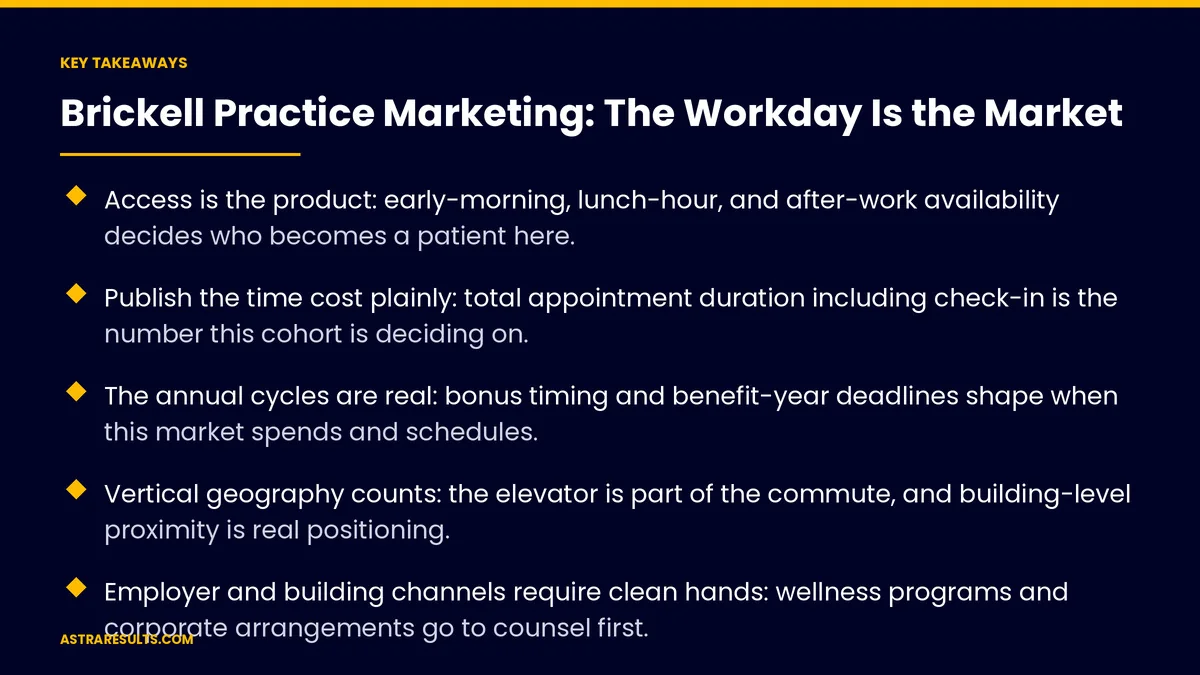
- Access is the product: early-morning, lunch-hour, and after-work availability decides who becomes a patient here.
- Publish the time cost plainly: total appointment duration including check-in is the number this cohort is deciding on.
- The annual cycles are real: bonus timing and benefit-year deadlines shape when this market spends and schedules.
- Vertical geography counts: the elevator is part of the commute, and building-level proximity is real positioning.
- Employer and building channels require clean hands: wellness programs and corporate arrangements go to counsel first.
- Measure the workday: slot-type performance, appointment-duration accuracy, and no-show patterns by time of day.
Published: October 7, 2026 | Reading Time: ~11 minutes | Category: Local SEO · Brickell
None of them will book the practice that requires a two-hour midday absence they can't explain. Brickell's marketing problem is therefore an access problem wearing a marketing costume. The practices that solve it capture a dense, affluent, high-repeat population from inside its own building. The kicker states it: the workday is the market.
This is the operational companion to the library's Brickell professional-services and tower-cohort playbooks. Where those addressed positioning and tone, this one addresses the calendar: the daily rhythm, the annual compensation and benefits cycles, and the building-and-employer channels the district specifically offers. Marketing guidance for licensed practices and firms only. Nothing here is medical, dental, legal, or financial advice.
Professional judgments belong to your licensed practitioners. Any arrangement involving employers, buildings, or compensated referral is a counsel question before it is a marketing decision. Compliance review precedes publication of every asset.
In This Playbook
- Access Is the Product
- Publish the Time Cost
- The Annual Cycles
- Vertical Geography
- Building and Employer Channels
- The Cohorts Upstairs
- Channels and Operations
- How should a Brickell practice measure its marketing?
- A 90-Day Build
Access Is the Product
The operational reality that determines everything.
The slot types that matter. before the workday (roughly 7:00 to 9:00 a.m. the highest-value and least-supplied inventory in the district), the lunch hour (fast, predictable, and unforgiving of overruns), after 5:30 p.m. (real but competitive with commuting and evening obligations), and the flexible-remote day, which reshaped this market.
Hybrid schedules produce mid-week midday availability that didn't exist before and that most practices haven't adjusted their scheduling to capture.
The publishing requirement. These slots convert only if they're visible before someone calls: stated on the site, reflected accurately in the profile, and bookable without a phone call per the two-rails rule, because this cohort books at 11 p.m. from a phone and won't leave a voicemail.
The staffing candor. Early and evening slots require staffing that costs more, so the practice should verify demand by slot type before committing. Publish only what it can reliably keep, since a 7:30 appointment that starts at 8:05 costs this cohort more than a canceled one.
Publish the Time Cost
The disclosure that converts, and almost nobody makes.
What this cohort is calculating. Not price but elapsed time away from the desk. Travel down and back, check-in, waiting, the appointment itself, and any post-appointment recovery or logistics.
What to publish. The plain total for each common appointment type, including check-in and expected wait, plus whether paperwork can be completed in advance and whether anything about the visit affects the rest of the workday.
Why it works. It removes the uncertainty that causes deferral. It signals that the practice understands the reader's constraint, the same friction-removal logic Astra applies to booking, aimed at the variable that governs the decision.
The clinical candor boundary. Any statement about downtime, recovery, or return-to-work is the provider's determination and belongs to them, stated as a range rather than a promise per the no-promises standard.
The overrun discipline. Publishing a duration creates an obligation to honor it. That makes schedule integrity a marketing asset and chronic overbooking a marketing liability.
The Annual Cycles
The district's own seasonality, per the seasonal method.
Compensation timing. Bonus and incentive cycles in finance, law, and professional services concentrate discretionary spending capacity into particular months, which shifts when elective and high-ticket decisions get made, a real pattern worth measuring in the practice's own data rather than assuming, since it varies by employer and year.
Benefit-year deadlines. Insurance benefit years, flexible spending and health savings account balances, and deductible resets create real, dated decision points, which is one of the few places where urgency is real rather than manufactured.
Which the honest-urgency line permits stating plainly ("if your plan's benefit year ends in December, here's what that means for treatment you've been considering") without a countdown or a scarcity claim.
The professional calendar. Quarter-ends, filing seasons, deal cycles, and trial calendars make certain weeks impossible for certain professions, which is scheduling intelligence more than campaign material.
The relocation inflow. This district absorbs new arrivals continuously, and orientation content for someone establishing care in a new city is inbound-market work Astra maps everywhere.
Vertical Geography
The positioning variable specific to tower districts.
The elevator is part of the commute. A practice in the same building as its patients has an advantage no campaign can replicate. A practice three blocks away is competing with a walk in Miami heat and humidity. The real service-area claim per the geo standard.
The practice's real catchment in this district is measured in walking minutes and specific towers, not in a radius. So corridor pages should name the actual buildings and paths, and claims beyond a real walk should be dropped.
The parking and access disclosure. For the patient driving in from elsewhere, this district's parking is a real deterrent. Publishing validation, garage options, and rideshare drop-off detail removes friction, exactly as the island access finding showed on the Beach.
The transit layer. The Metromover and rail connections put specific corridors within real reach, and naming those paths is more useful than any drive-time estimate.
Building and Employer Channels
The district's own channels, with the compliance line drawn first.
The clean-hands rule. Any arrangement in which value flows in exchange for patient direction (building concierge commissions, per-employee payments, referral compensation from an employer or property manager) is a counsel question before it is a marketing tactic, implicating anti-kickback and self-referral frameworks in healthcare and conduct rules across licensed professions, per the standing discipline.
What works without any of that. Being known and trusted by building management and concierge desks: earned through reliability, clear capability information, and responsiveness, exactly as the performance-based referral mechanic describes.
Corporate wellness and employer programs. Legitimate and valuable when structured properly (lunch-and-learn education, on-site screening events where appropriate, and benefit-navigation sessions) with the structure, any compensation, and the privacy implications reviewed by counsel and the participation-over-promotion rule governing conduct: education when invited, nothing sold from a conference table.
The privacy layer. Employer-adjacent health programs raise significant confidentiality questions. Nothing about an individual's participation or findings travels to an employer, and saying that plainly is what makes participation possible.
The Cohorts Upstairs
Who works in these towers, and what each needs.
The junior professional cohort. Long hours, low schedule control, high stress, and real prejuvenation-ethics exposure: served with early slots, candid pricing, and none of the appearance-pressure marketing this district invites.
The senior professional cohort. More schedule control but higher opportunity cost, valuing discretion and efficiency over everything, and frequently the household decision-maker for a family that lives elsewhere in the metro.
The building-and-service workforce. The district's substantial staff population (security, maintenance, food service, retail) with real needs, shift-based availability, and a strong preference for Spanish-language service. That makes them the district's clearest underserved cohort, exactly as the hospitality-workforce finding showed on the Beach.
The residential cohort. Brickell's towers are homes as well as offices, and the resident who works elsewhere behaves like a neighborhood patient rather than a corporate one. The language requirement per the chain rule: Spanish natively across all four cohorts, Portuguese for this district's substantial Brazilian professional population, with the staff-it rule governing any further claim.
Channels and Operations
Findability first. Profile accuracy including real slot availability, building-specific corridor pages, and the appointment-duration content, all built before spend, per the capture-before-attention sequencing.
Search and the answer layer. This cohort searches by constraint ("dentist open early Brickell," "dermatologist lunch hour appointment"). The practice whose availability content is explicit gets cited by assistants through the entity work our AI SEO service builds.
Booking and intake. Online booking is not optional here, reminders should assume a controlled calendar. Reschedule grace matters because this cohort's meetings move without warning. The practice that penalizes a last-minute work conflict loses a decade of visits over one fee.
Paid, narrow. Behind the negatives fortress with commercial-real-estate, coworking, restaurant, and business-services intent excluded wholesale, the district's dominant search noise. Reviews run never-gated and travel fast inside buildings and firms. Social runs restraint with availability and logistics as the content.
How should a Brickell practice measure its marketing?
The dashboard, per the case-level standard:
- Performance by slot type — early, lunch, after-work, and midday — as the flagship, since it tells the practice which inventory to expand and which to stop staffing
- Appointment-duration accuracy against published times, which is both a service metric and the integrity of the practice's central promise
- No-show and same-day cancellation rates by time of day, which typically differ sharply and inform overbooking policy
- Cohort mix — junior professional, senior professional, building workforce, resident — captured through source-of-truth intake, since their economics and needs diverge
- Building-level origin where patients volunteer it, which reveals the vertical-geography advantage concretely
- Benefit-year and compensation-cycle patterns measured in the practice's own data rather than assumed
- The workforce cohort's share as the underserved-market read
- Language cohorts read separately
- Cost per kept appointment by slot type, because early-morning inventory costs more to staff and should justify itself
A 90-Day Build
Days 1–30: Access and honesty
Slot-type demand assessed from existing data before adding capacity; early, lunch, and after-work availability decided and staffed only where sustainable; appointment durations measured plainly including check-in and wait. Online booking verified end to end on a phone; reschedule-grace policy written.
Days 31–60: Publish the constraint solutions
- Real availability and total time costs published on the site and profile
- Building-specific corridor pages live naming actual towers and walking paths
- Parking, validation, and rideshare detail published
- Benefit-year content prepared for the relevant window in plain, non-urgent language
- Spanish and Portuguese content live natively
Days 61–90: Channels and reads
- Building-management and concierge relationships built on capability and responsiveness with the clean-hands position documented by counsel
- Any employer or wellness program structured with counsel and privacy assurances published
- Narrow paid live behind the fortress
- First clear reads — slot-type performance, duration accuracy, no-show by time of day, cohort mix — and capacity reallocated toward the inventory the data supports
How Astra Builds Brickell Practices
Astra Results Marketing builds tower-district practices around the workday. Access engineered and published by slot type, total time cost disclosed as the number patients are deciding on, the district's compensation and benefit cycles measured rather than assumed, vertical geography claimed plainly in walking minutes and named buildings, building and employer channels built on performance with clean hands documented.
The underserved workforce cohort served rather than overlooked. Engagements begin with an access, duration, and cohort audit through our business consulting team.
Related reading
Frequently asked questions
What single change moves the most volume in a tower district?
Early-morning availability, published clearly. The 7:00-to-9:00 window is the highest-value and least-supplied inventory in the district. It converts the cohort whose midday hours belong to someone else. Verify demand by slot type in your own data before committing the staffing, then publish only what you can reliably keep, a 7:30 appointment that starts at 8:05 costs this cohort more than a cancellation would.
Why publish appointment duration?
Because it's the number this cohort is deciding on. They're calculating elapsed time away from the desk (travel, check-in, wait, appointment, and anything afterward) and uncertainty about that total causes deferral. Publishing a candid figure removes the hesitation and signals you understand the constraint. It also creates an obligation to honor it, which is exactly why schedule integrity becomes a marketing asset here.
Is benefit-year urgency legitimate to use?
Yes, when it's real: benefit years, flexible spending balances. Deductible resets are real dated decision points, and explaining what they mean for treatment someone has been considering is service. Say it plainly and once: no countdown timers, no scarcity language, no implication that the practice's availability is the deadline. The distinction between a real deadline and a manufactured one is visible to this audience immediately.
Can we pay a building concierge or partner with an employer for referrals?
Take any compensated arrangement to counsel before it exists. Patient direction in exchange for value implicates anti-kickback and self-referral frameworks and professional conduct rules. Build the relationship on performance instead: clear capability information, real responsiveness, and reliability. For employer wellness programs, have counsel review the structure and publish the privacy assurance plainly, because nothing about an individual's participation should ever reach an employer.
Who's the most overlooked group in the district?
The building and service workforce: security, maintenance, food service, and retail staff working in these towers, with real needs, shift-based availability, and a strong preference for Spanish-language service. They're a substantial population that almost nobody markets to directly, they're already in the building, and word of mouth inside a workforce that size moves quickly.
How should we handle last-minute cancellations from this cohort?
With grace, and treat it as an investment. Meetings and depositions move without warning, and a practice that charges a fee over a work conflict trades a decade of visits for one penalty. Publish a humane reschedule policy, run a real waitlist so the slot gets refilled, and track no-show rates by time of day. The patterns usually differ enough to inform where flexibility is affordable.
Ready to Build Around the Workday? Astra Results Marketing builds tower-district practices on published slot availability, candid total time costs, real benefit-cycle timing, candid vertical geography, and clean-hands building relationships. Start with an access, duration, and cohort audit for your practice. ▸ CALL (786) 321-2866 · ▸ REQUEST YOUR CONSULTATION