Rated 5 star on


Houston Personal Injury Attorney Marketing
Quick answer
A Houston injury firm should out-teach the billboards. Its content explains three Texas rules plainly: the two-year window, the six-month notice for many government claims, and the bar above 50% fault. The government-notice trap is the flagship topic. Intake screens for it early, and storm-season content stays protective.
Houston is one of the most heavily advertised injury markets in America (freeway billboards by the hundred, drive-time radio, a real local industry of legal advertising). The out-teach thesis Astra has proved in every loud market applies here with a Texas-specific curriculum.
Key Takeaways
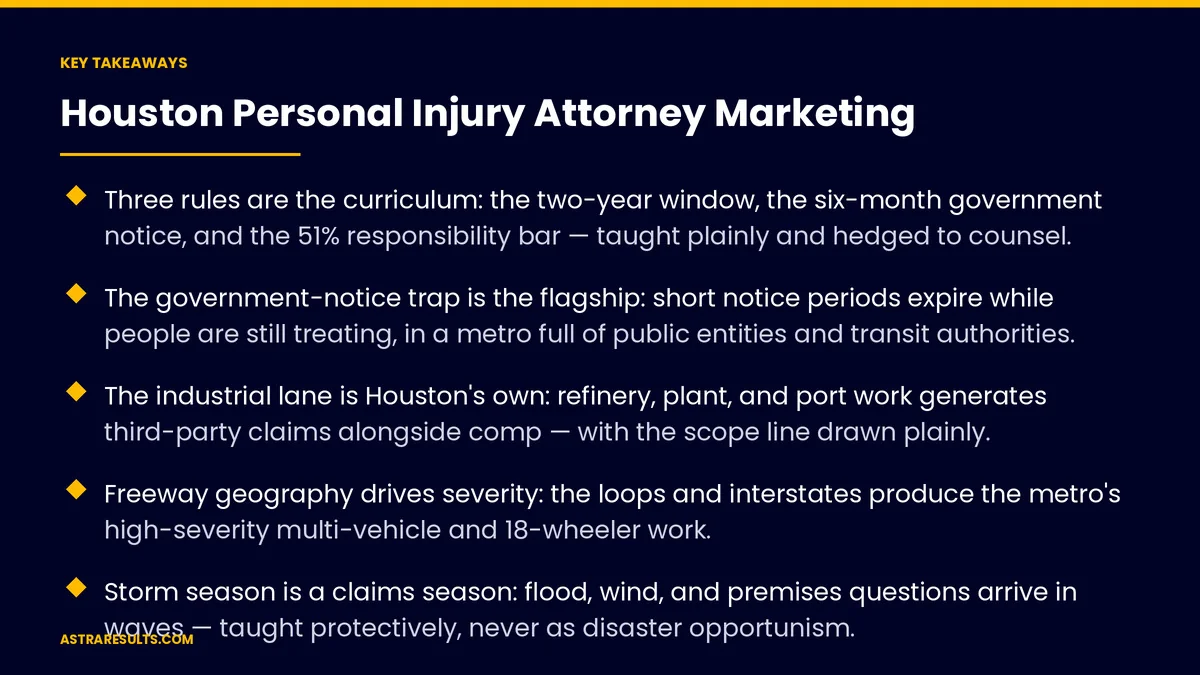
- Three rules are the curriculum: the two-year window, the six-month government notice, and the 51% responsibility bar — taught plainly and hedged to counsel.
- The government-notice trap is the flagship: short notice periods expire while people are still treating, in a metro full of public entities and transit authorities.
- The industrial lane is Houston's own: refinery, plant, and port work generates third-party claims alongside comp — with the scope line drawn plainly.
- Freeway geography drives severity: the loops and interstates produce the metro's high-severity multi-vehicle and 18-wheeler work.
- Storm season is a claims season: flood, wind, and premises questions arrive in waves — taught protectively, never as disaster opportunism.
- Measure the saves: notice-period rescues, responsibility consultations, and signed cases by lane and language on the ledger standard.
Published: October 14, 2026 | Reading Time: ~11 minutes | Category: Legal · Houston
Three rules decide most Houston cases before the facts are argued. Most personal injury claims carry a two-year limitations period. Claims against many governmental units are subject to a much shorter notice requirement. Commonly six months, with specific entities and charters sometimes setting even tighter windows, plus procedural requirements counsel must handle.
And Texas applies proportionate responsibility with a 51% bar. A claimant found more than 50% responsible generally recovers nothing, while at 50% or less recovery is reduced by that share. Teach all three loudly, in both of this metro's major languages, and the firm converts by protecting, exactly as the protective-education economics predict.
The tone carries the cluster's spine, tuned to Houston's plainspoken frequency: out-teach rather than out-shout; calm as the credibility.
Real deadlines urgent, manufactured panic never. The status-safe promise for a metro whose workforce includes hundreds of thousands who fear that calling a lawyer risks their status. Clean hands stated proudly in a market where solicitation rules matter; and the named-attorney anti-mill position. Marketing guidance for licensed attorneys only. Nothing here is legal advice.
Every deadline, threshold, and rule above and below is general information with exceptions, tolling doctrines, and entity-specific variations only counsel can apply. Texas attorney advertising rules govern every asset and require care in how firms describe results and specialization.
In This Playbook
- The Three Rules
- The Industrial Lane
- The Status-Safe Promise
- The Freeway and Street Geography
- Storm Season, Handled With Care
- Out-Teach the Billboards
- The Intake War
- Channels
- How should a Houston injury firm measure cost per case?
- A 90-Day Build
The Three Rules
The curriculum, hedged like the fact-intensive terrain it is.
Two years, generally. Most Texas personal injury claims run on a two-year limitations period, stated with the candor that exceptions run both directions (discovery rules, minors, and other doctrines can extend. Specific claim types and defendants compress), plus the standing hedge: your deadline is a legal determination; talk to counsel now, not near the edge.
Six months against many government units, and sometimes less. Claims involving cities, counties, transit authorities, school districts, and other governmental units generally require formal notice within a short window (commonly six months, with some entities' own charters or ordinances setting tighter requirements) long before most injured people have finished treatment. This is the flagship.
In a metro this full of public entities, buses, and public property, the notice trap quietly ends meritorious cases every week. The firm that teaches it loudly saves them.
The 51% bar, taught in both directions. Recovery is reduced by the claimant's share of responsibility and barred above 50%. So "it might have been partly my fault" is a reason to call rather than to give up, while no candid firm predicts where a jury will apportion.
The call-anyway sentence. Deadlines carry exceptions, entities vary. Cases often have more than one clock, if you think you missed something, call anyway.
The Industrial Lane
Houston's signature practice area, and the one generic firms handle worst.
The petrochemical corridor. Refineries, chemical plants, and the industrial belt along the Ship Channel employ a vast workforce. Serious incidents (releases, fires, equipment failures, falls) generate the metro's most complex injury work.
The comp-versus-third-party line, drawn plainly. Workers' compensation and potential third-party claims against contractors, equipment manufacturers, or premises owners are different questions. Texas's non-subscriber landscape adds another layer where employers opt out of the comp system entirely, taught at educational level as the scope honesty Astra requires, with every application counsel's and referrals made cheerfully where a matter belongs elsewhere.
The port and maritime overlap. The nation's busiest port complex means maritime and Jones Act questions sit beside land-based industrial work, named as its own specialist lane rather than blurred into general practice.
The worker tone. This content speaks to skilled trades with respect and in their languages, per the dignity standard Astra holds for the trades, and never exploits a tragedy for advertising, per the no-fear absolute.
The Status-Safe Promise
The fear-buried funnel, opened in this metro's own Spanish tone. Houston's injured (plant workers, drivers, construction crews, passengers, pedestrians) include enormous numbers of people who never call because they fear immigration consequences. The promise runs per the cluster's architecture.
Injured people can pursue claims, conversations are confidential, no documents are required to begin, stated plainly, hedged to confidential counsel for every individual situation, and written natively rather than translated per the chain rule. It is protective information the community deserves, never a recruitment lever. In a metro this size, it is also the largest underserved funnel in the market.
The Freeway and Street Geography
The metro's crash map, built as one-intent lanes.
The loops and interstates. I-45, I-10, the Beltway, and 610 generate high-severity multi-vehicle work, with the multi-insurer complexity named as exactly why counsel earns its keep.
18-wheelers and commercial vehicles. Freight through the port and the interstate corridor makes trucking a first-class lane, the federal-regulation and evidence-preservation layer named as specialist territory, with its own page and its own dedicated industrial-injury guide.
Coverage as curriculum. Texas is at-fault, minimum limits fall short of serious injury costs. UM/UIM coverage is the protection most drivers never learned they bought, taught as pure service.
Pedestrians, cyclists, and transit. A car-first metro's vulnerable-road-user lane served seriously, with public-vehicle and transit incidents routed straight to the notice flagship. The rideshare and delivery layer per the coverage-period framework.
Storm Season, Handled With Care
The claims wave this metro knows too well.
What the content covers. After major weather, questions arrive in volume. Vehicle damage and flood-loss basics, premises conditions, and the difference between an injury claim and a property-insurance dispute, taught at general educational level with the note that property claims are their own practice area and counsel routes accordingly.
The tone, strict. No disaster opportunism, no urgency theater, no chasing, the calm standard at its most tested, because a community recovering from a storm remembers exactly which firms showed up as neighbors and which showed up as advertisers.
The documentation guide. Photograph conditions, report promptly, seek care, keep records, published before hurricane season per the seasonal-asset discipline, and paired with the practice's own storm-contingency communication so clients know how to reach counsel when the power is out.
Out-Teach the Billboards
The saturation strategy.
The media candor. Billboard and radio saturation builds recall at brand budgets. The legacy-media take applies verbatim, and for everyone else the winning ground is the 2 a.m. search, the assistant answer, and the notice-period page that saves a case.
Anti-mill positioning per the named-attorney doctrine: the lawyer's name, candid case-mix candor, and the volume-model education delivered under steelman rules, practices named, competitors never.
Clean hands, stated plainly. Barratry and improper solicitation are serious matters in Texas, and the firm's published refusal of any pay-for-case arrangement is both an ethics statement and a differentiator in a market where communities know the ecosystem. Fee transparency per the contingency-candor standard, in plain language, in both languages.
The Intake War
The war clocks with Houston's triage. 24/7 literal, the never-voicemail rule absolute, bilingual at native speed, and every intake screening for governmental-entity involvement and incident date in the first three minutes, because the notice question belongs there and nowhere later, per the triage discipline this cluster proved. Industrial-incident calls get their own path.
Employer, site, and role captured for the comp-versus-third-party analysis counsel will run. The configuration our AI Inbound service builds carries capture, language routing, and clock-flagging with human escalation always.
Channels
Local Services Ads carry the screened layer with dispute hygiene. Search runs the expensive-vertical disciplines behind a negatives fortress tuned to this market (DIY small-claims intent, insurance-quote shoppers, workers'-comp-only searches routed to the right lane, property-insurance-claim traffic routed correctly, mega-brand navigational terms left unbought, jobs).
The AI-answer layer is where all three rules live ("how long do I have to sue in Texas," "can I sue the city of Houston," "¿puedo demandar si tuve parte de la culpa?") and the firm whose pages exist in both languages is the one cited, through the entity work our AI SEO service builds under named-attorney authorship.
Suburban and county-level geo pages run plainly across a metro spanning multiple counties and courthouses. Attorney video humanizes the name in the plain tone; reviews run never-gated. Spanish runs native throughout per the Spanish-first method, with Vietnamese assessed on the staff-it rule.
This metro hosts one of the nation's largest Vietnamese communities, and almost no injury firm serves it at chain depth.
How should a Houston injury firm measure cost per case?
The ledger, per the cost-per-case standard:
- Signed cases by lane, source, and language
- Notice-period saves — government-entity matters preserved because the short-clock lesson landed in time — as the flagship's proof
- Responsibility-consultation volume as the 51% teaching's ledger (the self-disqualifiers who called anyway)
- Industrial-lane volume with routing candor logged (matters referred where they belong)
- Storm-season waves read against the publishing calendar
- The status-safe funnel's health at the privacy standard (cohorts, never identities)
- Intake-clock compliance with the date-and-entity triage audited in call reviews
- Cost per signed case by channel — read on this metro's volumes and this cluster's protective terms
A 90-Day Build
Days 1–30: Rules and clocks
The three-rule curriculum drafted with attorney review; the government-notice flagship written for prominence; the status-safe promise written Spanish-first with counsel's sign-off; intake rebuilt with date-and-entity triage plus the industrial-incident path. Clean-hands and fee pages committed. Measurement instrumented for saves, responsibility consults, and language cohorts.
Days 31–60: Lanes live
The flagship pages published in both languages under named-attorney authorship; the industrial, freeway, trucking, vulnerable-road-user, and coverage lanes built. The storm-season library staged ahead of the season; LSAs and search live behind the fortress; attorney video begun on the three rules.
Days 61–90: War and reads
- After-hours capture audited against the never-voicemail rule
- County-level geo pages live
- Vietnamese capability assessed on the evidence against the staff-it gate before any page claims it
- AI-answer accuracy checked on the rule questions in both languages
- First clear reads — notice saves, responsibility consults, industrial routing, signed cases by lane and language — and next quarter set on the ledger, not the billboards
How Astra Builds Houston Injury Firms
Astra Results Marketing builds Houston injury marketing on the three rules that decide cases. The two-year window, the six-month government notice taught loudly enough to save cases. The 51% bar explained in both directions, plus the industrial lane served with scope candor, storm season handled without opportunism, and the status-safe promise delivered natively.
Engagements begin with a rules, lanes, and intake audit through our business consulting team.
Related reading
Frequently asked questions
Why treat the government-notice period as the flagship?
Because it's the deadline that ends good cases quietly. Claims involving cities, counties, transit authorities, and school districts generally require formal notice within a short window (commonly six months, sometimes less by charter or ordinance) which expires while people are still in treatment. In a metro this full of public entities, teach it prominently in both languages, hedge every specific to counsel, screen for it in the first three minutes of intake, and add the call-anyway sentence.
How do we explain the 51% bar without discouraging callers?
Teach both edges: recovery is reduced by your share of responsibility and barred only above 50%, so partial fault is a reason to call rather than to quit, while never predicting apportionment, because it's contested and fact-intensive. Add the practical layer on how responsibility gets argued and the adjuster-caution page beside it. The plain version rescues the self-disqualifier and earns the trust of the reader who can smell a guarantee.
What makes industrial injury marketing different from general PI?
The scope line and the tone: refinery, plant, and port incidents involve comp questions, potential third-party claims, non-subscriber employer situations, and sometimes maritime law, so the content teaches the categories plainly, states plainly that the analysis is fact-specific, and refers cheerfully where a matter belongs with a specialist. Speak to skilled trades with respect and in their languages, and never build advertising on a specific tragedy. This workforce talks, and it remembers both kinds of firms.
How should we handle marketing after a major storm?
As neighbors, not advertisers. Publish practical guidance (documentation, prompt reporting, seeking care, the difference between injury claims and property-insurance disputes with correct routing), keep the tone calm with zero urgency theater, and make sure clients know how to reach counsel when the power is out. Communities recovering from a storm remember exactly who showed up how, the firm that helped without chasing earns years of goodwill.
Are billboards worth it for a smaller Houston firm?
Only at budgets where recall math works. Otherwise own what the billboard can't. The notice-period page, the responsibility explainer, the coverage curriculum, and the assistant answers this metro asks at midnight. Recall advertising is a capital game and this market is full of capital. The teaching layer is the underdog's, and the researcher it converts is the client a serious firm wants.
Should we build Vietnamese-language capability?
If the chain can be real, it's one of this market's clearest openings. Houston hosts one of the largest Vietnamese communities in the country, injury needs are continuous. Almost no firm serves it at chain depth. Apply the staff-it-or-don't-say-it rule strictly (content, intake, counsel conversations, documents) and build Spanish completely first at metro scale. A half-served language in a crisis vertical fails people at the worst possible moment.
Ready to Teach the Three Rules That Decide Houston Cases? Astra Results Marketing builds Houston injury marketing on the two-year window, the six-month government notice, and the 51% bar. Plus the industrial lane, storm-season care, and the status-safe promise — measured on saves and signed cases by language. Start with a rules, lanes, and intake audit for your firm. ▸ CALL (786) 321-2866 · ▸ REQUEST YOUR CONSULTATION