 Rated 5 star on

International Shipping as a Marketing Message
Quick answer
International shipping becomes a selling point when a store removes the uncertainty shoppers fear. Collect duties and taxes at checkout so nothing is due at the door. Show clear delivery estimates by country and a simple returns policy. Since July 2026, small parcels into the EU no longer skip customs duty. Welcome Miami package forwarders clearly.
International shoppers rarely leave because of the shipping price alone. They leave because of uncertainty: Will customs add a bill at the door? When will it arrive? Can I return it? For many online stores, shipping is treated as a back-office detail. Stores that answer those questions upfront turn international shipping into a reason to buy.
Key Takeaways
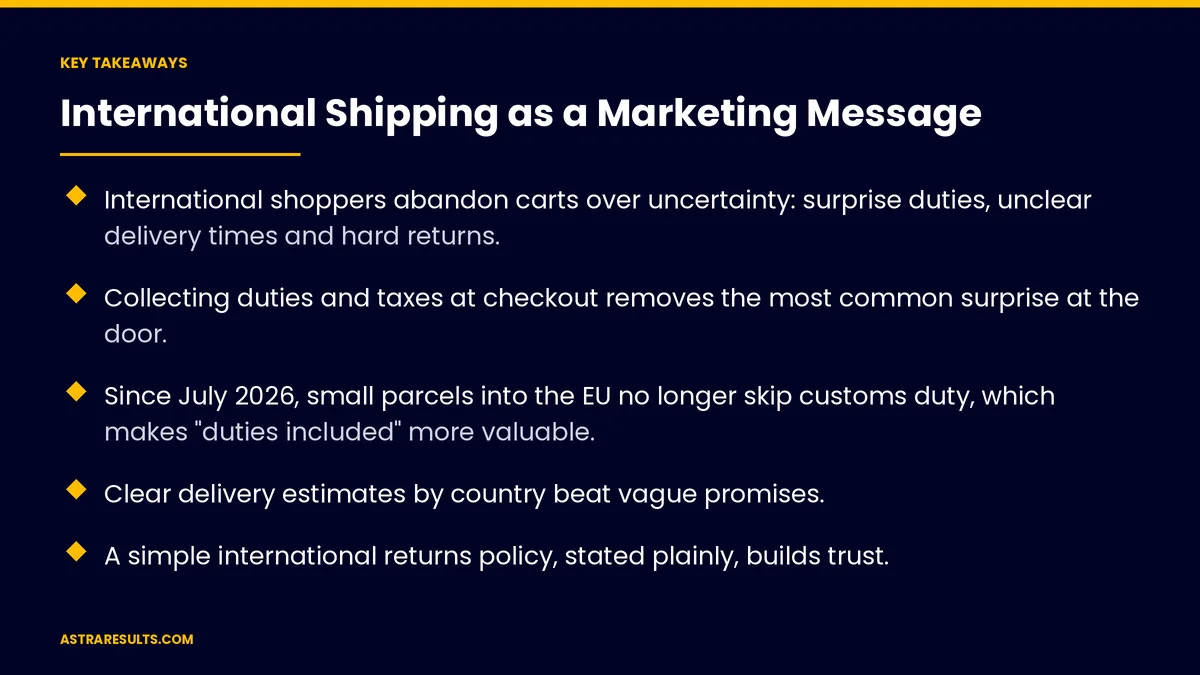
- International shoppers abandon carts over uncertainty: surprise duties, unclear delivery times and hard returns.
- Collecting duties and taxes at checkout removes the most common surprise at the door.
- Since July 2026, small parcels into the EU no longer skip customs duty, which makes "duties included" more valuable.
- Clear delivery estimates by country beat vague promises.
- A simple international returns policy, stated plainly, builds trust.
- Many Latin American shoppers buy through Miami package forwarders; welcome them clearly.
Published: October 10, 2026 | Reading Time: ~9 minutes | Category: E-Commerce Marketing
This guide covers how online stores make international shipping part of the pitch: duties and taxes shown upfront, clear delivery dates, workable returns, local currency and a few Miami-specific angles for Latin American shoppers. Put plainly: remove the surprises, then say so loudly.
Customs and tax rules change often and vary by country. Check current rules with your carrier, customs broker or tax advisor before you set prices.
In This Playbook
- Why international shoppers hesitate
- Duties and taxes, shown upfront
- What changed in 2025 and 2026
- Clear delivery dates
- Returns that work
- Local currency and language
- The Miami angle for Latin America
- Putting shipping in your marketing
- How should we measure international shipping results?
- The first three months
Why international shoppers hesitate
Surprise fees at the door. A customs or tax bill on delivery is the classic reason for refused packages.
Unclear delivery times. "Ships internationally" says nothing about when it arrives.
Returns that seem impossible. Shoppers assume sending something back abroad is costly or confusing.
Unfamiliar prices. Prices only in dollars make shoppers do the math.
The fix is information. Each worry has a clear answer you can show before checkout.
Duties and taxes, shown upfront
Collect at checkout. Charging duties and taxes when the order is placed, often called delivered duty paid, means nothing extra at the door.
Show the full price. Display the total, including duties and taxes, before payment. EU consumer rules expect the final price to be clear.
Say it plainly. "Duties and taxes included. Nothing to pay on delivery."
Use the right tools. Many store platforms and carriers can calculate landed cost at checkout. The wider setup is covered in the e-commerce stack.
What changed in 2025 and 2026
The EU ended its small-parcel duty exemption. From July 1, 2026, parcels under €150 sent to EU consumers no longer skip customs duty. A flat €3 duty per item type applies as an interim measure, and handling fees are expected to follow.
VAT still applies. EU VAT on small parcels has been due since 2021, often collected at checkout through the EU's import scheme.
Returns into the US need paperwork. The US ended its $800 duty-free exemption in August 2025, so returned goods crossing back need proper customs handling. Plan this with your carrier or broker.
The message gets stronger. With more fees at the border, "duties included" matters more than it did a year ago.
Clear delivery dates
Estimates by country. "Delivered in 5–8 business days to Colombia" beats "ships worldwide."
Show it early. On product pages and in the cart, not only at checkout.
Track and tell. Send tracking links and updates in the shopper's language, as covered in e-commerce engagement.
Be realistic. Customs can slow things down; build that into the estimate.
Returns that work
State the policy simply. Who pays return shipping, how long shoppers have and how refunds work.
Offer easy options. Prepaid labels, local return points or store credit where full returns aren't practical.
Explain duties on returns. Say whether duties and taxes are refunded when an item comes back.
Use AI for return questions. Answer common return questions quickly, as covered in catalog, support and returns.
Local currency and language
Show prices in local currency. Let shoppers see what they'll pay without converting.
Offer local payment options. Popular cards and payment methods in each market.
Translate the key pages. Product pages, shipping and returns, in the shopper's language.
Go beyond translation. Wording and examples that fit each market, as covered in bilingual marketing beyond translation.
The Miami angle for Latin America
Package forwarders are common. Many Latin American shoppers buy from US stores and ship to a Miami forwarding address that sends parcels on.
Welcome them clearly. Say you ship to forwarding addresses, and make sure fraud filters don't block them by mistake.
Fast Miami delivery matters. Quick delivery to Miami forwarders means faster arrival at home.
Speak to each market. Shoppers from Colombia, Venezuela and Argentina have different habits, as covered in marketing to Colombian, Venezuelan and Argentine clients.
Putting shipping in your marketing
Product pages. Delivery estimate and "duties included" near the price.
Ads. Lead with the benefit: "Free shipping to Mexico, duties included."
Email. Remind past international buyers about fast, fee-free delivery.
Landing pages by market. Shipping, returns and currency for each country you target.
Test the message. Compare shipping-led ads and pages against standard ones.
How should we measure international shipping results?
International conversion rate. By country.
Cart abandonment at the shipping step. Before and after showing duties and delivery dates.
Refused or abandoned parcels. Packages not accepted at the door.
Return rate and cost. By country.
Repeat international buyers. Shoppers who come back after a smooth first order.
The first three months
Days 1–30: fix the basics
Choose your top international markets. Set up duties and taxes at checkout, delivery estimates by country and a clear international returns policy. Record baseline conversion, abandonment and refused parcels.
Days 31–60: tell shoppers
Add delivery estimates and "duties included" to product pages, the cart and checkout. Show local currency, translate the key pages and welcome forwarding addresses.
Days 61–90: market it
Run shipping-led ads and emails in your top markets, and build a landing page for each. Compare conversion, abandonment and refused parcels with the baseline.
How Astra markets international shipping
Astra Results Marketing turns international shipping into a selling point. We help set up duties at checkout, delivery estimates and clear returns, then make them part of your product pages, ads, emails and market landing pages.
We plan for Latin American shoppers using Miami forwarders and measure results by country. Engagements begin with a markets and checkout review through our e-commerce marketing team.
Related reading
Frequently asked questions
Why do international shoppers abandon carts?
Mostly uncertainty: surprise duties or taxes at the door, unclear delivery times, hard returns and prices in an unfamiliar currency. Answering those questions upfront removes the doubt.
Should we charge duties at checkout?
For most stores, yes. Collecting duties and taxes when the order is placed means nothing to pay at the door, which reduces refused parcels and lets you advertise "duties included."
What changed for shipping to the EU?
From July 1, 2026, small parcels under €150 sent to EU consumers lost their customs duty exemption. A flat €3 duty per item type applies for now, with handling fees expected. VAT was already due.
How should we handle international returns?
State the policy simply, offer easy options such as prepaid labels or store credit, and explain whether duties are refunded. Returns into the US now need proper customs handling, so plan with your carrier.
Should we ship to package forwarders?
If you sell to Latin America, often yes. Many shoppers use Miami forwarding addresses. Say clearly that you ship to them, and check that fraud filters don't block them.
Where should we start?
With your top international markets: set up duties at checkout, delivery estimates and a clear returns policy, then show them on product pages and in ads.
Ready to make international shipping a reason to buy? Astra Results Marketing sets up duties at checkout, clear delivery dates and simple returns, then builds them into your product pages, ads and emails for each market you serve. ▸ CALL (786) 321-2866 · ▸ REQUEST YOUR CONSULTATION





