Rated 5 star on

Bilingual Marketing Beyond Translation
Quick answer
Treating Spanish as a channel means researching how Spanish speakers describe the problem rather than translating English keywords, choosing a register the audience recognises, staffing intake so somebody answers in Spanish, and giving the channel its own budget line. A translated campaign performs like a translated campaign, and the market is usually blamed for it.
Most "bilingual marketing" is an English campaign run through a translator. The keywords, the ads and the landing page are all translated. Then the leads arrive, nobody at the front desk speaks Spanish in that moment, and the campaign is judged a failure. The market did not fail. A translated campaign did exactly what translated campaigns do.
Key Takeaways
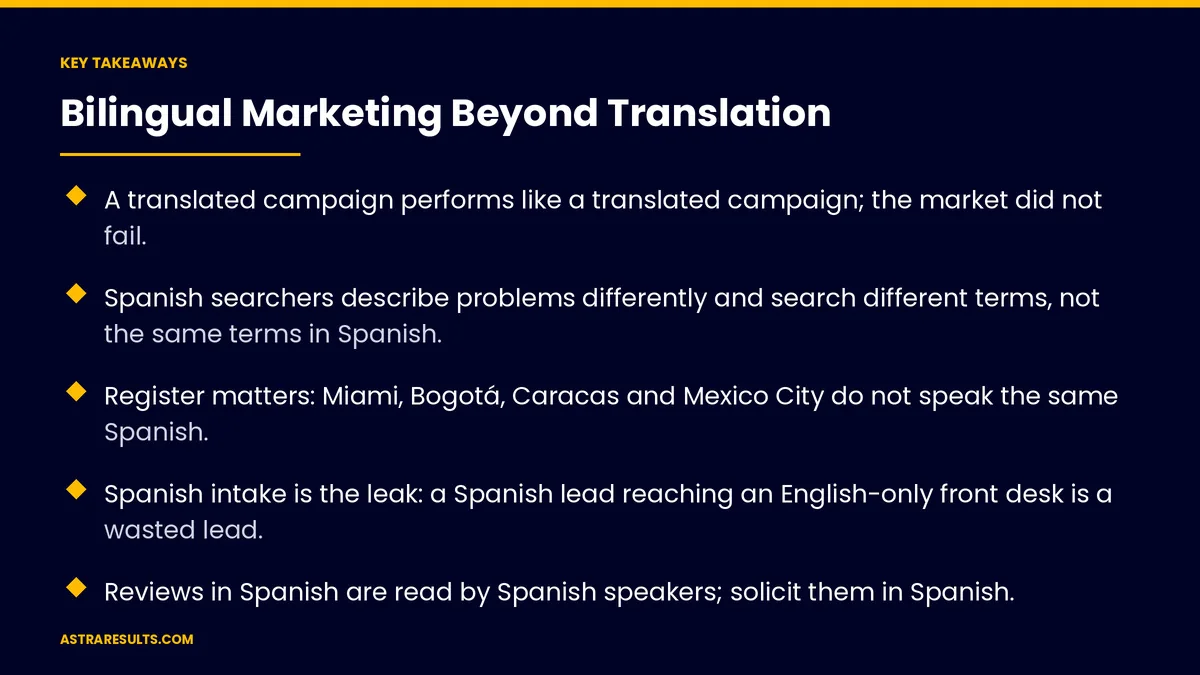
- A translated campaign performs like a translated campaign; the market did not fail.
- Spanish searchers describe problems differently and search different terms, not the same terms in Spanish.
- Register matters: Miami, Bogotá, Caracas and Mexico City do not speak the same Spanish.
- Spanish intake is the leak: a Spanish lead reaching an English-only front desk is a wasted lead.
- Reviews in Spanish are read by Spanish speakers; solicit them in Spanish.
- Run a P&L by language, or the Spanish channel will be cut the first time budget is tight.
Published: September 7, 2026 | Reading Time: ~12 minutes | Category: Bilingual
Spanish is a channel, not a translation task. It has its own search behavior, its own way of describing a problem, its own trust signals and its own intake requirements. This piece explains what treating it as a channel means in practice, and how to measure it as one. Put plainly: if the Spanish campaign shares a budget line with English, nobody will ever know if it works.
Guidance for owners and operators. Nothing here is legal advice. Advertising, consent and language-access rules vary by jurisdiction and industry and should be confirmed with counsel.
In This Playbook
- Why translation fails
- Intent research, done separately
- Register: which Spanish
- Spanish-first intake
- Reviews, referrals and community
- The P&L by language
- Where this applies beyond Miami
- What the first quarter looks like
- What Astra does here
Why translation fails
Translation preserves the words and loses the intent.
- Search behavior differs. Spanish speakers do not search the Spanish version of English keywords. They describe the problem in their own frame, with their own vocabulary, often with different levels of specificity. The translated keyword list captures a fraction of real demand.
- Trust signals differ. What makes an English-speaking customer trust a business is not identical to what makes a Spanish-speaking customer trust one. Family references, personal recommendation, the ability to speak to a person, and continuity of the same person matter more.
- The intake is the same. A translated campaign sends Spanish-speaking leads to the same phone line and the same form as English leads. If nobody on the other end speaks Spanish in that moment, the campaign paid for a lead the business could not serve.
- The measurement is blended. Spanish spend and English spend sit in one account, one budget and one report. When the blended number is disappointing, the smaller line gets cut, examined in attribution across channels.
Intent research, done separately
Spanish keyword research starts from scratch, not from the English list.
- Listen first. The Spanish-speaking customers the business already has: how did they describe the problem when they called? What words did they use? The intake recordings and the front desk are the research.
- Search the way they search. Long, conversational, problem-first queries are more common. Spellings vary. Anglicisms appear alongside native terms, and both need coverage.
- Regional terms. The same service has different names by country of origin, and Miami alone has customers from a dozen countries. The keyword set includes the variants the business hears.
- AI search behaves the same way. Spanish-speaking customers ask assistants in Spanish, and the content that gets cited is content written natively in Spanish, not translated, set out in AI search visibility.
- The negative keyword list is separate too. Spanish has its own irrelevant traffic: job seekers, students, do-it-yourself queries, and terms that mean something else in another country's Spanish.
Register: which Spanish
There is no neutral Spanish that reaches everyone equally well.
- The choice. A Miami business serving Cubans, Venezuelans, Colombians and Central Americans makes a register decision: a calibrated neutral that avoids any one country's slang, or deliberate variants for the largest groups.
- Formality. Usted versus tú is a business decision with consequences. Older customers and higher-ticket services favor formal address. Younger audiences and casual services may not.
- Vocabulary that divides. Everyday words for common objects and services differ by country in ways that can read as foreign or even wrong. A native speaker from the target community catches these; a translator from a different country does not.
- Tone. Directness, warmth, and humor calibrate differently. What reads as confident in English can read as cold in Spanish, and what reads as warm in one country's Spanish reads as unprofessional in another's.
- The rule. Copy is written by a native speaker of the register the business chose, and reviewed by someone from the customer base. Never translated and never machine-generated without that review.
Spanish-first intake
The campaign is only as good as what happens when the Spanish speaker calls.
- The requirement. A Spanish-speaking person or AI available whenever the Spanish campaign is running, including after hours, according to the intake standard.
- The routing. Spanish campaigns send to a Spanish line or a Spanish-tagged form, so the responder knows the language before answering. A caller who has to ask "¿habla español?" and wait is already halfway to the next business.
- The script. Written natively in Spanish with the same rigor as the English one, in the register the business chose, with the same qualifying questions and the same booking flow.
- AI intake in Spanish. Now practical: an AI that answers in the customer's language in seconds, books the appointment, and escalates to a Spanish-speaking human when the conversation needs one. This removes the single largest reason bilingual campaigns fail.
- The follow-up. In Spanish. The quote, the reminder, the review request, the reactivation message. Switching to English after the first contact tells the customer the Spanish was a lure.
Reviews, referrals and community
Reputation in the Spanish-speaking market moves differently.
- Reviews in Spanish. Spanish speakers read Spanish reviews first. A business with two hundred English reviews and none in Spanish has, to that reader, no reviews. Solicit in Spanish, from Spanish-speaking customers, after every job.
- Responses in Spanish. Every Spanish review answered in Spanish, by name, in register.
- Referral behavior. Personal recommendation carries more weight, travels through family and community networks, and happens on WhatsApp. A referral system for the Spanish market is built around making that forwarding easy.
- Community presence. Churches, associations, schools and community events matter as trust infrastructure. The posture is participation before promotion; showing up to sell is noticed and remembered.
- Video in Spanish. A native speaker on camera explaining what the business does, in the customer's register, outperforms any translated brochure.
The P&L by language
The single discipline that keeps the Spanish channel alive.
- Separate campaigns. Spanish and English in different campaigns, with different budgets, so spend is visible by language.
- Separate tracking. Spanish tracking numbers, Spanish-tagged forms, and a language field on every lead in the CRM.
- Separate outcomes. Cost per closed customer by language. Conversion rate at each seam by language. Twelve-month customer value by language cohort.
- What the P&L usually shows. Spanish leads that are cheaper to acquire, convert at a comparable or higher rate when intake is native, and refer at a higher rate. It also shows exactly where the Spanish funnel leaks, which is almost always intake.
- Why this saves the channel. When budget gets tight, the channel with its own P&L survives on its numbers. The channel buried in a blended report gets cut on a hunch.
Where this applies beyond Miami
The pattern holds anywhere a business serves a Spanish-speaking population.
- Florida statewide. Orlando, Tampa, Jacksonville and the Palm Beaches each have Spanish-speaking communities with different countries of origin and therefore different registers.
- Other US metros. Houston, Chicago, Los Angeles, New York each require the same discipline with a different register mix.
- Latin America from a US base. A business selling into Latin America is not doing bilingual marketing. It is doing Spanish-primary marketing with a different regulatory, payment and platform environment, and the register question becomes country-specific.
What the first quarter looks like
Days 1–30: research and register
Intake recordings and front desk notes reviewed for how Spanish-speaking customers describe the problem. Keyword and negative lists built from scratch. Register chosen and documented. Native-speaker copywriter and community reviewer identified.
Days 31–60: intake and campaigns
Spanish line or tagged form live. Spanish script written natively. Spanish-speaking coverage or AI intake confirmed for all campaign hours. Spanish campaigns launched in their own campaign groups with their own budgets. Language field added to the CRM.
Days 61–90: reputation and P&L
Review solicitation in Spanish after every job. Spanish review responses. The first cost per closed customer by language calculated, and the first seam-by-seam comparison of where each funnel leaks.
What Astra does here
Astra Results Marketing treats Spanish as a channel from the first meeting: intent research from the business's own Spanish-speaking customers, a documented register decision, copy written natively by speakers of that register, Spanish-first intake with AI and human coverage, review and referral systems built for how reputation moves in the community, and a P&L by language so the channel is judged on its own numbers.
The team operates natively in both languages. Engagements begin with a bilingual audit through our social media marketing team.
Related reading
Frequently asked questions
Why does translating an English campaign into Spanish fail?
Because translation preserves the words and loses the intent. Spanish speakers describe problems in their own frame with their own vocabulary, so the translated keyword list captures a fraction of real demand. Trust signals differ. And the translated campaign sends Spanish-speaking leads to the same English phone line, so the business pays for leads it cannot serve in the moment.
What does "register" mean and why does it matter?
The variety of Spanish the business chooses to speak: formal or informal address, vocabulary that differs by country, and tone. Miami alone has customers from a dozen countries, and everyday words can read as foreign or wrong across them. Copy is written by a native speaker of the chosen register and reviewed by someone from the customer base, never translated or machine-generated without that review.
What is the biggest leak in bilingual campaigns?
Intake. A Spanish-speaking caller who has to ask "¿habla español?" and wait is already halfway to the next business. Spanish campaigns need a Spanish line or tagged form, a natively written script, and Spanish-speaking coverage or AI intake for every hour the campaign runs, with follow-up, quotes, reminders and review requests also in Spanish.
How should reviews be handled for the Spanish market?
Solicited in Spanish, from Spanish-speaking customers, after every job, and answered in Spanish in register. Spanish speakers read Spanish reviews first; a business with two hundred English reviews and none in Spanish has, to that reader, no reviews. Referrals travel through family networks and WhatsApp, so the referral system is built to make that forwarding easy.
Why run a separate P&L by language?
Because the channel buried in a blended report gets cut on a hunch the first time budget is tight, while the channel with its own numbers survives on them. Separate campaigns, tracking numbers, tagged forms and a language field in the CRM produce cost per closed customer, seam-by-seam conversion and twelve-month value by language, and show exactly where the Spanish funnel leaks.
Does this apply outside Miami?
Anywhere a business serves Spanish speakers, with a different register mix in each market: Orlando, Tampa, Jacksonville and the Palm Beaches within Florida, and Houston, Chicago, Los Angeles and New York beyond it. Selling into Latin America is a different task again — Spanish-primary marketing with country-specific register and a different regulatory and payment environment.
READY TO TREAT SPANISH AS A CHANNEL? Astra Results Marketing builds the Spanish channel natively: intent research, register, Spanish-first intake with AI and human coverage, community reputation, and a P&L by language. Astra Results Marketing · 1101 Brickell Ave, Miami, FL 33131 · +1 (786) 321-2866 · [email protected] Find us on Google · Yelp ▸ CALL (786) 321-2866 · ▸ REQUEST YOUR CONSULTATION