Rated 5 star on

E-Commerce Engagement: Order Status to Reorder
Quick answer
Most online store contacts ask about order status, returns or stock, and the store's own systems can answer them. Proactive shipping updates prevent many contacts. Returns should be handled without friction. Each resolved contact is a chance to suggest the reorder. Astra measures contacts prevented, first-contact resolution, repeat purchases and revenue from conversations.
Half of an online store's support inbox is one question in different words: where is my order. The other half is returns, sizing and "is this back in stock." The team answers by looking up what the customer could have been told already. By the time each contact is closed, the moment to sell the next thing has passed.
Key Takeaways
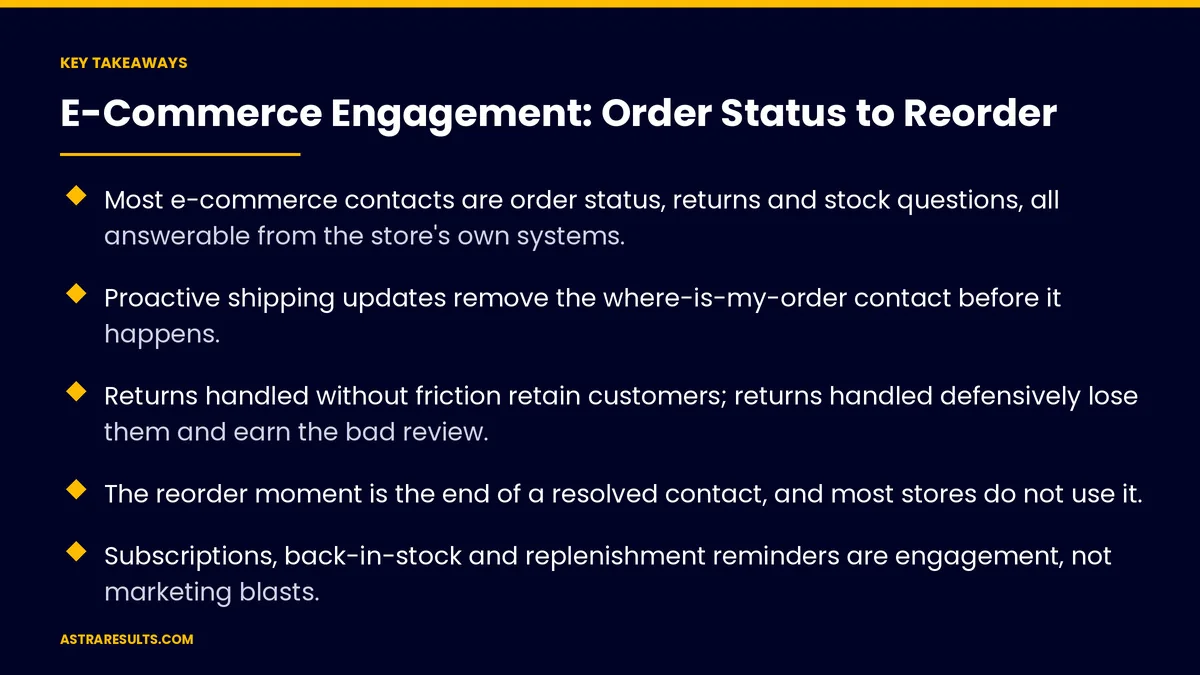
- Most e-commerce contacts are order status, returns and stock questions, all answerable from the store's own systems.
- Proactive shipping updates remove the where-is-my-order contact before it happens.
- Returns handled without friction retain customers; returns handled defensively lose them and earn the bad review.
- The reorder moment is the end of a resolved contact, and most stores do not use it.
- Subscriptions, back-in-stock and replenishment reminders are engagement, not marketing blasts.
- Measure by contacts prevented, resolution on first contact, repeat purchase rate and revenue attributed to conversations.
Published: October 6, 2026 | Reading Time: ~12 minutes | Category: Customer Engagement
E-commerce engagement is the arc from order confirmation to the next order. Most stores treat it as a cost center called support. This piece treats it as the moment the customer is most attentive and most reachable, and covers answering the routine in seconds, removing friction from returns, and making the reorder the natural end of every conversation.
Put plainly: the customer who asked where their order is has told you they care; answer, then offer.
Guidance for owners and operators of online stores and direct-to-consumer brands. Nothing here is legal advice. Consumer protection, refund rights, text and email consent, and marketplace policies apply and should be confirmed with counsel and with each platform's current terms.
In This Playbook
- The three questions
- Preventing the contact: proactive updates
- Answering in seconds
- Returns without friction
- The reorder moment
- Channels and the marketplace question
- What comes back
- The first three months
- What Astra does here
The three questions
Where is my order. The largest category in nearly every store, and the most preventable. The answer is in the order system and the carrier's tracking. The customer asks because nobody told them, or because the last update was three days ago and said "in transit."
Can I return this, and how. Sizing, color, changed mind, damaged. The policy exists. The process is where stores lose people, with forms, labels, waiting and silence.
Is it back in stock. A purchase intent stated plainly, usually answered with "we will let you know" and then not.
Everything else. Sizing advice, ingredients, compatibility, shipping to a country, discount codes that did not work. Answerable from the catalogue and the policy, in the store's voice, at any hour.
Preventing the contact: proactive updates
The principle. A contact the customer never had to make is worth more than one answered in ten seconds. Order status is the clearest case.
What gets sent. Confirmation with a realistic delivery window, not a placeholder. Shipped, with tracking. Out for delivery. Delivered, with a photo where the carrier provides one. And the one most stores skip: a delay notice, sent by the store before the customer notices, with the new date and an apology proportionate to the delay.
The channel. Whatever the customer chose at checkout, which for most is now text or a messaging app rather than email. Consent recorded at the point of choice.
The effect. Where-is-my-order contacts fall sharply when updates are timely and delay notices are proactive. The remaining contacts are the ones that need a person: lost parcels, wrong items, damage.
Answering in seconds
Identity. Order number, or the email or phone on the order, confirmed before any detail is disclosed. The same rule that governs account questions in wholesale, applied to a consumer.
Status, from the source. The order system and the carrier, live, in one sentence with the date. Not a link to a tracking page the customer has already refreshed.
Stock and catalogue. Availability by variant, from the inventory system, with a back-in-stock notification offered where the answer is no. Sizing and fit from the size guide and, where the store holds it, from returns data on that item.
Policy. Returns, exchanges, shipping and warranties stated plainly from the maintained policy. Never improvised, never softened into a promise the store does not keep.
Tone. In the store's voice, in the register the customer used, from sources only. The guide for that is replies in your voice.
Returns without friction
Why it matters. A customer who returns something and has a good experience buys again at a higher rate than one who never returned anything. One who is made to fight for a refund does not, and tells people.
The frictionless version. The customer says they want to return. The system confirms eligibility from the policy and the order date, offers exchange first where that is the store's preference, issues the label or the drop-off code, and confirms what happens next and when. Two messages, under a minute.
Exchange over refund. Offered as the default where the policy allows: a different size or color, shipped now, before the return arrives. Retains the sale and the customer.
Refund timing. Stated, then kept. "Within five business days of receipt" means the customer hears when it is received and when it is refunded, without asking.
What goes to a person. Damage claims above a threshold, suspected fraud, anything outside policy the customer is asking to have made an exception for, and any customer who is angry. The person arrives with the order, the photos and the history on screen, following the tiering in intelligent support.
The reorder moment
Where it is. The end of a resolved contact. The customer asked, got an answer, and is still in the conversation. They have shown they care about the order and they are reachable right now.
What it is not. A coupon pasted under every reply. An offer that ignores what they bought. A push that arrives while the problem is still open.
What it looks like. After a delivery confirmation: a note about what pairs with it, or how to use it. After a return for size: the right size, shipped. After a back-in-stock notice: a link that adds it to the cart. After a resolved complaint: nothing, until the next natural moment.
Consumables and replenishment. For anything that runs out, a reminder timed to the usage interval the store can see in the order history, sent before the customer would run out. This is the highest-converting message most stores never send.
Subscriptions. Offered when the second order of the same consumable is placed, not at the first. Managed by message: skip, pause, change date, without logging in.
Reviews. Asked for after delivery, once, timed to when the customer has used the product. Routed by content: a problem goes to a person before it goes public, a compliment goes public with the customer's permission.
Channels and the marketplace question
The store's own channels. Email, text, messaging apps, chat on the site. One record across all of them, keyed to the customer and the order.
Marketplaces. Contacts through a marketplace's messaging system follow that marketplace's rules, which restrict what can be said and whether the customer can be moved to the store's own channels. The system handles them inside the rules and never tries to route around them.
Spanish. A large share of South Florida and Latin American customers shop and ask in Spanish. Answers, updates and reorder moments in the customer's language and tone, not a translated template.
The stack beneath. Orders, inventory, shipping, returns, reviews and the customer record are separate systems in most stores. The engagement layer reads all of them and writes back, following the build order in the engagement stack explained.
What comes back
Contacts prevented. Where-is-my-order volume per hundred orders, before and after proactive updates. Often the largest single change.
First-contact resolution. The share of remaining contacts closed on the first interaction without a reopen.
Return experience. Time from request to label, exchange rate versus refund rate, and repeat purchase rate among customers who returned something.
Revenue from conversations. Orders placed within a set window after a resolved contact, a replenishment reminder or a back-in-stock notice, attributed with the discipline in attribution across every channel.
Repeat purchase rate. The store's number, moved from the engagement side. The growth playbook in growing an online store treats acquisition and retention as the two halves. This piece is the second half.
Support hours. Returned from lookups to the contacts that need judgment, against a baseline.
The first three months
Days 1–30: the contact log and the connections
Thirty days of contacts classified by type, channel and whether the answer existed in a system. Order, inventory, shipping, returns and review systems connected to one customer record. Policies written in plain language with the owner. Checkout channel choice and consent capture confirmed.
Days 31–60: prevent and answer
Proactive shipping and delay updates live on the customer's chosen channel. Order status, stock, sizing and policy answered in seconds in English and Spanish after identity confirmation. Return requests handled to label or exchange in under a minute within policy; exceptions and damage routed to a person.
Days 61–90: the reorder moment and the review
Post-delivery notes, replenishment reminders and back-in-stock notices live, each timed to the order history. Subscription offers on second consumable orders. Review requests routed by content. Contacts per hundred orders, first-contact resolution, exchange rate, revenue from conversations and repeat purchase rate compared to Day 1.
What Astra does here
Astra Results Marketing begins with the contact log, because most stores estimate where-is-my-order at half its real share and never connect it to the updates they failed to send. Prevention goes live before answering: timely shipping and delay notices on the channel the customer chose.
Answers and returns follow, from the store's systems, in the store's voice and the customer's language, with exchange offered first and exceptions handed to a person with the order on screen. The reorder moment is built into the end of every resolved contact and into the replenishment interval the order history shows.
Reporting runs on contacts prevented, first-contact resolution, return experience and revenue from conversations. Engagements begin with a thirty-day contact classification through our AI customer engagement team.
Related reading
Frequently asked questions
Why is where-is-my-order so common?
Because the customer was not told, or the last update said "in transit" three days ago. Proactive confirmations, shipping, delivery and especially delay notices, sent on the channel the customer chose, remove most of these contacts before they happen.
How should a return be handled?
Eligibility confirmed from the policy and order date, exchange offered first where the policy allows, label or drop-off code issued. The timeline for receipt and refund stated and then kept, all within a minute. Damage, fraud and exceptions go to a person with the order on screen.
What is the reorder moment?
The end of a resolved contact, when the customer has just shown they care about the order and is still in the conversation. A relevant next step, matched to what they bought, converts far better than a coupon pasted under every reply.
When should a subscription be offered?
On the second order of the same consumable, not the first, and managed by message afterwards: skip, pause or change the date without logging in. Replenishment reminders timed to the usage interval do the same job for customers who do not want a subscription.
How are marketplace contacts handled?
Inside each marketplace's rules, which restrict what can be said and whether the customer can be moved to the store's own channels. The system answers within those limits and never routes around them.
How is the return measured?
Where-is-my-order contacts per hundred orders, first-contact resolution, time to label and exchange rate on returns, revenue from orders placed after a conversation or reminder, repeat purchase rate and support hours returned, each against a thirty-day baseline.
Ready to turn your support inbox into your next order? Astra Results Marketing classifies your contacts, connects your store's systems to one customer record, sends the updates that prevent the question, and builds the reorder moment into every resolved conversation, measured in repeat purchases. ▸ CALL (786) 321-2866 · ▸ REQUEST YOUR CONSULTATION