Rated 5 star on


Miami Pain Management Practice Marketing
Quick answer
A Miami pain management practice should market by recognizing patients who have been doubted. It promises function, never relief, with no cure or pain-free language. Scope is stated plainly, including how multidisciplinary care fits. Medication stays out of marketing. Referral partners get communication back. Astra measures function, follow-through and retention.
Chronic pain patients arrive at a new practice carrying something no other specialty's patients bring in the same way: the experience of having been doubted. They have been told the imaging looks fine, that the pain can't be that bad, that they should try harder or worry less, sometimes by clinicians, often by employers and family.
Key Takeaways
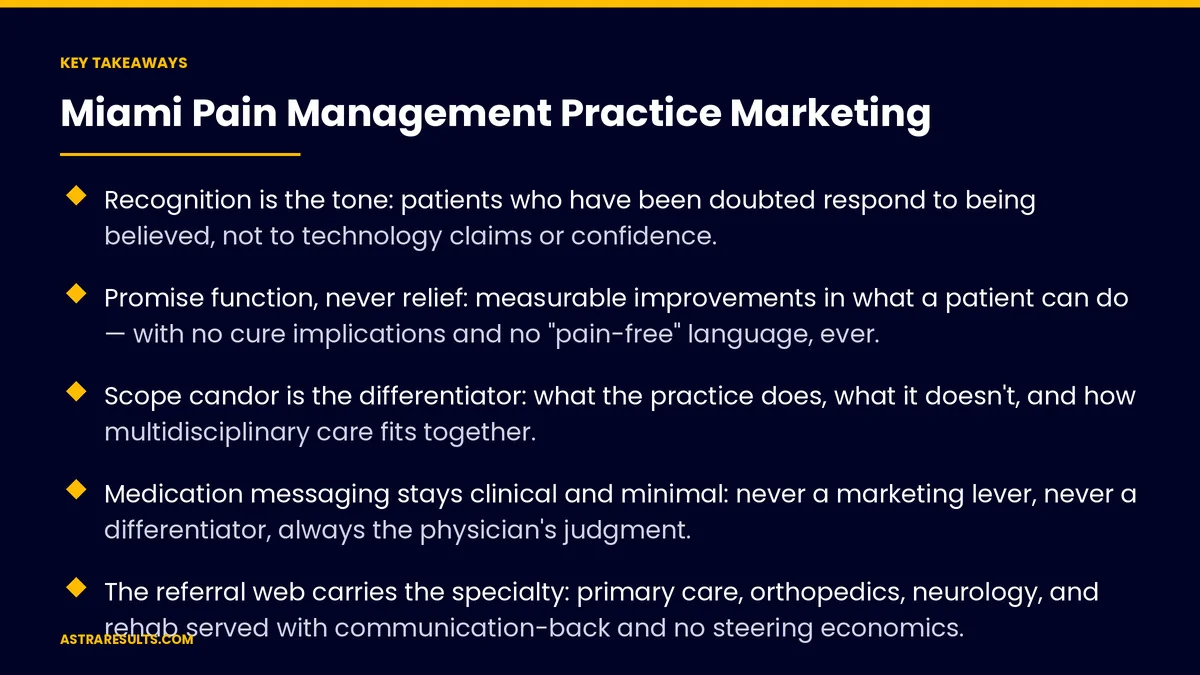
- Recognition is the tone: patients who have been doubted respond to being believed, not to technology claims or confidence.
- Promise function, never relief: measurable improvements in what a patient can do — with no cure implications and no "pain-free" language, ever.
- Scope candor is the differentiator: what the practice does, what it doesn't, and how multidisciplinary care fits together.
- Medication messaging stays clinical and minimal: never a marketing lever, never a differentiator, always the physician's judgment.
- The referral web carries the specialty: primary care, orthopedics, neurology, and rehab served with communication-back and no steering economics.
- Measure function and continuity: patient-reported function where tracked clinically, follow-through, retention, and referral truth.
Published: October 23, 2026 | Reading Time: ~11 minutes | Category: Medical · Pain Management
That experience shapes how they read every word a practice publishes. It explains why the most effective tone in this vertical isn't confidence or technology but recognition. The kicker states it: believed, not dismissed.
This is also the specialty where marketing ethics carry the highest stakes in medicine. The patient population is vulnerable by definition (in pain, frequently desperate, often financially strained by a condition that limits work) and the category's failure modes are severe: implied cure promises, "pain-free" language, medication-forward messaging, and volume-driven models that treat a chronic-disease population as a procedure pipeline.
Every discipline in this playbook exists to prevent those. Nothing here is medical advice; diagnosis, treatment selection, prescribing, and every clinical statement belong to your physicians. Controlled-substance advertising and prescribing are governed by federal and Florida law and by medical-board rules that only your counsel and clinicians can apply. Compliance review precedes publication of every asset.
This piece addresses marketing conduct only.
In This Playbook
- The Believed-Not-Dismissed Register
- Promise Function, Never Relief
- Scope Honesty and the Multidisciplinary Reality
- Medication Messaging
- Access, Intake, and the First Visit
- The Workers' Comp and Injury Interface
- The Referral Web
- Channels
- What belongs on a Miami pain management practice's dashboard?
- A 90-Day Build
The Believed-Not-Dismissed Register
The market's defining emotional reality.
What patients arrive with. Years of being questioned, invisible conditions that imaging doesn't explain, and a well-founded fear that the next practice will doubt them too: plus, frequently, the fear of being treated as a drug-seeking patient rather than a patient in pain.
What the tone does. Acknowledges the experience plainly and early ("your pain is real, and being doubted is part of what makes it exhausting"), describes the evaluation as thorough rather than skeptical, and explains what a first visit involves so the patient can arrive without dread, the transparency-as-care principle
Astra established in the fear-aware vertical, applied to a population with a different but equally specific fear.
What's banned. Any content implying that pain is a mindset problem, any framing that positions the practice as the arbiter of who "really" hurts, and, with equal force, any content that flatters a patient's hope with implied certainty.
The stigma line. Content never sorts patients into deserving and suspect categories, because a page that signals suspicion drives away exactly the patients who most need care.
Promise Function, Never Relief
The single most important content discipline in the specialty.
The rule. Market function (what a patient may be able to do again, measured and specific) rather than pain elimination, and never in absolute terms. Walk further. Sleep through more of the night. Return to a desk day. Lift a grandchild. Work a shift.
Why. Chronic pain is frequently managed rather than cured, "pain-free" is a promise nobody can keep, and the patient who was promised elimination and received improvement experiences a real result as a failure, the expectation-accuracy principle Astra proves in every outcome-sensitive vertical, at its most consequential.
The plain hedge on every claim. Outcomes vary, some conditions respond well and others partially. The physician's evaluation determines what's realistic, stated as a matter of course rather than as fine print.
The no-cure absolute. No cure language, no "eliminate your pain," no testimonial framing that implies typicality, and no before-and-after narrative that functions as an outcome guarantee.
What this buys. The patient who arrives with accurate expectations engages with a multi-visit treatment plan, which is the only version of this specialty that works clinically or commercially.
Scope Honesty and the Multidisciplinary Reality
The education gap this vertical leaves wide open.
What patients don't understand. That pain management spans interventional procedures, medication management, physical therapy and rehabilitation, behavioral health approaches, and lifestyle and functional strategies. That most patients need a combination rather than one thing.
The content that helps. What each component does, how they fit together, what a typical care pathway looks like over months. What the practice itself provides versus coordinates, with the scope-honesty standard applied plainly, including cheerful referral where a patient's needs sit elsewhere.
The behavioral-health component, handled with care. Pain psychology and coping-skills approaches are legitimate and evidence-supported components of comprehensive care. They must be presented as additive rather than as an implication that the pain is psychological, a distinction this population reads instantly and unforgivingly.
The realistic-timeline layer. What evaluation, trial, and adjustment periods look like, because a specialty built on iteration needs patients who expect iteration.
Medication Messaging
The subject that requires the most restraint.
The rule. Medication management is a clinical function described at the most general level necessary and never used as a marketing lever: no medication names as selling points, no positioning around prescribing willingness or unwillingness, no content that could be read as advertising access to controlled substances, and no framing that competes on what a practice will prescribe.
The compliance reality. Prescribing and advertising in this area are governed by federal and state law and medical-board rules, with requirements your counsel and clinicians must apply. That is why this section deliberately stops at conduct rather than specifics.
What patients legitimately need to know. That the practice's approach is individualized, that medication is one possible component among several, that safety and monitoring are part of care, and that the physician's judgment governs: stated calmly, once, without defensiveness.
The both-ways stigma trap. Content that advertises restriction ("we're not a pill mill") signals suspicion of patients, and content that advertises permissiveness attracts the wrong population and invites scrutiny. Neither belongs in marketing, the practice describes comprehensive care and lets clinical conduct speak.
Access, Intake, and the First Visit
Where trust is won or lost operationally.
The wait-time reality. Pain patients frequently wait months for specialty evaluation, and a practice with realistic, published availability wins on the availability-is-trust standard Astra documents everywhere.
The records burden. These patients carry years of imaging, notes, and prior treatments, a practice that makes records submission easy removes the largest practical barrier in the specialty.
The first-visit walkthrough. What the evaluation involves, how long it takes, what to bring, what will and won't be decided that day, published to lower dread, because a patient who has been doubted before arrives braced.
Intake tone. Staff trained to the same believed-not-dismissed standard, since a dismissive phone interaction ends the relationship before the physician ever sees the patient. The insurance-and-cost layer per the navigation standard: coverage for pain treatment is complicated and financially frightening for a population often out of work, explained plainly as service.
The Workers' Comp and Injury Interface
The lane that requires the most care in this market.
The reality. A significant share of chronic pain follows workplace and motor-vehicle injuries. That means pain practices interact with workers' compensation systems and with personal injury representation.
The marketing discipline. The practice may describe that it treats injury-related pain and works within those systems, in plain factual terms.
It does not market to attorneys as a referral-generation strategy in ways that imply anything other than independent clinical judgment, does not participate in arrangements that condition care on representation, and keeps documentation and treatment decisions visibly independent of any legal matter.
Why the line matters commercially as well as ethically. A pain practice perceived as an extension of litigation loses the physician referral web that sustains it. The clean-hands posture stated publicly protects both.
The patient-facing content. What to expect when treatment intersects with a claim, at general educational level, routed to their own counsel for anything legal.
The Referral Web
The channel that carries this specialty.
The sources. Primary care above all, plus orthopedics and sports medicine, neurology, neurosurgery and spine surgery, rheumatology, oncology for cancer-related pain, and physical therapy. The discipline per the referral-courtesy standard.
Consultation notes returned promptly and readably, the plan communicated so the referring physician can coordinate, patients returned for primary care rather than absorbed, and zero steering economics anywhere, particularly relevant where a practice owns imaging, therapy, or dispensing services.
What referrers need. A practice that takes complex patients seriously, communicates clearly, doesn't send patients back frustrated, and gives them candid answers about who it can and can't help.
The forwardable asset. The plain-language "what pain management involves" explainer a primary-care physician hands a hesitant patient, per the forwardable economics Astra keeps proving, which does double duty as the anxiety-reducer this population needs.
Channels
Search carries the condition-and-function library under named-physician authorship with the YMYL disciplines at full strength (condition explainers, procedure walkthroughs written to reduce dread, the multidisciplinary-pathway guide, the records-and-first-visit content) earning the AI answers this market asks ("what does a pain management doctor do," "will they think I'm drug seeking," "¿qué hace un especialista en dolor?") through the entity work our AI SEO service builds.
Physician video is unusually valuable here: a physician saying plainly that he believes patients and explains his evaluation approach does more than any copy. Paid runs narrow and conservative behind the negatives fortress. Medication-seeking query families excluded entirely, DIY-remedy and supplement shopping routed out, attorney-referral intent excluded, and jobs and CME traffic filtered.
Reviews run never-gated with privacy handled carefully, since pain patients may not want a public health disclosure, and never solicited in a way that pressures anyone. Spanish runs native per the chain rule, with Kreyòl and Portuguese on the staff-it rule. Pain description, functional goals, and medication safety instructions are comprehension-critical clinical conversations.
What belongs on a Miami pain management practice's dashboard?
The dashboard, per the case-level standard:
- Patient-reported function where the practice tracks it clinically — used internally to understand whether marketing attracts patients it can help, and never converted into outcome claims about people
- Follow-through and plan completion, the closest available proxy for expectation accuracy
- Retention and continuity years, because this is chronic-disease care
- Time-to-evaluation against published availability
- The referral ledger by physician relationship with note-turnaround measured as a service metric
- Records-submission friction (a real conversion variable in this specialty)
- The register audit — every asset reviewed on calendar against the banned-content list, including the both-ways stigma trap and any drift toward relief promises
- Language cohorts read separately
- Cost per new patient by source on the ledger standard, read on continuity years
A 90-Day Build
Days 1–30: Register and rules
- The believed-not-dismissed tone documented with the banned-content list (cure and pain-free language, mindset framing, medication-as-lever, both-ways stigma signals)
- Function-based claim standards written with physician sign-off
- The workers' comp and injury-interface conduct rules committed
- Intake staff trained to tone
- Measurement instrumented for function, follow-through, and referral truth
Days 31–60: The library live
Condition, procedure, and multidisciplinary-pathway content published under physician authorship in English and native Spanish. The first-visit and records walkthroughs live; the insurance-navigation content published as service; physician video begun on the belief-and-evaluation message; availability published plainly with realistic waits.
Days 61–90: Web and reads
- The referral web engaged with note-turnaround measured and the forwardable explainer distributed to primary care
- Conservative paid live behind the fortress with medication-query exclusions verified
- AI-answer accuracy checked in both languages
- The first tone audit completed
- First clear reads — function and follow-through signals, referral ledger, records friction, time-to-evaluation — and next quarter set on continuity years
How Astra Builds Pain Management Practices
Astra Results Marketing builds pain management marketing on recognition rather than confidence. The believed-not-dismissed tone, function promised instead of relief, multidisciplinary scope stated plainly, medication kept out of marketing entirely, the injury interface conducted cleanly. The referral web served with communication-back and zero steering economics, measured on function, follow-through, and continuity years.
Engagements begin with a tone, claims, and referral audit through our business consulting team.
Related reading
Frequently asked questions
What's the single most important shift in how we describe results?
From relief to function. Name what a patient may be able to do again (walk further, sleep more of the night, work a shift, lift a grandchild) with variability stated plainly and no absolute or cure language anywhere. "Pain-free" is a promise nobody can keep, and the patient promised elimination experiences real improvement as failure. Accurate expectations are what make a multi-visit plan work at all.
How do we address patients' fear of being seen as drug-seeking?
By removing suspicion from your content entirely. Acknowledge that being doubted is part of what makes chronic pain exhausting, describe your evaluation as thorough rather than skeptical, and never sort patients into deserving and suspect categories. Content that advertises restriction signals distrust. Content that advertises permissiveness attracts the wrong population. Describe comprehensive, individualized care and let clinical conduct do the rest.
Should we mention medications at all?
Only at the most general level care requires, and never as a differentiator: no medication names as selling points, no positioning on prescribing willingness, and nothing readable as advertising access to controlled substances, with your counsel and clinicians applying the specific federal, state, and board requirements. Patients legitimately need to know your approach is individualized and monitored. They don't need, and shouldn't be marketed, anything more specific.
How do we present behavioral-health components without implying the pain is psychological?
Frame them as additive, explicitly. Pain psychology and coping-skills approaches are evidence-supported components of comprehensive care that work alongside interventional and medical management, not instead of it. Say so in those terms. This population detects the implication that their pain is "in their head" instantly, so the sequencing and phrasing matter more here than almost anywhere else in medicine.
How should we handle injury and workers' comp cases in our marketing?
State factually that you treat injury-related pain and work within those systems, and stop there: no attorney-facing referral-generation marketing that implies anything but independent clinical judgment, no arrangements conditioning care on representation, and visibly independent documentation and treatment decisions. A pain practice perceived as an extension of litigation loses the physician referral web that sustains it.
What operational fix moves the needle fastest?
Records submission and the first-visit walkthrough. These patients carry years of imaging and notes. The practice that makes submission easy removes the specialty's biggest practical barrier, while publishing what the first visit involves lowers the dread a doubted patient arrives with. Pair both with intake staff trained to the same believed-not-dismissed tone, since a dismissive phone call ends the relationship before the physician ever sees the patient.
Ready to Build the Practice Patients Trust to Believe Them? Astra Results Marketing builds pain management marketing on the believed-not-dismissed tone, function promised plainly instead of relief, multidisciplinary scope stated plainly, and a referral web served with integrity. Measured on function, follow-through, and continuity years. Start with a tone, claims, and referral audit for your practice. ▸ CALL (786) 321-2866 · ▸ REQUEST YOUR CONSULTATION