Rated 5 star on


Miami Orthopedics & Sports Medicine Marketing
Quick answer
A Miami orthopedic or sports medicine practice should market the return to activity, not the procedure. Content is organized by activity and timeline, the way patients search. Conservative options lead, which builds trust for surgery later. Same-week evaluation for acute injuries is the product. Astra measures time-to-evaluation and return-to-activity outcomes.
Orthopedic patients arrive with a goal, not a procedure. The runner wants her half marathon. The tennis player wants his serve. The warehouse supervisor wants to lift without the shoulder catching. The grandmother wants the stairs back. Nobody wants surgery, and the practices that market operations instead of outcomes miss the entire framing their patients are using.
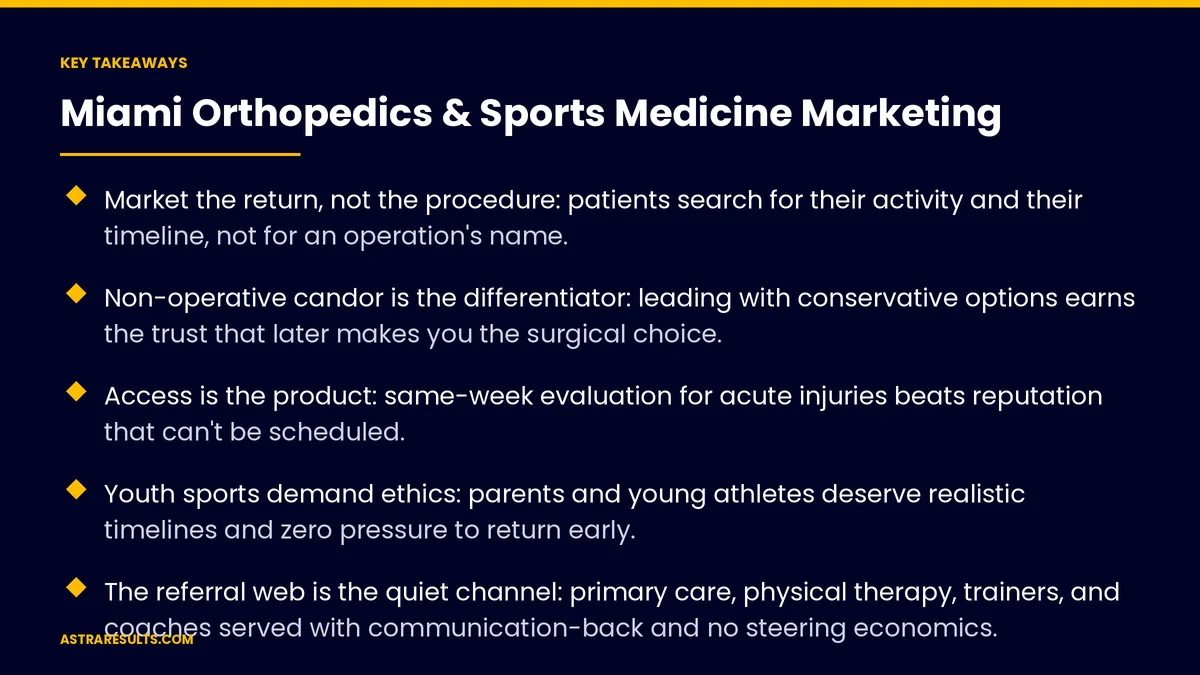
Key Takeaways
- Market the return, not the procedure: patients search for their activity and their timeline, not for an operation's name.
- Non-operative candor is the differentiator: leading with conservative options earns the trust that later makes you the surgical choice.
- Access is the product: same-week evaluation for acute injuries beats reputation that can't be scheduled.
- Youth sports demand ethics: parents and young athletes deserve realistic timelines and zero pressure to return early.
- The referral web is the quiet channel: primary care, physical therapy, trainers, and coaches served with communication-back and no steering economics.
- Measure the return: time-to-evaluation, non-operative share, return-to-activity outcomes, and referral-source truth.
Published: October 22, 2026 | Reading Time: ~11 minutes | Category: Medical · Orthopedics
This playbook builds on that reframe, and the kicker states it: back to what you do.
Two disciplines follow immediately, and both run against category habit.
Non-operative candor as the differentiator. Most orthopedic conditions are managed without surgery. The practice that leads with conservative options (physical therapy, injections where appropriate, activity modification, time) earns the trust that eventually makes it the surgical choice too, exactly as the conservative-ladder economics work in every vertical Astra has mapped.
Access as the actual product. Acute injuries and sudden pain are urgent experiences. A practice that can be seen this week beats a more famous one that can't, per the availability-is-trust standard. Marketing guidance for licensed practices only. Nothing here is medical advice. Diagnosis, imaging decisions, treatment selection, return-to-activity clearance, and every clinical statement belong to your physicians.
Compliance review precedes publication of every asset.
In This Playbook
- The Return-to-Activity Register
- Non-Operative Honesty
- Access Is the Product
- Youth Sports, With Ethics
- The Referral Web
- The Workforce and Commuter Layer
- Which marketing channels work for Miami orthopedic practices?
- Measurement
- A 90-Day Build
The Return-to-Activity Register
The reframe that reorganizes every asset.
What patients search. Not "arthroscopic meniscectomy" but "knee pain when running," "how long before I can play tennis," "shoulder pain lifting overhead," "can I still work with a torn rotator cuff". The concern-and-question architecture built for how people describe their own lives.
The content that converts. Activity-anchored education organized by what the patient wants back (running, lifting, swimming, golf, tennis, pickleball, dancing, carrying a toddler, standing an eight-hour shift) each explaining what the common causes are, what evaluation involves, what non-operative management typically looks like.
How return timelines generally work, with every specific belonging to the physician and every timeline hedged as individual.
The tone. Capable and calm, never catastrophizing. The calm standard applied to a vertical where fear of surgery and fear of permanent limitation both live, and where scare-framing an injury to drive a call fails the same no-fear absolute Astra holds everywhere.
Non-Operative Honesty
The differentiator hiding in plain sight.
The reality. A large share of orthopedic and sports-medicine conditions are managed without an operation. Patients arriving at a surgeon's office frequently expect to be talked into one.
The move. Publish the conservative pathway prominently: what physical therapy accomplishes, where injections fit and where they don't, what activity modification and load management mean practically. How long a reasonable trial of non-operative care generally runs before decisions change.
Why it converts. It addresses the unspoken fear directly ("will this practice recommend surgery because that's what it does?"), and it produces the advise-against effect Astra keeps documenting. The practice known for saying "you don't need an operation" becomes the practice people trust when it says they do.
The measurement. The non-operative share of new patient encounters tracked and understood, per the down-scope logic, not as a target to hit, but as a signal that referral sources and content are attracting appropriately matched patients.
Access Is the Product
The operational layer that decides this market.
The acute-injury clock. A rolled ankle, a shoulder that gave out, a knee that swelled overnight. These are same-week experiences, and the practice that publishes and keeps an evaluation-access promise wins patients from more prestigious competitors who can offer an appointment in five weeks.
The engineering. Reserved acute slots, a triage path that answers today, imaging coordination explained so patients understand the sequence. The never-voicemail standard with the two-rails booking rule so scheduling doesn't require a phone call.
The insurance-and-cost layer. Orthopedic care runs through insurance for most patients, and the navigation content Astra keeps finding to be the most valued service material applies here (what a visit involves, how referrals and authorizations generally work, what questions to ask a plan) published as service, in every language the practice serves.
Youth Sports, With Ethics
The lane that demands the most care.
The market. This region's youth-sports culture is year-round and intense (travel teams, showcase tournaments, specialization at young ages). It generates a continuous stream of overuse injuries, growth-related conditions, and anxious parents.
The absolutes. Candid return-to-play timelines with no implication that a practice can accelerate them, zero content that pressures a young athlete toward early return, no marketing that positions the practice as the one that "clears" athletes faster, and the minors-in-imagery rules held absolutely.
The service content parents need. What overuse injuries are and why they happen, the risks of year-round single-sport specialization at general educational level, when pain warrants evaluation versus rest, and how to have the conversation with a coach, the protective education that serves families and earns the practice its reputation among them.
The coach-and-trainer relationship. Served with education and communication-back, never with arrangements that make a practice the default referral for reasons other than care.
The Referral Web
The quiet channel that carries this vertical.
The sources. Primary care physicians, urgent-care centers, emergency departments, physical therapists, athletic trainers, chiropractors where appropriate, and the region's concierge practices, each a relationship rather than a lead source. The discipline per the referral-courtesy standard.
Findings and plans returned promptly, the referring clinician informed, patients returned for their ongoing care, and zero steering economics in any direction, a rule that matters especially where a practice owns or partners with imaging or therapy services, because the referral relationship survives only if everyone believes the clinical reasoning.
The rehab-partner integrity question. In-house or partnered physical therapy is common and legitimate. The plain practice makes clear that patients may choose their therapy provider, states any ownership relationship plainly, and never conditions care on using it. The forwardable asset per the forwardable economics.
The activity-specific recovery guide a primary-care physician or trainer hands to a patient puts the practice's name in the room before the referral question is asked.
The Workforce and Commuter Layer
South Florida's occupational reality.
Work-related orthopedic conditions. Hospitality, construction, warehouse, and service work generate the region's repetitive-strain and lifting-injury burden, served with content that respects the worker per the dignity register Astra holds for the trades, and with the note that workers' compensation matters run their own pathway, which the practice explains at general level rather than pretending doesn't exist.
The desk-and-tower cohort. The Brickell professional with neck and back complaints wants an evaluation that fits a workday, the same lunch-hour logic that governs every tower-adjacent practice in Astra.
The active-retiree cohort. This region's large population of active older adults wants joint-preservation and return-to-golf-and-tennis content, addressed with respect rather than decline framing.
Which marketing channels work for Miami orthopedic practices?
Search carries the activity library: the concern-and-question pages under named-physician authorship, the non-operative pathway published prominently, and the access promise stated plainly.
Earning the AI answers this market asks ("how long to recover from a meniscus tear," "do I need surgery for a rotator cuff tear," "¿cuánto tiempo para volver a correr?") through the entity work our AI SEO service builds. Physician video works unusually well here.
A surgeon explaining what a diagnosis does and doesn't mean is the format this vertical was made for. The profile carries access reality and languages properly. Reviews run never-gated and matter enormously in a vertical where patients research surgeons carefully.
Paid runs narrow behind the negatives fortress: supplement and brace shopping routed to education, exercise-program and DIY-rehab content excluded, workers'-comp-attorney intent routed correctly, jobs and CME traffic out. Spanish runs native per the chain rule, rehabilitation instructions in particular are a comprehension-dependent clinical document, with Portuguese and Kreyòl on the staff-it rule.
Community presence runs the sports-league and team circuit under the participation rules, education and coverage offered as a neighbor, never as a referral arrangement.
Measurement
The dashboard, per the case-level standard:
- Time-to-evaluation for acute presentations, audited against the published access promise as the flagship operational metric
- The non-operative share of new encounters as the honesty-and-matching signal
- Referral-source truth logged at intake by relationship, with the web ledger read as the practice's real balance sheet
- The activity-library entrances and their consult conversion by concern
- The youth-sports lane's volume with the tone audit beside it
- Return-to-activity outcomes where the practice tracks them clinically, used carefully and never as marketing claims about people
- Conversion from evaluation to treatment plan started per the four-stage funnel
- The language split throughout
- Cost per new patient by source on the ledger standard
A 90-Day Build
Days 1–30: Access and framing
The acute-evaluation promise engineered and published (reserved slots, triage path, imaging sequence explained). The activity-anchored content map built with physician sign-off; the non-operative pathway drafted for prominent placement; the youth-sports tone and its absolutes written. Measurement instrumented for time-to-evaluation, non-operative share, and referral truth.
Days 31–60: The library live
The activity and concern pages published under physician authorship in English and native Spanish. The non-operative pathway live; insurance-navigation content published as service; physician video begun on the highest-anxiety diagnoses; booking-first shipped beside a staffed phone rail; paid live behind the fortress.
Days 61–90: Web and reads
- The referral web engaged with communication-back running and rehab-partner disclosure clear
- The forwardable recovery guides distributed to primary care and trainers
- Team and league presence begun under participation rules
- AI-answer accuracy checked on the timeline questions in both languages
- First clear reads — time-to-evaluation, non-operative share, referral ledger, activity-page conversion — and next quarter set on the return-to-activity ledger this vertical keeps
How Astra Builds Orthopedic Practices
Astra Results Marketing builds orthopedics and sports medicine on the patient's actual goal. The return-to-activity tone instead of procedure marketing, non-operative candor published as the differentiator it is, access engineered and promised, youth sports served with ethics, and the referral web cultivated with communication-back and zero steering economics, measured on time-to-evaluation, non-operative share, and the referral ledger.
Engagements begin with an access, content, and referral audit through our business consulting team.
Related reading
Frequently asked questions
Why organize content by activity instead of by procedure or body part?
Because that's how patients search and think. They want to run, lift, serve, or carry a grandchild again, and they describe symptoms in those terms rather than in clinical ones. Activity-anchored pages match real queries, earn the AI answers those queries now generate, and frame the practice as the one that understood the goal, while procedure-named pages compete for a small pool of already-decided searchers.
Doesn't leading with non-operative options cost surgical volume?
It usually builds it. Patients arrive fearing they'll be talked into an operation. The practice that publishes the conservative pathway plainly resolves that fear and becomes the trusted opinion, including when surgery is indicated. Track the non-operative share as a matching signal rather than a target. The effect Astra documents across verticals is that the practice known for saying "not yet" is believed when it says "now."
How fast does our access promise need to be?
Fast enough to be the reason someone chooses you. Acute injuries are same-week experiences, and a published, kept evaluation window beats a more famous practice booking five weeks out. Engineer reserved acute slots and a triage path that answers today, publish the promise only if it's staffed, and audit time-to-evaluation as your flagship operational metric, because in this vertical, access is the product.
What are the hard rules for youth-sports marketing?
Candid timelines, no acceleration implications, and never a syllable of pressure toward early return, plus no positioning as the practice that clears athletes faster, and the standing imagery rules for minors held absolutely. Serve parents with protective education (overuse injuries, specialization risks at general level, when pain warrants evaluation), and build coach and trainer relationships on education rather than referral arrangements.
How should we handle in-house physical therapy in our marketing?
With disclosure and choice stated plainly. Say that patients may choose their therapy provider, disclose any ownership or partnership relationship, and never condition care on using it. In-house rehab is legitimate and often better-coordinated; what damages a referral web is the appearance that clinical reasoning follows ownership. The relationships that carry this vertical survive only on the belief that they don't.
Does Spanish-language content matter as much in orthopedics?
Arguably more: rehabilitation depends on instruction comprehension. A home-exercise program a patient can't fully read is a treatment plan that won't be followed. Run the full chain natively (content, scheduling, the visit, and the instructions that go home) and add Portuguese and Kreyòl where the chain is staffed. In this vertical, language capability is directly connected to outcomes rather than merely to acquisition.
Ready to Market the Return Instead of the Procedure? Astra Results Marketing builds orthopedic and sports medicine practices on the return-to-activity tone, non-operative candor, engineered access, and a referral web run with integrity. Measured on time-to-evaluation and the non-operative share. Start with an access, content, and referral audit for your practice. ▸ CALL (786) 321-2866 · ▸ REQUEST YOUR CONSULTATION