Rated 5 star on

The Astra Method: Strategy, Execution, Measurement
Quick answer
One team owns strategy, execution and measurement, and answers for revenue rather than for a channel metric. Every engagement starts by reverse-engineering the revenue model to find the binding constraint, then sequences fast wins ahead of slow compounding work so the plan survives its first slow month. Nobody gets to hide behind a ranking.
Most agencies sell a channel. You buy SEO, or ads, or social, and the agency's job is to make that channel's numbers go up. Whether revenue goes up is your problem. The structure guarantees that nobody is accountable for the only outcome that matters.
Key Takeaways
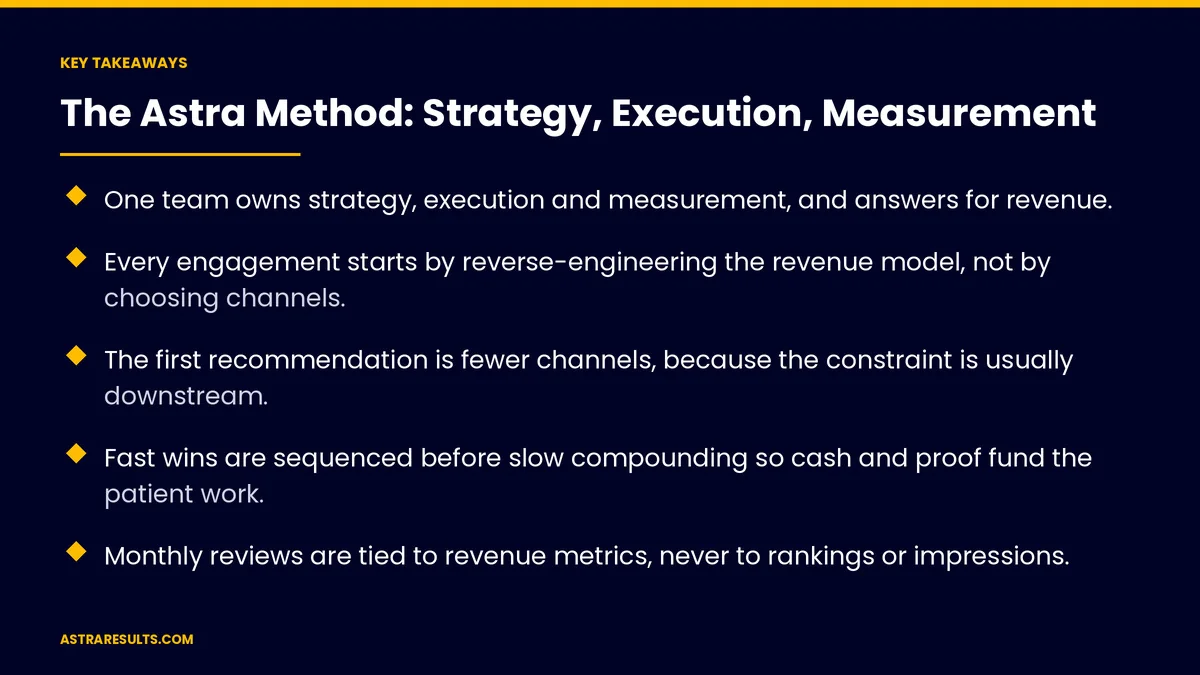
- One team owns strategy, execution and measurement, and answers for revenue.
- Every engagement starts by reverse-engineering the revenue model, not by choosing channels.
- The first recommendation is fewer channels, because the constraint is usually downstream.
- Fast wins are sequenced before slow compounding so cash and proof fund the patient work.
- Monthly reviews are tied to revenue metrics, never to rankings or impressions.
- The client's accounts, content and data are theirs from day one.
Published: September 26, 2026 | Reading Time: ~12 minutes | Category: Strategy
Astra was built on a different premise: one team owns strategy, execution and measurement, and the number that team answers for is revenue. This piece explains how that works in practice, step by step, from the first diagnostic to the monthly review. If you remember one thing: nobody should be able to hide behind a ranking.
Guidance describing Astra's operating method. Nothing here is financial, legal or tax advice. Results depend on the business, its market and its execution; nothing below is a promise of specific outcomes.
In This Playbook
- Why one accountable team
- Step one: reverse-engineer the revenue model
- Step two: find the binding constraint
- Step three: sequence fast wins before slow compounding
- Step four: execute under one roof
- Step five: measure against revenue
- What stays yours
- Pricing, transparently
- Who the method is for
- A 90-day engagement
Why one accountable team
Split accountability is the industry default. An SEO vendor, a PPC vendor, a social vendor, a web developer. Each reports its own numbers. Each is doing well by its own report. Revenue is flat, and every meeting is about whose fault that is not.
- The structural problem. When five vendors each own a channel, nobody owns the seams between channels, and the seams are where the money leaks, laid out in the four-stage engine.
- The alternative. One team, one definition of a lead, one report, one person who has to explain the revenue number. That person cannot blame the intake process, because they own the intake process.
- What it costs. Breadth. A single accountable team has to be competent across strategy, paid media, organic, conversion, AI systems and analytics. That is harder to build than a specialist shop. It is also the only structure where accountability is real.
Step one: reverse-engineer the revenue model
The engagement does not start with "which channels do you want." It starts with arithmetic.
- What a customer is worth. First-year value, lifetime value, margin. Not what the owner hopes. What the books say.
- How many the business closes. Leads in, quotes out, customers won, by source and by month, for as far back as the data goes.
- Where the pipeline leaks. The conversion rate at each seam: contact, appointment, quote, close, repeat. The worst seam is the constraint.
- What the target requires. If the goal is a revenue number, the model says how many customers that takes, how many leads that takes at current conversion, and what it would take instead if conversion improved.
- The output. A one-page model that every later decision refers back to. When a channel is proposed, the question is what it does to this model.
Step two: find the binding constraint
The model almost always points somewhere unexpected.
- The common finding. Demand is adequate and conversion is broken. Leads arrive and wait hours for a response. After-hours contacts hit voicemail. Quotes get one follow-up. Half the pipeline evaporates before anyone sells anything.
- The uncomfortable recommendation. Hold or trim demand spend and fix intake first. Owners who came in expecting a bigger ad budget sometimes leave the first meeting with a smaller one and a plan to answer the phone in five minutes.
- Why this is the right order. Every dollar of demand poured into a leaking conversion stage is partly wasted. Fixing the leak makes every subsequent demand dollar work harder, which is the subject of the intake standard.
- When the constraint is demand. It happens. A business with excellent conversion and no leads has a demand problem, and the method says so. The point is diagnosis before prescription, not a fixed answer.
Step three: sequence fast wins before slow compounding
The plan has two speeds.
- Weeks. Intake answered around the clock. Follow-up cadence installed. Negative keywords added. Landing pages fixed. Review requests automated. These change what happens to demand that already exists, and they produce cash within a month or two.
- Months. SEO and AI search visibility. Content that gets cited. Brand awareness through video and connected TV. Referral systems. These build assets that compound and take patience.
- The sequence. Fast first. The cash funds the slow work. The proof earns the patience.
- The discipline. Resisting the slow, interesting work until the fast, boring work has paid for it.
Step four: execute under one roof
Strategy without execution is a deck. Execution without strategy is a channel collector.
- What Astra executes directly. Paid search and social, connected TV, SEO and AI SEO, content and video, web design and development, AI intake and outbound systems, automation and custom AI, analytics. The team that diagnosed the problem builds the fix.
- Why that matters. The handoff from strategist to executor is where most agency plans die. When the same team does both, the plan survives contact with reality.
- The partner badges, in proportion. Google Premier Partner, Microsoft Advertising Partner, Meta Business Partner, Shopify Partner, CallRail Agency Partner. These mean early access, support and training. They do not mean the platforms favor Astra's clients in auctions. Anyone who tells you otherwise is selling.
- The bilingual layer. Spanish is a channel, not a translation task. Campaigns, intake and content are built for Spanish-speaking customers by native speakers, because a translated English campaign performs like a translated English campaign.
Step five: measure against revenue
The monthly review has one question: did revenue move, and what did it?
- What the report shows. Cost per closed customer by source. Conversion rate at each seam versus last month. Speed to lead by hour of day. Twelve-month customer value by cohort. The binding constraint, named, and whether it moved, the case for which sits in the attribution standard.
- What the report does not lead with. Rankings, impressions, followers, traffic. They appear in an appendix because they are inputs, not outcomes.
- The review conversation. Twenty minutes on what moved revenue, ten on what did not and why, and a decision about next month's constraint. Not a forty-page deck.
- The test. If the owner leaves the review knowing what to fix next, the measurement is working.
What stays yours
- Accounts. Ad accounts, analytics, tracking, business profiles: created in the client's name, with Astra as a manager. If the relationship ends, access is revoked, not transferred.
- Content. Every article, video, image and landing page belongs to the client on delivery.
- Data. Call recordings, lead records, customer data, reports. The client's.
- Why this is stated up front. Because the industry norm is the opposite, and owners have been burned by agencies that held accounts hostage. Ownership is a term of the engagement, not a favor.
Pricing, transparently
- Monthly retainers cover strategy, execution and measurement as one fee, with scope defined in writing.
- Media spend is separate, paid directly to the platforms from the client's account. Astra does not mark it up.
- Project work — a website, an app, a custom AI system — is scoped and priced on its own.
- The strategy session is a paid, one-time diagnostic that produces the revenue model and the constraint. It is not a sales call dressed as consulting.
- What transparency means in practice. The client can see every dollar of media spend in their own account, every hour of project work in the scope, and every metric in a report they could reproduce.
Who the method is for
- The owner-operator crossing $1M who has outgrown doing marketing personally and does not want to hire a department.
- The $1M–$10M company with disconnected vendors, flat revenue, and no idea which of them is working.
- The multi-location or multi-line business that needs central measurement and a clear split between what the center and the locations own, according to the centralization question.
- The company preparing to raise or sell that needs marketing to show up as a system on the balance sheet, not as an expense.
- Who it is not for. The business that wants a vendor to run one channel and report its numbers. That is a legitimate need. It is not what Astra does.
A 90-day engagement
Days 1–30
The revenue model built from real data. Speed to lead measured for the first time. Definitions written and shared. The binding constraint named. Accounts audited and moved into the client's name where they are not already.
Days 31–60
The constraint fixed, intake and follow-up. Fast wins live. Demand spend frozen while conversion is repaired. The first monthly review against revenue.
Days 61–90
Slow-compounding work started with the cash and proof from the fast work. The next constraint identified. The plan for months four through twelve set against the model.
How Astra runs this
Astra Results Marketing operates from Miami as a single accountable team for strategy, execution and measurement. Every engagement begins with the revenue model and the binding constraint, sequences fast wins before slow compounding, executes under one roof in English and Spanish, and reviews monthly against revenue rather than rankings.
The client's accounts, content and data are theirs from day one. Pricing is transparent, with media spend paid directly to platforms and never marked up. Engagements begin with a paid strategy session through our business consulting team.
Related reading
Frequently asked questions
What is different about the Astra method?
One team owns strategy, execution and measurement and answers for revenue, instead of five vendors each reporting a channel's numbers while nobody owns the seams between them. Every engagement starts by reverse-engineering the revenue model — what a customer is worth, how many the business closes, where the pipeline leaks — and only then choosing what to build.
Why is the first recommendation often fewer channels?
Because the model usually finds that demand is adequate and conversion is broken: leads wait hours for a response, after-hours contacts hit voicemail, quotes get one follow-up. Every dollar of demand poured into that leak is partly wasted. Fixing intake first makes every later demand dollar work harder, so owners sometimes leave the first meeting with a smaller ad budget and a plan to answer in five minutes.
What do the partner badges actually mean?
Early access to features, dedicated support, and training from Google, Microsoft, Meta, Shopify and CallRail. They do not mean those platforms favor Astra's clients in ad auctions or rankings. They are a signal of competence and access, not of preferential treatment, and anyone claiming otherwise is selling.
What does the monthly review cover?
Cost per closed customer by source, conversion rate at each seam versus last month, speed to lead by hour of day, twelve-month customer value by cohort, and whether the binding constraint moved. Rankings, impressions, followers and traffic appear in an appendix as inputs, not outcomes. The test is whether the owner leaves knowing what to fix next.
Who owns the accounts, content and data?
The client, from day one. Ad accounts, analytics and business profiles are created in the client's name with Astra as a manager, so ending the relationship revokes access rather than requiring a transfer. Every article, video and landing page belongs to the client on delivery, as do call recordings, lead records and reports.
How is pricing structured?
A monthly retainer covers strategy, execution and measurement as one fee with written scope. Media spend is separate, paid directly to the platforms from the client's own account, and never marked up. Project work such as a website, an app or a custom AI system is scoped and priced on its own. The engagement starts with a paid strategy session that produces the revenue model and names the constraint.
READY TO HAVE ONE TEAM ANSWER FOR REVENUE? Astra Results Marketing reverse-engineers the revenue model, fixes the binding constraint, executes under one roof, and reviews monthly against revenue, with your accounts, content and data staying yours. Astra Results Marketing · 1101 Brickell Ave, Miami, FL 33131 · +1 (786) 321-2866 · [email protected] Find us on Google · Yelp ▸ CALL (786) 321-2866 · ▸ REQUEST YOUR CONSULTATION