 Rated 5 star on

Community Management as a Sales Function
Quick answer
Treat social comments and messages as sales leads, because many carry buying signals like price, availability and location. Set response-time targets. Route leads to sales or intake and log them in your CRM. Write reply guidelines for prices and tone. Acknowledge complaints publicly, resolve them privately and measure sales, not just engagement.
Many businesses treat comments and messages on social media as housekeeping: reply when there's time, delete spam, move on. But a comment asking "How much?" or a message asking "Do you deliver to Kendall?" is a customer ready to buy. When those wait for hours, the sale goes to whoever replies first.
Key Takeaways
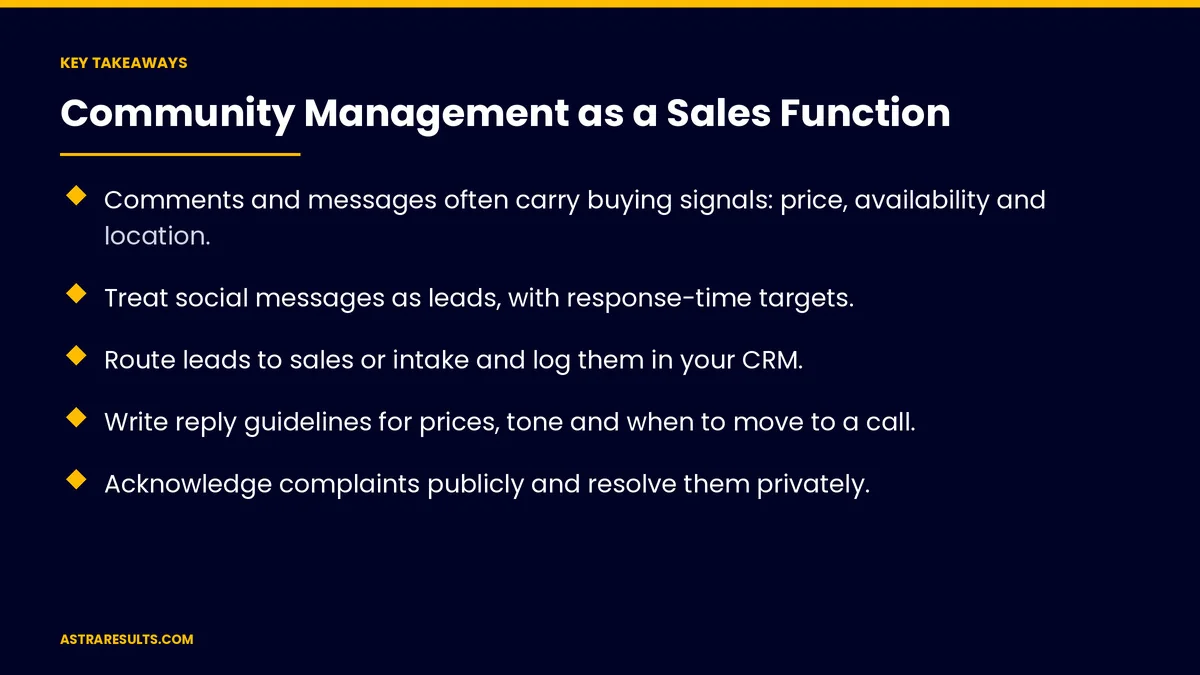
- Comments and messages often carry buying signals: price, availability and location.
- Treat social messages as leads, with response-time targets.
- Route leads to sales or intake and log them in your CRM.
- Write reply guidelines for prices, tone and when to move to a call.
- Acknowledge complaints publicly and resolve them privately.
- Measure conversations, leads and sales, not just engagement.
Published: October 8, 2026 | Reading Time: ~8 minutes | Category: Social Media Marketing
This guide covers community management as a sales function: buying signals in comments, messages as leads, routing and response times, reply guidelines, handling complaints, Spanish replies, after-hours coverage, moderation, customer content and what to measure. Put plainly: answer every buying question fast, route every lead and count the sales social brings in.
In This Playbook
- What buying signals show up in social comments?
- Messages as leads
- Routing
- Reply guidelines
- Handling complaints
- Spanish replies
- How can businesses cover social messages after hours?
- Moderation
- Customer content
- What to measure
- The first three months
What buying signals show up in social comments?
Price questions. "How much?" and "Do you have payment plans?"
Availability. "Open Saturday?" or "In stock?"
Location. "Do you serve Kendall?"
Comments on ads. Often the warmest leads of all.
Messages as leads
Every message counts. Direct messages are leads, as covered in the intake gap.
Response-time targets. Minutes during business hours, as covered in speed to lead.
Logged in the CRM. With the platform and post as the source.
Routing
Sales questions. To sales or intake.
Service questions. To support.
Local questions. To the right location, as in franchise social.
Urgent issues. To a manager right away.
Reply guidelines
Tone. Friendly, short and on brand.
Prices. Give ranges or invite a message, following your pricing policy.
Move to a call or message. When details or personal information are involved.
Accurate claims only. As covered in creative compliance.
Handling complaints
Acknowledge publicly. Quickly and politely.
Resolve privately. By message or phone.
Follow up. Close the loop when it's fixed.
Learn from patterns. As in restaurant review analysis.
Spanish replies
Reply in the language used. Written by fluent staff.
Route to Spanish-speaking sales. When the conversation moves to a call.
How can businesses cover social messages after hours?
AI drafts, people approve. Or clear auto-replies with next steps.
Instant answers to common questions. Hours, locations and booking links, as in AI inbound intake.
Morning follow-up. Every after-hours lead contacted first thing.
Moderation
Clear rules. Spam, harassment and off-topic posts.
Consistent action. Hide, delete or respond by the rules.
Don't delete fair criticism. Respond instead.
Customer content
Photos and stories. Shared with permission.
Real reviews only. No fake or paid-for praise.
Industry examples are in auto dealer social.
What to measure
Response time. Comments and messages.
Conversations to leads. Share that become leads.
Leads to sales. Revenue from social conversations.
Complaints resolved. And time to resolve.
Engagement quality. As covered in social media KPIs.
The first three months
Days 1–30: set targets and rules
Set response-time targets, write reply guidelines and moderation rules and decide where each type of message goes.
Days 31–60: route and log
Route messages to sales, support and locations, log social leads in the CRM and add Spanish and after-hours coverage.
Days 61–90: measure sales
Track response time, conversations to leads and leads to sales, and refine guidelines based on what converts.
How Astra runs community management
Astra Results Marketing runs community management as a sales function. We spot buying signals, route messages as leads, write reply guidelines, cover Spanish and after-hours conversations and measure the sales social brings in.
Engagements begin with a social review through our social media marketing team.
Related reading
Frequently asked questions
Is community management really about sales?
Often, yes. Comments and messages asking about price, availability or location come from people ready to buy.
How fast should we reply to social messages?
Within minutes during business hours, and first thing the next morning for after-hours messages.
Where should social leads go?
To sales or intake, logged in your CRM with the platform and post as the source.
How should we answer price questions publicly?
Follow your pricing policy: give ranges where you can, or invite a message for a quote.
How do we handle complaints?
Acknowledge publicly and politely, resolve privately, then follow up when it's fixed.
What should we measure?
Response time, conversations that become leads, leads that become sales and complaints resolved.
Ready to turn comments and messages into sales? Astra Results Marketing runs community management that spots buying signals, routes every lead fast and measures the sales your social channels bring in. ▸ CALL (786) 321-2866 · ▸ REQUEST YOUR CONSULTATION





