 Rated 5 star on

Restaurant NLP: Reading Every Review at Once
Quick answer
Language AI lets a restaurant group read every review, not just the angriest few. Collect reviews using each platform's allowed methods. Sort and score them by topic, since one review can praise the food and fault the service. Flag possible food safety complaints the same day. Managers approve drafted replies and act on patterns.
A busy restaurant group gets reviews every day on Google, Yelp, delivery apps, surveys and social media. Managers read a few, react to the angriest and miss patterns, like the dish that keeps disappointing. Language AI can read every review, sort it by topic and location and flag what needs attention today.
Key Takeaways
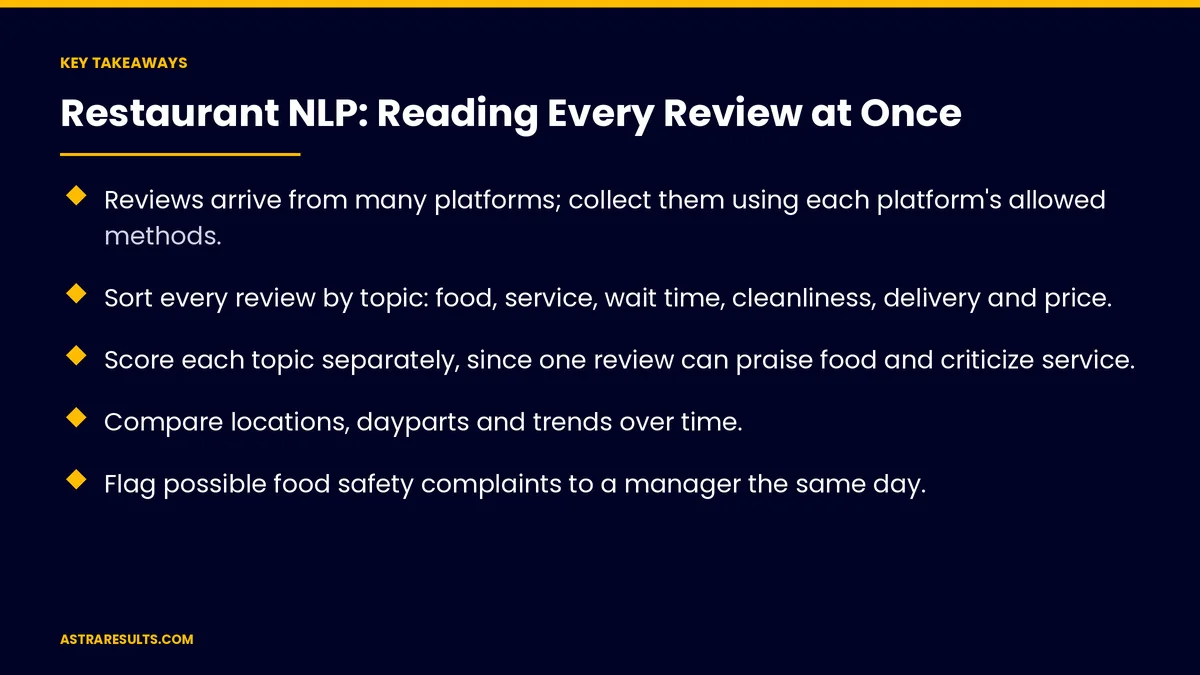
- Reviews arrive from many platforms; collect them using each platform's allowed methods.
- Sort every review by topic: food, service, wait time, cleanliness, delivery and price.
- Score each topic separately, since one review can praise food and criticize service.
- Compare locations, dayparts and trends over time.
- Flag possible food safety complaints to a manager the same day.
- Draft replies for managers to approve, and turn patterns into operational changes.
Published: October 23, 2026 | Reading Time: ~8 minutes | Category: Natural Language Processing
This guide covers restaurant review analysis: collecting reviews properly, sorting by topic, scoring each topic, comparing locations and times, urgent alerts, Spanish reviews, reply drafts, turning insights into action and what to measure. Put plainly: read every review automatically, act on patterns and never miss an urgent one.
In This Playbook
- Collect reviews properly
- Sort by topic
- Why should each review topic get its own score?
- Compare locations and times
- Which restaurant reviews need a same-day alert?
- Spanish reviews
- Reply drafts
- Turn insights into action
- Reviews and visibility
- What to measure
- The first three months
Collect reviews properly
Every source. Google, Yelp, delivery apps, surveys and social media.
Allowed methods. Official exports and connections permitted by each platform's terms.
One place. All reviews together, tagged by location and date.
Sort by topic
Food. Taste, temperature, portions and specific dishes.
Service. Friendliness, speed and accuracy.
Wait times. Seating, kitchen and pickup.
Cleanliness. Dining room and restrooms.
Delivery. Packaging, timing and missing items.
Price and value. Worth the money or not.
Why should each review topic get its own score?
Mixed reviews are common. "Great food, slow service" means two scores.
Topic scores over time. Not just star averages.
Rules or AI. Simple keywords catch some topics; language AI handles the rest, as weighed in rules vs NLP classification.
Compare locations and times
By location. Which restaurants lead or lag on each topic.
By daypart. Lunch versus dinner, weekday versus weekend, with waits measured directly as in restaurant vision.
By dish. Items that keep earning complaints or praise.
Connect to operations data. As in restaurant group AI.
Which restaurant reviews need a same-day alert?
Possible food safety issues. Mentions of illness go to a manager the same day.
Serious service complaints. Rude staff or safety concerns flagged fast.
Viral risk. Reviews gaining attention on social media.
Spanish reviews
Read in Spanish. Not just translated for scores.
Reply in the reviewer's language. Written or reviewed by fluent staff.
Reply drafts
Drafted by AI, approved by managers. Accurate and on brand.
No invented details. Replies stick to what happened, as covered in hallucinations.
Reply to the good and the bad. Thank, fix and invite back.
Turn insights into action
Menu changes. Fix or drop dishes that keep disappointing.
Staffing. Add help where waits run long.
Training. Target topics where a location lags.
Products to sell. Dishes diners love can become retail items, as in restaurant retail.
Weekly summaries for managers. As in meeting notes to action items.
Reviews and visibility
Reviews affect search. As covered in restaurant group SEO.
And AI answers. When people ask where to eat, as in restaurant ChatGPT ads.
What to measure
Topic scores by location. Over time.
Urgent alerts handled. And response time.
Reply rate. Share of reviews answered.
Changes made. Menu, staffing or training actions from insights.
Rating trend. After changes.
The first three months
Days 1–30: collect and sort
Connect review sources using allowed methods, gather past reviews and sort them by topic and location.
Days 31–60: alerts and replies
Set urgent alerts for food safety and serious complaints, and start manager-approved reply drafts in English and Spanish.
Days 61–90: act and measure
Share weekly summaries, make menu, staffing or training changes and track topic scores and rating trends.
How Astra reads restaurant reviews
Astra Results Marketing builds review analysis for restaurant groups. We collect reviews from every platform the right way, sort and score them by topic and location, flag urgent issues, draft replies for approval and turn patterns into action.
Engagements begin with a review analysis setup through our natural language processing team.
Related reading
Frequently asked questions
What can language AI do with restaurant reviews?
Read every review, sort it by topic and location, score each topic, flag urgent issues and draft replies for managers.
How do we collect reviews from different platforms?
Using official exports and connections permitted by each platform's terms, then storing them in one place.
Why score topics separately?
Because one review can praise the food and criticize the service. Topic scores show what to fix.
What counts as urgent?
Possible food safety issues, serious service or safety complaints and reviews gaining attention on social media.
Should AI reply to reviews automatically?
AI can draft replies, but managers should approve them so they're accurate and on brand.
How do insights become action?
Through weekly summaries that lead to menu, staffing or training changes, then tracking the results.
Ready to read every review without reading every review? Astra Results Marketing collects and sorts your reviews by topic and location, flags urgent issues, drafts replies for approval and turns patterns into action. ▸ CALL (786) 321-2866 · ▸ REQUEST YOUR CONSULTATION





