Rated 5 star on

AI Inbound Intake: Every Lead Answered in Seconds
Quick answer
AI inbound intake answers every call, form and message within seconds, around the clock and in the customer's language. It qualifies the need, books the appointment, and hands anything requiring judgment to a person with the context attached. Most lost leads are lost to slow response rather than to a competitor's better pitch, and seconds are now available.
A business spends money to make the phone ring, and then it rings at 6:40 PM and nobody answers. Or at 10:15 AM while the only person who answers is with a customer. Or the form arrives at midnight and gets read at nine. Each lead was real, and the customer has already called the next business.
Key Takeaways
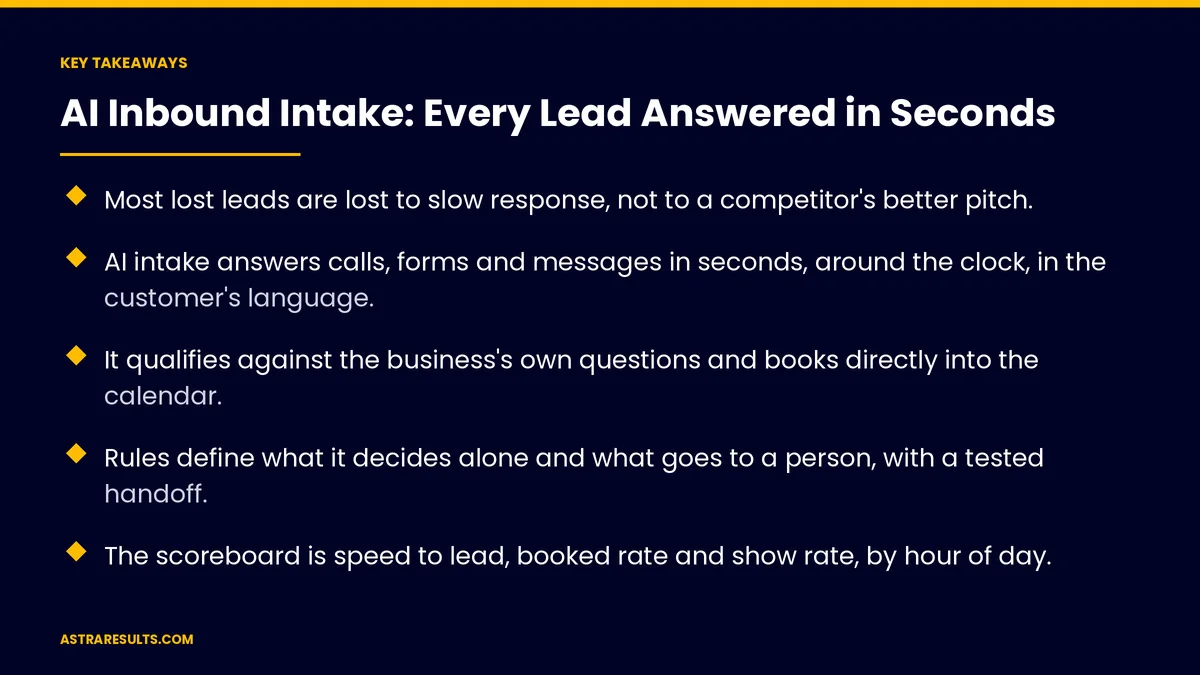
- Most lost leads are lost to slow response, not to a competitor's better pitch.
- AI intake answers calls, forms and messages in seconds, around the clock, in the customer's language.
- It qualifies against the business's own questions and books directly into the calendar.
- Rules define what it decides alone and what goes to a person, with a tested handoff.
- The scoreboard is speed to lead, booked rate and show rate, by hour of day.
- It pays back fastest for businesses already spending on demand they cannot answer.
Published: September 3, 2026 | Reading Time: ~13 minutes | Category: AI Intake
AI inbound intake closes that gap. It answers every call, form and message in seconds, in the customer's language, qualifies the need, books the appointment, and hands anything that needs a person to a person, with the context attached. This is the complete guide: how it works, what it decides alone, where it escalates, and how to measure it. Stated simply: the fastest response wins the lead, and seconds are now available.
Guidance for owners and operators. Nothing here is legal advice. Call recording, messaging consent, data retention and any sector rules on customer communications vary by jurisdiction and must be confirmed with counsel before deployment.
In This Playbook
- The problem is response time
- What AI intake does
- What it decides alone, and what it does not
- How a conversation goes
- Voice, text and the channels between
- What it costs and what it returns
- The scoreboard
- Common failures
- How the first quarter runs
- How this is done at Astra
The problem is response time
Owners assume lost leads went to a competitor with a better offer. Mostly they went to whoever answered first.
- The pattern. A lead that waits an hour for a callback is often already booked elsewhere. A lead that reaches voicemail after hours has, in many cases, called two more businesses before the morning. A form submission that gets a reply the next day is competing with three that replied in minutes.
- The measurement almost nobody has. Median minutes from inbound contact to first response, by hour of day. Businesses that measure it for the first time are usually shocked by the after-hours and lunch-hour numbers, examined in the intake standard.
- The arithmetic. A business spending $10,000 a month on demand with a 50% first-hour response rate is spending $5,000 a month on leads it does not reach in time. Doubling the ad budget doubles that number, as covered in the leaking engine.
- The fix is not more staff. A front desk cannot be in two conversations, cannot work at midnight, and cannot answer the form and the phone at once. Software can.
What AI intake does
- Answers immediately. Phone, web form, chat, SMS, WhatsApp and social messages, each in seconds, at any hour.
- Speaks the customer's language. English, Spanish, or both in the same conversation, natively rather than translated, set out in Spanish as a channel.
- Qualifies. Asks the business's own intake questions — what is the need, where, when, any details that determine fit — in a natural conversation, not a form.
- Books. Checks the real calendar and books the appointment or consultation in the moment, then confirms by text or email.
- Captures. Records source, contact details, answers and the transcript into the CRM automatically.
- Escalates. Hands to a named person anything outside its authority, with the full context so the customer never repeats themselves.
- Follows up. Sends the reminder, the reschedule offer, the review request, on the business's schedule.
What it decides alone, and what it does not
This is the design decision that determines whether the system is trusted.
- Decides alone. Answering hours, location and service questions. Booking into open slots. Collecting intake details. Sending confirmations and reminders. Rescheduling within the rules. Routing a request to the right team.
- Prepares, then a person decides. Anything involving pricing outside a stated range. Complaints. Cancellations with refund implications. Anything the customer marks as urgent or sensitive. Anything the AI is not confident it understood.
- Never. Clinical, legal or financial advice. Promises the business has not authorized. Anything a regulator would expect a licensed person to say.
- The handoff. A named human, a response-time commitment, and a message to the customer that sets the expectation. The handoff is tested before launch, not discovered during one, laid out in the rules before launch.
How a conversation goes
A plausible after-hours call to a home services company.
The customer describes a water heater that stopped working. The AI confirms the service area from the address, asks whether there is active leaking, and learns there is not. It offers the first available morning slot, books it, confirms the technician's arrival window, and sends a text with the appointment and a number to call if the situation changes.
Total time: under three minutes. The customer did not wait, did not repeat themselves, and did not call a competitor. The business woke up to a booked job with the intake already in the CRM.
Had the customer said water was actively flooding the kitchen, the rules would have escalated to the on-call technician immediately, with the address and description attached, and told the customer help was being contacted.
Voice, text and the channels between
- Phone. Still the largest channel for most service businesses. Voice AI now handles natural conversation, interruptions and accents well enough for intake, and knows when to hand off.
- Web forms. Replaced or supplemented by a conversation that qualifies in real time instead of collecting fields for someone to read later.
- Chat and SMS. The channels customers increasingly prefer for first contact, especially after hours.
- WhatsApp. The default channel for much of the Spanish-speaking market and for Latin America. Intake that does not live there misses those customers.
- Social messages. Instagram and Facebook DMs, answered with the same standard rather than left for whoever checks the account.
- One conversation across channels. The customer who texted, then called, is recognized as the same person with the same context.
What it costs and what it returns
- Costs. A monthly fee that typically compares to a fraction of a single front-desk salary. Setup: the intake questions, the rules, the calendar and CRM connections, the scripts in each language. The owner's time reviewing transcripts in the first weeks.
- Returns. Leads that were being lost to response time, now booked. After-hours demand captured. The front desk freed for the customers in front of them. Cleaner CRM data than any human enters by hand.
- Who it pays back fastest for. Businesses already spending on demand — ads, SEO, referrals — that cannot answer all of it. Fixing intake makes every existing marketing dollar work harder before a single new dollar is spent.
- Who should wait. Businesses with very low lead volume and a person who answers everything in minutes. The problem it solves has to exist.
The scoreboard
- Speed to lead by hour of day. Median time to first response. The headline metric, and the one that should collapse to seconds.
- Contact rate. Share of inbound leads that received a response at all.
- Booked rate. Share of qualified leads with an appointment on the calendar.
- Show rate. Share of booked appointments kept, which reminders should lift.
- Escalation rate and time. How often the AI handed off, and how fast the person picked up.
- Cost per booked appointment by source, which is the number that connects intake to the demand spend, according to attribution by channel.
- Transcript review findings. What the AI got wrong, weekly at first, and what changed as a result.
Common failures
- Launching without the rules. The AI improvises on a refund question and the owner finds out from an angry customer.
- No real handoff. Escalation goes to an inbox nobody watches. The customer waited on a robot and then waited on a person.
- Generic scripts. The intake questions were not the business's own, so the appointments are poorly qualified.
- Ignoring the transcripts. The system drifts, nobody notices, trust erodes.
- Treating it as a chatbot. Deployed as a website widget only, while the phone still goes to voicemail.
How the first quarter runs
Days 1–30: measure and design
Speed to lead measured for the first time, by hour. The intake questions written from the business's real qualification criteria. The decide-alone and escalate lists drafted. Calendar and CRM connections identified. Scripts written natively in each language.
Days 31–60: build and parallel-run
The system connected to phone, forms, chat and messaging. The handoff tested with real people. Two weeks running alongside the existing process, with every transcript reviewed.
Days 61–90: launch and tune
The system live on all channels. Weekly transcript review. Speed to lead, booked rate and show rate compared to the Day-1 baseline. Rules adjusted from what the transcripts show.
How this is done at Astra
Astra Results Marketing designs intake around the business's own qualification questions, writes the decide-alone and escalate rules with the owner before launch, connects the system to the real calendar and CRM, and builds scripts natively in English and Spanish. The handoff to a person is tested, not assumed.
Because the same team runs the demand channels feeding the intake, cost per booked appointment by source is measured end to end. Engagements begin with a speed-to-lead measurement through our AI inbound intake team.
Related reading
Frequently asked questions
Why are leads really lost?
Mostly to slow response, not to a competitor's better offer. A lead that waits an hour is often already booked elsewhere; an after-hours lead that hits voicemail has called two more businesses before morning. The measurement almost nobody has is median minutes to first response by hour of day, and the after-hours and lunch-hour numbers are the shock.
What does AI inbound intake actually do?
Answers phone, forms, chat, SMS, WhatsApp and social messages in seconds at any hour, in English or Spanish natively; asks the business's own qualification questions in a natural conversation; books into the real calendar and confirms; records everything into the CRM with source; escalates anything outside its authority to a named person with full context; and sends reminders and follow-ups on schedule.
What should the AI never decide alone?
Pricing outside a stated range, complaints, cancellations with refund implications, anything the customer marks urgent or sensitive, and anything it is not confident it understood — those go to a person with the context attached. It never gives clinical, legal or financial advice, never makes promises the business has not authorized, and never says anything a regulator would expect a licensed person to say.
How does the handoff to a person work?
A named human, a response-time commitment, and a message to the customer that sets the expectation. When rules trigger — an active leak, a complaint, a refund — the AI contacts that person immediately with the address, description and transcript, so the customer never repeats themselves. The handoff is tested with real people before launch, because an escalation that lands in an unwatched inbox is worse than no AI at all.
Who does it pay back fastest for?
Businesses already spending on demand they cannot answer. A company with $10,000 a month in marketing and a 50% first-hour response rate is losing $5,000 a month to slow response; fixing intake makes every existing dollar work harder before a new one is spent. Businesses with very low volume and a person who truly answers everything in minutes should wait, because the problem it solves has to exist.
What are the metrics?
Speed to lead by hour of day as the headline, which should collapse to seconds. Contact rate, booked rate and show rate. Escalation rate and how fast the person picked up. Cost per booked appointment by source, which connects intake to the demand spend. And weekly transcript review findings — what the AI got wrong and what changed as a result.
READY TO ANSWER EVERY LEAD IN SECONDS? Astra Results Marketing measures your speed to lead, designs intake around your own qualification questions, writes the rules with you, and connects the system to your calendar and CRM in English and Spanish. Astra Results Marketing · 1101 Brickell Ave, Miami, FL 33131 · +1 (786) 321-2866 · [email protected] Find us on Google · Yelp ▸ CALL (786) 321-2866 · ▸ REQUEST YOUR CONSULTATION