 Rated 5 star on

Lead Scoring That Sales Trusts
Quick answer
Sales trusts lead scores that show their reasons and prove themselves against closed deals. Score on fit, intent, timing and source using real CRM data. Build the model with sales input from the start. Begin with simple rules, and add machine learning once there's enough deal history. Review the scores regularly.
Lead scoring promises to tell sales which leads to call first. In many companies, salespeople ignore the scores within a month. The numbers seem random, nobody explains them and the "hot" leads don't close. Scoring that sales trusts shows its reasons, uses what salespeople know and proves itself against real deals.
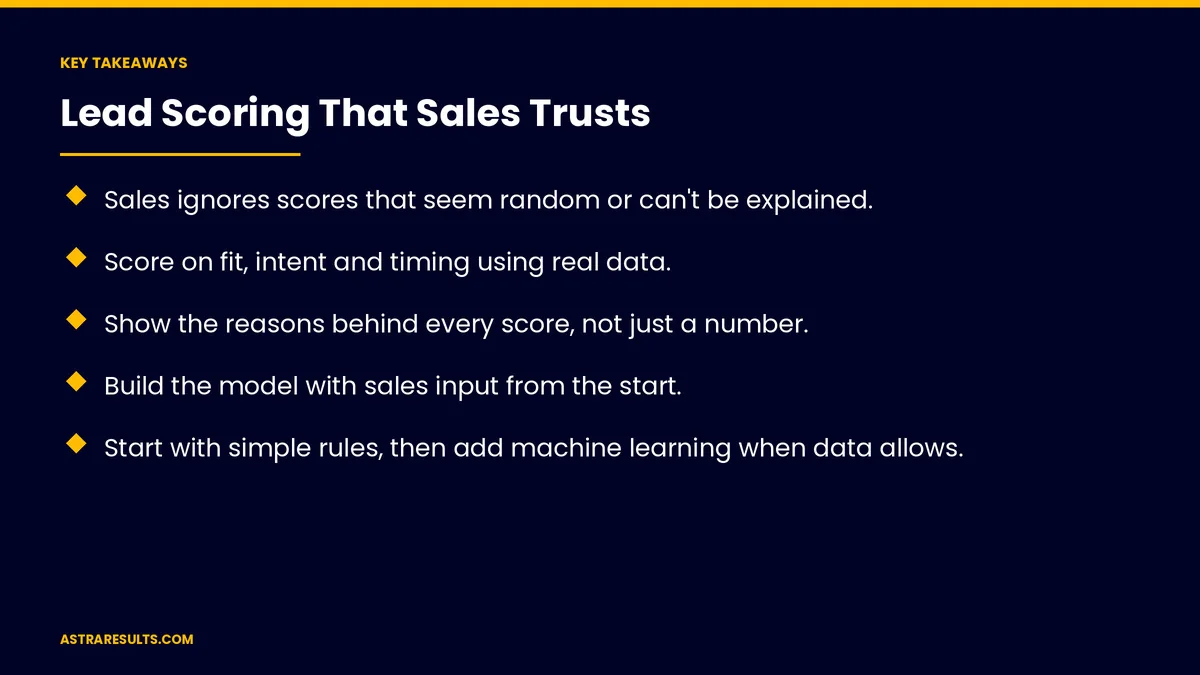
Key Takeaways
- Sales ignores scores that seem random or can't be explained.
- Score on fit, intent and timing using real data.
- Show the reasons behind every score, not just a number.
- Build the model with sales input from the start.
- Start with simple rules, then add machine learning when data allows.
- Check scores against closed deals and adjust regularly.
Published: October 8, 2026 | Reading Time: ~8 minutes | Category: Machine Learning & Analytics
This guide covers lead scoring for incoming leads: why sales ignores scores, what to score on, showing reasons, using sales input, starting simple, routing by score, feedback loops, checking against closed deals, avoiding bias and what to measure. Put plainly: show why each lead scored high, build with sales and prove the scores against closed deals.
For deciding who to contact first in outreach, see ML scoring for outbound.
In This Playbook
- What makes sales distrust a lead score?
- Which signals should a lead score be built on?
- Show the reasons
- Use sales input
- Start simple
- Route by score
- Feedback loops
- Check against closed deals
- Avoid bias
- What to measure
- The first three months
What makes sales distrust a lead score?
No reasons. A number with no explanation.
Bad early results. "Hot" leads that never close.
Built without them. Sales had no say.
Too many leads called "hot." Scores that don't separate.
Which signals should a lead score be built on?
Fit. Industry, size, location and service needed.
Intent. Pages viewed, forms filled and questions asked.
Timing. How soon they need help.
Source. Channels that historically close, as tracked in call tracking.
Show the reasons
Top reasons next to the score. "Requested a quote, in service area, needs it this month."
Plain language. No model jargon.
Visible in the CRM. Where salespeople work.
Use sales input
Ask what a good lead looks like. Their experience is data.
Review early scores together. Agree on what's right and wrong.
Name a sales champion. Someone who helps refine scoring.
Start simple
Rules first. Points for clear signals.
Machine learning later. When there's enough closed-deal history, as covered in machine learning for operators.
Reports before predictions. As weighed in ML vs business intelligence.
Route by score
High scores first. Called within minutes, as covered in speed to lead.
Middle scores nurtured. Follow-up sequences.
Low scores still answered. Nobody ignored.
Rules and owners. As in turning predictions into decisions.
Fast answering matters most, as covered in the intake gap.
Feedback loops
Sales marks outcomes. Won, lost and why.
Bad scores flagged. One click to say "this was wrong."
Monthly updates. Scoring adjusted from feedback.
Check against closed deals
Do high scores close more? Compare by score band.
Revenue by score band. Not just win rate.
Booked jobs too. As in tracking LSA leads.
Avoid bias
Score on behavior and fit. Not on protected characteristics.
Watch proxies. Data that stands in for things you shouldn't use.
Review regularly. Especially in regulated industries.
What to measure
Win rate by score band. High should beat low clearly.
Sales use of scores. Leads worked in score order.
Time to first contact. For high scores.
Feedback volume. Flags from sales.
Revenue from high-score leads. Share of total.
The first three months
Month one: agree
Interview sales on what makes a good lead, review past closed deals and agree on fit, intent and timing signals.
Month two: score and show reasons
Launch simple rule-based scores with reasons in the CRM, and route high scores for fast follow-up.
Month three: prove it
Compare win rates by score band, collect sales feedback and adjust; add machine learning when data allows.
How Astra builds lead scoring
Astra Results Marketing builds lead scoring sales teams use. We start with sales input and simple rules, show reasons beside every score, route leads by score and prove the scores against closed deals.
Engagements begin with a data review through our machine learning and advanced analytics team.
Related reading
Frequently asked questions
Why do salespeople ignore lead scores?
Because scores often come without reasons, don't match results and were built without sales input.
What should leads be scored on?
Fit, intent, timing and source, using real data from your CRM and website.
How do we make scores trustworthy?
Show the top reasons beside each score, build with sales input and prove scores against closed deals.
Should we start with machine learning?
Usually not. Start with simple rules and add machine learning once there's enough closed-deal history.
How do we avoid unfair scoring?
Score on behavior and fit, never protected characteristics, and watch for data that stands in for them.
What should we measure?
Win rate and revenue by score band, sales use of scores, time to first contact and feedback volume.
Ready for lead scores your sales team uses? Astra Results Marketing builds lead scoring with sales input, clear reasons beside every score and proof against closed deals. ▸ CALL (786) 321-2866 · ▸ REQUEST YOUR CONSULTATION





