 Rated 5 star on

ML vs Business Intelligence
Quick answer
Business intelligence describes what happened through reports, dashboards and KPIs, while machine learning predicts what is likely to happen or suggests what to do. Build reliable reports and shared definitions first. Machine learning needs enough history and a clear decision to improve. Show predictions inside existing dashboards, and retrain models as they drift.
Business intelligence and machine learning both turn data into decisions, but they answer different questions. Reports and dashboards show what happened and where. Machine learning predicts what's likely to happen next or suggests what to do. Many businesses jump to machine learning before their reports are reliable, then wonder why predictions disappoint.
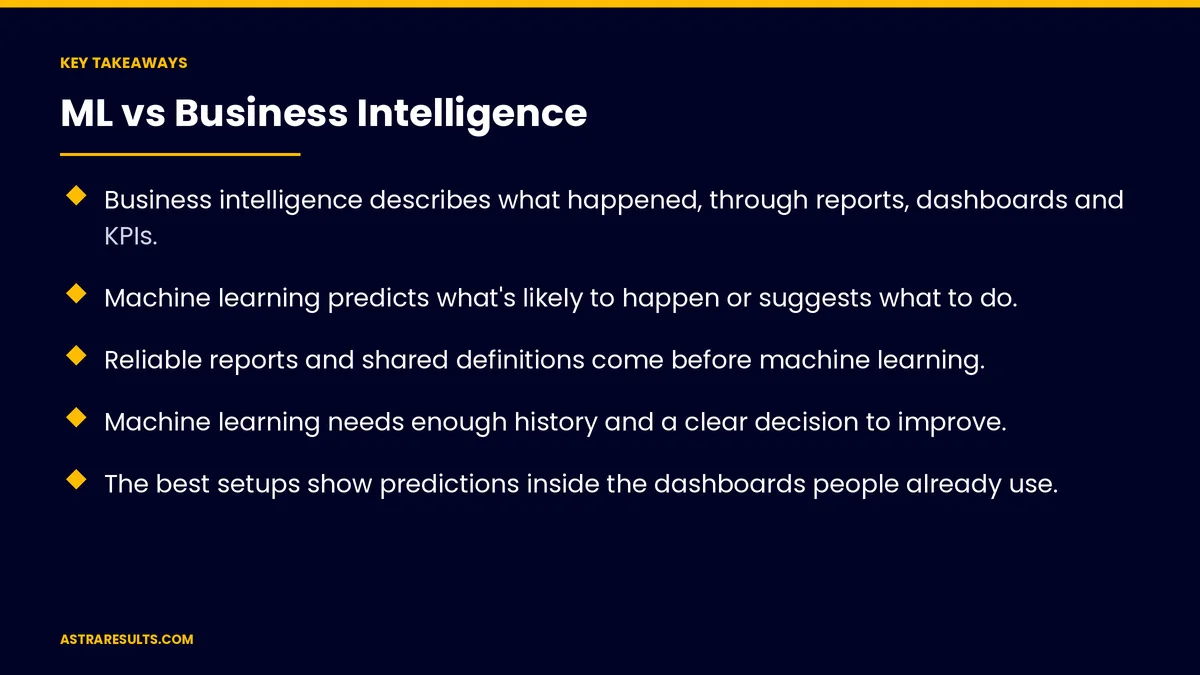
Key Takeaways
- Business intelligence describes what happened, through reports, dashboards and KPIs.
- Machine learning predicts what's likely to happen or suggests what to do.
- Reliable reports and shared definitions come before machine learning.
- Machine learning needs enough history and a clear decision to improve.
- The best setups show predictions inside the dashboards people already use.
- Models drift over time, so check and refresh them regularly.
Published: October 25, 2026 | Reading Time: ~8 minutes | Category: Machine Learning & Analytics
This guide explains machine learning and business intelligence in plain terms: what each answers, the questions that point to each, why reports come first, what machine learning needs, how they work together, when machine learning isn't needed, keeping models accurate and examples by business function. Put plainly: get reliable reports first, then predict where a better guess pays off.
In This Playbook
- What business intelligence does
- What machine learning does
- The questions that point to each
- Why reports come first
- What machine learning needs
- How they work together
- When machine learning isn't needed
- Keeping models accurate
- Examples by business function
- What to measure
- The first three months
What business intelligence does
Reports and dashboards. Sales, costs, jobs and customers, by period and place.
Shared definitions. Everyone agrees what "revenue" or "active customer" means.
Looks back. Explains what happened and where to look.
Foundations matter. As covered in data engineering.
What machine learning does
Predicts. Demand, cancellations, late payments or project overruns.
Scores. Which leads, customers or orders need attention first.
Recommends. Next products, staffing levels or reorder amounts.
Flags the unusual. Spending, orders or readings that look wrong.
Explained for operators in machine learning for operators.
The questions that point to each
Business intelligence. "How many jobs did we finish last month by region?"
Machine learning. "Which customers are likely to cancel next month?"
Business intelligence. "Which products sold best last quarter?"
Machine learning. "How much of each product should we order next week?" as in demand forecasting.
Why reports come first
Trustworthy numbers. Predictions built on messy data mislead.
Clear definitions. Models need the same definitions reports use.
Know the baseline. You can't measure improvement without it.
Track data quality. As covered in data KPIs.
What machine learning needs
Enough history. Many past examples of what you want to predict.
A clear decision. What will people do differently with the prediction?
A way to act. Predictions must reach the people or systems that act on them.
A business case. As covered in the business case for predictive analytics.
How they work together
Predictions in dashboards. Risk scores and forecasts shown next to the usual reports.
Explain the drivers. Show the main reasons behind each prediction where possible.
Track results. Did acting on predictions improve the numbers?
Example. Cross-sell views built from unified data, then ranked by a model, as in insurance agency data.
When machine learning isn't needed
A simple rule works. "Flag invoices over 60 days late."
Too little data. A handful of examples can't train a reliable model.
No decision changes. If nobody will act differently, a prediction adds nothing.
Size matters less than fit. As weighed in is custom AI right for your size.
Keeping models accurate
Models drift. Customers, prices and markets change.
Check accuracy regularly. Compare predictions with what happened.
Refresh when needed. Retrain on newer data.
Understand the parts. As covered in the ML stack explained.
Examples by business function
Sales. Reports on pipeline; models scoring which deals will close.
Operations. Reports on jobs completed; models forecasting next week's workload.
Finance. Reports on cash; models predicting late payments.
Customer service. Reports on ticket volume; models flagging customers at risk of leaving.
What to measure
Report trust. How often numbers are questioned or corrected.
Prediction accuracy. Against what happened.
Decisions changed. Actions taken because of predictions.
Business results. Revenue, costs or retention after acting.
Model freshness. Time since last accuracy check.
The first three months
Days 1–30: fix the reports
Agree on definitions, fix data quality issues and build the core dashboards people use each week.
Days 31–60: pick one prediction
Choose one decision where a better guess pays off, check you have enough history and build a simple model.
Days 61–90: show and measure
Show predictions in the dashboard, track whether people act on them and compare results with the baseline.
How Astra combines BI and machine learning
Astra Results Marketing builds reliable reporting first, then adds machine learning where predictions pay off. We agree on definitions, fix data quality, build dashboards and add forecasts, scores and alerts people can act on.
We check models regularly and measure business results. Engagements begin with a data and reporting review through our machine learning and advanced analytics team.
Related reading
Frequently asked questions
What's the difference between business intelligence and machine learning?
Business intelligence shows what happened through reports and dashboards. Machine learning predicts what's likely to happen or suggests what to do.
Should we do business intelligence or machine learning first?
Business intelligence. Reliable reports and shared definitions are the foundation machine learning needs.
When does machine learning make sense?
When you have enough history, a clear decision a better prediction would improve and a way to act on the predictions.
When isn't machine learning needed?
When a simple rule works, data is too thin or no decision would change based on the prediction.
Can predictions appear in our dashboards?
Yes, and they should. Showing forecasts and scores next to existing reports helps people act on them.
Do machine learning models stay accurate?
Not on their own. Models drift as conditions change, so check accuracy regularly and retrain on newer data.
Ready for reports you trust and predictions you can act on? Astra Results Marketing builds reliable reporting first, then adds forecasts, scores and alerts where they pay off, checked regularly and shown where your team already looks. ▸ CALL (786) 321-2866 · ▸ REQUEST YOUR CONSULTATION





