 Rated 5 star on


AI Outbound + ML: Scoring Who to Contact First
Quick answer
An outbound score should rank prospects by fit, timing and intent, so reps spend limited time on the right people first. Start with written rules agreed with your reps. Add machine learning once several hundred contacted prospects have known outcomes. Show the reasons behind every score, prove lift with a holdout group, and never override opt-outs.
Every outbound team has more prospects than time. A rep can write a good message to thirty people a day, not three thousand. So the real question each morning is who goes first. Most teams answer it by habit: the newest list, the biggest logo, whoever the rep remembers. A score answers it with evidence.
Key Takeaways
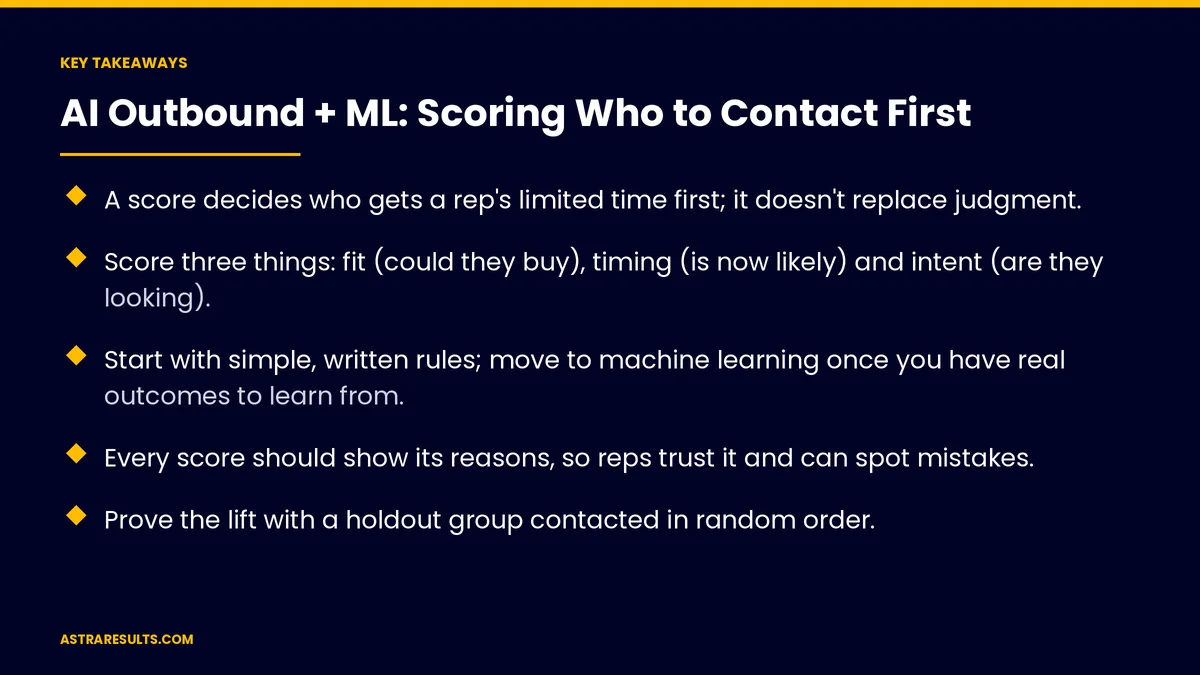
- A score decides who gets a rep's limited time first; it doesn't replace judgment.
- Score three things: fit (could they buy), timing (is now likely) and intent (are they looking).
- Start with simple, written rules; move to machine learning once you have real outcomes to learn from.
- Every score should show its reasons, so reps trust it and can spot mistakes.
- Prove the lift with a holdout group contacted in random order.
- No score overrides consent, opt-outs or do-not-contact rules.
Published: October 6, 2026 | Reading Time: ~11 minutes | Category: Outbound Sales
This guide covers how to rank prospects by fit, timing and intent, how to start with simple rules before machine learning, and how to prove the score works. It also covers what a score must never do. Put plainly: a good score puts the right thirty people at the top of the queue, and shows why.
This is general guidance. If you score individual consumers rather than businesses, data-use and privacy laws may apply to what you collect and how you use it. Confirm with counsel.
In This Playbook
- What a score is for
- Score three things
- Start with rules, not a model
- When to add machine learning
- Show the reasons
- What a score must never do
- Prove it works
- How to read the results
- The first three months
What a score is for
Order, not permission. A score sorts the list. It decides who gets contacted first, not whether someone may be contacted at all. Consent and opt-out rules still apply to every name, as covered in outbound compliance.
Time is the limit. With approved, researched outreach, a rep handles a few dozen good messages a day. The score makes sure those few dozen are the best bets, which is the whole idea behind outbound without a sales floor.
It should change behavior. If reps would contact the same people anyway, the score adds nothing. A useful score regularly surfaces prospects nobody would have picked by hand.
Score three things
Fit: could they buy? Industry, size, location, the services they use and whether they match your best customers. A shipper on a lane you run well is a strong fit, as in outbound by lane.
Timing: is now likely? A new location, a funding round, a contract renewal date, a seasonal peak or a change of leadership. Timing turns a good fit into a good week to call.
Intent: are they looking? A fresh job post for the role you fill, as in staffing outbound. A visit to your pricing page, a quote request that went quiet, or a reply to a past message.
Keep them separate. Show all three, not just one blended number. A rep treats "great fit, no timing" differently from "weak fit, clear intent."
Start with rules, not a model
Why rules first. A model learns from outcomes: replies, meetings and won deals. If you don't have a few hundred of those yet, there is nothing for it to learn from. Written rules work from day one.
What rules look like. Points for each signal, agreed with the reps who know the market. For example: plus 20 for a job post in the last seven days, plus 15 for a lane you run, minus 30 if contacted in the last 30 days.
Write them down. Every rule, its points and the reason for it. When results come in, you can see which rules helped and which didn't.
Review monthly. Compare the score with what happened. If high scorers aren't replying, change the rules before you add complexity.
When to add machine learning
When you have outcomes. Once you have several hundred contacted prospects with known results, a model can find patterns the rules miss. The trade-offs are explained for non-specialists in machine learning for operators.
Train on the outcome you want. Meetings booked or deals won, not opens or clicks. A model trained on opens learns to find people who open email.
Use clean history. The model is only as good as the records behind it: who was contacted, when, how and what happened. Inconsistent records produce a confident, wrong score. That groundwork is covered in the foundation every AI project needs.
Keep it simple to start. A straightforward model with reasons you can read usually beats a complex one nobody can explain.
Retrain on a schedule. Markets change. Refresh the model every quarter, and check it against the rules it replaced.
Show the reasons
Every score comes with why. "Score 84: new warehouse in Doral, lane you run, no contact in 90 days." Reps trust what they can check.
Reasons catch mistakes. If the top reason is something silly, like a company name containing a keyword, the rep sees it and flags it.
Reasons feed the message. The signal that raised the score is often the best opening line. The draft can start from it, as in drafts humans approve.
What a score must never do
Override consent or opt-outs. A high score never puts an opted-out or do-not-contact name back in the queue.
Use protected traits. For any scoring that touches individuals, never use, or stand in for, age, race, national origin, religion, sex, disability or other protected characteristics.
Push for more contact. A high score is a reason to send a better message, not more of them. Cap contacts per prospect regardless of score.
Run unwatched. Someone reviews a sample of top-scored prospects every week to check that the reasons still make sense.
Prove it works
Use a holdout group. Each week, set aside a random slice of prospects and contact them in random order, ignoring the score. Contact the rest by score.
Compare outcomes. Meetings and deals per hundred contacted, scored group against holdout. The difference is the lift the score gives you.
Check by band. Reply and meeting rates should fall from the top 10% of scores to the bottom. If the bottom does as well as the top, the score isn't working.
Start small. Test on one segment before you change how the whole team works, the approach in AI pilots that fail safely.
How to read the results
Lift over holdout. Meetings and deals per hundred contacted, scored versus random.
Rate by score band. Replies, meetings and wins in each tenth of the score range.
Coverage. The share of prospects with enough data to score.
Rep overrides. How often reps skip a top-scored prospect, and why. Frequent skips point to a problem in the score.
Revenue from scored outreach. Deals traced to the first message, using attribution across every channel.
The first three months
Days 1–30: rules and records
List the fit, timing and intent signals you can collect today. Write a points-based rule set with your best reps. Clean up contact history so every outreach has a date, channel and outcome. Set up the holdout group from the first week.
Days 31–60: score and send
Sort the daily queue by score, with reasons shown on every prospect. Draft messages from the top reason, approved by a rep. Track replies, meetings and overrides by score band. Review the rules every two weeks.
Days 61–90: prove and decide
Compare the scored group with the holdout. Adjust rules that didn't predict outcomes. If you now have enough outcomes, train a first model on meetings booked and test it against the rules on a small segment before switching.
How Astra builds scoring
Astra Results Marketing builds outbound scoring that a sales team can read. We start with written rules for fit, timing and intent, agreed with your reps, and set up a random holdout group from the first week so every claim about the score can be checked.
Scores show their reasons, feed the first line of each approved message, and never override consent, opt-outs or contact limits. A model comes in once there are real outcomes to learn from. Reporting covers lift over holdout and results by score band. Engagements begin with a signal and data review through our AI outbound sales team.
Related reading
Frequently asked questions
What should an outbound score measure?
Three things, shown separately: fit (whether the prospect could buy), timing (whether now is likely) and intent (whether they are looking). A blended single number hides why a prospect ranks high, and reps act differently on each.
Do we need machine learning to score prospects?
Not at first. Written rules agreed with your reps work from day one. A model helps once you have several hundred contacted prospects with known outcomes, such as meetings booked or deals won, for it to learn from.
What outcome should a model be trained on?
The one you care about: meetings booked or deals won. Training on opens or clicks teaches the model to find people who open email, which is not the same as people who buy.
How do we know the score works?
Keep a random holdout group contacted without the score and compare meetings and deals per hundred contacted. Also check that reply and meeting rates fall from the top score band to the bottom.
Can a high score override an opt-out?
No. A score only sets the order of contact. Opted-out and do-not-contact names never re-enter the queue, and every prospect keeps the same contact limits regardless of score.
Why show reasons with every score?
Because reps trust what they can check, reasons expose mistakes quickly, and the signal behind a high score is often the best first line for the message.
Ready to know who to contact first? Astra Results Marketing builds outbound scoring on fit, timing and intent, with reasons your reps can read, a holdout group that proves the lift, and hard limits that keep consent and opt-outs ahead of any score. ▸ CALL (786) 321-2866 · ▸ REQUEST YOUR CONSULTATION





