Rated 5 star on

Machine Learning for Operators, Not Data Scientists
Quick answer
Machine learning predicts, and everything useful is what you do with the prediction. Four use cases pay back first for most businesses: demand forecasting, churn prediction, lead scoring and anomaly detection. Each needs history with outcomes recorded, and each needs a decision attached in advance, because a prediction nobody acts on is an expensive chart.
Machine learning has a reputation problem with business owners. It sounds like something that needs a PhD, a data lake and eighteen months, and produces a slide about accuracy nobody knows what to do with. Some of that is earned. Most comes from projects built for the technology rather than for a decision due on Monday.
Key Takeaways
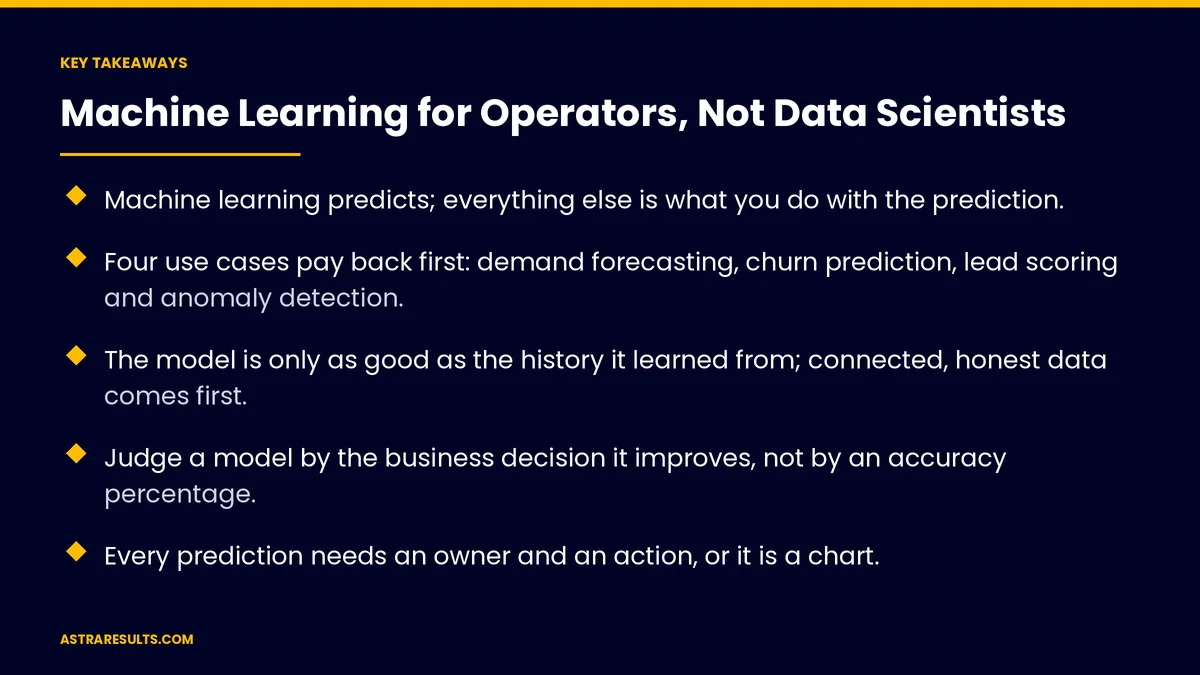
- Machine learning predicts; everything else is what you do with the prediction.
- Four use cases pay back first: demand forecasting, churn prediction, lead scoring and anomaly detection.
- The model is only as good as the history it learned from; connected, honest data comes first.
- Judge a model by the business decision it improves, not by an accuracy percentage.
- Every prediction needs an owner and an action, or it is a chart.
- Start with one decision, one model, one before-and-after number.
Published: September 16, 2026 | Reading Time: ~13 minutes | Category: Machine Learning
This guide is written for the operator, not the data scientist. It explains what machine learning does — it predicts — which four predictions pay back first for most businesses, what data they need, how to judge whether a model is any good without understanding the math, and how to turn a prediction into an action. The short version: a prediction nobody acts on is a very expensive chart.
Guidance for owners and operators. Nothing here is financial, legal or technical advice. Models that affect credit, employment, insurance, housing or other regulated decisions are subject to fairness and disclosure rules that vary by jurisdiction and must be reviewed with counsel.
In This Playbook
- What machine learning does
- Use case one: demand forecasting
- Use case two: churn prediction
- Use case three: lead scoring
- Use case four: anomaly detection
- The data question
- How to judge a model without the math
- From prediction to decision
- Build, buy or wait
- Three months, step by step
What machine learning does
Strip the vocabulary away and machine learning does one thing: it looks at what happened before and predicts what will happen next.
- Given history, predict the future. Sales by day for three years, predict sales next month. Customers who left and customers who stayed, predict who leaves next. Leads that closed and leads that did not, predict which new lead closes.
- Given examples, sort new ones. Transactions that were fraud and transactions that were fine, flag the next suspicious one. Support tickets by category, route the next one.
- Given behavior, recommend. What customers like this one bought next, suggest it to this one.
- What it does not do. Understand the business. Know why something happened. Decide what to do about it. Those remain the operator's job.
- The frame. A very experienced employee who has seen every customer and every transaction, has perfect recall, and can tell you the odds — but who has never made a decision and never will, set out in the readiness conditions.
Use case one: demand forecasting
The prediction with the most direct line to money.
- What it predicts. Sales, orders, calls, covers, bookings or units, by day or week, weeks ahead.
- What it needs. History with dates. Two years is comfortable; one is workable. Plus the things that moved demand: promotions, holidays, weather, price changes, marketing spend.
- What changes when it works. Staffing matches demand instead of guessing. Inventory matches sales instead of hoping. Cash planning has a basis.
- Who it fits. Restaurants, retail, hospitality, home services, logistics, manufacturing, any business where the cost of being over or under is real.
- The action. A forecast feeds the schedule and the purchase order. If nobody changes the schedule or the order, the forecast did nothing.
Use case two: churn prediction
Knowing who is about to leave while there is still time to keep them.
- What it predicts. For each customer, the probability they stop buying, cancel or lapse in the next period.
- What it needs. Customer history with an outcome: who left and when. Behavior before they left: purchase frequency, support contacts, engagement, payment patterns. The pattern before leaving is the signal.
- What changes when it works. Retention effort goes to the customers who are at risk and worth keeping, not to everyone or to whoever complained loudest.
- Who it fits. Subscriptions, memberships, maintenance plans, recurring services, B2B accounts, property management, insurance agencies.
- The action. A ranked list every week. Someone calls the top of it. Retention is the cheapest revenue a business earns, laid out in the retention stage, and this is how it becomes a system.
Use case three: lead scoring
Telling sales which leads to call first.
- What it predicts. For each new lead, the probability it becomes a customer, and often the expected value if it does.
- What it needs. Lead history with outcomes, and the attributes known at intake: source, service requested, location, timing, responses to qualification questions.
- What changes when it works. Sales time goes to the leads most likely to close. Follow-up cadence adapts to likelihood. Marketing learns which sources produce leads that score high, according to attribution by channel.
- The trust problem. Salespeople ignore scores they do not believe. The model earns trust by being right visibly and by explaining itself: this lead scores high because of source, service and timing.
- The action. The CRM sorts by score. The first call of the day goes to the top.
Use case four: anomaly detection
Catching what is wrong before it becomes expensive.
- What it predicts. What normal looks like, so that abnormal stands out: a transaction that does not fit the pattern, a machine reading that drifts, an invoice that is unusual, a sudden drop in a location's sales.
- What it needs. Enough history to know what normal is. Often the least data-hungry use case.
- What changes when it works. Fraud, errors and failures get flagged in hours instead of discovered in the monthly close.
- Who it fits. Anyone with transactions, equipment or multiple locations. Especially manufacturers, logistics companies, retail chains and any business with payment volume.
- The action. An alert to a named person, with what was unusual and why. Not a dashboard nobody opens.
The data question
Every model is only as good as the history it learned from.
- Connected. The model needs customers, transactions and outcomes to refer to the same people. Disconnected systems produce a model that learned from fragments.
- Honest. If the CRM says a lead closed when it did not, the model learns that lie.
- Enough. Roughly, hundreds of examples of the outcome you want to predict. A business with thirty churned customers cannot train a churn model yet; it can track them until it can.
- With outcomes. The most common gap. Businesses record what happened but not how it ended. Which leads closed. Which customers left. Which forecasts were right.
- The practical sequence. For many businesses, the first ML project is data engineering: connecting systems and starting to record outcomes. The model comes six months later, and it is worth the wait.
How to judge a model without the math
An accuracy number means nothing on its own. These questions mean everything.
- Better than what? Better than the current method — the manager's guess, last year's number, first-come-first-served. If the model does not beat that, it is not worth running.
- Right where it matters? A churn model that catches the customers who were going to leave anyway but misses the ones worth saving is accurate and useless.
- What does a wrong prediction cost? Overstaffing costs wages. Understaffing costs customers. The model should be tuned toward the cheaper mistake.
- Does it explain itself? A model that says why — this customer scores high because of these three signals — can be trusted, corrected and acted on. A black box cannot.
- Is it still right? Businesses change. A model trained on last year drifts. Someone checks it monthly against what happened.
From prediction to decision
This is where most projects die, and it has nothing to do with technology.
- Every prediction has an owner. A named person who receives it, is expected to act on it, and is accountable for whether they did.
- Every prediction has an action. The forecast changes the schedule. The churn score triggers a call. The lead score sorts the queue. The anomaly sends an alert. Written down before the model is built.
- Every action has a measurement. Did retention improve for the customers the model flagged? Did close rate improve for the leads it ranked? Did overtime fall? The before-number is recorded before launch.
- The feedback loop. What happened flows back to the model, so it learns whether it was right.
- The failure mode. A beautiful dashboard, an accuracy slide, and a business that runs exactly as it did before.
Build, buy or wait
- Buy when the use case is common and a product exists that fits: many CRMs now score leads, many platforms forecast. Check that it can be judged against the current method.
- Build when the decision is specific to the business, the data is proprietary, and the value justifies it. Most custom ML for businesses under $50M is one of the four use cases above, tuned to their data.
- Wait when the data is not connected, outcomes are not recorded, or there are not enough examples yet. Use the waiting time to fix those.
- The honest cost. A first custom model is a project measured in weeks to a few months, not years, when the data is ready. The data work is what takes time.
Three months, step by step
Days 1–30: choose the decision
The four use cases scored against the business: which decision, made better, is worth the most? The current method documented as the baseline. Data audited: connected, honest, enough, with outcomes. The gaps listed.
Days 31–60: data and first model
Systems connected for the chosen use case. Outcomes recorded going forward. If history allows, a first model trained and compared to the baseline on past data. The owner named and the action written.
Days 61–90: run and measure
Predictions delivered to the owner weekly. The action taken. The before-number compared to the after. The decision to expand, adjust or stop made on that comparison, not on the accuracy slide.
Where Astra fits in
Astra Results Marketing starts with the decision, not the model: which of the four use cases improves a decision worth the most, what the current method is, and whether the data can support it yet. When it cannot, the engagement begins with connecting systems and recording outcomes. When it can, the model is built to explain itself, judged against the baseline, and delivered to a named owner with a written action.
The same team runs the marketing and intake systems that generate the data, so lead scoring and churn prediction connect to the channels that produced the customers. Engagements begin with a decision-and-data audit through our business consulting team.
Related reading
Frequently asked questions
What does machine learning actually do for a business?
It predicts. Given history it forecasts the future; given labeled examples it sorts new ones; given behavior it recommends. It does not understand the business, explain why something happened, or decide what to do. Think of it as an experienced employee with perfect recall who can tell you the odds but has never made a decision. The decision stays with the operator.
Which use cases pay back first?
Demand forecasting, which feeds staffing and purchasing. Churn prediction, which ranks customers by risk so retention effort goes where it counts. Lead scoring, which tells sales who to call first and tells marketing which sources produce leads that close. And anomaly detection, which flags fraud, errors and failures in hours rather than at the monthly close. Most custom ML for businesses under $50M is one of these four.
What data does a model need?
Connected data, so customers, transactions and outcomes refer to the same people. Honest data, because the model learns any lie the CRM tells. Enough examples, roughly hundreds of the outcome being predicted. And outcomes recorded, which is the most common gap: businesses log what happened but not how it ended. For many, the first ML project is data engineering, and the model comes months later.
How do I know if a model is good without understanding the math?
Ask whether it beats the current method — the manager's guess or last year's number. Whether it is right where it matters, not just on average. What a wrong prediction costs in each direction, so it is tuned toward the cheaper mistake. Whether it explains itself so it can be trusted and corrected. And whether someone checks it monthly against what happened, because models drift as businesses change.
Why do ML projects fail?
Because the prediction never became a decision. A beautiful dashboard and an accuracy slide, and a business that runs exactly as before. Every prediction needs a named owner who receives it and is accountable for acting, a written action — the forecast changes the schedule, the score triggers a call — and a measurement of whether the action improved the outcome against a recorded before-number.
Should a business build, buy or wait?
Buy when the use case is common and a product fits, as long as it can be judged against the current method. Build when the decision is specific, the data is proprietary and the value justifies it. Wait when data is not connected, outcomes are not recorded or there are too few examples, and use the time to fix those. When data is ready, a first custom model is weeks to a few months, not years.
READY TO MAKE ONE DECISION BETTER WITH A PREDICTION YOU CAN ACT ON? Astra Results Marketing starts with the decision, audits whether the data can support it, builds models that explain themselves, and delivers every prediction to a named owner with a written action. Astra Results Marketing · 1101 Brickell Ave, Miami, FL 33131 · +1 (786) 321-2866 · [email protected] Find us on Google · Yelp ▸ CALL (786) 321-2866 · ▸ REQUEST YOUR CONSULTATION