Rated 5 star on


Miami Gastroenterology & Specialty Clinic Marketing
Quick answer
A Miami gastroenterology clinic should market against embarrassment, not competition. Pages use plain, shame-free language and explain the visit step by step. Prep content addresses the real objection to colonoscopy. Screening guidance cites current guidelines set by physicians. Alarm symptoms go to prompt evaluation. Astra measures completed screenings, not bookings.
Gastroenterology's central marketing problem is not competition or cost. It is embarrassment. Patients delay colonoscopies for years, describe symptoms vaguely or not at all, avoid discussing them with family, and often arrive having self-diagnosed from the internet because asking a person felt worse.
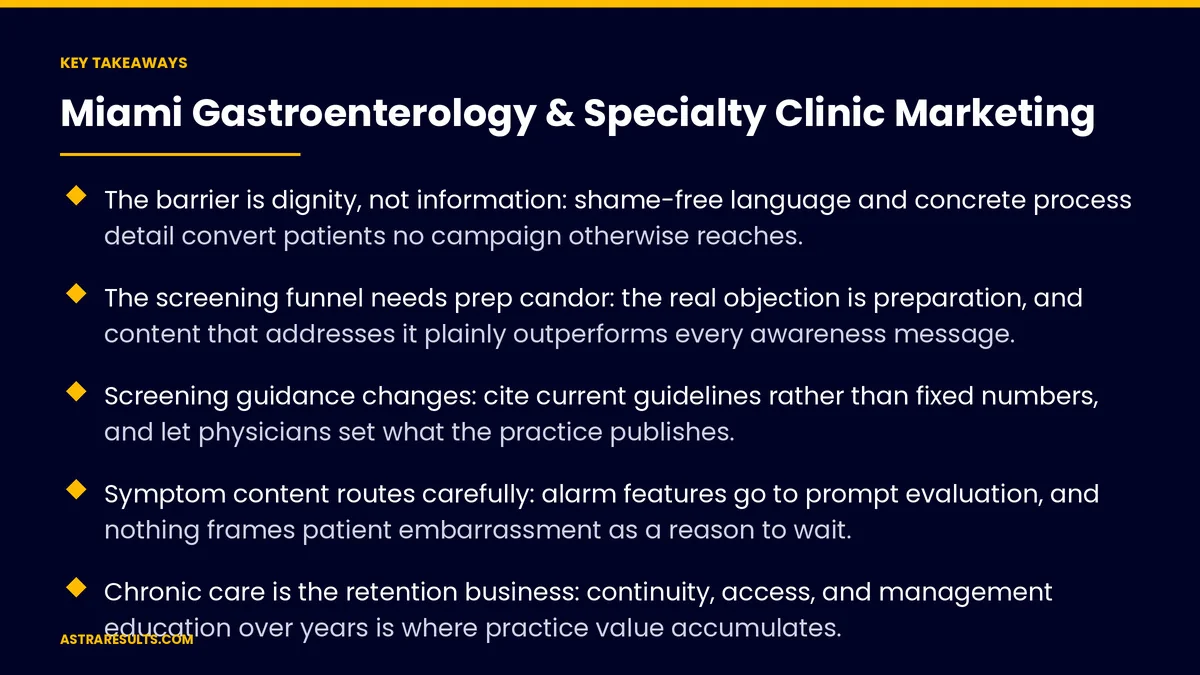
Key Takeaways
- The barrier is dignity, not information: shame-free language and concrete process detail convert patients no campaign otherwise reaches.
- The screening funnel needs prep candor: the real objection is preparation, and content that addresses it plainly outperforms every awareness message.
- Screening guidance changes: cite current guidelines rather than fixed numbers, and let physicians set what the practice publishes.
- Symptom content routes carefully: alarm features go to prompt evaluation, and nothing frames patient embarrassment as a reason to wait.
- Chronic care is the retention business: continuity, access, and management education over years is where practice value accumulates.
- Measure screening completion, not bookings: the scheduled colonoscopy that never happens is this specialty's signature loss.
Published: October 19, 2026 | Reading Time: ~11 minutes | Category: Medical · Gastroenterology
That single dynamic explains more about this specialty's funnel than any channel analysis: the barrier is dignity, not information, and the practice that removes shame from the conversation converts patients no campaign otherwise reaches. The kicker states it: screening without shame.
The strategic consequence is that two very different marketing jobs sit inside one practice. The screening job is a public-health funnel: asymptomatic people who need a preventive procedure they'd rather not think about, converted by making the process concrete, dignified, and low-friction.
The chronic-care job is a relationship business: patients with ongoing conditions who need continuity, access, and candid management education over years. They require different content, different measurement, and different tones. Practices that market only the first never build the second. Marketing guidance for licensed practices only. Nothing here is medical advice.
Screening intervals, diagnostic decisions, treatment selection, and every clinical statement belong to your physicians and must follow current guidelines as they evolve. Compliance review precedes publication of every asset.
In This Playbook
- The No-Shame Register
- The Screening Funnel
- Symptom Content That Routes
- Chronic Care Is the Retention Business
- Access, Logistics, and Completion
- The Referral Web
- Channels
- What belongs on a Miami GI clinic's marketing dashboard?
- A 90-Day Build
The No-Shame Register
The discipline that unlocks the funnel.
What patients experience. Symptoms they consider humiliating, a procedure culture full of jokes, and a sense that discussing digestive health marks them as unpleasant. So they wait, minimize, and arrive late.
What the tone does. Names symptoms plainly and clinically without euphemism or comedy, states explicitly that these are ordinary medical matters clinicians discuss all day, describes the visit so patients know what will and won't be asked, and never uses humor about the specialty in a way that confirms the patient's fear that this is funny to everyone else.
The specific banned moves. Coy language that signals the practice is also uncomfortable, "no need to be embarrassed" framing that introduces embarrassment as the topic, and any content that treats a symptom as a punchline.
What replaces them. Matter-of-fact clinical directness in the transparency-as-care register Astra built for the fear-aware vertical: because the mechanism is identical, only the emotion differs. Fear there, shame here.
The staff dimension. Intake and scheduling teams trained to the same standard, since one awkward phone interaction confirms every hesitation a patient overcame to make the call.
The Screening Funnel
The public-health job, engineered plainly.
The guidance question, handled correctly. Screening recommendations, including the age at which average-risk screening begins and the intervals that follow, are set by evolving professional guidelines and by individual risk factors, so practice content should cite current guidance and defer to the physician rather than publishing a fixed number that ages badly.
Family history, prior findings, and other conditions change the answer, which is precisely why the content's job is to prompt the conversation rather than to settle it.
The real objection is prep. Patients don't fear the procedure, they dread the preparation. Almost no practice addresses it directly. Content that explains plainly what preparation involves, what the options generally are, what the day looks like, and what makes it more tolerable will outperform every awareness message the practice could publish.
The sedation and comfort layer. What patients experience, what they'll remember, and what recovery is like, the dread-reduction content Astra keeps proving converts avoidant populations.
The alternatives conversation, plainly. Non-invasive screening options exist and have real trade-offs in sensitivity and follow-up requirements. A practice that explains the trade-offs rather than dismissing alternatives earns the patient who was going to choose one anyway, and frequently converts her to the more appropriate option through candor rather than pressure.
The logistics that decide completion. Transportation requirements, time off work. The escort rule are the practical barriers, addressed as service, because they are the actual reasons appointments don't happen.
Symptom Content That Routes
The careful middle of this specialty's content.
The alarm-feature discipline. Certain presentations warrant prompt medical evaluation rather than watchful waiting. Content addressing symptoms must say so clearly and early, with emergency presentations routed to emergency care, the routing-before-capturing standard Astra established in cardiology, applied here with equal force.
The non-alarming majority, served generously. Most digestive complaints are common, manageable, and worth evaluating without panic. Reflux, IBS-pattern symptoms, food-related complaints, and the questions patients are too embarrassed to ask a person. This is the highest-value content in the specialty because it's where shame does its worst work.
The shame-and-delay warning, stated once and gently. Embarrassment causes delay, delay costs outcomes. Clinicians do not find these conversations remarkable: said plainly, without alarm, and never as a fear lever.
The self-diagnosis reality. Patients arrive having read extensively, sometimes accurately, content that respects that research while explaining what evaluation adds converts better than content that condescends.
Chronic Care Is the Retention Business
The half of the practice screening marketing ignores.
The populations. Inflammatory bowel disease, celiac disease, chronic liver conditions including the increasingly diagnosed metabolic ones, chronic reflux, and functional disorders, patients who need a specialist relationship for years or decades.
What they need from marketing. Candid management education (what living well with the condition looks like, what flares mean, what monitoring involves), access when something changes, and the continuity promise Astra documents in every chronic-disease specialty.
The nutrition-and-lifestyle layer, handled carefully. Dietary management is central to much of this specialty. It must run in the no-shame, no-lecture register, because a patient lectured about food stops reporting plainly, and because this content sits adjacent to disordered-eating territory that requires real care and physician governance.
The wellness-adjacent boundary. Gut-health marketing is saturated with supplement claims and elimination-diet certainty. The practice's advantage is evidence honesty: engaging the questions patients bring from that world seriously, saying what's supported and what isn't, and never selling into the gap.
The measurement consequence. Chronic-care value shows up in retention years, not acquisition months.
Access, Logistics, and Completion
Where this specialty's revenue leaks.
The scheduled-but-never-completed problem. This specialty's signature loss is the screening appointment that gets booked and abandoned: during prep, at the transportation problem, or at the time-off-work reality.
The fixes are operational. Prep instructions in plain language and in the patient's own language, reminder sequences that address the barriers rather than just the date, transportation and escort requirements explained early, and a human reachable for the prep questions patients are embarrassed to ask. The insurance-and-cost layer per the navigation standard.
Coverage for screening versus diagnostic procedures is confusing, cost surprises after a procedure damage trust badly. The practice that explains the general distinction plainly, while routing specifics to the patient's plan, prevents the most common complaint in the specialty.
The referral-wait reality. Publishing candid availability and a fast path for concerning symptoms works here as everywhere, per the availability-is-trust standard.
The Referral Web
The channel that carries the specialty.
The sources. Primary care above all, the screening referral pipeline is the practice's largest single channel, plus internal medicine and cardiology, OB-GYN, surgeons, oncology, rheumatology, and increasingly the concierge practices whose members expect coordinated specialty access.
What referrers need. Reliable scheduling turnaround for screening referrals, prompt readable reports, the finding communicated so the primary physician can act. Patients returned rather than absorbed: the communication-back standard with zero steering economics, which matters especially where a practice has ownership interests in endoscopy facilities, pathology, or anesthesia services.
The forwardable asset. The plain-language, shame-free "what a colonoscopy involves" guide a primary-care physician hands a hesitant patient. The single most useful forwardable in this specialty, because it does the persuading the referring physician doesn't have time for.
Community screening education under the participation rules: real public-health education, especially in communities with lower screening rates, delivered as service rather than lead generation.
Channels
Search carries the library under named-physician authorship with YMYL disciplines intact (the shame-free symptom explainers, the prep-candor content, the screening-guidance page that cites current recommendations, condition-management guides, and the insurance-distinction explainer) earning the AI answers this market asks ("what is colonoscopy prep really like," "when should I start screening," "¿es normal tener estos síntomas?") through the entity work our AI SEO service builds.
Physician video works well precisely because a doctor discussing these topics calmly and without humor is itself the shame-removal mechanism. Paid runs behind the negatives fortress: supplement and cleanse-product shopping excluded wholesale, at-home-test comparison shoppers served with the plain trade-off content rather than dismissed, fad-diet traffic filtered, jobs out.
Reviews run never-gated with unusual privacy care, since patients may not want a public association with this specialty, asked once, never pressured. Spanish runs native per the chain rule, with Kreyòl and Portuguese on the staff-it rule. Prep instructions are the clearest case in medicine of a document whose comprehension determines whether a procedure happens at all.
What belongs on a Miami GI clinic's marketing dashboard?
The dashboard, per the case-level standard:
- Screening completion rate — not booking rate — as the flagship, because the scheduled-and-abandoned procedure is this specialty's defining loss
- Prep-related cancellation and reschedule reasons captured specifically, since they diagnose which content and reminders are missing
- Time-to-appointment for concerning symptoms against published availability
- The referral ledger by physician relationship with scheduling turnaround and report turnaround measured as service metrics
- Chronic-care retention years and follow-up completion as the second business's flagship
- The forwardable guide's distribution and pull-through
- The register audit — content reviewed on calendar for euphemism, humor drift, and any framing that reintroduces shame
- Language cohorts read separately, with completion rates by language as the sharpest test of whether the prep instructions work
- Cost per completed procedure and per retained chronic patient on the ledger standard
A 90-Day Build
Days 1–30: Register and prep
- The no-shame tone documented with the banned-moves list and staff trained to it
- The prep-candor content drafted with physician sign-off
- The screening-guidance page written to cite current recommendations rather than fixed numbers
- The alarm-feature routing standards set
- Measurement instrumented for completion rate and prep-cancellation reasons
Days 31–60: The library live
Symptom, prep, screening, and condition-management content published under physician authorship in English and native Spanish. The insurance-distinction explainer live; physician video begun in the calm, humor-free tone; reminder sequences rebuilt to address barriers rather than dates; a human path published for prep questions.
Days 61–90: Web and reads
- The referral web engaged with scheduling and report turnaround measured
- The forwardable colonoscopy guide distributed to primary care
- Community screening education begun under participation rules
- AI-answer accuracy checked in both languages
- The first tone audit completed
- First clear reads — completion rate, prep-cancellation causes, referral ledger, chronic retention — and next quarter set on completions rather than bookings
How Astra Builds GI and Specialty Clinics
Astra Results Marketing builds gastroenterology marketing on dignity. The no-shame tone enforced across content and staff, prep candor treated as the conversion lever it is, screening guidance cited rather than fixed, symptom content that routes alarm features properly, chronic care built as the retention business it is.
The referral web served with communication-back and zero steering economics, measured on completion rather than booking. Engagements begin with a tone, prep, and referral audit through our business consulting team.
Related reading
Frequently asked questions
What actually moves screening volume?
Prep candor. Patients don't fear the procedure. They dread the preparation, and almost nobody addresses it directly. Publish what prep involves in plain language, what the options generally are, what the day looks like. What makes it more tolerable; then rebuild reminders to address the barriers (transportation, escort, time off) rather than just the date. Awareness campaigns move bookings. Prep content moves completions.
Should we publish the age screening starts?
Cite current professional guidance and defer to your physicians rather than publishing a fixed number. Recommendations evolve, and individual risk factors (family history, prior findings, other conditions) change the answer for many patients. The content's job is to prompt the conversation, not to settle it, which also keeps the page from aging into misinformation the moment guidance shifts.
How do we talk about symptoms patients find humiliating?
Plainly and clinically, without euphemism and without jokes. Name the symptom, state that clinicians discuss these matters routinely, and describe what the visit involves so nobody arrives braced. Avoid "no need to be embarrassed" framing, which introduces embarrassment as the subject, and train intake to the same tone, because one awkward phone call confirms every hesitation the patient just overcame.
How should we handle at-home screening tests?
Explain the trade-offs plainly rather than dismissing them. Non-invasive options are real, have real differences in sensitivity and follow-up requirements, and a patient who was going to choose one anyway will trust the practice that engaged the question. Candor converts more of those patients to the appropriate option than dismissal ever does. It earns the ones who don't convert as future referrers.
What's the biggest revenue leak in this specialty?
The scheduled procedure that never happens: abandoned during prep, at the transportation problem, or at the time-off reality. Measure completion rate rather than booking rate, capture cancellation reasons specifically, and treat prep instructions in the patient's own language as the clinical document they are. A booking metric will tell you your marketing works while your schedule quietly empties.
How do we compete with gut-health supplement marketing?
With evidence candor: engage the questions patients bring from that world seriously, say plainly what's supported and what isn't, and never sell into the gap. Keep dietary content in the no-lecture register with physician governance, this material sits near disordered-eating territory and requires real care, and let the practice be the credible voice in a space full of certainty for sale.
Ready to Remove Shame From the Screening Conversation? Astra Results Marketing builds GI and specialty clinic marketing on the no-shame tone, prep candor as the real conversion lever, guidance cited properly, and chronic care built as the retention business. Measured on completions rather than bookings. Start with a tone, prep, and referral audit for your practice. ▸ CALL (786) 321-2866 · ▸ REQUEST YOUR CONSULTATION