Rated 5 star on


Miami Chiropractic & Wellness Practice Marketing
Quick answer
A Miami chiropractic or wellness practice should claim only what it can support. That means musculoskeletal complaints, function and pain, with no implied cures. A clear page on when the practice refers out earns physician referrals. Phased care with reassessment points replaces prepaid packages. Astra measures completed care plans and retention.
Chiropractic has a marketing credibility problem, and it is worth naming precisely. The practices that solve it locally capture something valuable: the patients, physicians, and referral relationships that the category's worst actors have made unavailable to everyone else in the market.
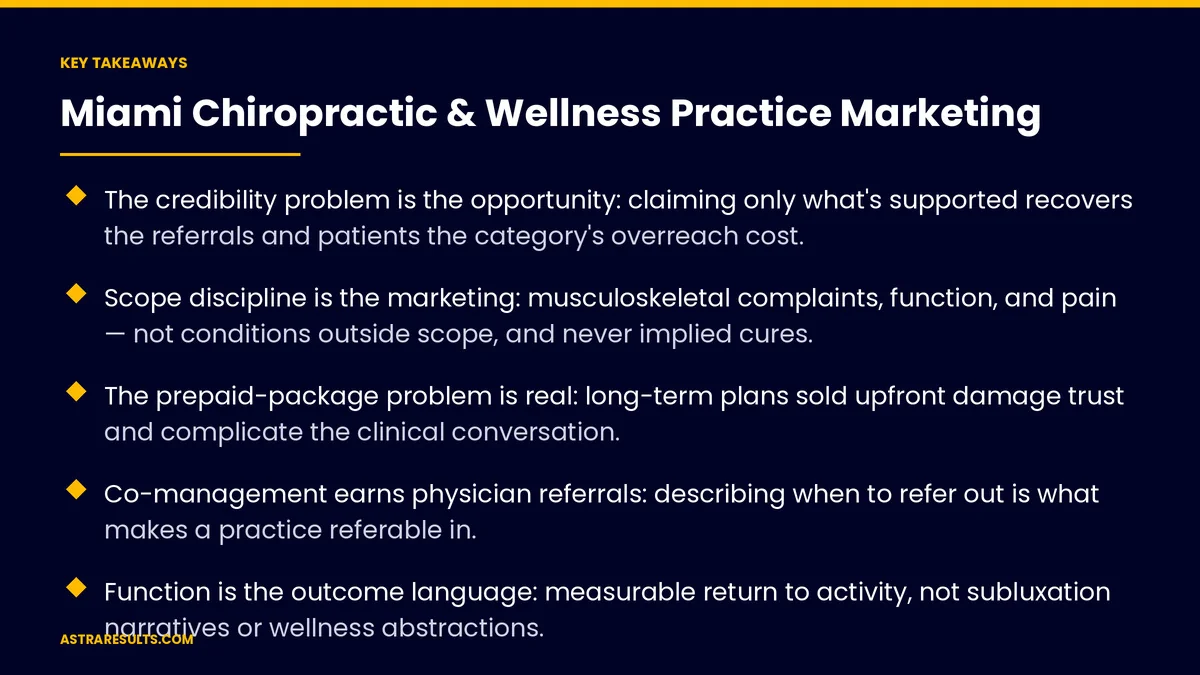
Key Takeaways
- The credibility problem is the opportunity: claiming only what's supported recovers the referrals and patients the category's overreach cost.
- Scope discipline is the marketing: musculoskeletal complaints, function, and pain — not conditions outside scope, and never implied cures.
- The prepaid-package problem is real: long-term plans sold upfront damage trust and complicate the clinical conversation.
- Co-management earns physician referrals: describing when to refer out is what makes a practice referable in.
- Function is the outcome language: measurable return to activity, not subluxation narratives or wellness abstractions.
- Measure completed plans and retention: the abandoned care plan is this vertical's signature loss, exactly as in rehab.
Published: October 14, 2026 | Reading Time: ~11 minutes | Category: Wellness · Miami
The problem isn't the profession. It's the claims. A market saturated with promises about treating conditions far outside musculoskeletal scope, lifetime "wellness plans" sold as prepaid packages, x-ray-driven fear presentations, and outcome language no clinical literature supports has trained physicians to withhold referrals and trained a sophisticated slice of patients to stay away entirely.
The practice that markets only what it can support recovers both. The kicker states the rule: claim what you can support.
The strategy that follows is the one Astra applies wherever a vertical sits adjacent to unsupported claims. The evidence register built for men's health, the wellness-bridge discipline built for the Westside, and the function-not-relief standard built for pain management. Applied here it produces a practice that is referable, retained, and structurally distinct from the storefront model.
Marketing guidance for licensed practitioners only. Nothing here is medical or chiropractic advice. Diagnosis, treatment, imaging decisions, and every clinical statement belong to your licensed practitioners. Florida Board of Chiropractic Medicine advertising rules, scope-of-practice limits, and prohibitions on misleading claims govern every asset. Compliance review precedes publication.
In This Playbook
- Claim What You Can Support
- Scope Discipline as Positioning
- The Prepaid-Package Problem
- Co-Management and the Referral Web
- The Personal Injury Interface
- Function as the Outcome Language
- Corridors, Cohorts, and Channels
- What belongs on a Miami chiropractic practice's dashboard?
- A 90-Day Build
Claim What You Can Support
The discipline that defines this playbook.
What's banned, plainly. Claims that chiropractic care treats conditions outside musculoskeletal scope, implied cures, blanket assertions about immune function or organ systems, fear-based imaging presentations used to sell treatment plans, and testimonial framing that implies typical results. Most of which are also regulatory exposure under advertising and scope rules your counsel will confirm.
What's supportable and marketable. Care for musculoskeletal complaints (back and neck pain, headaches of musculoskeletal origin, joint and mobility limitations, sports and work-related strain) described in terms of pain, function, and mobility, with realistic expectations and no promises.
Why restraint converts. The patient this practice wants is frequently a skeptic who has heard the overreach. The practice that states its scope plainly reads as the credible one, the same evidence-honesty conversion Astra documents in every market saturated with certainty for sale.
The imaging candor. If imaging is used, describe its clinical purpose factually. Never use imaging as a persuasion instrument or a fear device, because that specific practice is what physicians most cite when declining to refer.
Scope Discipline as Positioning
The move that makes a practice referable.
State what you treat. A specific, candid list of the complaints the practice manages, which paradoxically makes the practice look more expert rather than more limited, the specificity-beats-comprehensiveness principle Astra proves in every vertical.
State what you don't. The conditions and presentations that warrant physician evaluation, and the plain statement that the practice refers those out, including red-flag presentations where the practice's job is to route rather than to treat, per the routing-before-capturing standard Astra holds for all health content.
Why this is the referral strategy. Physicians withhold referrals from practices that appear to treat everything, and extend them to practices that demonstrably know their boundaries. So the "when we refer out" content is simultaneously patient-protective and the single most effective physician-facing asset a chiropractic practice can publish.
The wellness-adjacent line. Where the practice offers nutrition, massage, or lifestyle services, they're described as what they are, within the practitioner's licensure, and never as a system that treats disease. The evidence-limits standard applied inside the practice's own menu.
The Prepaid-Package Problem
The commercial practice that costs the category most.
The pattern. Extended treatment plans sold upfront as prepaid packages, sometimes financed, frequently before the patient's response to care is known, which converts a clinical judgment into a sales transaction and creates exactly the dynamic patients describe when they warn friends off the profession.
The clinical problem. A plan sold before response is observed can't be adjusted plainly. The practice has a financial interest in the original recommendation being right.
The marketing consequence. Package-driven positioning attracts price-and-deal shoppers and repels the referral sources and self-paying professionals who evaluate credibility first.
The plain alternative. Treatment recommended in phases with reassessment points, pricing published transparently per visit or per defined phase, no upfront commitment beyond what's clinically justified, and the scope-and-terms clarity Astra requires wherever recurring commitments exist. What's included, what happens if care ends early, and what the reassessment will consider.
The regulatory note. Prepaid arrangements and their advertising carry specific requirements your counsel should review. The marketing question is separate from and downstream of that.
Co-Management and the Referral Web
The channel that separates a clinical practice from a storefront.
The sources. Primary care, orthopedics and sports medicine, pain management, physical therapy (a collaborative rather than competitive relationship when both practices are open about scope), neurology for appropriate cases, and sports organizations.
What earns the referral per the courtesy standard: prompt readable progress notes, a treatment plan with a defined endpoint rather than an indefinite horizon, candid communication when a patient isn't responding, prompt referral back when the presentation warrants it, and no attempt to absorb the patient's broader care.
The co-management content. Publishing how the practice works alongside physicians and therapists (who does what, how communication flows, what a shared plan looks like) is both service content and the clearest signal a practice is safe to refer to.
The reverse flow. Practices that refer out generously receive referrals in, the routing-as-trust-investment logic Astra keeps proving.
The Personal Injury Interface
The lane requiring the most care in this market.
The reality. A meaningful share of chiropractic volume in South Florida arrives from motor-vehicle injuries. That puts practices in contact with personal injury representation and with Florida's insurance framework, where treatment timing and documentation carry consequences the practice's counsel should map. The marketing discipline, imported from the industrial-injury standard.
The practice may state factually that it treats injury-related musculoskeletal complaints and works within those systems. It does not market to attorneys as a volume-referral strategy in ways that imply anything other than independent clinical judgment, does not participate in arrangements conditioning care on representation, and keeps documentation and treatment decisions visibly independent of any legal matter.
Why the line is commercially decisive. A practice perceived as an injury-mill loses the physician web entirely. The physician web is what sustains a practice across a career rather than a cycle.
The patient-facing content. What to expect when treatment intersects with a claim, at general level, with legal questions routed to the patient's own counsel.
Function as the Outcome Language
The tone that replaces the category's abstractions.
What to promise. Measurable return to activity (sitting through a workday, sleeping through the night, lifting a child, returning to a sport) with variability stated and no absolutes, exactly as the pain-management standard requires.
What to retire. Subluxation-centered explanatory narratives aimed at lay audiences, "true health" and "best wellness" abstractions, and posture-alarm content that pathologizes normal variation.
The active-care emphasis. Exercise, movement, and self-management are central to musculoskeletal outcomes, and a practice that publishes home-program content and emphasizes patient agency positions itself as clinical rather than dependency-creating, while producing better adherence and completion, which is where the revenue is.
The maintenance conversation, plainly. Some patients benefit from periodic care and some don't, the distinction is clinical, and describing it that way is more persuasive to a skeptical market than any lifetime-plan pitch.
Corridors, Cohorts, and Channels
The cohorts.
- The tower professional with desk-related neck and back complaints who needs early-morning or lunch-hour access
- The active-lifestyle patient wanting return-to-sport
- The hospitality and construction workforce with occupational strain, served in the worker-dignity register
- The family household where one patient becomes several
- The active-retiree cohort wanting mobility and independence rather than decline framing
The channels.
- Local search with the profile precise and candid hours (early and evening availability is a real differentiator), the complaint-and-function content library under named-practitioner authorship earning the AI answers this market asks ("chiropractor or physical therapist for back pain," "is it safe for neck pain," "¿cuántas visitas necesito?") through the entity work our AI SEO service builds
- Video for movement demonstrations and first-visit walkthroughs
- Reviews never-gated and decisive in a locally-chosen category
- Paid behind the negatives fortress with deal and package intent excluded wholesale, equipment and DIY-cracking content routed out, massage-and-spa confusion filtered, and no fear or cure creative anywhere
Spanish runs native per the chain rule, with Kreyòl and Portuguese on the staff-it rule — home-exercise instructions are comprehension-dependent.
What belongs on a Miami chiropractic practice's dashboard?
The dashboard, per the case-level standard:
- Care-plan completion and visits-per-plan as the flagship, since the abandoned plan is this vertical's signature loss exactly as in rehab
- Cancellation reasons captured specifically, because each names a different fix
- The physician-referral ledger by relationship, with referrals-out logged as the trust investment they are
- Function-based outcome measures where the practice tracks them clinically, used internally rather than as marketing claims
- The claims audit — content reviewed on calendar against the scope-and-support standard, as a first-class KPI in a vertical where drift is the category norm
- New-patient source truth with the injury-lane share visible
- Retention and reactivation read plainly (periodic care where clinically indicated, never as a volume target)
- Language cohorts
- Cost per completed care plan on the ledger standard
A 90-Day Build
Days 1–30: Claims and scope
- Every existing asset audited against the support standard with unsupportable claims removed
- The treat-and-refer-out lists drafted with practitioner sign-off
- The function-based outcome language adopted and the retired vocabulary documented
- The package model reviewed with counsel and replaced with phased, transparently priced care if applicable
- Measurement instrumented for completion, cancellation reasons, and the claims audit
Days 31–60: The library live
- Complaint-and-function content published under practitioner authorship in English and native Spanish
- The co-management and refer-out content live as the physician-facing asset it is
- Home-exercise materials built for usability in both languages
- Transparent pricing published
- Paid rebuilt behind the fortress with package and fear creative eliminated
Days 61–90: Web and reads
- The physician and therapist web engaged with progress notes and defined endpoints showed
- The injury-interface conduct rules verified in practice
- AI-answer accuracy checked in both languages
- The first claims audit completed
- First clear reads — completion rate, cancellation causes, referral ledger both directions, injury-lane share — and next quarter set on completed care plans
How Astra Builds Chiropractic and Wellness Practices
Astra Results Marketing builds chiropractic and wellness marketing on supportable claims. Scope stated plainly in both directions, the prepaid-package model replaced with phased transparent care, co-management published as the referral strategy it is, function adopted as the outcome language, and the injury interface conducted cleanly, measured on completed care plans, the referral ledger, and the claims audit.
Engagements begin with a claims, scope, and referral audit through our business consulting team.
Related reading
Frequently asked questions
Why restrict our claims when competitors don't?
Because the unrestricted claims are what cost this category its referrals and its credible-patient segment. Reclaiming both is worth more than any campaign. Physicians withhold referrals from practices that appear to treat everything, and skeptical self-paying patients screen for exactly the overreach your competitors publish. Claim what you can support and you become the practice that's safe to refer to and credible to choose.
What's the strongest physician-facing content we can publish?
The "when we refer out" page: a plain statement of the presentations that warrant physician evaluation and the practice's commitment to routing them. It's patient-protective, it shows boundaries, and it's the single clearest signal to a referring physician that your clinical judgment can be trusted. Pair it with co-management content describing how communication and shared plans work.
Are prepaid treatment packages worth keeping?
They're the practice most damaging to this category's credibility: selling an extended plan before a patient's response to care is known converts a clinical judgment into a transaction and gives the practice a financial stake in its original recommendation. Replace them with phased care, reassessment points, transparent per-visit or per-phase pricing, and no commitment beyond what's clinically justified, and have counsel review whatever arrangement you use.
How should we handle motor-vehicle injury patients in our marketing?
State factually that you treat injury-related musculoskeletal complaints and work within those systems, then stop: no attorney-facing volume-referral marketing, no arrangements conditioning care on representation, and visibly independent documentation and treatment decisions. A practice perceived as an injury-mill loses the physician web. The physician web is what sustains a practice across a career rather than a cycle.
What outcome language should we use instead of wellness abstractions?
Function: sitting through a workday, sleeping through the night, lifting a child, returning to a sport, with variability stated and no absolutes. Retire subluxation-centered lay explanations, "best wellness" framing, and posture-alarm content that pathologizes normal variation. Then emphasize active care and home programs, which both improve outcomes and position the practice as clinical rather than dependency-creating.
What should we measure?
Care-plan completion and visits-per-plan, with cancellation reasons captured specifically. The abandoned plan is this vertical's signature loss, and each reason names a different operational fix. Add the referral ledger in both directions, function measures tracked internally, and a calendar claims audit against the support standard, because in a category where claim drift is the norm, governance is a competitive advantage rather than overhead.
Ready to Build the Practice Physicians Refer To? Astra Results Marketing builds chiropractic and wellness marketing on supportable claims, scope stated in both directions, phased transparent care, and co-management published as strategy. Measured on completed care plans and the referral ledger. Start with a claims, scope, and referral audit for your practice. ▸ CALL (786) 321-2866 · ▸ REQUEST YOUR CONSULTATION