Rated 5 star on

Miami Cardiology & Internal Medicine Marketing
Quick answer
A Miami cardiology or internal medicine practice should market with a calm tone, never fear. Symptom pages send emergencies to emergency services before any practice call-to-action. Quick appointments for concerning symptoms and human after-hours answers build trust. Content speaks to families as well as patients. Astra measures retention and follow-up completion.
This is the vertical where the library's ethical disciplines matter most and pay off longest. Cardiac and chronic-disease care involves real mortality risk, patients who arrive frightened, families who arrive frightened alongside them, and a marketing environment where fear converts, which is precisely why no vertical in Astra holds the calm register more strictly.
Key Takeaways
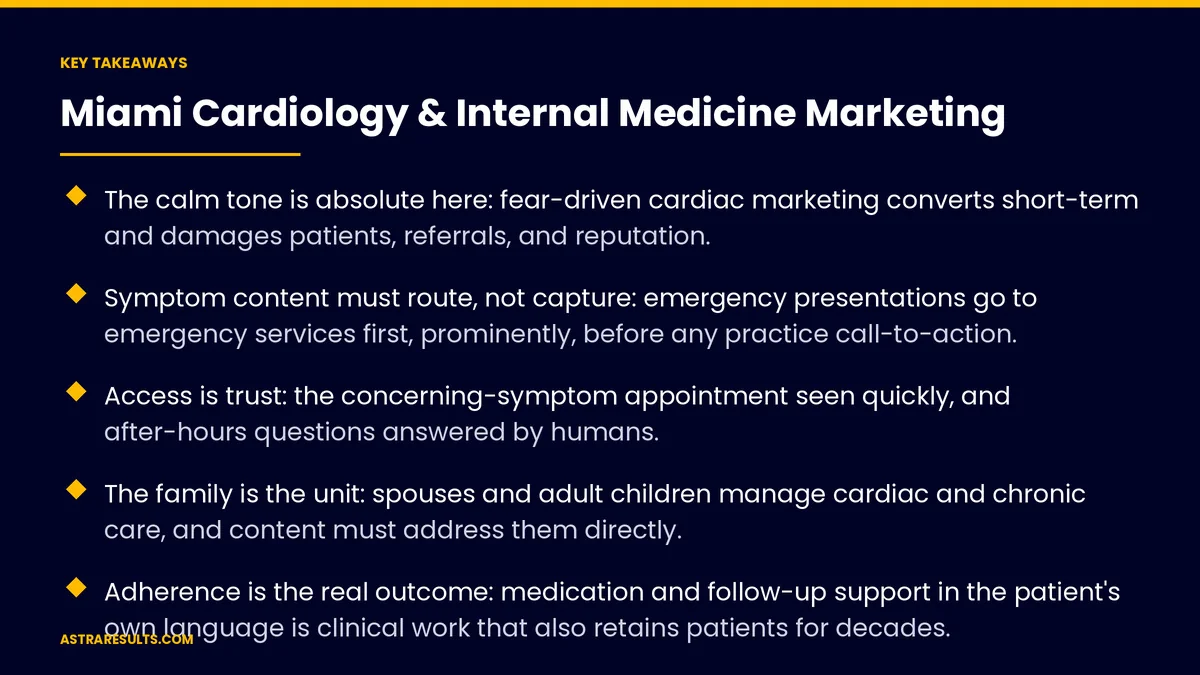
- The calm tone is absolute here: fear-driven cardiac marketing converts short-term and damages patients, referrals, and reputation.
- Symptom content must route, not capture: emergency presentations go to emergency services first, prominently, before any practice call-to-action.
- Access is trust: the concerning-symptom appointment seen quickly, and after-hours questions answered by humans.
- The family is the unit: spouses and adult children manage cardiac and chronic care, and content must address them directly.
- Adherence is the real outcome: medication and follow-up support in the patient's own language is clinical work that also retains patients for decades.
- Measure continuity: retention years, follow-up completion, time-to-appointment for concerning symptoms, and referral-source truth.
Published: October 12, 2026 | Reading Time: ~11 minutes | Category: Medical · Cardiology
Scare-driven cardiac marketing works in the short term and produces exactly the wrong outcomes: anxious patients who overuse urgent channels, real emergencies that get delayed by content designed to generate appointments rather than route correctly, and a practice reputation that the region's physicians will not refer into. The kicker names the standard: calm, clear, and in time.
The strategic frame follows from the medicine. Cardiology and internal medicine are relationship practices with episodic acute moments. The value is built over years of chronic-disease management and delivered in the minutes when something is wrong.
Marketing that understands that builds two things simultaneously: a long-horizon trust asset (education, continuity, adherence support) and a short-clock access promise (the concerning symptom seen quickly, the after-hours question answered by a human). Marketing guidance for licensed practices only. Nothing here is medical advice. Diagnosis, testing decisions, medication management, and every clinical statement belong to your physicians.
Content in this vertical must route emergency symptoms to emergency services. Compliance review precedes publication of every asset.
In This Playbook
- The Calm Register, Absolutely
- Symptom Content That Routes Correctly
- Access as Trust
- The Family and Caregiver Unit
- Adherence Is the Real Outcome
- The Referral Web
- Why is demand for cardiology care so high in South Florida?
- Channels
- Measurement
- A 90-Day Build
The Calm Register, Absolutely
The rule that governs every asset in this vertical.
What's banned. Fear-forward creative, mortality-statistic hooks, "silent killer" framing deployed to drive appointments, risk-quiz funnels engineered to alarm, and any content that leaves a frightened reader more frightened without a clear next step.
Why it's strategy as well as ethics. Cardiac fear content generates volume from the worried-well while frightening people who need care into paralysis. The region's referring physicians, who see the downstream of both, route their patients elsewhere.
What replaces it. Capable, specific, unhurried education (what a symptom can mean, what evaluation involves, what the common conditions are, and what living well with a managed condition looks like) the protective-education economics Astra proves in every vertical, applied where the stakes are highest.
The tone test. A frightened patient should finish the page calmer and clearer about what to do next, not more urgent about calling.
Symptom Content That Routes Correctly
The single most important technical discipline in this playbook.
The rule. Any page addressing symptoms that can indicate an emergency (chest pain, shortness of breath, syncope, stroke-adjacent symptoms) leads with emergency routing.
Call emergency services, go to the emergency department, do not drive yourself, do not wait for an office appointment: stated first, stated prominently, above any practice call-to-action, with the plain framing that a practice appointment is the wrong destination for those presentations.
Why practices get this wrong. Symptom keywords have enormous volume and obvious commercial appeal, so pages get built to capture rather than to route, which is a patient-safety problem before it's a marketing one.
What's still legitimate and valuable. The non-emergency layer (the intermittent symptom, the abnormal result from a physical, the family-history question, the medication concern, the "my doctor mentioned a murmur" search) where an office evaluation is the right next step, served with real usefulness.
The compliance point. This is exactly the kind of content that requires clinician review before publication, per the YMYL standard Astra holds for all medical content.
Access as Trust
The operational promise that decides referrals and retention.
The concerning-symptom clock. The abnormal test result, the new but non-emergent symptom, the medication side effect. These need to be seen in days rather than weeks. The practice that publishes and keeps that window earns both patients and the availability-is-trust reputation Astra documents in every access-sensitive specialty.
The after-hours question. Chronic-disease patients have questions at night, and reaching a human (a nurse line, an on-call pathway, a same-day callback) is the single most retention-relevant operational investment in this vertical, per the never-voicehold standard.
The results-communication layer. Waiting for cardiac test results is one of the most anxious experiences in medicine, and a practice with a published, kept results-communication standard converts that anxiety into loyalty. Booking without a phone call per the two-rails rule, with the phone rail fully staffed for the older cohort that prefers it.
The Family and Caregiver Unit
The structural reality of cardiac and chronic care.
Who is searching. Adult children researching a parent's diagnosis, spouses managing medications and appointments, and family members flying in to help. The household-unit model applied to a specialty where the caregiver often manages the plan.
The content they need. What a new diagnosis means in plain language, what questions to ask at the next appointment, how to support medication routines, what warning signs warrant a call versus emergency care, and how to be useful without taking over, service-first material almost no practice publishes.
The multilingual dimension. This region's caregiver reality frequently spans languages and generations: the elder whose clinical conversations happen in Spanish or Kreyòl and the adult child who verifies in English, which is the dual-verification funnel at its most consequential, because instructions that the caregiver cannot fully read are a treatment plan that will not be followed per the safety framing
Astra holds.
The consent and privacy layer. Family involvement is governed by the patient's authorization. The practice's materials should explain that plainly rather than assuming.
Adherence Is the Real Outcome
The long-horizon work that also happens to be the retention engine.
The clinical reality. Chronic-disease outcomes depend on medication adherence, follow-up completion, and lifestyle sustainability far more than on any single visit. That means the practice's supporting infrastructure is clinical work.
The marketing consequence. Recall systems that recall, refill and follow-up communication in the patient's own language, and education built for sustainability rather than intensity, including the no-shame register Astra requires for lifestyle counsel, because a patient lectured about diet and exercise stops reporting plainly.
The prevention-program discipline. Risk-reduction and prevention services are legitimate and valuable, marketed on capability and candid expectation rather than on alarm, and never as a substitute for the primary care and specialty relationships a patient already has.
The measurement. Follow-up completion and retention years, which in this vertical are the closest available proxy for whether the marketing attracted patients the practice can help.
The Referral Web
The channel that carries this specialty.
The sources. Primary care physicians above all, plus emergency departments, hospitalists, concierge practices, endocrinology, nephrology, and the orthopedic and surgical practices that need pre-operative cardiac evaluation. The discipline per the referral-courtesy standard.
Consultation notes returned promptly and readably, the referring physician informed of findings and plan, patients returned for their primary care rather than absorbed, and zero steering economics, which in a specialty with in-house testing and imaging is the credibility question the whole web watches.
The pre-operative lane. Surgical clearance is a high-volume, relationship-defining referral category. The practice that turns clearances around reliably becomes the default.
The forwardable asset. The plain-language explainer a primary-care physician hands a nervous patient, "here's what your cardiology appointment will involve", per the forwardable economics Astra keeps proving.
Why is demand for cardiology care so high in South Florida?
The demographic reality. South Florida's large older population, its significant cardiometabolic disease burden, and its concentration of active retirees make this specialty's demand structurally high. Make the seasonal population swing an operational planning matter, since snowbird patients arrive needing continuity with practices elsewhere.
The continuity-of-care layer. Records portability, coordination with out-of-state physicians, and clear scope statements about what a seasonal relationship can and cannot provide. Service content almost nobody publishes.
The hurricane-season layer. Patients on cardiac medications need to know how prescriptions, records, and contact work when systems are down, the contingency communication Astra established, at its most medically consequential.
The language layer. The full chain natively in Spanish, with Kreyòl and Portuguese on the staff-it rule: because medication instructions, symptom-reporting thresholds, and dietary guidance are comprehension-dependent clinical documents.
Channels
Search carries the education library under named-physician authorship with the E-E-A-T and YMYL disciplines at their strictest (condition explainers, test-and-procedure walkthroughs, caregiver guides, and the plain symptom-routing pages) earning the AI answers this market asks ("what does an abnormal EKG mean," "questions to ask a cardiologist," "¿qué significa presión alta sin síntomas?") through the entity work our AI SEO service builds.
Physician video is unusually effective here. A cardiologist explaining a test calmly is the format that most reduces patient anxiety. The profile carries access reality, hospital affiliations stated exactly, and languages properly; reviews run never-gated.
Paid runs narrow and conservative behind the negatives fortress: emergency-symptom keywords are not bought as acquisition terms, supplement and device shopping routed out, clinical-trial and jobs traffic excluded, and insurance-directory noise filtered. Community presence runs health-education programs under the participation rules, real screening and education events, never sales from a folding table.
Measurement
The dashboard, per the case-level standard:
- Time-to-appointment for concerning symptoms, audited against the published promise
- Follow-up completion and retention years as the flagship, because this specialty's value is continuity
- The referral ledger by physician relationship with pre-operative clearance turnaround tracked as its own service metric
- Caregiver-content engagement and the household-attribution reality
- The after-hours response performance
- Results-communication compliance against the published standard
- The routing audit — symptom pages reviewed on calendar to confirm emergency guidance leads and no page has drifted into capture
- The language split throughout with adherence signals read per language
- Cost per new patient by source on the ledger standard — reported on retention years rather than acquisition months
A 90-Day Build
Days 1–30: Register and routing
The calm-tone rules written with the banned-content list. Every symptom page audited or drafted with emergency routing leading and clinician review completed. The access promises engineered (concerning-symptom window, after-hours pathway, results-communication standard). Measurement instrumented for time-to-appointment, follow-up completion, and referral truth.
Days 31–60: The library live
Condition, test, and caregiver content published under physician authorship in English and native Spanish. The adherence-support infrastructure built (recall, refill communication, sustainable-lifestyle education in the no-shame register); physician video begun on the highest-anxiety topics; booking-first shipped beside a fully staffed phone rail.
Days 61–90: Web and reads
- The referral web engaged with communication-back and pre-operative turnaround measured
- The forwardable patient explainer distributed to primary care
- Seasonal-continuity and hurricane-contingency content published
- AI-answer accuracy checked in both languages
- The first routing audit completed
- First clear reads — access clocks, follow-up completion, referral ledger, caregiver engagement — and next quarter set on retention years
How Astra Builds Cardiology Practices
Astra Results Marketing builds cardiology and internal medicine on the calm tone held absolutely. Symptom content that routes emergencies correctly before it captures anything, access promises engineered and published, the family and caregiver unit addressed directly, adherence supported as the clinical work it is.
The referral web served with communication-back and zero steering economics, measured on retention years, access clocks, and the routing audit. Engagements begin with a tone, routing, and access audit through our business consulting team.
Related reading
Frequently asked questions
Fear-based cardiac content clearly gets clicks. Why avoid it?
Because it harms the people you're trying to reach and the reputation you need: alarm content floods the schedule with the worried-well while frightening sick patients into delay, and the referring physicians who see both outcomes stop sending patients. The calm tone converts more slowly and holds. The test is simple. A frightened reader should finish your page calmer and clearer about what to do, not more urgent about calling.
How should we handle high-volume symptom keywords like chest pain?
By routing rather than capturing. Lead the page with emergency guidance (call emergency services, don't drive yourself, don't wait for an office appointment) stated prominently above any practice call-to-action, then serve the non-emergent layer (intermittent symptoms, abnormal results, family history) where an office visit really is the right step. Get clinician review before publishing, and audit those pages on calendar for drift.
What access promise actually matters most?
Two: the concerning-symptom appointment measured in days rather than weeks, and an after-hours pathway where a chronic-disease patient reaches a human. The second is the most retention-relevant operational investment in this specialty. Patients with managed conditions have questions at night. The practice that answers them keeps families for decades and earns the referral web's trust in the process.
Why build content for caregivers rather than patients?
Because caregivers are frequently the ones searching, scheduling, and managing the plan, adult children and spouses researching a diagnosis at midnight. Give them plain-language explanations, questions to ask, medication-support guidance, and candid warning-sign thresholds. Then make sure home instructions are readable in the language the caregiver uses, since a plan the caregiver can't read is a plan that won't be followed.
How do we market prevention programs without alarming people?
On capability and candid expectation. Describe what a program includes, who it suits, what it can and cannot change. How it complements rather than replaces existing primary care, with no risk-quiz funnels engineered to frighten and no implication that everyone needs it. Prevention marketed calmly attracts patients who will sustain the program, which is the only version that produces outcomes worth publishing.
What matters most in the referral relationship?
Notes returned promptly and readably, findings communicated to the referring physician, patients returned for their primary care rather than absorbed. Pre-operative clearances turned around reliably, plus zero steering economics, which matters most where the practice owns testing or imaging. Referral webs run on the belief that clinical reasoning is independent. Nothing rebuilds that belief once a practice gives the web a reason to doubt it.
Ready to Build the Calm, Accessible Cardiology Practice? Astra Results Marketing builds cardiology and internal medicine on the calm tone, symptom content that routes correctly, engineered access, caregiver-aware education, and a referral web served with integrity. Measured on retention years and access clocks. Start with a tone, routing, and access audit for your practice. ▸ CALL (786) 321-2866 · ▸ REQUEST YOUR CONSULTATION