 Rated 5 star on


Search, Performance Max or Both: A Decision Guide
Quick answer
Most local service businesses should start with Search campaigns and add Performance Max once conversion data is solid. Search gives keyword-level control and clear reporting. Performance Max reaches many Google channels from one campaign but needs strong creative. Running both works best with brand terms in Search and exclusions in Performance Max.
Google Ads now gives most businesses two main paths. Search campaigns show text ads for the keywords you choose. Performance Max uses Google's automation to show ads across Search, YouTube, Display, Gmail, Discover and Maps from one campaign. Each has strengths, each can waste money, and running both means managing how they overlap.
Key Takeaways
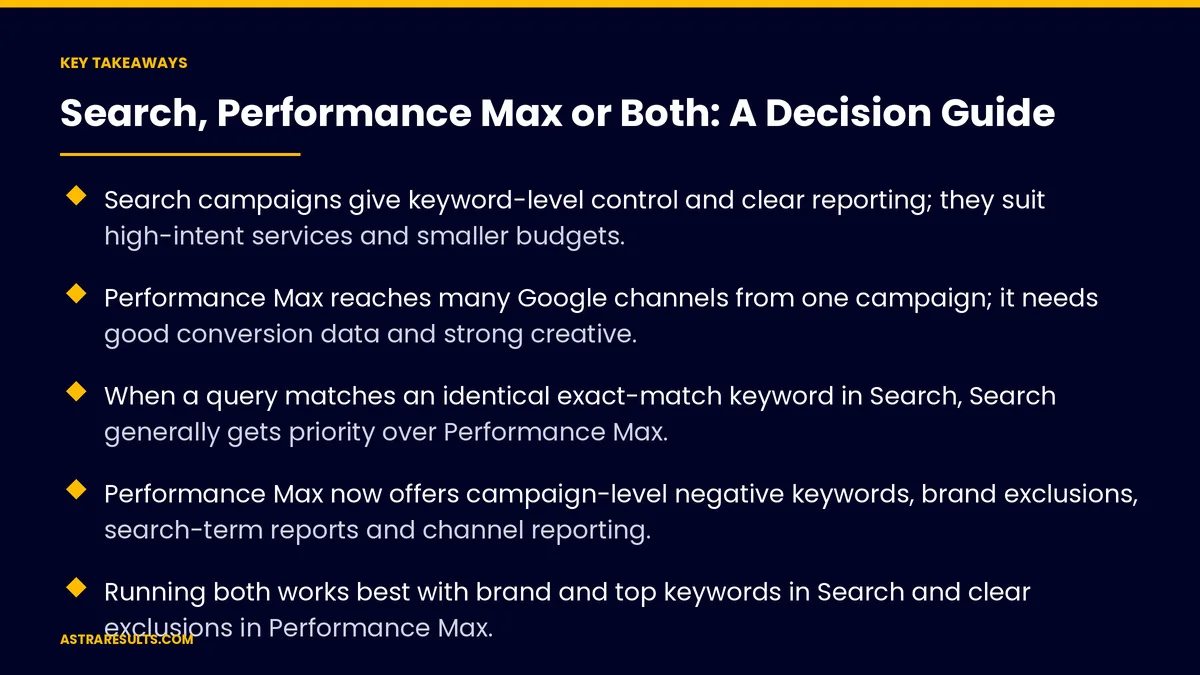
- Search campaigns give keyword-level control and clear reporting; they suit high-intent services and smaller budgets.
- Performance Max reaches many Google channels from one campaign; it needs good conversion data and strong creative.
- When a query matches an identical exact-match keyword in Search, Search generally gets priority over Performance Max.
- Performance Max now offers campaign-level negative keywords, brand exclusions, search-term reports and channel reporting.
- Running both works best with brand and top keywords in Search and clear exclusions in Performance Max.
- Judge both on cost per customer and new customers, not on the platform's own conversion counts alone.
Published: October 28, 2026 | Reading Time: ~10 minutes | Category: Pay-Per-Click Advertising
This guide explains what each campaign type does, which businesses suit which, how to run both without them competing, what the newer Performance Max controls allow and how to judge results fairly. Put plainly: choose Search for control, Performance Max for reach, and run both only when you can manage the overlap.
Google changes campaign features often. Check current settings in your account before you plan.
In This Playbook
- What each campaign type does
- When Search alone is the better choice
- When Performance Max makes sense
- How Search and Performance Max overlap
- The newer Performance Max controls
- Running both without competing
- Special cases
- Judging results fairly
- What to measure
- The first three months
What each campaign type does
Search campaigns. You choose keywords, write ads and pick landing pages. Ads show on Google search results when people search those terms. The full approach is in the Google Ads playbook.
Performance Max. You provide goals, creative assets, audience signals and, for stores, a product feed. Google decides where and when to show ads across its channels, aiming at your conversion goal.
The trade. Search gives control and clarity. Performance Max gives reach and automation, with less say over where ads appear.
When Search alone is the better choice
High-intent local services. Plumbers, lawyers, clinics and contractors whose customers search for exactly what they need.
Smaller budgets. A focused budget works harder on chosen keywords, as covered in Google Ads on a $2,000 budget.
Limited conversion data. Automation learns from conversions. With few each month, it has little to learn from.
Tight control needed. Regulated industries, sensitive topics or strict brand rules.
Clear reporting needed. When you must see exactly which searches led to which leads.
When Performance Max makes sense
Online stores with product feeds. Performance Max can show products across Shopping, Search and other channels from one campaign.
Steady conversion volume. Enough conversions each month for the system to learn what works.
Good creative assets. Images, videos and copy for channels beyond Search.
Goals beyond Search. Reaching people on YouTube, Gmail and Maps as well as search results.
Accurate conversion tracking. Performance Max aims at whatever you tell it counts, so bad tracking means bad results.
How Search and Performance Max overlap
Exact match gets priority. When someone's search matches an identical exact-match keyword in a Search campaign, Google generally serves the Search ad rather than Performance Max.
Other matches compete. Phrase and broad match keywords, and Performance Max search themes, compete on relevance and ad strength.
Budget limits matter. If a Search campaign runs out of budget, Performance Max may serve on terms you meant for Search.
Broader matching adds overlap. Newer options that widen what Search campaigns match, such as AI Max, increase overlap with Performance Max. Keep exact-match versions of your most important terms.
The newer Performance Max controls
Campaign-level negative keywords. Block irrelevant searches for a single Performance Max campaign, and use shared lists across campaigns. Build them from the search-term report, the same habit as negative-keyword discipline.
Brand exclusions. Keep Performance Max off your brand terms when a separate brand Search campaign handles them.
Search-term reports. See which searches triggered Performance Max ads.
Channel reporting. See how results split across Search, YouTube, Display and other channels.
What's still harder to see. Exact placements on YouTube, Display, Gmail and Discover remain less transparent than Search.
Running both without competing
Brand in Search. Run a dedicated brand Search campaign with exact-match brand terms, and exclude your brand in Performance Max.
Top keywords in Search. Keep exact-match versions of your best-converting non-brand terms in Search.
Budget Search properly. So it doesn't run out and hand its terms to Performance Max.
Exclude overlap. Add your core Search terms as negatives in Performance Max where needed.
Review both search-term reports. Check monthly for searches showing up in the wrong place.
Send each to the right page. Matched landing pages convert better in both, and they're worth testing in the order covered in landing page testing.
Special cases
Local service businesses. Local Services Ads may fit alongside Search, as weighed in Google Ads vs Local Services Ads.
Online stores. A clean product feed and conversion tracking come first, as covered in the e-commerce stack.
New accounts. Start with Search to build conversion history before adding Performance Max.
Judging results fairly
Cost per customer. Not just cost per conversion as reported by Google.
New versus returning customers. Performance Max can lean on people who would have bought anyway, such as brand searchers.
Lead quality. For service businesses, the share of leads that become paying customers.
Test when you can. Pause or add a campaign in one region or period and compare results, using attribution across every channel.
What to measure
Cost per customer by campaign type. The deciding number.
Search-term overlap. How often the same searches appear in both.
New-customer share. Especially for Performance Max.
Channel split. Where Performance Max spends its budget.
Lead or order quality. By campaign type.
The first three months
Days 1–30: decide and set up
Check conversion tracking and conversion volume. Decide Search only, Performance Max only or both, based on your goals, data and need for control. Set up brand exclusions and negative keywords before launch.
Days 31–60: run and watch overlap
Run the chosen setup. Review search-term reports in both campaign types every few weeks. Keep Search budgets from running out, and add negatives where overlap appears.
Days 61–90: judge and adjust
Compare cost per customer, new-customer share and lead quality by campaign type. Test changes in one region or period where possible, and shift budget toward what brings customers.
How Astra runs Search and Performance Max
Astra Results Marketing chooses campaign types based on your goals, conversion data and need for control. We run Search where control matters, add Performance Max where reach and data support it, and manage overlap with brand exclusions, negative keywords and exact-match priority.
Results are judged on cost per customer and new customers, not platform counts alone. Engagements begin with an account and tracking review through our pay-per-click advertising team.
Related reading
Frequently asked questions
What is the difference between Search and Performance Max?
Search campaigns show ads for keywords you choose, with clear control and reporting. Performance Max uses Google's automation to show ads across Search, YouTube, Display, Gmail, Discover and Maps from one campaign, aimed at your conversion goal.
Which is better for a local service business?
Usually Search, because customers search for exactly what they need and budgets are often modest. Local Services Ads may also fit. Performance Max can help later, once conversion tracking is solid and volume is steady.
Will Performance Max steal traffic from my Search campaigns?
It can. Google generally gives priority to Search when a query matches an identical exact-match keyword, but other matches compete. Use brand exclusions, negative keywords in Performance Max and well-funded exact-match Search campaigns to limit overlap.
Can I add negative keywords to Performance Max?
Yes. Performance Max now supports campaign-level negative keywords and shared lists, alongside account-level negatives and brand exclusions. Build them from the Performance Max search-term report.
How do I know if Performance Max is working?
Judge it on cost per customer, new-customer share and lead or order quality, not just the conversions Google reports. Where possible, test by adding or pausing it in one region or period.
Should a new account start with Performance Max?
Usually not. Start with Search to build conversion history and confirm tracking, then add Performance Max once there's enough data for it to learn from.
Ready to run the right campaign types for your goals? Astra Results Marketing chooses Search, Performance Max or both based on your goals and data, manages overlap with exclusions and exact-match priority, and judges every campaign on cost per customer. ▸ CALL (786) 321-2866 · ▸ REQUEST YOUR CONSULTATION





