Rated 5 star on


Marketing Attribution Across Every Channel
Quick answer
Platform reports over-count because each one measures only its own front door. A workable attribution system needs four things: written definitions of lead, qualified, appointment and closed; source captured at first contact; phone calls tracked; and the CRM recording what happened. The number that settles arguments is cost per closed customer by source.
Ask five vendors which channel produced last month's customers and you will get five answers that add up to more than a hundred percent. The ad platform claims the sale. The SEO report claims the sale. The social report claims the assist. Nobody is lying. Each is measuring its own front door and none of them can see the house.
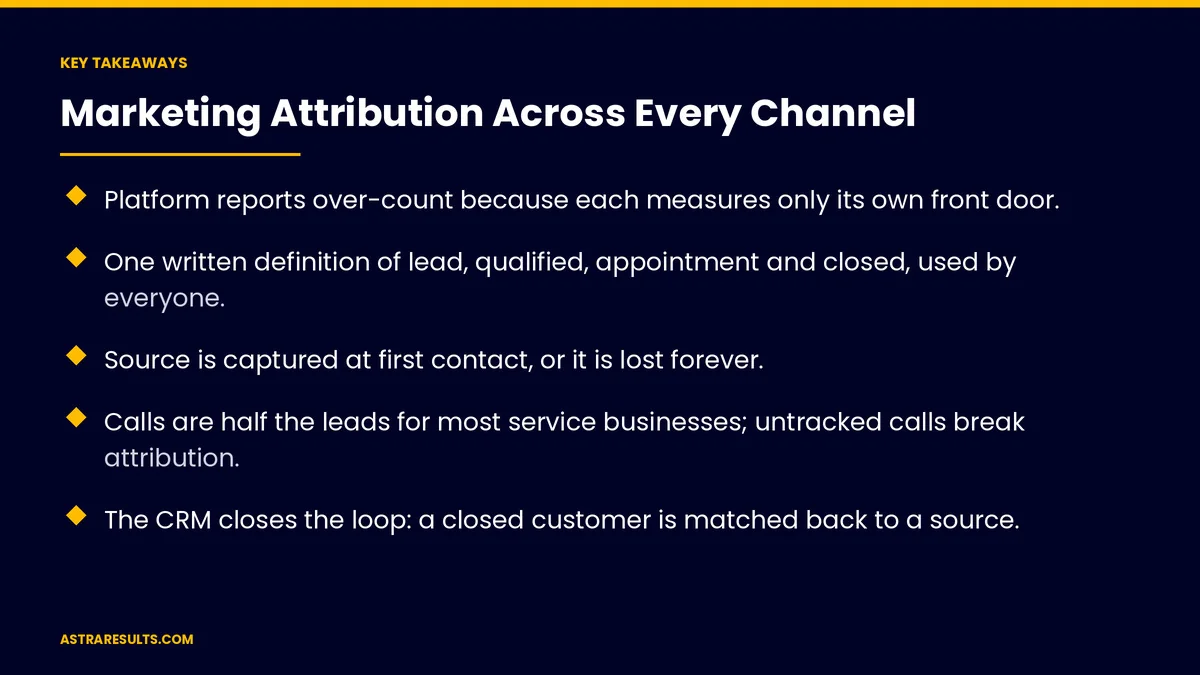
Key Takeaways
- Platform reports over-count because each measures only its own front door.
- One written definition of lead, qualified, appointment and closed, used by everyone.
- Source is captured at first contact, or it is lost forever.
- Calls are half the leads for most service businesses; untracked calls break attribution.
- The CRM closes the loop: a closed customer is matched back to a source.
- The scoreboard is cost per closed customer by source, then twelve-month value by cohort.
Published: September 16, 2026 | Reading Time: ~12 minutes | Category: Measurement
Attribution is the discipline of seeing the house. This piece lays out a practical system a business can run: one definition of a lead, source captured at first contact, phone calls tracked, the CRM closing the loop, and one number that settles arguments. The takeaway that matters: cost per closed customer by source, or you are guessing.
Guidance for owners and operators. Nothing here is financial or legal advice. Tracking, recording and data practices are subject to consent and privacy rules that vary by jurisdiction and must be confirmed with counsel.
In This Playbook
- Why platform reports do not add up
- Step one: define the stages in writing
- Step two: capture source at first contact
- Step three: track the calls
- Step four: close the loop in the CRM
- Step five: the scoreboard
- Assisted channels and the honest limit
- What this changes in practice
- A 90-day plan
- Astra's part in it
Why platform reports do not add up
Every ad platform attributes conversions to itself using its own window and its own rules. Google counts a click within thirty days. Meta counts a view within one day. The SEO tool counts a visit from search.
A customer who saw a streaming ad, searched the brand name, clicked a Google ad, left, came back from an Instagram post and finally called is counted by all four. The business had one customer and four reports claiming it.
- The consequence. Budget flows to whichever platform reports best, which is often whichever platform's attribution window is most generous. Real performance is invisible.
- The fix is not a better platform report. It is a system the business owns, detailed in the four-stage engine, where each customer is counted once and traced to what started the relationship.
Step one: define the stages in writing
Attribution fails before it starts when "lead" means something different to marketing, sales and the owner.
- Lead. An inbound contact with a name and a way to reach them. Not a click. Not a visit.
- Qualified lead. A lead the business can serve: right geography, right need, right budget range.
- Appointment or quote. The point at which the business has committed time to a specific prospect.
- Closed customer. Money received, or a signed agreement with money scheduled.
- Retained customer. A second purchase, a renewal, or an active plan at twelve months.
Written once. Used by everyone. Any report that does not use these words this way is not admitted.
Step two: capture source at first contact
Source is the channel that produced the first contact. It is captured at that moment or it is lost forever.
- Web forms. Hidden fields that record the referring channel, campaign and landing page, passed into the CRM with the lead.
- Phone calls. Tracking numbers per channel, so a call from an ad, a call from the Google Business Profile and a call from the website are distinguishable. Call recording where permitted, so the source question can be answered from the recording when the tracking fails.
- Chat and messaging. The conversation opens with the channel already tagged, either by a pre-filled message or by the tool that launched it.
- Walk-ins and referrals. The person at the front asks one question — "how did you hear about us?" — and records the answer. Imperfect and essential.
- The rule. A lead without a source is a data quality failure and gets counted as one, so the gap is visible instead of hidden inside "direct."
Step three: track the calls
For most service businesses, half or more of leads arrive by phone. A system that tracks forms and ignores calls is measuring the smaller half.
- Dynamic number insertion. The number shown on the website changes based on how the visitor arrived, so the call carries its source.
- Numbers per channel. A distinct number on the ad, on the business profile, on the truck, on the print piece.
- Call outcomes. Answered, missed, voicemail, booked, not qualified. Logged for every call, not just the ones that became customers.
- Speed to lead, from the call log. Median time from inbound call or missed call to first callback, by hour of day. The call log is where this number lives, and it is the most important number in the business, as covered in the intake standard.
- The tool. CallRail or equivalent, integrated with the CRM so calls become leads with sources rather than a separate spreadsheet.
Step four: close the loop in the CRM
The CRM is where a source meets an outcome.
- Every lead enters with its source. From the form fields, the tracking number or the front desk question.
- Every stage change is recorded. Qualified, appointment, quote, closed, lost with reason.
- Every closed customer carries the source forward. So the revenue can be summed by the channel that started it.
- Lost reasons are categorized. Price, timing, competitor, not qualified, no response. "No response" is the category that exposes intake problems.
- The discipline. The CRM is updated by the people who talk to customers, the same day. A CRM updated weekly from memory is a work of fiction.
Step five: the scoreboard
With the first four steps in place, the numbers that matter become computable.
- Cost per closed customer by source. Total spend on a channel divided by customers it produced. This is the number that decides budget, explored in the attribution standard.
- Conversion rate at each seam by source. Lead to qualified, qualified to appointment, appointment to close. A channel with cheap leads and terrible conversion is expensive.
- Twelve-month customer value by source cohort. Customers acquired from each channel in a given month, and what they were worth a year later. Almost always shows that the "expensive" channel produced the customers who stayed.
- Speed to lead by hour of day. The intake metric that lives in the call log.
- The share of leads with unknown source. The data quality metric. Above ten percent and the other numbers cannot be trusted.
Assisted channels and the honest limit
Some channels rarely produce the first contact and still matter.
- Awareness channels. Connected TV, video, brand social. They create the demand that search later captures. First-contact attribution under-credits them.
- The honest approach. Measure awareness channels on their own terms: branded search volume before and after, direct traffic lift, geographic lift where the campaign ran versus where it did not. Do not force them into a click model they cannot win.
- Multi-touch models. Useful for large budgets with clean data. Overkill and unreliable for most businesses under $10M, where the seams leak more than the model gains.
- What to admit. No attribution system is complete. The goal is a system good enough to make budget decisions with, not a perfect accounting.
What this changes in practice
- Budget moves to what closes. Not to what reports well.
- Intake gets fixed. Because "no response" shows up as the top lost reason and cost per closed customer exposes it.
- Vendors get compared fairly. One definition, one report, one number.
- The monthly review changes. From "rankings are up" to "this channel produced eleven customers at this cost, and that one produced three," according to the Astra method.
- Retention becomes visible. The cohort view shows which customers came back, which nobody was watching before.
A 90-day plan
Days 1–30: definitions and capture
The five stage definitions written and circulated. Hidden fields added to every form. Tracking numbers deployed per channel. The front desk question scripted. The CRM configured with source and lost-reason fields.
Days 31–60: the loop
Every lead entering with a source. Every stage change logged same day. Call outcomes recorded. The first cost per closed customer by source calculated, imperfectly, and the unknown-source share measured.
Days 61–90: the scoreboard
Conversion rate by seam by source. Speed to lead by hour. The first cohort view for customers acquired in month one. The first budget decision made on the numbers instead of the platform reports.
Astra's part in it
Astra Results Marketing installs the system before spending on channels: written definitions, source captured at first contact, call tracking integrated with the CRM, lost reasons categorized, and a scoreboard led by cost per closed customer by source.
The monthly review runs on that scoreboard, not on platform reports, and awareness channels are measured on their own terms rather than forced into a click model. Engagements begin with an attribution audit through our business consulting team.
Related reading
Frequently asked questions
Why do the platform reports add up to more than 100%?
Because each platform attributes conversions to itself using its own window and rules. A customer who saw a streaming ad, searched the brand, clicked a Google ad, returned from Instagram and then called is counted by all four. The business had one customer and four reports claiming it. The fix is a system the business owns where each customer is counted once.
What is the first thing to fix?
Definitions. Attribution fails before it starts when "lead" means something different to marketing, sales and the owner. Write down what counts as a lead, a qualified lead, an appointment, a closed customer and a retained customer, and use those words the same way everywhere. Any report that does not is not admitted.
How is source captured?
At first contact, or it is lost forever. Hidden form fields carry channel and campaign into the CRM. Tracking numbers distinguish a call from an ad, from the business profile and from the website. Chat opens with the channel tagged. The front desk asks "how did you hear about us?" and records the answer. A lead with no source is counted as a data quality failure so the gap stays visible.
Why do phone calls matter so much?
Because for most service businesses half or more of leads arrive by phone, so a system that tracks forms and ignores calls measures the smaller half. Dynamic number insertion and per-channel numbers carry the source. Logging every call's outcome — answered, missed, booked, not qualified — also produces speed to lead by hour of day, often the most important number in the business.
What is the one number that settles budget arguments?
Cost per closed customer by source: total spend on a channel divided by the customers it produced. It replaces cost per lead, which rewards channels that produce unqualified volume. Behind it sits twelve-month customer value by source cohort, which almost always shows the "expensive" channel produced the customers who stayed.
How are awareness channels like CTV measured?
On their own terms, not forced into a click model they cannot win. Branded search volume before and after, direct traffic lift, and geographic lift where the campaign ran versus where it did not. Multi-touch models are useful for large budgets with clean data and unreliable for most businesses under $10M. No attribution system is complete; the goal is one good enough to make budget decisions with.
READY TO KNOW WHICH CHANNEL PRODUCES CUSTOMERS? Astra Results Marketing installs attribution before spending: written definitions, source at first contact, call tracking in the CRM, and a scoreboard led by cost per closed customer by source. Astra Results Marketing · 1101 Brickell Ave, Miami, FL 33131 · +1 (786) 321-2866 · [email protected] Find us on Google · Yelp ▸ CALL (786) 321-2866 · ▸ REQUEST YOUR CONSULTATION