Rated 5 star on

Google Ads for Service Businesses: The Full Playbook
Quick answer
Search advertising captures demand that already exists, which is its entire advantage over every other channel. Structure the account so each campaign has one job and one budget you can judge on its own. Negative keywords are the highest-return hour in the account. The landing page has one job, and what happens after the click decides everything.
A service business buying Google Ads is buying one thing: the moment someone decides they need what it sells and types it. That moment is worth more than any other in marketing, which is why it costs what it does, and why the winners are not the biggest budgets but the ones who waste the least.
Key Takeaways
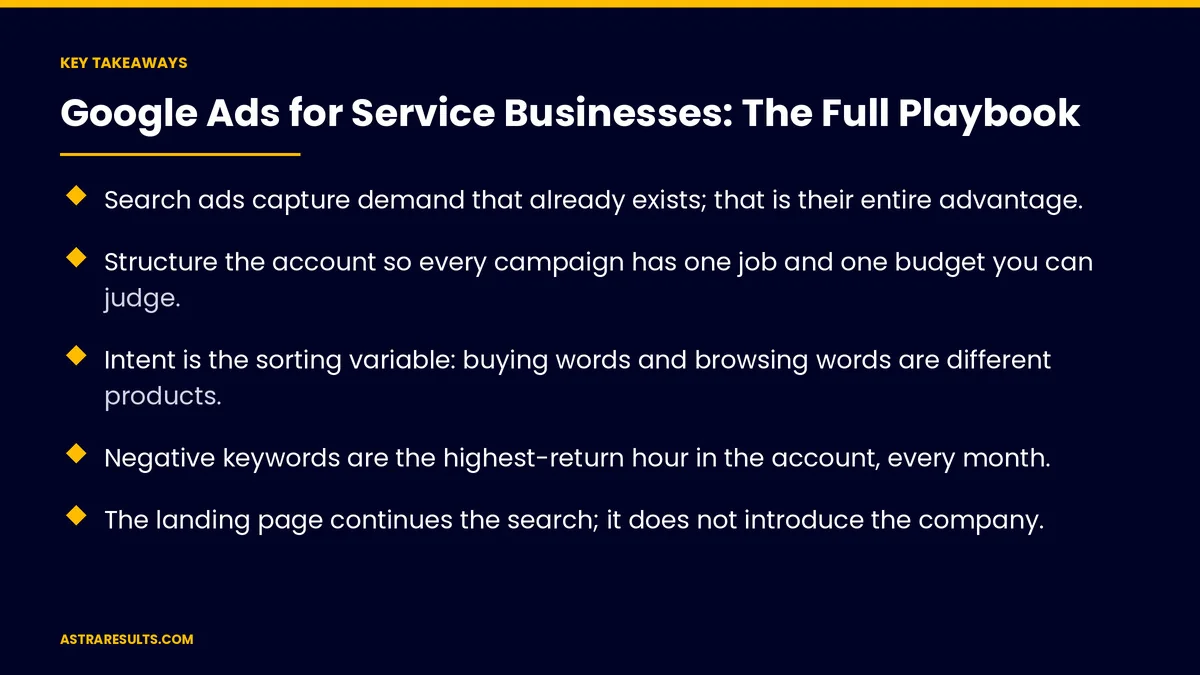
- Search ads capture demand that already exists; that is their entire advantage.
- Structure the account so every campaign has one job and one budget you can judge.
- Intent is the sorting variable: buying words and browsing words are different products.
- Negative keywords are the highest-return hour in the account, every month.
- The landing page continues the search; it does not introduce the company.
- Cost per closed customer is the only number that decides anything.
Published: September 13, 2026 | Reading Time: ~14 minutes | Category: Paid Search
This playbook covers the whole account: how to structure it, how to tell buying intent from browsing, the negative keyword work nobody does, the landing page that has one job, and why what happens after the click decides everything. The short version: you are not buying clicks; you are buying the chance to answer a phone.
Guidance for owners and operators. Nothing here is legal advice. Advertising rules vary by industry and jurisdiction, and some services carry restrictions on claims, targeting and required disclosures that must be reviewed with counsel.
In This Playbook
- What search advertising actually buys
- Structure: one job per campaign
- Intent: buying words versus browsing words
- Negative keywords: the highest-return hour
- Bidding and budget, plainly
- The landing page has one job
- What happens after the click?
- Measuring it
- Where accounts go wrong
- A 90-day sequence
- Working with Astra on this
What search advertising actually buys
- Existing demand, at the moment of need. Nobody searches for an emergency plumber out of curiosity. The search happened because something broke.
- A position, not an audience. Unlike social or streaming, the business is not choosing who to reach; it is bidding to appear when a particular thing is typed.
- Speed. A campaign can produce leads this afternoon, which is why it is the right first channel for most service businesses and the right lever when a slow month needs fixing.
- What it does not buy. Awareness among people who do not yet know they need the service. That is a different job for a different channel, detailed in the four-stage engine.
- The consequence. A search budget is capped by how many people search. Past that point, more budget buys worse traffic, and the right move is a different channel rather than a bigger bid.
Structure: one job per campaign
Most underperforming accounts are badly structured before they are badly optimized.
- Split by service. Each service the business sells gets its own campaign, because each has a different value and a different close rate. Mixing them means the cheap one eats the budget the profitable one needed.
- Split by geography where service areas differ in value, competition or language.
- Split by intent. Emergency and immediate-need searches deserve their own campaign with their own bids and their own hours.
- Split by brand. Brand searches are cheap and convert well; leaving them in a general campaign flatters the account's average and hides how the non-brand terms are doing.
- Keep it small enough to manage. Ten well-structured campaigns a person reviews weekly beat forty that nobody opens.
- How to know. Can you look at any campaign and say what it is for and whether it is working? If not, split it or merge it.
Intent: buying words versus browsing words
The single largest source of wasted spend.
- Buying language. The service plus a qualifier that implies action: near me, today, emergency, cost, quote, open now, a neighborhood, a brand of equipment.
- Browsing language. How to, why does, what is, DIY, diagram, salary, jobs, training, course, free. These searchers are not customers, and many never will be.
- The trap. Broad match against a service keyword catches both, and the browsing searches are cheaper per click, so they consume a growing share of the budget while producing nothing.
- The discipline. Start narrow — phrase and exact match on proven buying terms — and widen deliberately, watching what the widening brings in.
- The search terms report. The actual queries that triggered ads, reviewed weekly. This is where the account tells you the truth about what you are buying.
Negative keywords: the highest-return hour
- What it is. A list of terms that prevent ads from showing. Every account needs one, and most have a token dozen.
- The universal set. Jobs, careers, salary, hiring, free, cheap, DIY, how to, training, course, complaints, lawsuit, reviews of competitors, and the names of competitors unless competitor bidding is deliberate.
- The business-specific set. Services the business does not offer, brands it does not carry, areas it does not serve, customer types it cannot profitably take.
- The rhythm. The search terms report reviewed weekly at first, monthly once stable, with new negatives added every time.
- Why it compounds. Every negative added is spend permanently redirected from traffic that never converts to traffic that might.
- The measurement. The share of spend on terms that produced no leads, falling month over month.
Bidding and budget, plainly
- Start where you can learn. Manual or conversion-focused bidding with enough volume to produce signal. Automated strategies need conversion data to work; giving them none and blaming them is common. Google's own documentation on conversion tracking and match types is the reference for the mechanics here (Google Ads Help).
- Feed it real conversions. A conversion should be a lead or a booked appointment, not a page view or a click on a phone number that nobody answered, explored in outputs over inputs.
- Budget by campaign, not by account. The emergency campaign and the browsing-adjacent campaign should not share a pool.
- Dayparting. Ads run when someone can answer. A business that answers 8am to 6pm and runs ads at 2am is buying voicemail, unless it has AI intake covering those hours.
- The ceiling. When impression share for buying terms is already high, more budget buys lower-intent traffic. Recognize the ceiling instead of pushing through it.
The landing page has one job
- Continue the search. Someone who searched for a specific service in a specific area should land on a page about that service in that area. A generic homepage makes them start over, and many do not.
- Answer the three questions fast. Do you do this? Do you serve my area? How do I reach you right now?
- One action. Call, book, or submit — with the same action repeated, not four competing ones.
- Proof close to the action. Reviews, credentials, photos of real work, near the button rather than at the bottom.
- Speed. A page that takes four seconds on a phone loses a meaningful share of the traffic already paid for.
- Match the promise. If the ad said same-day, the page says same-day. Mismatch is the most expensive kind of wasted click.
What happens after the click?
The part of the account that lives outside the account, and the part that decides its results.
- Answering. A lead that reaches voicemail was paid for and lost. For most service businesses, the phone is the majority of conversions, which is the subject of speed to lead.
- Tracking the calls. Dynamic numbers so calls carry their source, and outcomes logged: answered, missed, booked, not qualified.
- Following up. Forms and missed calls returned within minutes, not the next day.
- Feeding it back. Which campaigns produced booked customers, not just leads, returned into the bidding and the budget decisions.
- The uncomfortable math. An account with a 50% answer rate is paying double for every customer it gets, and no amount of bid optimization fixes that.
Measuring it
- Cost per closed customer by campaign. The number that decides budget, according to attribution by channel.
- Lead-to-customer rate by campaign. A campaign with cheap leads and terrible conversion is expensive.
- Search terms waste. Share of spend on queries that produced nothing.
- Answer rate and speed to lead. Because they cap everything else.
- Impression share on buying terms, as a diagnostic for whether more budget is even available.
- What not to lead with. Clicks, impressions, average position, quality score. All diagnostics, none outcomes.
Where accounts go wrong
- Everything in one campaign. No visibility, no control, the cheapest clicks winning the budget.
- Broad match with no negatives. The fastest way to spend a budget on people looking for jobs.
- Sending all traffic to the homepage. Paying for intent and then discarding it.
- Ads running when nobody answers.
- Conversions defined as anything. Page views counted as leads, making the report look fine while the phone stays quiet.
- Set and forget. Accounts drift. Competitors change bids, new query patterns appear, and an unattended account decays predictably.
A 90-day sequence
Days 1–30: structure and waste
The account restructured one campaign per job. Conversions redefined as leads and booked appointments. Call tracking installed. The negative keyword list built properly. Dayparting matched to when someone answers.
Days 31–60: intent and landing
Match types tightened to proven buying terms. Search terms reviewed weekly with negatives added. Landing pages built per service and area, matching ad promises, with one action and proof near it.
Days 61–90: close the loop
Booked outcomes fed back from the CRM. Cost per closed customer calculated by campaign. Budget reallocated on that number. The ceiling identified for campaigns already at high impression share, and the surplus moved elsewhere.
Working with Astra on this
Astra Results Marketing restructures before it optimizes: one job per campaign, conversions defined as leads and booked appointments rather than page views, call tracking so the phone is measurable, and a negative keyword list built properly rather than inherited.
Because the same team owns the intake, the answer rate and speed to lead are treated as part of the account's performance rather than someone else's problem. Reporting leads with cost per closed customer by campaign. Engagements begin with an account and waste audit through our pay-per-click advertising team.
Related reading
Frequently asked questions
What does Google Ads buy for a service business?
Existing demand at the moment of need — nobody searches for an emergency plumber out of curiosity. It buys a position when a particular thing is typed, rather than an audience, and it can produce leads the same afternoon. What it does not buy is awareness among people who do not yet know they need the service, which is a different job for a different channel.
How should the account be structured?
One job per campaign: split by service because each has a different value and close rate, by geography where areas differ in value or language, by intent so emergency searches get their own bids and hours, and by brand so cheap brand traffic does not flatter the account average. Ten campaigns someone reviews weekly beat forty nobody opens. The test is whether you can say what each campaign is for and whether it is working.
What is the difference between buying and browsing searches?
Buying language pairs the service with a qualifier implying action — near me, today, emergency, cost, quote, a neighborhood. Browsing language is how to, why does, DIY, salary, jobs, training, free. Broad match catches both, and browsing clicks are cheaper, so they quietly consume a growing share of budget while producing nothing. The search terms report, reviewed weekly, is where the account tells the truth.
Why do negative keywords matter so much?
Because every negative added permanently redirects spend from traffic that never converts. Most accounts have a token dozen. The universal set covers jobs, careers, salary, free, cheap, DIY, how to, training, complaints and competitor names; the business-specific set covers services not offered, brands not carried and areas not served. Reviewed weekly at first, then monthly, with new negatives added every time.
What should the landing page do?
Continue the search. Someone who searched a specific service in a specific area lands on a page about that service in that area, not a generic homepage that makes them start over. It answers three questions fast — do you do this, do you serve my area, how do I reach you now — offers one repeated action, puts proof near the button, loads fast on a phone, and matches whatever the ad promised.
What is the most common reason accounts underperform?
What happens after the click. For most service businesses the phone is the majority of conversions, and an account with a 50% answer rate is paying double for every customer it gets — something no bid optimization can fix. Ads running when nobody answers, forms returned the next day, and conversions defined as page views all produce reports that look fine while the phone stays quiet.
READY TO STOP PAYING FOR CLICKS NOBODY ANSWERS? Astra Results Marketing restructures the account one job per campaign, redefines conversions as booked customers, installs call tracking, and reports cost per closed customer by campaign. Astra Results Marketing · 1101 Brickell Ave, Miami, FL 33131 · +1 (786) 321-2866 · [email protected] Find us on Google · Yelp ▸ CALL (786) 321-2866 · ▸ REQUEST YOUR CONSULTATION