 Rated 5 star on


Landing Page Testing: What to Test First
Quick answer
Test the offer first, after fixing broken forms, slow loading, mobile problems and tracking. The offer usually matters more than any design change. Next test the headline's match with the ad, the form length and the proof shown. Button color comes last. Run each test long enough and judge it by qualified leads.
Many teams start landing page testing with button colors. It's easy to set up and almost never matters. Meanwhile the form is broken on some phones, the headline doesn't match the ad, and the offer gives nobody a reason to act now. The order you test in decides whether testing pays off or just keeps people busy.
Key Takeaways
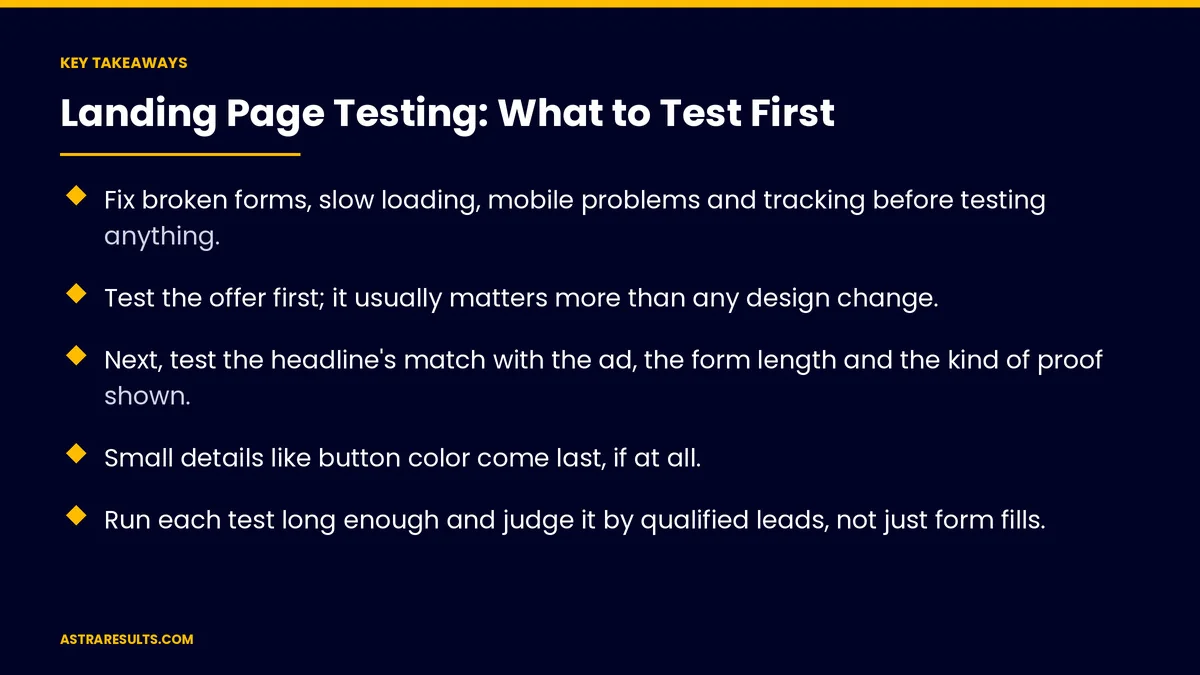
- Fix broken forms, slow loading, mobile problems and tracking before testing anything.
- Test the offer first; it usually matters more than any design change.
- Next, test the headline's match with the ad, the form length and the kind of proof shown.
- Small details like button color come last, if at all.
- Run each test long enough and judge it by qualified leads, not just form fills.
- With modest traffic, test bigger changes, one at a time, and use visitor recordings and feedback.
Published: October 8, 2026 | Reading Time: ~9 minutes | Category: Landing Pages
This guide sets out what to test on a landing page, in order: basics first, then the offer, headline, form and proof before smaller details. It also covers running fair tests, judging by lead quality and testing with modest traffic. Put plainly: fix what's broken, test what's big, and only then refine the details.
In This Playbook
- What should we fix before testing a landing page?
- Test the offer first
- Then the headline and message
- Then the form
- Then proof and trust
- Details come last
- How to run a fair test
- Judge by lead quality
- Testing with modest traffic
- What should a landing page test measure?
- The first three months
What should we fix before testing a landing page?
Broken forms. Test every form on real phones and browsers. A form that fails for some visitors ruins any test.
Slow loading. A slow page loses visitors before they see anything you're testing.
Mobile layout. Most ad traffic is on phones. Check that the offer and button are visible without scrolling far.
Tracking. Make sure calls, forms and bookings are counted correctly, as covered in website KPIs.
Matching ads. Make sure each ad points to the right page, as covered in landing page vs homepage. Local Services Ads send leads to your Google profile instead, so verification matters there, as covered in getting Google Verified.
Test the offer first
What you're offering. A free estimate, a consultation, a discount, a guide, a same-day appointment.
Why now. A reason to act today, such as limited appointments this week, stated only if true.
What it costs the visitor. Time, information and money. Lower barriers often lift results.
Big changes, big lessons. Offer tests often move results more than any design test.
Then the headline and message
Match the ad. The headline should repeat the promise the visitor clicked on.
Lead with the benefit. What the visitor gets, not what your company is called.
Test different angles. Speed, price, expertise or reassurance, depending on what your customers care about.
Keep it clear. A specific, plain headline usually beats a clever one.
Then the form
Fewer fields. Ask only what you need to follow up. Every extra field loses people.
Call or form. Test a prominent phone button against the form, especially on mobile.
Booking instead of a form. Letting visitors pick a time can bring more committed leads.
Watch quality. Shorter forms may bring more leads but fewer good ones, so check both.
Then proof and trust
Reviews and ratings. Real reviews near the form.
Before-and-after or results. Where your industry allows them.
Credentials. Licenses, certifications and years in business.
Faces. Photos of your team instead of stock images.
High-trust decisions need more. Consultations for legal, medical or financial services need extra proof, as covered in CRO for high-ticket consultations.
Details come last
Button text. Clear action words often beat "Submit."
Layout order. Moving proof or the form higher or lower.
Images. Different hero photos.
Colors. Rarely worth testing unless contrast makes the button hard to see.
How to run a fair test
One main change per test. So you know what made the difference.
Split traffic evenly. Half the visitors see each version at the same time.
Run long enough. At least a full week or two, so weekdays and weekends are both included, and until each version has enough conversions that the difference isn't just luck.
Don't stop early. Early leads often look better or worse than they really are.
Write it down. What you tested, why, the result and what you'll do next.
Judge by lead quality
Form fills aren't the goal. Customers are.
Track what happens next. Which version's leads booked, bought or signed.
Use your CRM. Connect leads to outcomes, as covered in attribution across every channel.
Pick the winner on results. A version with fewer but better leads can be the right choice.
Testing with modest traffic
Test bigger changes. Small tweaks need huge traffic to show a difference.
Test one thing at a time, in sequence. Run one version for a period, then the next, comparing carefully.
Watch real visitors. Recordings and heatmaps, used with consent, show where people get stuck.
Ask customers. A short question to new leads about what almost stopped them.
Small budgets need focus. The same principle as running Google Ads on $2,000.
What should a landing page test measure?
Conversion rate. By version, overall and on mobile.
Qualified lead rate. The share of leads that fit your services.
Lead-to-customer rate. By version, from CRM records.
Cost per customer. Ad spend divided by customers from each version.
Test log. Number of tests run and lessons learned.
The first three months
Days 1–30: fix the basics
Test every form on real devices, fix loading speed and mobile layout, confirm tracking and match each ad to the right page. Record baseline conversion and lead quality.
Days 31–60: test the big things
Test the offer first, then the headline. Run each test long enough, judge on qualified leads and write down the results.
Days 61–90: form and proof
Test form length or call versus form, then proof placement. Keep the winners, plan the next test and review lead-to-customer rates by version.
How Astra tests landing pages
Astra Results Marketing tests landing pages in the order that pays. We fix forms, speed, mobile layout and tracking first, then test the offer, headline, form and proof before smaller details.
We run fair tests long enough, judge results by qualified leads and customers, and keep a log of what we learn. Engagements begin with a landing page audit through our landing pages team.
Related reading
Frequently asked questions
What should we test first on a landing page?
Fix the basics first: forms, speed, mobile layout and tracking. Then test the offer, because it usually matters more than any design change.
Is testing button colors worth it?
Rarely. Offer, headline, form length and proof usually matter far more. Test colors only if the button is hard to see.
How long should a landing page test run?
At least a full week or two, so weekdays and weekends are included, and until each version has enough conversions that the difference isn't just chance. Don't stop early.
Should we judge tests by form fills?
Not alone. Track which version's leads became customers. A version with fewer but better leads can be the better choice.
How do we test with low traffic?
Test bigger changes, one at a time, run versions in sequence and compare carefully, and use visitor recordings, heatmaps and short customer questions to learn more.
How many changes should one test include?
One main change, so you know what caused the difference. Bigger, bolder changes are fine as long as they test one idea.
Ready to test the things that move results? Astra Results Marketing fixes your landing page basics first, then tests the offer, headline, form and proof, runs fair tests long enough and judges every result by the customers it brings. ▸ CALL (786) 321-2866 · ▸ REQUEST YOUR CONSULTATION





