 Rated 5 star on

The Creative Brief That Prevents Ten Revisions
Quick answer
A clear one-page brief, filled in before work starts, prevents most creative revisions. Set one measurable goal and name the audience. Give the work one main message and the proof behind it. List the must-haves, formats and sizes. Name who approves and limit the rounds. Then send one combined set of notes that describes problems.
Most creative revisions don't come from bad designers or writers. They come from briefs that never said what the work had to do, who it was for or who would approve it. The first round guesses, five people send five opinions and the project drifts. A one-page brief, filled in before work starts, prevents most of that.
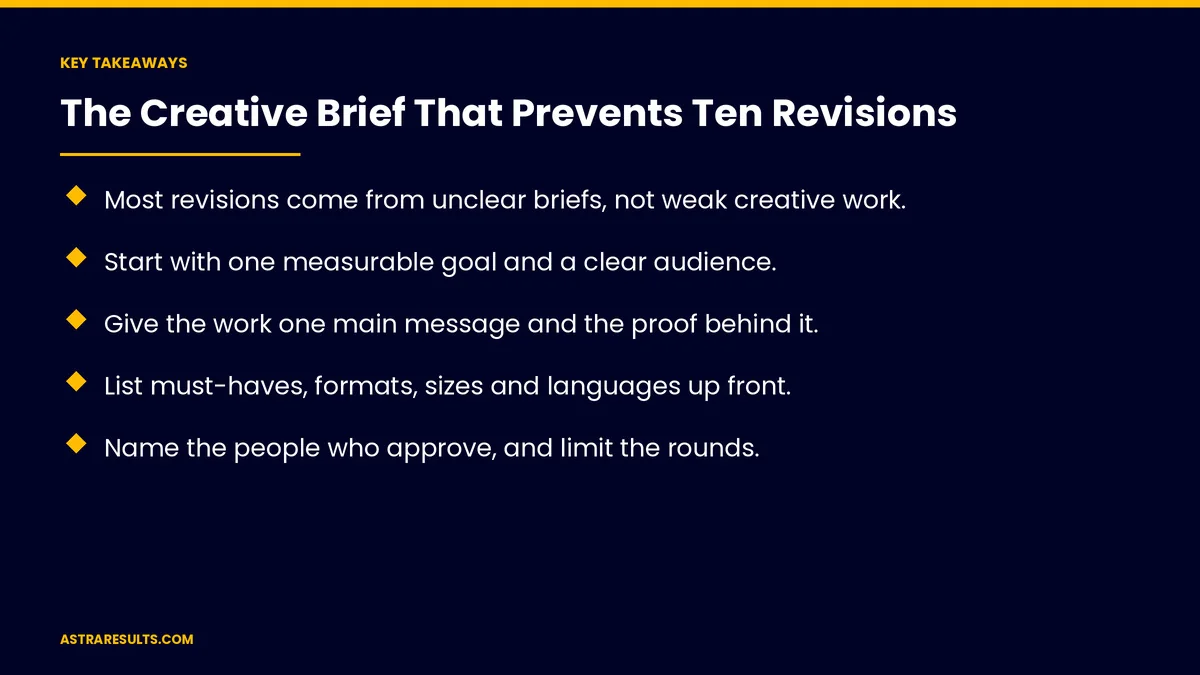
Key Takeaways
- Most revisions come from unclear briefs, not weak creative work.
- Start with one measurable goal and a clear audience.
- Give the work one main message and the proof behind it.
- List must-haves, formats, sizes and languages up front.
- Name the people who approve, and limit the rounds.
- Consolidate feedback and describe problems, not solutions.
Published: October 24, 2026 | Reading Time: ~8 minutes | Category: Creative Marketing
This guide covers how to write a creative brief: the goal, the audience, one message, proof, must-haves, deliverables and formats, tone and examples, budget and timeline, approvals, feedback rules, common mistakes and what to measure. Put plainly: decide what the work must do before anyone starts making it.
In This Playbook
- The goal
- The audience
- How many messages should a creative brief carry?
- Proof
- Must-haves
- Deliverables and formats
- Tone and examples
- Budget and timeline
- Who should sign off on creative work?
- Feedback rules
- Common mistakes
- What to measure
- The first three months
The goal
One business goal. More bookings, more sign-ups or more store visits.
Measurable. A number to check after launch.
The job of this piece. What the ad, video or page must make someone do.
The bigger idea is covered in creative marketing ideas that earn attention.
The audience
Who they are. Customers, prospects or a specific group.
What they think now. Beliefs, doubts and objections.
What we want them to think or do. After seeing the work.
Language. English, Spanish or both, written natively, as covered in Spanish landing pages.
How many messages should a creative brief carry?
The single thing to remember. One sentence.
Not five messages. Extra points dilute the main one.
Concept first. The idea before the format, as covered in creative + video.
Proof
Reasons to believe. Results, reviews, guarantees or credentials.
Approved claims only. Checked before work begins, as covered in creative compliance.
Must-haves
Brand rules. Logo, colors, fonts and tone, ideally from a design system.
Required text. Disclaimers, licenses or legal lines.
Contact details. Phone, website and calls to action.
Deliverables and formats
Every piece listed. Ads, social posts, videos, pages or print, including short conversational ad cards.
Sizes and lengths. Each format and placement.
Variations. Versions for testing, as with seasonal creative at scale.
One shoot, many cuts. Plan them all, as covered in shooting once, cutting twenty.
Tone and examples
Tone words. Three words that describe the feel.
Examples you like. And why.
Examples you don't. And why not.
Budget and timeline
Budget range. So ideas fit what's possible.
Key dates. First draft, feedback, final files and launch.
Buffer time. For approvals, fixes and weather on shoot days, as in video production in Orlando.
Who should sign off on creative work?
Name the approvers. Usually one decision-maker plus required reviewers.
Limit the rounds. Two rounds of changes is common.
Legal review early. Not after final files.
Feedback rules
One combined set of notes. Not separate emails from five people.
Describe problems, not solutions. "The headline doesn't feel urgent," not "make it red."
Tie notes to the brief. Does it meet the goal and message?
Be specific. Point to the exact part that needs work.
Common mistakes
No clear goal. Work can't be judged without one.
Too many messages. Nothing stands out.
Missing formats. Sizes discovered after the design is done.
Surprise approvers. New opinions in the last round.
The same idea in software work is covered in writing a software spec.
What to measure
Revision rounds. Per project.
On-time delivery. Against the timeline.
Results against the goal. The number in the brief.
First-round approval rate. Work approved with minor changes.
Feedback quality. Combined, specific notes received.
The first three months
Days 1–30: build the template
Create a one-page brief template with goal, audience, message, proof, must-haves, formats, tone, budget, timeline and approvers.
Days 31–60: use it on every project
Fill in the brief before work starts, get the approver to sign off on it and collect combined feedback.
Days 61–90: measure and refine
Track revision rounds and on-time delivery, compare results against goals and improve the template.
How Astra briefs creative work
Astra Results Marketing starts every creative project with a clear brief. We agree on the goal, audience, message and proof, list every format, name the approvers and set feedback rules before work begins.
Fewer revisions, faster launches and work that does its job. Engagements begin with a creative planning session through our creative marketing team.
Related reading
Frequently asked questions
What is a creative brief?
A one-page document that says what creative work must do, who it's for, the main message, the formats needed and who approves it.
Why do creative projects need so many revisions?
Usually because the brief was unclear: no measurable goal, too many messages, missing formats or approvers who appear late.
How long should a creative brief be?
About one page. Long enough to cover the essentials, short enough that everyone reads it.
Who should approve creative work?
One decision-maker plus any required reviewers, such as legal, named in the brief before work starts.
How should we give feedback on creative?
Combine notes into one set, describe problems rather than solutions and tie every note back to the brief.
How many revision rounds are normal?
Two rounds of changes is common when the brief is clear. More rounds usually point to a brief problem.
Ready for creative that comes back right the first time? Astra Results Marketing starts every project with a clear brief: one goal, one message, every format listed and named approvers, so work launches faster with fewer revisions. ▸ CALL (786) 321-2866 · ▸ REQUEST YOUR CONSULTATION





