 Rated 5 star on

Creative + Video: Concept First, Camera Second
Quick answer
A business video should start with a clear idea, not a camera booking. Settle one goal, one audience and one message first. A simple story shape helps: hook, problem, turn, proof and call to action. Scripts and storyboards save money on shoot day. Plan formats for each channel and test concepts cheaply before production.
Many business videos fail before anyone presses record. Someone says "we need a video," a crew is booked and the team hopes a message appears in the edit. The result looks polished and says little. Strong videos start with a clear idea: who it's for and what it should make them do.
Key Takeaways
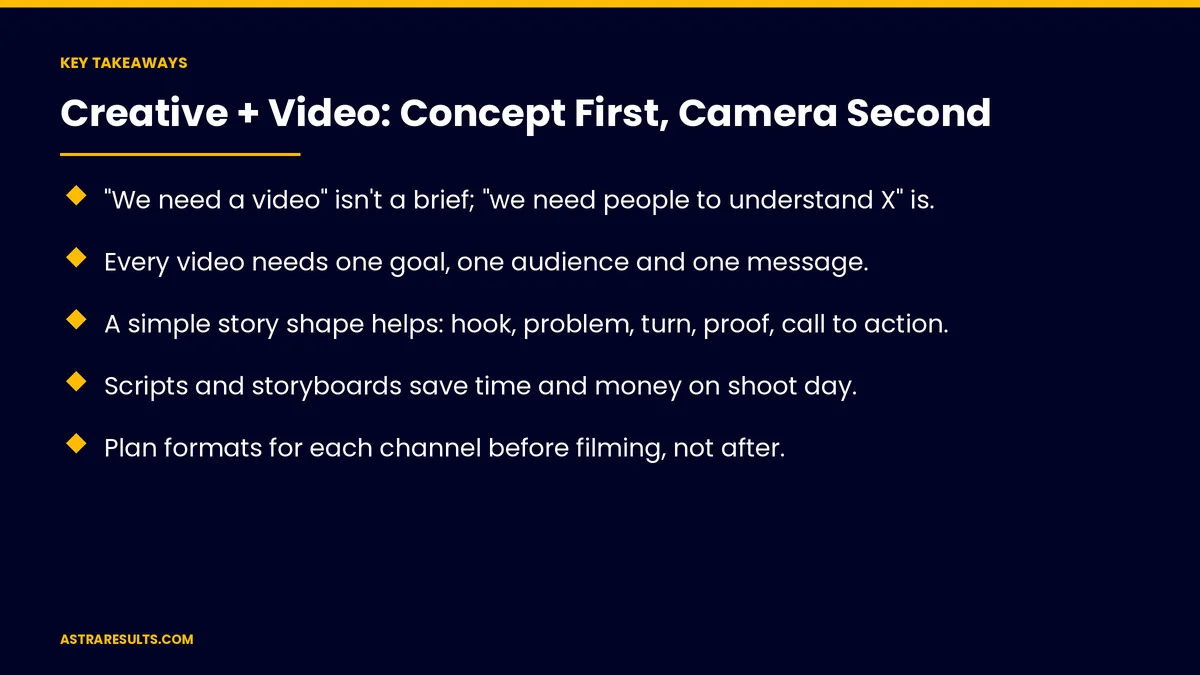
- "We need a video" isn't a brief; "we need people to understand X" is.
- Every video needs one goal, one audience and one message.
- A simple story shape helps: hook, problem, turn, proof, call to action.
- Scripts and storyboards save time and money on shoot day.
- Plan formats for each channel before filming, not after.
- Test concepts cheaply with mockups before paying for production.
Published: October 10, 2026 | Reading Time: ~8 minutes | Category: Creative Marketing
This guide covers putting the concept first: one goal, audience and message, a simple story, scripts and storyboards, formats per channel, cheap tests, budgeting and early checks on rights and claims. Put plainly: settle the idea, the message and the story before anyone films.
In This Playbook
- Why concepts come first
- One goal, one audience, one message
- A simple story shape
- Scripts and storyboards
- Which video formats suit each channel?
- Test concepts cheaply
- Budget for thinking
- Check rights and claims early
- Concepts in practice
- How do we measure a video concept's success?
- The first three months
Why concepts come first
Cameras can't fix a weak idea. Good lighting won't make an unclear message clear.
Edits get expensive. Finding the story after filming means reshoots and long edits.
Clear ideas travel. A strong concept works across formats and channels.
Ideas that earn attention are covered in creative marketing ideas that earn attention.
One goal, one audience, one message
The goal. What should viewers do or believe after watching?
The audience. Who exactly is this for: new customers, current clients or job seekers?
The message. One sentence the video must get across.
Cut the rest. Extra messages dilute the main one.
A simple story shape
Hook. A first few seconds that earn attention.
Problem. What the viewer struggles with.
Turn. How things change, with your product or service.
Proof. Real examples, customers or results, stated accurately.
Call to action. The one next step.
Scripts and storyboards
Write the script. Words people would say out loud.
Storyboard the shots. Simple sketches or photos of each scene.
Plan the shot list. What to film, where and with whom.
Use the full process. As covered in business video from brief to broadcast.
Which video formats suit each channel?
Decide before filming. Vertical for short social, horizontal for websites and YouTube.
Lengths. A short cut, a medium version and a full version.
Plan extra clips. One shoot can feed many pieces, as covered in shooting once, cutting twenty.
Captions and text. Many people watch without sound.
Test concepts cheaply
Static mockups. Test the message as an image ad first.
Rough cuts. Simple animations or phone footage to check the story. AI tools can help, but the idea comes first, as in AI in marketing.
Ask real customers. Do they understand the message?
Change the idea, not the footage. Fixing a concept is cheaper than reshooting.
Budget for thinking
Concept and planning matter. Time spent on the idea saves money on production.
Match production to purpose. Some ideas need a full crew; others work with a phone.
Small teams can do a lot. With the right setup, as covered in the video production stack for small teams.
Check rights and claims early
Claims in the script. Make sure they can be backed up, as covered in creative compliance.
Releases and music. Plan them before shoot day, as covered in video rights and releases.
Locations. Permission to film where you plan to shoot.
Concepts in practice
A restaurant. Not "show the food," but "show why regulars come back every week."
A construction firm. Not "show our projects," but "show how we finish on schedule," as in construction firm video.
A software company. Not "explain features," but "show one problem solved in a minute."
How do we measure a video concept's success?
Message recall. Do viewers remember the main point?
Completion rate. Do they watch to the end?
Action taken. Clicks, calls or sign-ups after watching, as covered in social media KPIs.
Production time and cost. Before and after planning concepts first.
Reshoots avoided. Fewer changes after filming.
The first three months
Days 1–30: define the concepts
For your next videos, write one goal, one audience and one message each. Outline the story with a hook, problem, turn, proof and call to action.
Days 31–60: test and plan
Test concepts with static mockups or rough cuts, write scripts, build shot lists and plan formats for each channel. Check claims, releases and music.
Days 61–90: produce and measure
Film with the plan, cut versions for each channel and measure recall, completion and action against past videos.
How Astra develops creative concepts
Astra Results Marketing starts every video with the concept. We define the goal, audience and message, shape the story, test ideas cheaply and plan every format before filming.
Rights and claims are checked early, and results are measured by what viewers do. Engagements begin with a creative brief session through our creative marketing team.
Related reading
Frequently asked questions
Why start with the concept instead of filming?
Cameras can't fix a weak idea. Settling the goal, message and story first avoids long edits and reshoots, and makes every version stronger.
What should a video brief include?
One goal, one audience, one message, a simple story outline and the formats needed for each channel.
What's a simple story structure for business videos?
A hook, the viewer's problem, the turn your product or service brings, proof and one call to action.
How can we test a video idea before filming?
Run the message as a static ad, make a rough cut with simple footage or animation, and ask real customers whether the message is clear.
Do we need a big production budget?
Not always. Match production to the idea. Some concepts need a full crew; others work with a phone and good planning.
When should we check rights and claims?
During planning, before shoot day: script claims, releases, music licenses and location permissions.
Ready for videos built on a clear idea? Astra Results Marketing starts every video with the concept: one goal, one message, a simple story and formats planned for every channel before the camera rolls. ▸ CALL (786) 321-2866 · ▸ REQUEST YOUR CONSULTATION





