Rated 5 star on


Creative Marketing: Ideas That Earn Attention
Quick answer
Creative earns attention by saying something specific a competitor could not say, in a voice the business can sustain. If a competitor could run your ad with their logo on it, you have not made an ad. A written brief agreed before work starts removes most revision cycles, and concepts come from customer language rather than a workshop.
Creative is the part of marketing most businesses judge by taste and manage by committee, which is why so much of it ends up identical to the competition. Everyone in the category uses the same stock photograph, the same adjectives, and the same promise to be trusted and professional. None of it is wrong. All of it is invisible.
Key Takeaways
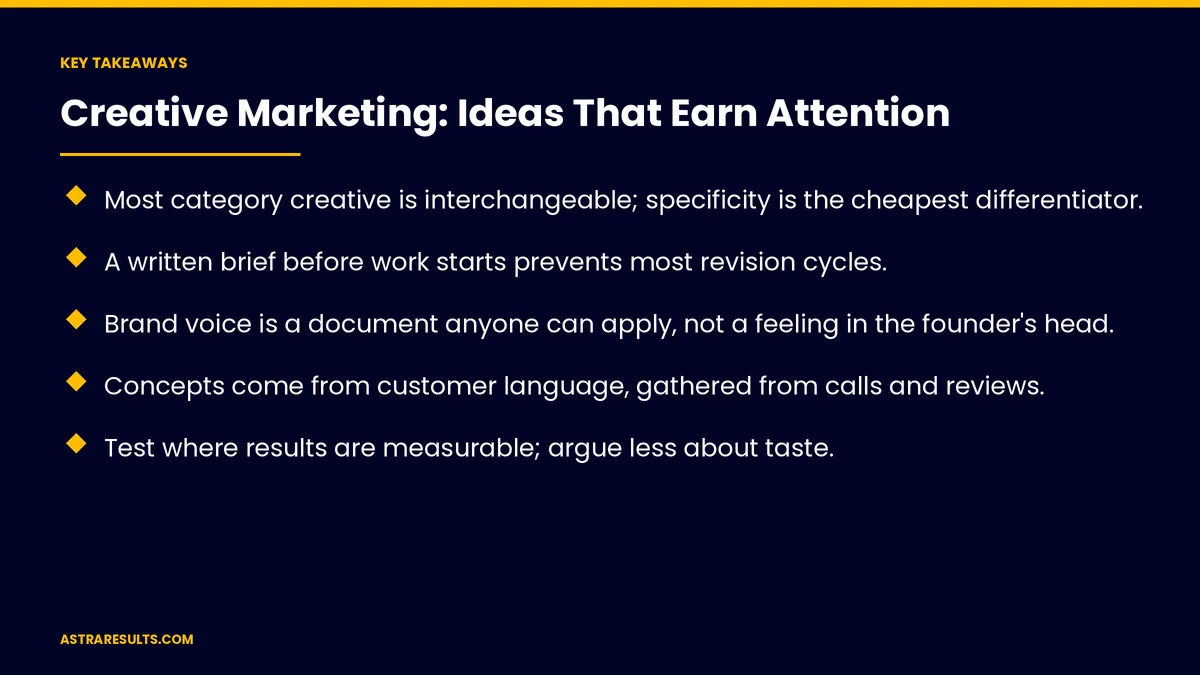
- Most category creative is interchangeable; specificity is the cheapest differentiator.
- A written brief before work starts prevents most revision cycles.
- Brand voice is a document anyone can apply, not a feeling in the founder's head.
- Concepts come from customer language, gathered from calls and reviews.
- Test where results are measurable; argue less about taste.
- Consistency across surfaces compounds; novelty for its own sake resets it.
Published: September 11, 2026 | Reading Time: ~13 minutes | Category: Creative
Good creative is not a matter of being clever. It is a matter of saying something specific that a competitor could not say, in a voice the business can sustain, produced through a process that does not consume everyone's week in revisions. This piece covers that process. Stated simply: if a competitor could run your ad with their logo on it, you have not made an ad.
Guidance for owners and operators. Nothing here is legal advice. Advertising claims, comparative advertising, endorsements and use of likenesses carry requirements that vary by industry and jurisdiction and should be reviewed with counsel.
In This Playbook
- Why most category creative is interchangeable
- Which brief prevents ten rounds of revisions?
- Brand voice as a document
- Concepts come from customer language
- Testing, where it is possible
- Consistency and the temptation to refresh
- Working with a creative team
- What the first quarter looks like
- Working with Astra on this
Why most category creative is interchangeable
- The mechanism. A business looks at what competitors do to understand the category conventions, then produces something within them. Everyone does this, and the category converges.
- The stock photograph problem. Images chosen because they are inoffensive are also unmemorable, and customers have seen the same ones on three other sites.
- The adjective problem. Trusted, professional, reliable, customer-focused, quality. Every competitor claims them, so none of them carry information.
- The test that exposes it. Cover the logo. If the piece could belong to any competitor, it is not doing the job it was paid for, which is the same test applied to written content in depth over volume.
- What breaks the pattern. Specifics. The actual process, the actual people, the actual guarantee, the actual thing that is true here and not next door.
Which brief prevents ten rounds of revisions?
Most revision cycles are a brief problem wearing a creative costume.
- What a brief must contain. Who this is for, what they currently believe, what we want them to believe, the one thing we must say, what we cannot claim, where it will appear, and what success looks like.
- Who writes it. Whoever owns the outcome, not the creative team. A creative team writing its own brief is guessing at intent and will be corrected in round three.
- What it must not contain. Solutions. "A video with drone footage" is not a brief; it is a preemptive answer that skips the thinking.
- The approval question, answered upfront. Who approves, on what criteria, and by when. Unnamed approvers appearing at the end is the single largest cause of wasted creative work.
- The claims list. What the business can and cannot say, checked with counsel where the category is regulated, before the work rather than after it is designed.
- The effect. A brief takes an hour and routinely saves several rounds.
Brand voice as a document
- Why it needs to be written. Because five people write for the business — the owner, the salesperson, the person answering messages, the agency, and the person who updates the website — and without a document they write as five different companies.
- What the document holds. How the business talks, with examples of on-voice and off-voice sentences. The words it uses and the ones it avoids. Formality level. How it handles bad news, complaints and price questions.
- How to derive it. From the best of what already exists: the way the owner explains the work to a customer, the review that describes the business accurately, the email that got a reply.
- The bilingual dimension. Voice does not translate cleanly. A Spanish voice guide is a separate document written by a native speaker of the register, not a translated version, as explored in Spanish as a channel.
- The test of a good voice document. A new writer produces something on-voice on the first attempt.
Concepts come from customer language
- Where the good lines already exist. In recorded intake calls, in reviews, in the questions customers ask before buying, in the objection the salesperson hears weekly.
- What to listen for. The words customers use for the problem, which are rarely the words the industry uses. The relief they express afterward. The fear they mention before committing.
- Why this beats brainstorming. A concept built from a sentence a real customer said is grounded and specific. A concept built in a meeting is a guess dressed as insight.
- The practical method. Read a hundred reviews and listen to twenty calls, pulling exact phrases. The campaign is usually in there.
- The connection to search. The same customer language is what the business should be ranking and being cited for, so the research serves two purposes, as detailed in intent over keywords.
Testing, where it is possible
- What can be tested. Ad creative, subject lines, headlines, landing pages, thumbnails — anywhere enough volume exists to distinguish a real difference from noise.
- What cannot. A logo, a brand identity, a long-term positioning. These are judgment calls, and pretending a small test settles them produces false confidence.
- How to test properly. One variable, enough volume, a predefined success metric, and long enough to be meaningful. Most informal creative tests are underpowered and read as conclusive.
- What testing is really for. Ending arguments about taste with evidence, and finding the occasional result nobody predicted.
- The metric. Cost per closed customer by creative, not click-through rate, which frequently favors creative that attracts the wrong people, as covered in outputs over inputs.
Consistency and the temptation to refresh
- Why consistency matters. Recognition compounds. A business that looks the same across its site, ads, social, vehicles, invoices and premises builds recall with every impression.
- The internal boredom problem. The team sees the creative hundreds of times more than any customer and tires of it long before the market has noticed it.
- The rule of thumb. When the people inside the business are sick of it is roughly when the market is starting to recognize it.
- When to refresh. When it is dated, when the business has changed, or when performance has decayed with evidence — not on a calendar.
- What to keep even in a refresh. The elements customers use to recognize the business: the color, the mark, the name treatment. Changing everything discards the accumulated recognition.
Working with a creative team
- Give them the brief and the constraints, not the solution. The value of a creative partner is the thinking; specifying the output buys execution only.
- Consolidate feedback. One set of consolidated notes beats five people commenting separately, which produces contradictions the team resolves by guessing.
- Distinguish preference from problem. "I do not like blue" is a preference. "Our customers will not understand this" is a problem. Only one needs solving.
- Respect the claims list. Asking creative to say something the business cannot substantiate is asking for a compliance problem with good typography.
- Ownership. Working files, fonts, photography rights and usage terms specified in the contract, so future edits do not require paying again, as set out in what stays yours.
What the first quarter looks like
Days 1–30: gather and define
A hundred reviews and twenty calls mined for exact customer language. The brand voice document drafted from the best existing material, with on-voice and off-voice examples. The claims list agreed with counsel where relevant. The brief template adopted with named approvers.
Days 31–60: make
Two or three concepts built from customer language, produced for the surfaces that matter most. Real photography replacing stock. The cover-the-logo test applied before anything ships.
Days 61–90: test and standardize
Creative tested where volume allows, judged on cost per closed customer. The winning direction applied consistently across surfaces. The voice document handed to everyone who writes for the business.
Working with Astra on this
Astra Results Marketing starts by mining the business's own customer language from reviews and recorded calls, because a concept built from a sentence a real customer said beats one built in a meeting. The brand voice is written as a document with on-voice and off-voice examples, so five different people writing for the business sound like one.
Every brief names its approvers and its claims limits before work starts, creative is tested on cost per closed customer rather than click-through rate, and the cover-the-logo test is applied before anything ships. Working files and rights belong to the client. Engagements begin with a voice and creative audit through our creative marketing team.
Related reading
Frequently asked questions
Why does most creative in a category look the same?
Because businesses study competitors to learn the conventions and then produce work within them, so the category converges. Stock photographs chosen for being inoffensive are also unmemorable, and adjectives every competitor claims — trusted, professional, reliable — carry no information. The test is to cover the logo: if the piece could belong to any competitor, it is not doing the job it was paid for.
What should a creative brief contain?
Who it is for, what they currently believe, what we want them to believe, the one thing that must be said, what cannot be claimed, where it will appear, and what success looks like. It is written by whoever owns the outcome rather than the creative team, and it must not contain solutions — "a video with drone footage" is a preemptive answer that skips the thinking. It should also name the approvers.
Why write brand voice down?
Because at least five people write for a business — the owner, a salesperson, whoever answers messages, the agency, whoever updates the site — and without a document they write as five different companies. The document holds on-voice and off-voice examples, the words used and avoided, formality, and how bad news and price questions are handled. A good one lets a new writer get it right first time.
Where do good creative concepts come from?
Customer language, gathered from recorded intake calls, reviews, pre-purchase questions and the objection the salesperson hears weekly. Listen for the words customers use for the problem, which are rarely the industry's words. Reading a hundred reviews and listening to twenty calls surfaces the campaign, and the same language is what the business should be ranking and being cited for.
What creative can and cannot be tested?
Ad creative, subject lines, headlines, landing pages and thumbnails can be tested where volume is sufficient to separate a real difference from noise. A logo, a brand identity or a long-term positioning cannot, and pretending a small test settles them produces false confidence. Judge tests on cost per closed customer, not click-through rate, which favors creative that attracts the wrong people.
When should creative be refreshed?
When it is dated, when the business has changed, or when performance has decayed with evidence — not on a calendar. The team sees the work hundreds of times more than any customer and tires of it long before the market notices it, so internal boredom is roughly the point at which recognition is starting to build. Even in a refresh, keep the elements customers use to recognize the business.
READY TO MAKE WORK A COMPETITOR COULD NOT RUN? Astra Results Marketing mines your own customer language for concepts, writes the voice document your whole team can apply, names approvers and claims limits before work starts, and tests on cost per closed customer. Astra Results Marketing · 1101 Brickell Ave, Miami, FL 33131 · +1 (786) 321-2866 · [email protected] Find us on Google · Yelp ▸ CALL (786) 321-2866 · ▸ REQUEST YOUR CONSULTATION