 Rated 5 star on

Video Rights, Music Licensing and Releases
Quick answer
A business video is safe to publish only once ownership, music and releases are settled in writing. The production contract should say who owns the final video and raw footage. Music needs a license that covers your use. Get written releases from everyone identifiable, because Florida law requires consent to use a likeness.
A great video can be pulled offline in a day. A song claim mutes it, a former employee asks to be removed, or a customer objects to an ad they never agreed to. Most of these problems start before filming, when nobody checked who owns the footage, what the music license covers or who signed a release.
Key Takeaways
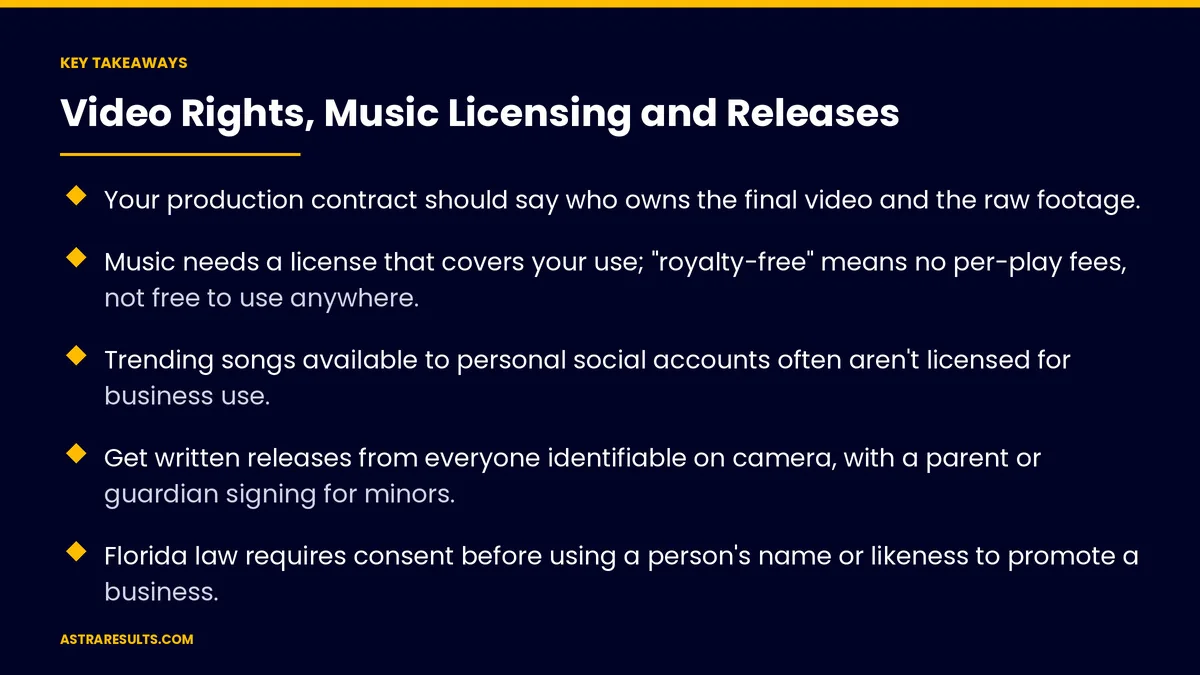
- Your production contract should say who owns the final video and the raw footage.
- Music needs a license that covers your use; "royalty-free" means no per-play fees, not free to use anywhere.
- Trending songs available to personal social accounts often aren't licensed for business use.
- Get written releases from everyone identifiable on camera, with a parent or guardian signing for minors.
- Florida law requires consent before using a person's name or likeness to promote a business.
- Testimonials must reflect real experiences, and paid or connected endorsers must be disclosed.
Published: October 29, 2026 | Reading Time: ~9 minutes | Category: Video Production
This guide covers the rights and permissions a business needs before publishing video: owning the footage, licensing music, collecting releases from people and locations, handling logos and artwork and following the rules for testimonials. Put plainly: settle ownership, music and signatures before you shoot, not after you post.
This is general information, not legal advice. Have counsel review your production contracts and release forms.
In This Playbook
- Who owns the video
- Music licensing basics
- Music on social platforms
- Releases from people
- Locations, logos and artwork
- Testimonials and reviews
- AI voices and likenesses
- A pre-shoot checklist
- Which video rights issues should we track?
- The first three months
Who owns the video
Put it in the contract. State who owns the final edit, the raw footage and the project files.
Ownership or license. Some producers transfer ownership; others grant a license with limits on where and how long you can use the video.
Raw footage matters. You may want it later for new cuts, as covered in shooting once, cutting twenty.
Freelancers and staff. Make sure everyone who shoots or edits has signed terms that cover the work.
The full production process is covered in business video from brief to broadcast.
Music licensing basics
Two rights in a song. The composition, meaning the melody and lyrics, and the recording itself. Using a commercial song in a video usually needs permission for both.
Stock music libraries. Paid libraries license tracks for business use under set terms. Read what each license covers: platforms, ads, broadcast and how long.
Royalty-free isn't free. It usually means you pay once and owe no per-play fees, within the license terms.
Keep the paperwork. Save every license and receipt with the project.
Original music. A composer can write and license music made for you.
Music on social platforms
Personal and business accounts differ. Songs available to personal accounts often aren't cleared for brand use.
Use the commercial library. Many platforms offer business accounts a library of music cleared for commercial use.
Claims and muting. Unlicensed music can trigger automated claims that mute, block or take over earnings from a video.
Ads need clear rights. Boosting a post turns it into an ad, so the music must be licensed for advertising.
Releases from people
Anyone identifiable. Get a signed release from people who can be recognized, such as customers, staff, actors and bystanders featured on camera.
Florida's rule. State law requires consent before using a person's name or likeness to promote a business. Get it in writing.
Minors. A parent or guardian must sign for anyone under 18. Schools have extra steps, as covered in school social media for enrollment and parents.
Employees. Get releases from staff too, and say whether the video can stay up after they leave.
Say how it will be used. Websites, social media, ads and broadcast, and for how long.
Locations, logos and artwork
Location releases. Get written permission to film on private property, including what can be shown.
Public places. Permits may be needed for filming in some public spaces, especially with crews and equipment.
Logos and brands. Avoid featuring other companies' logos prominently, especially in ads.
Artwork and murals. Art in the background can be protected. Get permission or keep it out of frame.
Testimonials and reviews
Real experiences only. Testimonials must reflect what customers really experienced, and results shown should be typical or clearly explained.
Disclose connections. If someone was paid, received free products or is an employee or relative, say so clearly.
No fake reviews. The FTC's rule on consumer reviews bans fake reviews and testimonials, including ones made up or bought.
Keep records. Save releases and notes on how each testimonial was collected.
Regulated fields. Lawyers, doctors and financial advisers face extra rules on testimonials, as covered in video for medical and legal practices. Check with counsel.
AI voices and likenesses
Consent first. Never clone a person's voice or face without written permission.
Say how it will be used. The release should cover AI-generated versions specifically.
Disclose where needed. Some platforms require labels for AI-generated or altered content.
Stock AI tools. Check the license terms for commercial use, just as with stock music.
A pre-shoot checklist
Contract signed. Ownership of the final video and raw footage is clear.
Music chosen and licensed. Before editing, not after.
Releases ready. For people, minors, staff and locations.
Shot list checked. Logos, artwork and private property planned for.
Testimonials documented. Real customers, connections disclosed.
Files organized. Licenses and releases stored with the project, so they're easy to find for video SEO or a new cut.
Which video rights issues should we track?
Claims and takedowns. Music or rights claims per video.
Release coverage. The share of on-camera people with signed releases.
License records. Every video with its licenses on file.
Reuse. How often footage is reused without new rights problems.
Video results. Views and leads, as covered in video KPIs.
The first three months
Days 1–30: contracts and forms
Review production contracts for ownership of final videos and raw footage. Have counsel prepare release forms for people, minors, staff and locations. Choose a stock music library and read its license terms.
Days 31–60: apply on every shoot
Use the pre-shoot checklist on every production. License music before editing, collect releases on set and document every testimonial.
Days 61–90: audit what's live
Check videos already published for music licenses, releases and testimonial disclosures. Fix or remove anything missing, and organize all licenses and releases by project.
How Astra handles video rights
Astra Results Marketing produces video with rights settled before the camera rolls. We clarify ownership of final videos and raw footage, license music for every intended use and collect releases from people, minors, staff and locations.
Testimonials come from real customers with connections disclosed, and every license and release is stored with the project. Engagements begin with a video and rights review through our video production and creative marketing team.
Related reading
Frequently asked questions
Who owns a video we paid to produce?
Whoever the contract says. Some producers transfer ownership of the final video and raw footage; others grant a license with limits. Put ownership in writing before production starts.
Can we use a popular song in our business video?
Usually not without permission for both the song and the recording, which can be expensive. Licensed stock music or original music is the practical choice for most businesses.
Does "royalty-free" mean we can use music anywhere?
No. It usually means you pay once and owe no per-play fees, but the license still limits where and how you can use it. Read the terms.
Do we need releases from everyone on camera?
From anyone who can be identified, in writing. Florida law requires consent before using a person's name or likeness to promote a business, and a parent or guardian must sign for minors.
What are the rules for customer testimonials?
They must reflect real experiences, connections such as payment or free products must be disclosed, and fake or bought reviews are banned by the FTC. Regulated fields have extra rules.
Can we use AI to recreate someone's voice or face?
Only with that person's written permission covering AI-generated versions, and with labels where platforms require them.
Ready to publish video without rights problems? Astra Results Marketing produces video with ownership, music licenses and releases settled before filming, testimonials documented and every license stored with the project. ▸ CALL (786) 321-2866 · ▸ REQUEST YOUR CONSULTATION





