Rated 5 star on

Business Video From Brief to Broadcast
Quick answer
Business video works when it starts from the job it has to do rather than from the wish to have a video. Write the brief first, shoot the work being done instead of a brand film, and plan one production day to yield a quarter of edits. Captions are not optional, and rights and releases are settled before the shoot.
Most business video gets commissioned backwards. Someone decides the company needs a video, a crew arrives, a polished two-minute film about values and passion is produced, it goes on the homepage, and it is never used again. It cost real money and it sold nothing, because nobody asked what job it was supposed to do before the camera came out.
Key Takeaways
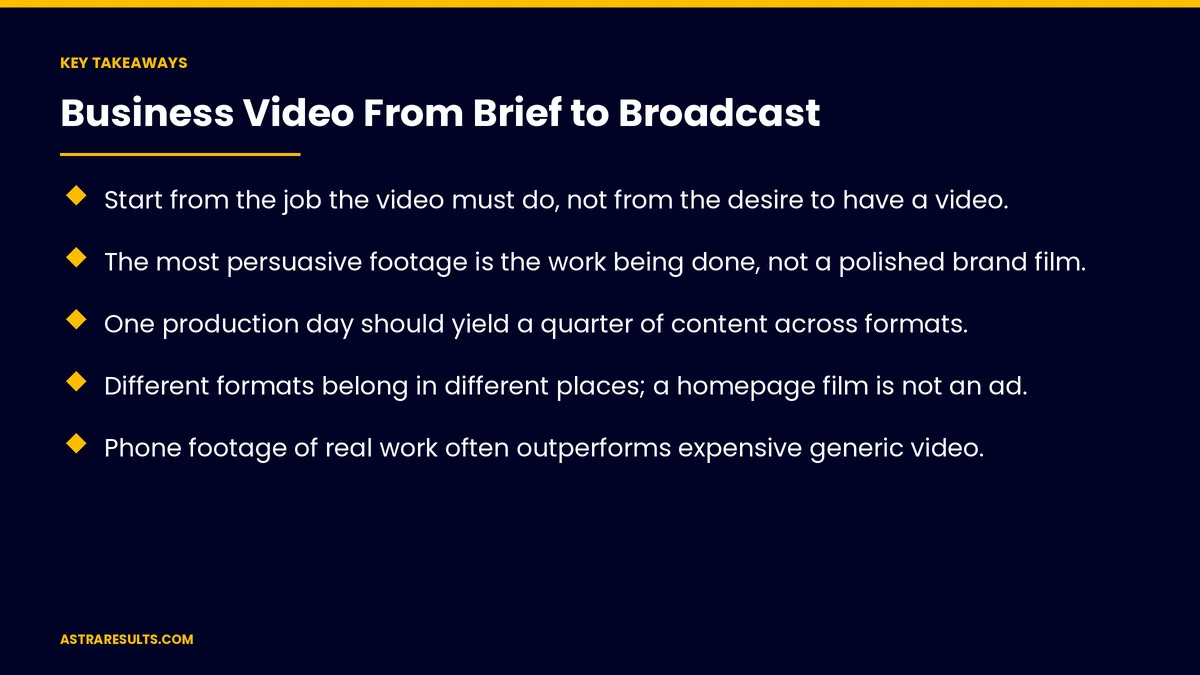
- Start from the job the video must do, not from the desire to have a video.
- The most persuasive footage is the work being done, not a polished brand film.
- One production day should yield a quarter of content across formats.
- Different formats belong in different places; a homepage film is not an ad.
- Phone footage of real work often outperforms expensive generic video.
- Measure video by conversion on the pages it lives on and customers it produced.
Published: September 9, 2026 | Reading Time: ~14 minutes | Category: Video Production
Video works when it starts from the job. This guide covers that sequence: writing a brief that names the job, what to actually shoot, how one production day becomes a quarter of content, where each format belongs, and how to tell whether any of it worked. Reduced to a sentence: shoot once, cut twenty times, or the economics never work.
Guidance for owners and operators. Nothing here is legal advice. Music licensing, appearance releases, location permissions and advertising claims carry requirements that vary by jurisdiction and should be reviewed with counsel.
In This Playbook
- Start from the job
- What to shoot
- The production day
- One shoot, a quarter of content
- Where each format belongs
- Captions, always
- Which rights, releases and music clearances are needed?
- What it costs and what drives it
- Measuring video
- A 90-day plan
Start from the job
- The wrong question. "What video should we make?"
- The right question. "What is someone not doing, and could seeing something change that?"
- The jobs video does well. Proving competence by showing real work. Explaining something that is hard to describe in text. Introducing the person a customer will deal with. Demonstrating a process so a buyer knows what to expect. Answering the objection that stops deals.
- The jobs it does badly. Building generic brand feeling in the absence of anything specific to show. Replacing a clear written explanation. Conveying detailed information the viewer needs to reference later.
- The brief. One page: the job, the viewer, where it will live, what it must make them do, and what it must never claim. If that page cannot be written, the video is not ready to shoot.
What to shoot
The honest list, ordered by how much most businesses underuse it.
- The work itself. The install, the repair, the build, the kitchen, the floor, the crew. Almost every business has footage-worthy work and almost none of it gets shot.
- The people who do it. The technician explaining what they are doing, in their own words. More persuasive than any scripted spokesperson.
- The process, start to finish. What a customer experiences from first call to completion, so a buyer knows what they are buying.
- The answers. The ten questions customers always ask, each answered on camera in under a minute, as covered in content that gets cited.
- Customers, with permission. In their words, naming the specific thing that mattered.
- The before and after. Where the work has a visible result, shot from the same position.
- What to skip. Drone footage of the building, stock-style office shots, and anything that would work equally well for a competitor.
The production day
- Plan for volume. A day producing one finished video is a day priced wrong. The same day should produce the raw material for a dozen.
- Batch by setup. All the interview answers in one sitting, all the process footage in one visit, all the product shots together. Moving the camera is what costs time.
- Sound over picture. Bad audio makes a video unwatchable; imperfect picture rarely does. A lapel microphone is the cheapest quality upgrade available.
- Coach, do not script. People reading a script look like people reading a script. Give them the question, let them answer it three times, keep the third.
- Shoot for the crop. Frame so the same footage works vertical, square and wide, because it will need to.
- Capture more than the plan. The unscripted moment in the workshop is often the clip that performs.
One shoot, a quarter of content
This is the economics of the whole channel.
- The long piece. Two to three minutes for the website, explaining what the business does or how the process works.
- The short answers. Ten to twenty clips under a minute, each answering one question, for social, service pages and AI-citable content.
- The ad cuts. Six to fifteen seconds, with the hook in the first two, for paid social and connected TV, the case for which sits in creative that stops the scroll.
- The vertical cuts. The same content reframed for phone-first platforms.
- Stills. Frame grabs and photography from the same day, for the website and profiles.
- The library effect. Two shoots a year, planned this way, keep every channel supplied. Businesses that commission one video a year starve the channels that consume creative fastest.
Where each format belongs
- Homepage. One short piece that answers "what is this and is it for me." Not autoplaying with sound.
- Service pages. The explainer and the process video for that specific service, near the action.
- Paid social. Short, hook-first, captioned, in the platform's native aspect ratio. Multiple variants, because they fatigue.
- Connected TV. The most produced format, full screen, sound on, judged by completed views, which is the subject of awareness channels.
- Search and AI. Question-answer clips embedded on pages that answer those questions in text too.
- Sales and intake. The process video sent to a prospect before a consultation, which shortens the conversation.
- Recruiting. The team and the work, which is the most effective hiring content most businesses never make.
Captions, always
- Because most viewing is silent. On social especially, a video without captions is a video most people do not watch.
- Burned in or platform-native. Either works; absent does not.
- Accuracy matters. Auto-captions get names, technical terms and accents wrong, and wrong captions read as carelessness.
- Second language. Captioning in Spanish opens the same footage to a different audience without reshooting, which is close to free reach, the mechanics of which are in Spanish as a channel.
Which rights, releases and music clearances are needed?
The administrative part that quietly creates risk.
- Appearance releases. Written permission from everyone identifiable on camera — employees and customers — covering the uses the business intends, including paid advertising.
- Customer property. Permission to film and publish someone's home or premises, and care with anything identifying.
- Music licensing. Commercial use requires a license. Platform audio libraries carry their own terms and are not cleared for paid advertising use.
- Ownership. The business owns the raw footage, not just the finished cuts. Without the raw files, every future edit means paying again, according to what stays yours.
- Retention of releases. Filed and findable, because the question arrives years later.
What it costs and what drives it
- The main drivers. Days of shooting, number of locations, crew size, and how much post-production each cut needs.
- Where money is well spent. Sound, lighting, a competent editor, and enough shooting time to get real moments.
- Where it is usually wasted. Elaborate concepts, actors, sets, and animation for things that could simply be filmed.
- The phone question. For social and answers, phone footage with good sound and light is competitive. For connected TV and the homepage, it is not.
- The comparison to make. Cost per finished asset from a planned day versus per-video pricing for one-offs. The gap is usually large.
Measuring video
- Conversion rate on pages with and without the video. The cleanest test available.
- Watch time and completion, which say whether the opening works.
- Paid social cost per booked customer by creative, which is how ad cuts are judged.
- Completed views for connected TV, with branded search lift as the outcome signal.
- Assets produced per shoot day, which measures whether the production is being run economically.
- Views, in the appendix. A video with many views and no conversions did a different job than intended.
A 90-day plan
Days 1–30: brief and plan
The jobs video must do, listed by where deals stall. The ten questions customers always ask, written. Locations, people and releases arranged. The shot list built for volume across formats.
Days 31–60: shoot and cut
One production day, batched by setup, capturing work, people, process and answers. The edit produces the long piece, the short answers, the ad cuts, the vertical versions and stills. Captions on everything, in both languages where relevant.
Days 61–90: place and measure
Assets placed on the homepage, service pages, paid social, intake follow-up and recruiting. Conversion compared on pages before and after. Ad creative tested and rotated. The next shoot planned from what performed.
How Astra produces video
Astra Results Marketing writes the brief before the shoot: the job, the viewer, the destination, and the action it must produce. Production days are planned for volume so one shoot supplies a quarter of content across the website, paid social, connected TV, intake and recruiting.
Releases, music licensing and raw footage ownership are handled at the start, and the client owns the raw files rather than only the finished cuts. Reporting runs on conversion where the video lives and cost per booked customer by creative. Engagements begin with a video brief through our video production and creative marketing team.
Related reading
Frequently asked questions
What makes business video fail?
Starting from the desire to have a video rather than from the job it must do. A polished film about values and passion goes on the homepage, costs real money and sells nothing, because nobody asked what someone is not doing and whether seeing something could change that. The fix is a one-page brief naming the job, the viewer, the destination and the required action before anyone shoots.
What should a business actually shoot?
The work itself — the install, the repair, the build, the crew — which almost every business has and almost none films. The people who do it, explaining in their own words. The process from first call to completion. The ten questions customers always ask, each answered in under a minute. Customers with permission. Before-and-after where results are visible. Skip drone shots of the building and anything a competitor could use unchanged.
How does one shoot become a quarter of content?
By planning for volume and batching by setup: all interview answers in one sitting, all process footage in one visit. The edit then produces a long website piece, ten to twenty short answer clips, six-to-fifteen-second ad cuts with the hook in the first two seconds, vertical reframes, and stills. Two shoots a year planned this way keep every channel supplied.
Do videos need captions?
Yes, because most social viewing is silent and a video without captions is one most people do not watch. Burned-in or platform-native both work; absent does not. Auto-captions get names, technical terms and accents wrong, and wrong captions read as carelessness. Captioning in Spanish opens the same footage to a different audience without reshooting.
What legal matters need handling?
Written appearance releases from everyone identifiable, covering the intended uses including paid advertising; permission to film and publish a customer's home or premises; music licensing, since platform audio libraries carry their own terms and are often not cleared for paid ads; and ownership of the raw footage, not just the finished cuts, because without the raw files every future edit means paying again.
Is phone footage good enough?
For social clips and question-answer content, phone footage with good sound and light is competitive — and real work shot on a phone often outperforms polished generic video. For connected TV and the homepage piece it usually is not. Either way, sound is where the money should go first: bad audio makes a video unwatchable, while imperfect picture rarely does.
READY TO MAKE VIDEO THAT DOES A JOB? Astra Results Marketing writes the brief first, plans production days for volume so one shoot supplies a quarter of content, handles releases and ownership up front, and measures conversion rather than views. Astra Results Marketing · 1101 Brickell Ave, Miami, FL 33131 · +1 (786) 321-2866 · [email protected] Find us on Google · Yelp ▸ CALL (786) 321-2866 · ▸ REQUEST YOUR CONSULTATION