Rated 5 star on

Conversational AI: Voice, Chat, SMS, WhatsApp
Quick answer
Voice is still the largest channel for most service businesses and the least forgiving of delay. Web chat is the easiest to deploy and reaches only people already on the site. SMS carries high attention and tight consent rules, and WhatsApp is the default for much of the Hispanic market. Choose where your customers already are.
Businesses usually pick a conversational AI channel the way they pick a colour: someone suggests web chat because every site has one, and the decision is made. Then the customers who would have used it turn out to prefer messaging, and the ones who call still reach voicemail after hours.
Key Takeaways
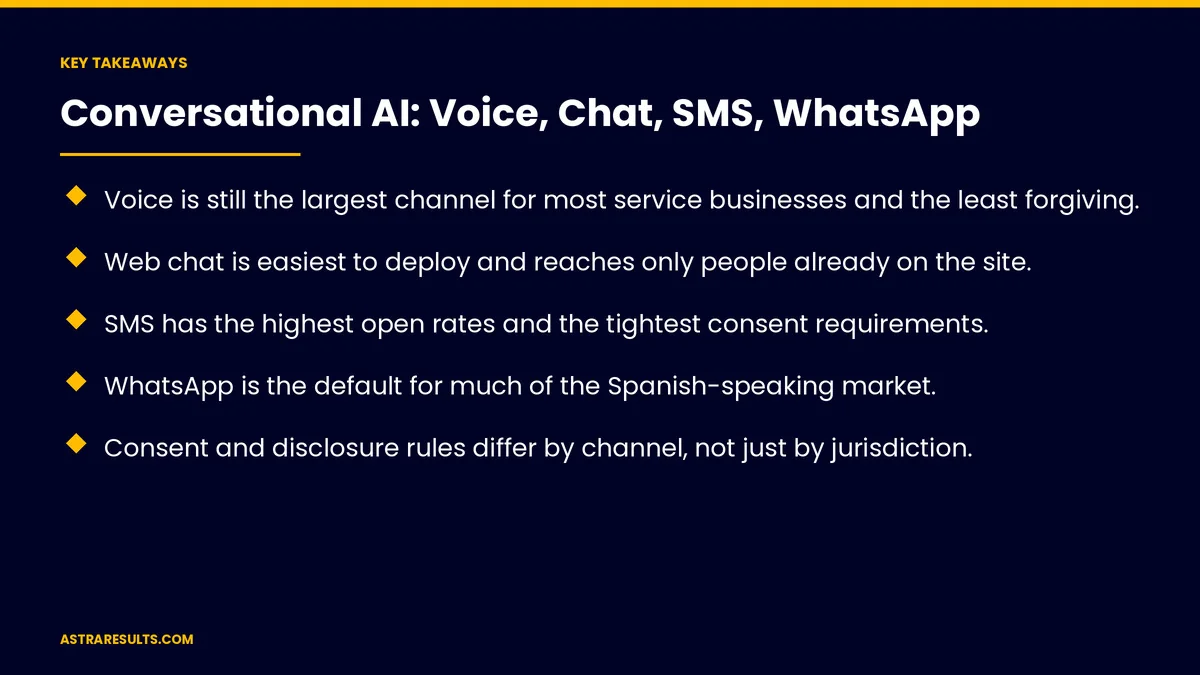
- Voice is still the largest channel for most service businesses and the least forgiving.
- Web chat is easiest to deploy and reaches only people already on the site.
- SMS has the highest open rates and the tightest consent requirements.
- WhatsApp is the default for much of the Spanish-speaking market.
- Consent and disclosure rules differ by channel, not just by jurisdiction.
- The channel is a door; one conversation and one record must span all of them.
Published: September 11, 2026 | Reading Time: ~12 minutes | Category: Customer Engagement
The channels differ more than they appear to. They have different tolerances for delay, different consent rules, different costs of getting it wrong and different demographics. This piece compares them and covers the requirement that matters more than any of them individually. Put plainly: pick the channel your customers already use, then make it one conversation.
Guidance for owners and operators. Nothing here is legal advice. Consent, recording, disclosure and messaging rules differ sharply by channel and jurisdiction and must be confirmed with counsel before deployment.
In This Playbook
- Voice: largest, hardest, least forgiving
- Web chat: easiest to deploy, narrowest reach
- SMS: high attention, tight rules
- WhatsApp: the default for a large audience
- Email and the others
- Choosing: a short method
- One conversation, not four
- The first three months
- How does Astra choose the channel?
Voice: largest, hardest, least forgiving
- Why it still dominates. For home services, healthcare, trades, legal and most urgent-need categories, the majority of first contacts are phone calls.
- What AI voice does well now. Natural conversation, interruptions, accents, and structured tasks — confirming details, answering hours and service questions, qualifying a need, booking into a real calendar.
- Where it struggles. Emotional calls, complex negotiations, anything where the caller is already angry, and heavy background noise from a job site.
- Why it is least forgiving. A poor voice experience irritates people faster than a poor chat experience. There is no scrollback, no way to re-read, and hanging up is one tap.
- The design rules. Short turns, no long menus, an obvious route to a person, and never pretending to be human when asked directly, as set out in disclosure and handoff.
- Recording. Rules vary by jurisdiction and some require all-party consent. This is a counsel question before deployment, not a setting.
Web chat: easiest to deploy, narrowest reach
- The advantage. Fastest to implement, fully controlled, no carrier or platform rules, and the customer is already reading about the service.
- The limit. It reaches only people currently on the website. It does nothing for the caller, the person who found the business on a map, or anyone contacting after they have left the page.
- Where it performs. Pre-purchase questions, pricing and availability, and qualifying visitors who would otherwise leave without contacting.
- The proactive question. Chat that opens itself after a delay lifts engagement and annoys some visitors. Worth testing rather than assuming, and worth restricting to pages where a question is likely.
- The mobile reality. Most visits are on phones, where a chat window occupies the screen. Poorly implemented mobile chat costs more conversions than it creates.
- The honest role. A good supporting channel and a poor primary one for most service businesses.
SMS: high attention, tight rules
- Why it works. Open rates far above email, near-immediate reading, and no app required.
- What it suits. Appointment confirmations and reminders, status updates, simple two-way exchanges, and reaching someone who did not answer a call.
- What it does not suit. Long explanations, anything needing formatting, and anything the customer will want to refer back to in detail.
- The consent requirement. Text messaging to customers is regulated, with rules covering prior consent, identification, opt-out handling and timing, and the specifics vary by jurisdiction and message type. Confirm with counsel before the first send, and treat an opt-out as immediate and permanent.
- The cost shape. Per message, which matters at volume and rewards messages that are worth sending.
- The discipline. Frequency is where SMS programs fail. One unnecessary message costs more goodwill here than on any other channel.
WhatsApp: the default for a large audience
- Who uses it. Much of the Spanish-speaking market in the United States, and the default business channel across most of Latin America.
- Why it matters commercially. A business serving those customers without it is absent from where the conversation would naturally happen, as explored in Spanish as a channel.
- What it does well. Rich two-way conversation, images and documents, voice notes, and a persistent thread the customer can scroll back through.
- The platform rules. Business messaging on the platform has its own requirements for opt-in, message categories, templates for business-initiated messages and time windows for free-form replies. These change, so verify current rules rather than relying on a summary.
- The operational advantage. Photos of the problem, the model number, the meter reading — sent without friction, which shortens diagnosis in trades and services.
- The record. The thread is the record, which is useful for the customer and requires the same retention and privacy thinking as any other channel.
Email and the others
- Email. Best where a complete answer matters more than speed, and where the customer needs something to keep. Slowest tolerance, richest content.
- In-app messaging. For businesses with an app, where the customer is already authenticated and context is known.
- Social direct messages. Answered to the same standard rather than left to whoever checks the account, since a message asking price is a lead wherever it arrives.
- Voice notes. Increasingly common in messaging channels, and worth handling rather than ignoring.
- The principle. Coverage follows the customer. A channel nobody in the customer base uses is a cost with no return.
Choosing: a short method
- Count what arrives now. Calls, forms, chats, messages, over a representative month. This usually settles the argument.
- Ask where customers would prefer to reach you, because current volume reflects what the business has offered rather than what people want.
- Check the demographic and language mix. Age and language correlate strongly with channel preference.
- Start with the largest gap. Usually after-hours voice, because that is where paid demand is lost most often, as detailed in answering in seconds.
- Add the second channel only when the first is working. Two channels done well beat four deployed thinly.
One conversation, not four
- The requirement. A customer who chats on Tuesday, calls on Wednesday and messages on Thursday is one person with one issue.
- What that needs. Identity resolution across channels, a shared conversation history, and a record in the CRM rather than in each tool.
- Why businesses get this wrong. Channels are bought separately, each with its own inbox, and nobody owns the join, as covered in connected data.
- The customer-visible failure. Being asked to repeat everything, which is the most common complaint about any automated system.
- The internal failure. Two people working the same issue from different tools, or an escalation that loses what the customer already said.
- How to know. Can a person picking up any conversation see everything that came before, regardless of channel?
The first three months
Days 1–30: count and confirm
A representative month of contact counted by channel, with after-hours separated. Customer language and demographic mix established. Consent, recording and disclosure rules confirmed with counsel for each channel under consideration.
Days 31–60: the largest gap
The single biggest coverage gap closed, after-hours voice, with disclosure, escalation and recording handled correctly. Identity and history written to the CRM from the first day.
Days 61–90: the second channel
Added only if the first is measurably working, joined to the same record and the same history. Repeat-contact rate measured, since customers repeating themselves is the clearest signal the join has failed.
How does Astra choose the channel?
Astra Results Marketing counts what actually arrives before recommending a channel, because the channel a business is offered is rarely the one its customers would choose, and after-hours voice is the most common unmeasured gap.
Consent, recording and disclosure rules are confirmed with the client's counsel per channel before deployment, since they differ by channel rather than only by jurisdiction. Identity and conversation history are written to one record from day one, so a customer who moves between channels never repeats themselves. Engagements begin with a contact-channel audit through our AI customer engagement team.
Related reading
Frequently asked questions
Which channel should a business start with?
Usually the largest coverage gap, which for most service businesses is after-hours voice, because phone remains the majority of first contacts and that is where paid demand is lost most often. Settle it by counting what actually arrives over a representative month by channel, then asking where customers would prefer to reach you — current volume reflects what has been offered rather than what people want.
Why is voice the least forgiving channel?
Because a poor voice experience irritates people faster than a poor chat experience: there is no scrollback, no way to re-read, and hanging up is one tap. AI voice now handles natural conversation, interruptions and accents well for structured tasks, but struggles with emotional calls, negotiations and heavy background noise. Short turns, no long menus and an obvious route to a person are the design rules.
What is web chat good for?
Pre-purchase questions, pricing and availability, and qualifying visitors who would otherwise leave without contacting. Its limit is that it reaches only people currently on the website — not callers, not people who found the business on a map, not anyone contacting after leaving the page. On mobile, where most visits happen, a poorly implemented chat window costs more conversions than it creates.
What makes SMS different?
High open rates and near-immediate reading, with no app required, which suits confirmations, reminders, status updates and reaching someone who missed a call. It carries the tightest consent requirements — prior consent, identification, opt-out handling and timing, varying by jurisdiction and message type — and frequency is where programs fail, since one unnecessary message costs more goodwill here than anywhere else.
Why does WhatsApp matter?
Because it is the default business channel for much of the Spanish-speaking market in the United States and across most of Latin America, so a business serving those customers without it is absent from where the conversation would naturally happen. It also shortens diagnosis in trades and services, since photos of the problem, model numbers and meter readings are sent without friction.
What does "one conversation" mean in practice?
That a customer who chats on Tuesday, calls on Wednesday and messages on Thursday is treated as one person with one issue: identity resolved across channels, shared conversation history, and the record in the CRM rather than in each tool. The test is whether a person picking up any conversation can see everything that came before. The visible failure is being asked to repeat everything.
READY TO COVER THE CHANNELS YOUR CUSTOMERS USE? Astra Results Marketing counts what arrives before recommending anything, confirms consent and recording rules per channel with your counsel, and writes identity and history to one record from day one. Astra Results Marketing · 1101 Brickell Ave, Miami, FL 33131 · +1 (786) 321-2866 · [email protected] Find us on Google · Yelp ▸ CALL (786) 321-2866 · ▸ REQUEST YOUR CONSULTATION