Rated 5 star on


AI Outbound Sales: Pipeline Without a Sales Floor
Quick answer
AI outbound does the research, writes the first message, sequences follow-ups across channels, watches for replies, and hands a qualified conversation to a person the moment it becomes one. The list decides the campaign: a precise list with an ordinary message beats a brilliant message sent to the wrong people. Deliverability and consent are where it fails.
Outbound sales used to require a room of people making calls and sending emails, most of which went unanswered, with a manager counting dials. The economics only worked at scale, so small and mid-sized companies mostly did not do it. They waited for the phone to ring.
Key Takeaways
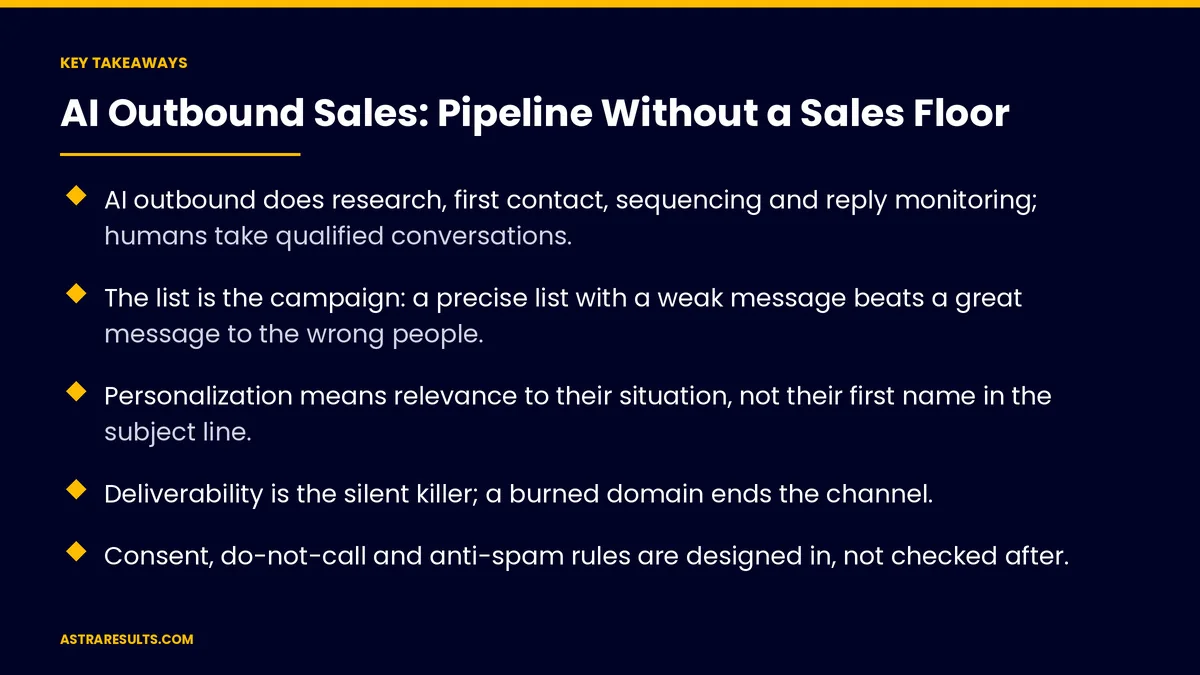
- AI outbound does research, first contact, sequencing and reply monitoring; humans take qualified conversations.
- The list is the campaign: a precise list with a weak message beats a great message to the wrong people.
- Personalization means relevance to their situation, not their first name in the subject line.
- Deliverability is the silent killer; a burned domain ends the channel.
- Consent, do-not-call and anti-spam rules are designed in, not checked after.
- Measure meetings held and pipeline created, never messages sent.
Published: September 3, 2026 | Reading Time: ~13 minutes | Category: AI Outbound
AI outbound changes the economics. Software now does the research, writes the first message, sequences the follow-ups across channels, watches for replies, and hands a qualified conversation to a human at the moment it becomes one. This is the complete guide: how the system works, what it must never do, where deliverability and consent decide everything, and how to measure it in meetings rather than messages. Stated simply: the AI earns the conversation; the human closes it.
Guidance for owners and operators. Nothing here is legal advice. Outbound communication is governed by consent, do-not-call, anti-spam and privacy rules that differ by channel, jurisdiction and industry, and every campaign must be reviewed with counsel before it runs.
In This Playbook
- What changed
- The list is the campaign
- Personalization that means something
- Sequences across channels
- Deliverability: the silent killer
- Consent and compliance, designed in
- The handoff to a human
- What to measure
- Who this is for
- A 90-day sequence
- How this is done at Astra
What changed
The mechanics of outbound have been the same for decades. What changed is who does each step.
- Research. Finding the right companies and the right people inside them, and learning enough about each to say something relevant. AI does this in minutes per hundred rather than hours per ten.
- First contact. Writing a message specific to that company's situation. AI drafts; a human approves the approach, the tone and the claims.
- Sequencing. The second, third and fourth touches across email, phone and professional networks, timed and varied. AI runs the schedule and adapts to responses.
- Reply handling. Reading the reply, classifying it — interested, not now, wrong person, unsubscribe — and acting on each. AI classifies; the interested ones go straight to a person.
- What did not change. The person who takes the meeting, understands the need, and earns the trust. That is still a human, and the system exists to put that human in front of qualified people.
The list is the campaign
Most outbound fails before the first message, in the list.
- Precision over volume. A hundred companies that fit the ideal customer exactly outperform five thousand that roughly match. Fit criteria: industry, size, geography, a signal that the need exists now — a new location, a hiring spike, a leadership change, a regulatory deadline.
- Signals over lists. The best outbound is triggered by something that happened, not by a static list. The company that just opened a second location needs what a two-location company needs, this month.
- The right person. Not the CEO by default. The person whose problem this solves and who can start a conversation about it.
- Data hygiene. Verified emails, current titles, correct company. Bounces and wrong-person replies damage deliverability and reputation, discussed in connected data as a prerequisite.
- Suppression. Existing customers, active prospects, do-not-contact records and competitors excluded before anything sends.
Personalization that means something
Inserting a first name is not personalization. Relevance is.
- What relevance looks like. A reference to the company's actual situation — the expansion, the job posting, the product line, the market they entered — connected to the specific problem the sender solves. One or two sentences that prove the message was written for them.
- What the AI does. Reads public information about the company and drafts the relevant opening. Proposes the angle.
- What the human does. Sets the offer and the claims the AI may make. Reviews the drafts, at least by sample, for accuracy and tone. Never lets a claim go out that the business would not make in person.
- What to avoid. Fake familiarity. Flattery. Anything that pretends to a relationship that does not exist. Sophisticated buyers recognize it instantly and it poisons the domain's reputation as well as the brand's.
- The bar. Would the recipient, reading it, believe a competent person spent five minutes on them? If yes, it is personalized.
Sequences across channels
One message is not outbound. A sequence is.
- The structure. Typically five to eight touches over three to five weeks. Email as the backbone. Phone for the touch where a voice matters. A professional network connection where the audience lives there. Each touch adds something — a resource, a specific observation, a question — rather than repeating the ask.
- Timing. Business hours in the recipient's time zone. Spaced so the sequence reads as persistent rather than desperate.
- Adaptation. A reply stops the sequence and routes to a person. An open with no reply might shift the next touch. An unsubscribe stops everything and is recorded permanently.
- The exit. After the sequence, the contact rests for months before any re-approach, and the re-approach is a new angle, not the same sequence again.
- Voice, carefully. AI voice can place calls, but outbound voice is the most regulated channel and the one buyers resent most when done badly. Many businesses reserve phone touches for humans, or use AI voice only where the recipient has consented to contact.
Deliverability: the silent killer
An outbound program that ignores deliverability ends the channel for the company, sometimes permanently.
- What happens. Too many sends from a new domain, high bounce rates, spam complaints or spam-trap hits, and the domain's reputation collapses. Every email from the company, including invoices and customer service, starts landing in spam.
- The protections. Sending domains separate from the company's primary domain. Warm-up periods before volume. Strict volume caps per mailbox per day. Verified lists to keep bounces near zero. Authentication records configured properly. Unsubscribe that works in one click.
- The monitoring. Bounce rate, spam complaint rate, reply rate and inbox placement, watched daily. A spike in complaints stops the campaign the same day.
- The rule. Deliverability constraints set the volume, not the other way around. A program that wants to send more than deliverability allows needs more domains and more time, not more sends.
Consent and compliance, designed in
Outbound is legal when done within the rules and a liability when not.
- The principle. Rules differ by channel — email, phone, SMS, messaging apps — by jurisdiction and by whether the recipient is a business or a consumer. Business-to-business email operates under different rules than consumer SMS. Counsel maps the rules for each channel and market before the first send.
- What every program needs. Honest sender identity. A working unsubscribe honored immediately and permanently. Suppression against do-not-call and do-not-contact records where they apply. Consent captured and stored where a channel requires it. Records that show what was sent to whom and when.
- What the AI never does. Contacts anyone on a suppression list. Sends after an unsubscribe. Misrepresents who is sending or why. Makes claims the business has not approved.
- The posture. Compliance is a design input, as covered in rules before launch. Checking it after a campaign runs is how businesses discover they have a problem.
The handoff to a human
The system's entire purpose is this moment.
- What triggers it. A reply expressing interest. A question that needs a real answer. A request for a call or a meeting. Any reply the AI cannot confidently classify.
- What the human receives. The full thread, the research that prompted the outreach, the company's context, and a suggested next step. Within minutes, not the next morning, set out in speed to lead.
- What the human does. Responds personally, books the meeting, and runs the conversation. The AI steps back. The prospect should never feel they were handed from a machine to a person; they should feel the person was there all along.
- The failure to avoid. An interested reply sitting in a queue for two days. The AI worked for three weeks to earn that reply, and the delay throws it away.
What to measure
Messages sent is not a metric. It is a cost.
- Reply rate, positive and total. The first signal of list and message quality.
- Meeting rate. Meetings booked as a share of contacts reached. The number that shows whether the system produces conversations.
- Meetings held. Because booked is not held.
- Pipeline created. Qualified opportunities and their value, by campaign and by list segment.
- Closed revenue by campaign, on the sales cycle's timeline, according to attribution by channel.
- Deliverability health. Bounce, complaint and placement rates, as guardrails.
- Cost per meeting held and per closed customer, compared against every other channel the business runs.
Who this is for
- B2B companies selling to identifiable businesses with a describable ideal customer.
- Companies with a sales capacity problem, not a lead problem: a good closer with an empty calendar.
- Businesses entering a new market or segment where inbound has not built up yet.
- Who should not start here. Consumer businesses in heavily regulated channels. Companies without a person to take the meetings. Companies whose offer is not yet clear enough to describe in two sentences.
A 90-day sequence
Days 1–30: define and comply
Ideal customer written with fit criteria and trigger signals. Offer and approved claims documented. Counsel reviews the channel and market rules. Sending domains set up and warming. List built, verified and suppressed.
Days 31–60: sequence and test
The sequence written and reviewed. AI-drafted openings sampled for accuracy and tone. A small first batch sent under strict volume caps. Deliverability watched daily. The handoff tested with real replies.
Days 61–90: scale and measure
Volume raised as deliverability allows. Reply, meeting and held rates by segment. The first pipeline and cost-per-meeting numbers. The list refined toward the segments that reply.
How this is done at Astra
Astra Results Marketing builds the list before the message: ideal customer and trigger signals defined, data verified, suppressions applied, and the rules for each channel mapped with counsel before anything sends. The AI drafts relevance a human approves, sequences across channels under volume caps that deliverability sets, and routes every interested reply to a named person within minutes.
Measurement runs on meetings held and pipeline created, compared against the company's other channels. Engagements begin with an ideal-customer and compliance review through our AI outbound sales team.
Related reading
Frequently asked questions
What does AI do in outbound sales?
The research on companies and people, the drafting of a relevant first message, the sequencing of follow-ups across email, phone and professional networks, and the reading and classifying of replies. What it does not do is take the meeting. The interested reply goes to a human within minutes, with the full thread and research attached, and that person runs the conversation.
Why is the list the campaign?
Because most outbound fails before the first message. A hundred companies that fit the ideal customer exactly, ideally triggered by a signal that the need exists now, outperform five thousand that roughly match. The list also needs the right person rather than the CEO by default, verified data so bounces stay near zero, and suppression of customers, active prospects, do-not-contact records and competitors.
What counts as real personalization?
Relevance to the company's actual situation — the expansion, the hire, the market entered — connected to the specific problem the sender solves, in a sentence or two that proves the message was written for them. Not a first name in the subject line, and never fake familiarity or flattery. The test is whether the recipient would believe a competent person spent five minutes on them.
Why does deliverability matter so much?
Because a burned domain ends the channel and can push the company's invoices and customer service emails into spam too. Protections include separate sending domains, warm-up periods, strict daily caps per mailbox, verified lists, proper authentication and one-click unsubscribe, with bounce and complaint rates watched daily. Deliverability sets the volume; wanting to send more means more domains and more time, not more sends.
How is compliance handled?
As a design input, not an afterthought. Rules differ by channel, jurisdiction and whether the recipient is a business or a consumer, so counsel maps them before the first send. Every program has honest sender identity, an unsubscribe honored immediately and permanently, suppression against do-not-contact records, consent captured where a channel requires it, and records of what went to whom. The AI never sends after an unsubscribe or makes unapproved claims.
What are the right metrics?
Reply rate, meeting rate, meetings held, pipeline created by campaign and segment, closed revenue on the sales cycle's timeline, and cost per meeting held and per closed customer compared against the company's other channels. Deliverability health — bounce, complaint and placement rates — serves as the guardrail. Messages sent is a cost, not a metric.
READY TO FILL A CLOSER'S CALENDAR WITHOUT A SALES FLOOR? Astra Results Marketing builds outbound from the list up: ideal customer and signals, verified data, compliance mapped with counsel, AI-drafted relevance a human approves, and every interested reply routed to a person in minutes. Astra Results Marketing · 1101 Brickell Ave, Miami, FL 33131 · +1 (786) 321-2866 · [email protected] Find us on Google · Yelp ▸ CALL (786) 321-2866 · ▸ REQUEST YOUR CONSULTATION