Rated 5 star on

Building an iPhone App: From Idea to App Store
Quick answer
Write what the app is for in one sentence before scoping anything, then build a first version that does one job well. Feature lists are where budgets die. App Store review adds time and specific requirements around privacy and account deletion. Launch is not the end: retention begins the next day, and that is the expensive part.
Most app projects fail before a line of code is written, in the gap between "we should have an app" and a written answer to what it is for. The ones that survive that gap then fail in a second place: the assumption that launch is the finish line, when it is closer to the start of the expensive part.
Key Takeaways
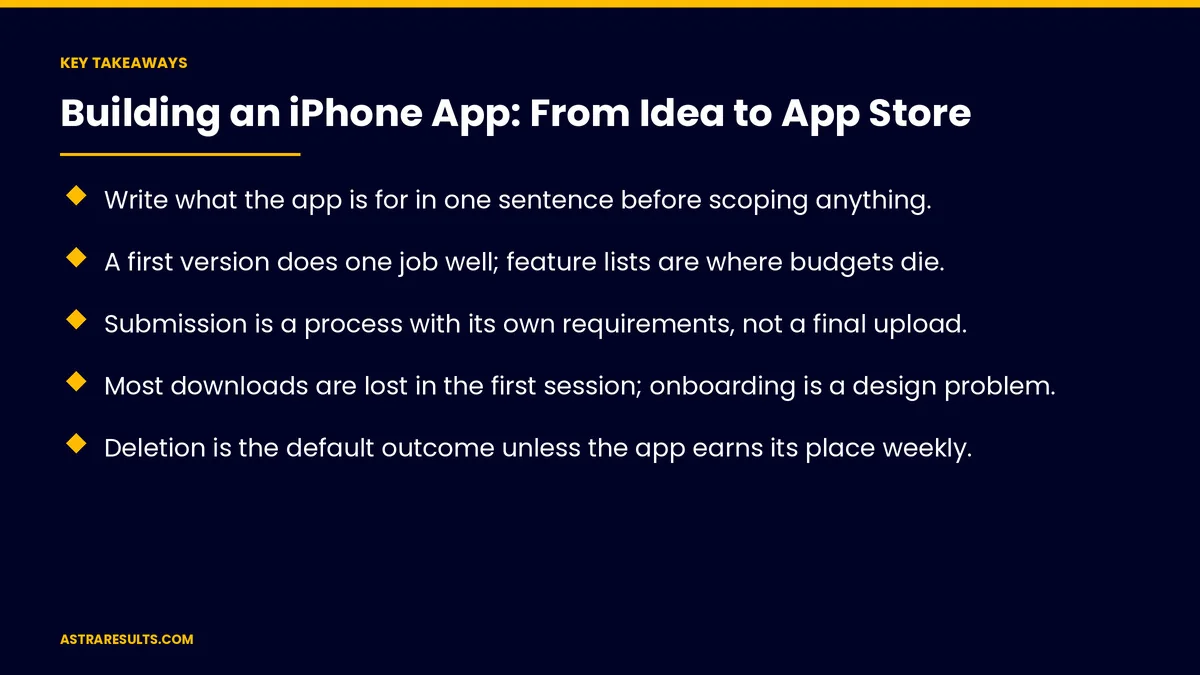
- Write what the app is for in one sentence before scoping anything.
- A first version does one job well; feature lists are where budgets die.
- Submission is a process with its own requirements, not a final upload.
- Most downloads are lost in the first session; onboarding is a design problem.
- Deletion is the default outcome unless the app earns its place weekly.
- Budget the year after launch, not just the build.
Published: September 8, 2026 | Reading Time: ~14 minutes | Category: iPhone
This guide walks the whole path — scoping a first version someone will use, what the build involves, what App Store submission requires, what launch week looks like, and the retention problem that begins the day after. Stated simply: the app is not done at launch; that is when it starts costing money.
Guidance for owners and operators. Nothing here is legal advice. App Store policies, privacy disclosure requirements and payment rules change and must be verified before relying on them.
In This Playbook
- Before anything: the one-sentence test
- Scoping a first version
- What the build involves
- App Store submission
- Launch week
- The first session decides everything
- Retention: the real problem
- After launch: the running cost
- A 90-day sequence
- How this is done at Astra
Before anything: the one-sentence test
- The sentence. "This app lets [a specific person] do [a specific thing] [better than how they do it now]."
- Why it is hard. Most app ideas fail it because the real answer is "our customers could check things," which describes a website.
- What passes. A repeat-purchase business where the app removes friction from reordering. A service where customers need to track something in real time. A loyalty relationship where the app is the card. A workforce whose work happens away from a desk.
- What fails. An app because competitors have one. An app to "increase engagement." An app that duplicates a website with no added capability.
- The alternative to consider first. If the sentence describes something a mobile website does, a progressive web app removes the cost and the store entirely, examined in the app-or-web decision.
Scoping a first version
- One job, done completely. Not the eventual vision. The single thing that makes someone open it the first week.
- The cut list. Everything that is not that job, written down as version two so it stops being argued about.
- What is not optional even in version one. Account handling if there are accounts, and in-app deletion of them; privacy disclosures matching the real data collection; crash reporting; and analytics that answer whether people completed the main task.
- The push notification question. Decide early what will be sent and how often. Notifications are the main retention tool and the main reason apps get deleted.
- Timeline honesty. A focused first version is months, not weeks, and not a year. Projects that must be complete before they are useful get cancelled before they are complete, the case for which sits in phasing that survives.
What the build involves
- Design first, in the platform's language. Screens, flows and states — including empty, loading, error and offline — designed before development rather than discovered during it.
- The backend question. Most apps need a server, accounts and data storage. If a business system already exists, the work is integration rather than invention, and that integration is the largest variable.
- Offline and poor connection. What the app does on the subway and in a basement. Answering this late means rebuilding.
- Devices and versions. Which iPhones and which iOS versions are supported, decided in writing, tested on the oldest one supported rather than the newest.
- Test on real devices. Simulators hide performance, battery and network behavior.
- Accessibility from the start. Dynamic type, contrast, screen reader labels. Retrofitting is expensive and usually done badly, detailed in platform conventions.
App Store submission
- The developer account. An organization account requires a verified legal entity, which takes time. Start it early; it delays more launches than any technical issue. Apple publishes the review guidelines every submission is judged against, worth reading before the build rather than after a rejection (App Store Review Guidelines).
- What the listing needs. Name, subtitle, description, keywords, screenshots at required sizes, an optional preview video, a support URL and a privacy policy URL.
- Privacy declarations. A detailed statement of what data is collected, why, and whether it is linked to the user, shown on the listing. It must match what the app does.
- Review. Usually days. Rejections are common for first submissions and are usually about metadata, permissions justification or account handling rather than code. Budget time for one round.
- Common rejection reasons. Requiring an account for functionality that does not need one, missing account deletion, permissions requested without explanation, placeholder content, and broken links in the listing.
- TestFlight first. Real users on real devices before submission catches what internal testing does not.
Launch week
- What launch is not. A marketing event by itself. An app with no distribution plan gets the downloads its existing audience provides and no more.
- Where first users come from. Existing customers told directly — email, SMS, in-store, on invoices. This is the only reliable channel most businesses have.
- The store listing as conversion. The first screenshot and the subtitle decide installs. Most people never read the description.
- Early reviews matter disproportionately. Ask satisfied users at a good moment, in the app, after they have completed something successfully.
- Watch the funnel, not the total. Downloads, first-session completion, day-one return, day-seven return. The drop-off between them is where the problem is.
- Be ready to ship a fix. Something will be wrong in the first week. Having the next build ready to submit matters more than launching perfectly.
The first session decides everything
- The number to know. A large share of people who download an app open it once and never again. The first session is most of the battle.
- Ask for nothing first. No sign-up wall before the person has seen value, if the app can function without one.
- Permissions in context. Ask for notifications, location or camera at the moment the feature needs them, with a sentence explaining why. Asking for everything at launch is how permissions get denied permanently.
- Show the main thing immediately. Not a tour. The screen that does the job.
- Pre-fill what you know. An existing customer who logs in should not re-enter what the business already has, which is the subject of knowing who is asking.
- Measure it. The percentage of first sessions that complete the main task is the single most useful number in the first month.
Retention: the real problem
- The default is deletion. Phone storage is contested, and an app that is not opened for a few weeks gets removed.
- What earns a place. Something the customer needs regularly: reordering, tracking, access, loyalty value, or a record they refer back to.
- Notifications, used carefully. Relevant and timely earns opens; frequent and generic earns a disabled notification setting and then a deletion.
- The re-engagement window. Someone who has not opened the app in a month is close to gone, and the effective channel at that point is email or SMS, not a push they will not see.
- Measuring it. Day-seven and day-thirty retention by cohort, and the share of active customers using the app. Downloads are not the number.
- The uncomfortable possibility. Some businesses discover retention is structurally low because customers only need them twice a year. That is an argument for a web experience rather than an app, and better learned early.
After launch: the running cost
- Operating system releases. Annual, occasionally breaking, and a business whose app does not work on the new iOS the week it ships will hear about it.
- Device releases. New screen sizes and capabilities each year.
- Dependency and security updates. Continuous.
- Backend costs. Servers, storage, notifications, and any third-party services, scaling with usage.
- Support. Someone answering store reviews and users who cannot log in.
- The budget line. A meaningful annual percentage of the build, every year, plus whatever new features the business wants. An app without that line dies quietly, according to the maintenance nobody budgets.
A 90-day sequence
Days 1–30: define and design
The one-sentence test passed, or the project redirected to a web experience. The single job for version one agreed and everything else written to a version-two list. Developer account started. Screens and states designed, including offline and error.
Days 31–60: build and test
The core job built and integrated with existing systems. Real devices across the supported range. TestFlight with real users, gathering what internal testing missed. Privacy declarations drafted from the actual data collection.
Days 61–90: submit and launch
Submission with time budgeted for one rejection round. Existing customers told directly through the channels the business already owns. First-session completion, day-one and day-seven retention watched daily. The first fix build ready to ship.
How this is done at Astra
Astra Results Marketing applies the one-sentence test before scoping, and recommends a progressive web app when that sentence describes something a website does — because two store listings nobody installs is an expensive lesson. Version one does one job completely, with everything else recorded as version two so it stops consuming the budget.
Privacy declarations are drafted from real data collection, submission time includes a rejection round, and launch uses the channels the business already owns rather than assuming store discovery. Reporting after launch leads with first-session completion and retention by cohort rather than downloads. Engagements begin with the one-sentence test through our UI/UX development and design team.
Related reading
Frequently asked questions
How do I know whether my business needs an app?
Write one sentence: this app lets a specific person do a specific thing better than how they do it now. Most ideas fail it, because the real answer is "our customers could check things," which describes a website. What passes is repeat purchasing where the app removes friction, real-time tracking, loyalty where the app is the card, or a workforce working away from a desk. If the sentence describes a mobile website, build a web app instead.
What belongs in a first version?
One job, done completely — the single thing that makes someone open it in the first week — with everything else written to a version-two list so it stops being argued about. Not optional even in version one: account deletion if there are accounts, privacy disclosures matching real data collection, crash reporting, analytics that show whether people completed the main task, and a decision about what notifications will be sent.
What does App Store submission involve?
An organization developer account requiring a verified legal entity, which takes time and delays more launches than any technical issue. A listing with screenshots at required sizes, a support URL and a privacy policy. Detailed privacy declarations matching what the app does. And a review that commonly rejects first submissions over metadata, permissions justification or account handling rather than code, so budget a round.
Why does the first session matter so much?
Because a large share of people who download an app open it once and never again. Ask for nothing before showing value, request permissions in context at the moment a feature needs them rather than all at launch, show the screen that does the job instead of a tour, and pre-fill what the business already knows about an existing customer. The share of first sessions completing the main task is the most useful early number.
How is retention improved?
By being something customers need regularly — reordering, tracking, access, loyalty value, a record they return to — and by using notifications that are relevant and timely rather than frequent and generic. Someone who has not opened the app in a month is close to gone, and the channel that reaches them then is email or SMS. Measure day-seven and day-thirty retention by cohort, not downloads.
What does an app cost after launch?
Annual operating system releases that occasionally break things, new device sizes each year, continuous dependency and security updates, backend and notification costs that scale with usage, and someone answering store reviews and login problems. Budget a meaningful annual percentage of the build every year, plus new features. An app without that line dies quietly.
READY TO TEST WHETHER THE APP IS WORTH BUILDING? Astra Results Marketing applies the one-sentence test first, recommends a web app when that is the plain answer, scopes version one to a single job, and budgets the year after launch alongside the build. Astra Results Marketing · 1101 Brickell Ave, Miami, FL 33131 · +1 (786) 321-2866 · [email protected] Find us on Google · Yelp ▸ CALL (786) 321-2866 · ▸ REQUEST YOUR CONSULTATION