 Rated 5 star on

AI Overviews vs Classic Rankings
Quick answer
Classic rankings still matter, because Google's AI Overviews and AI Mode are built on the same indexing and quality systems. A page must be indexed and eligible for a snippet to appear as a supporting link. No special schema is required. Simple questions now send fewer clicks, but complex and commercial searches still bring visitors.
For twenty years, search meant a list of ten links. Now many searches open with an AI-written answer and a few supporting links. Owners ask the obvious question: do rankings still matter? They do, but not in quite the same way. AI answers sit on the same foundation as classic results, and they change how people click.
Key Takeaways
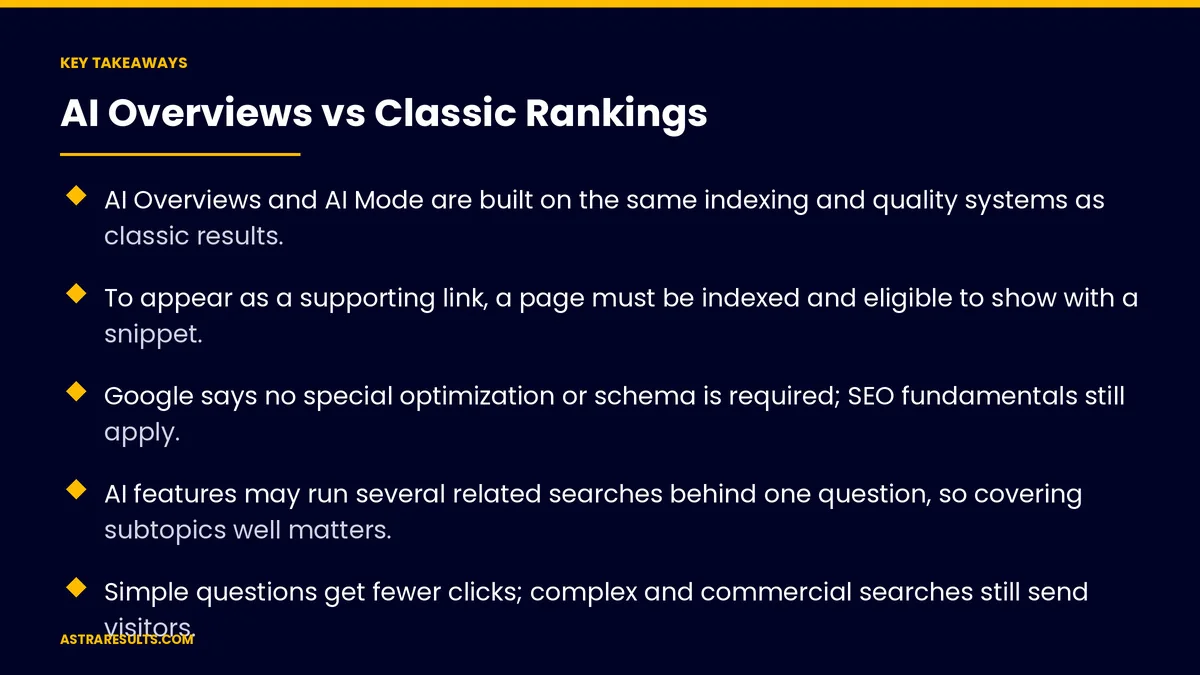
- AI Overviews and AI Mode are built on the same indexing and quality systems as classic results.
- To appear as a supporting link, a page must be indexed and eligible to show with a snippet.
- Google says no special optimization or schema is required; SEO fundamentals still apply.
- AI features may run several related searches behind one question, so covering subtopics well matters.
- Simple questions get fewer clicks; complex and commercial searches still send visitors.
- Search Console counts AI feature traffic inside normal web results, so measure outcomes, not just clicks.
Published: October 12, 2026 | Reading Time: ~10 minutes | Category: AI SEO
This guide explains how Google's AI Overviews and AI Mode relate to classic rankings, what stays the same, what changes for your content, and how to measure results now that the numbers are mixed together. Put plainly: the foundation hasn't changed, but the page that wins now answers the whole question, not just the keyword.
Search features change often. Check Google's current documentation before you change your site's settings.
In This Playbook
- Two ways Google now answers
- What stays the same
- What changes for your content
- How clicks shift
- What to do about it
- Controlling how your content appears
- How to measure it now
- The first three months
Two ways Google now answers
Classic results. The familiar list of links, ranked by relevance and quality, with titles and snippets.
AI Overviews. A short AI-written summary at the top of some results, with links to the pages it drew from.
AI Mode. A conversational search experience for deeper questions, comparisons and follow-ups, also with supporting links.
They differ from each other too. Google notes that AI Overviews and AI Mode may use different models and techniques, so the links they show can vary (Google Search Central).
What stays the same
Indexing comes first. A page Google can't find, crawl or index can't appear anywhere, AI answer or classic list.
Snippet eligibility. Google says a page must be indexed and eligible to show with a snippet to be a supporting link in AI features.
Quality systems. AI features are rooted in the same ranking and quality systems as regular search. Pages that rank well for a topic are the pool AI answers draw from.
No special code. Google says there's no special schema or technical trick required for AI features. Normal structured data still helps your pages in classic results.
Fundamentals still pay. Fast pages, clear structure, internal links, useful content and trust signals help in both. The broader strategy is in SEO for growth companies.
What changes for your content
Questions get broken down. Google says AI features may run several related searches across subtopics to build one answer. A page that covers the subtopics well has more chances to be used.
Answer first. State the direct answer early on the page, then explain. Content that buries the answer is harder to draw from.
Cover the whole question. A guide that addresses cost, timing, options and risks for a topic does better than thin pages on single keywords.
Original information stands out. Your own data, examples, processes and expert views give AI answers something they can't get elsewhere.
Clear structure. Headings that match real questions, short paragraphs and lists make content easier to understand, for people and systems alike.
Trust matters more on serious topics. Health, legal and financial content needs named experts and accurate claims, as covered in content for YMYL practices.
How clicks shift
Simple questions get fewer clicks. If the AI answer fully covers "what time does the bank open," fewer people need to visit a page.
Complex questions still send visitors. People comparing options, checking details or ready to act still click through to sources they trust.
Commercial and local searches still matter most. Searches like "emergency plumber near me" or "injury lawyer Miami" lead to calls and bookings, and local results remain central for them, as covered in national vs local SEO.
Being cited is visibility too. A supporting link in an AI answer puts your brand in front of searchers even when they don't click right away.
Plan for fewer, better visits. Traffic to basic informational pages may fall while leads from in-depth and commercial pages hold or grow.
What to do about it
Audit your top pages. Which ones answer simple questions that AI may now cover, and which ones serve buyers comparing options?
Strengthen commercial pages. Service, pricing, comparison and location pages tie directly to leads.
Deepen your best topics. Build groups of pages that cover a subject fully, with clear answers to the follow-up questions people ask.
Add what only you know. Case examples, local detail, process steps and expert input.
Keep the technical basics clean. Make sure important pages are indexed, fast and eligible for snippets.
Think beyond Google. Other AI assistants answer questions too. Getting cited across them is covered in AI SEO.
Controlling how your content appears
Existing preview controls apply. Settings that limit snippets, such as nosnippet and max-snippet, also affect how your content can be used in AI features.
Limiting them has a cost. Blocking snippets can reduce how your pages appear in classic results too.
Decide page by page. Most businesses want their content shown. Limit only pages with a specific reason, and confirm details in Google's documentation first.
How to measure it now
AI feature traffic is mixed in. Google says traffic from AI features is counted within the normal web search results in Search Console, not as a separate report.
Watch outcomes, not just clicks. Calls, form leads, bookings and sales from organic search tell you more than raw traffic.
Track by query type. Compare informational, commercial and branded searches separately. Shifts in each tell different stories.
Check key searches by hand. For your most important questions, look at what the AI answer says and which sources it cites, on a regular schedule.
Watch branded search. More people searching your name can signal growing visibility from AI citations.
Connect it to revenue. Trace leads to customers using attribution across every channel, and weigh organic alongside paid, as in budgeting across three surfaces.
The first three months
Days 1–30: audit and baseline
List your top 50 search queries and sort them into informational, commercial, local and branded. Check how AI answers handle the most important ones and which sources they cite. Confirm key pages are indexed and snippet-eligible. Record leads from organic search as a baseline.
Days 31–60: strengthen and deepen
Improve commercial and location pages first. Add direct answers, subtopic coverage and original detail to your best topic pages. Fix technical issues the audit found.
Days 61–90: measure and adjust
Compare organic leads, branded searches and query-type trends against the baseline. Re-check AI answers for your key questions. Shift effort toward the pages and topics that bring customers.
Where Astra comes in
Astra Results Marketing treats AI Overviews and classic rankings as one search strategy with two ways of showing results. We keep the technical foundation clean, strengthen the commercial pages that bring leads, and deepen topic coverage with direct answers and original detail.
We measure outcomes, not just clicks, track your key searches by hand, and connect organic visibility to customers. Engagements begin with a search visibility audit through our AI SEO team.
Related reading
Frequently asked questions
Do classic rankings still matter with AI Overviews?
Yes. AI Overviews and AI Mode are rooted in the same indexing and quality systems as classic results. Pages that rank well for a topic form the pool AI answers draw from, and classic results still appear below AI answers.
How does a page appear in AI Overviews?
Google says a page must be indexed and eligible to show with a snippet to appear as a supporting link. No special optimization or schema is required; strong SEO fundamentals and content that answers the question fully give a page its best chance.
What is query fan-out?
A technique Google says AI Overviews and AI Mode may use: running several related searches across subtopics and sources to build one answer. It means pages that cover the subtopics of a question well have more chances to be used.
Will AI Overviews reduce our traffic?
Simple informational questions may send fewer clicks when the AI answer covers them. Complex, commercial and local searches still send visitors ready to act, so focus on the pages that bring leads.
Can we see AI Overview traffic in Search Console?
Not separately. Google says traffic from AI features is counted within normal web search results in Search Console. Measure leads and sales from organic search, track query types, and check key AI answers by hand.
Should we block our content from AI features?
Usually not. Preview controls like nosnippet and max-snippet affect AI features but can also reduce how pages appear in classic results. Limit only specific pages with a clear reason, after checking Google's current documentation.
Ready for search that works with AI answers and classic results? Astra Results Marketing keeps your technical foundation clean, strengthens the pages that bring leads, deepens topic coverage with direct answers and original detail, and measures organic search by the customers it brings. ▸ CALL (786) 321-2866 · ▸ REQUEST YOUR CONSULTATION





