Rated 5 star on

AI SEO: Getting Cited by ChatGPT and Google AI
Quick answer
AI SEO is the work of becoming a source that answer engines choose to cite. Traditional SEO is the floor rather than the whole job: pages have to be indexable, fast and credible before anything can quote them. Above that floor, engines favour question-shaped content answered directly, consistent entity signals, and claims specific enough to attribute.
A growing share of buyers no longer scroll through ten blue links. They ask a question and read one answer, assembled by an AI from sources it chose. If the business is one of those sources, it gets named. If not, it does not exist in that conversation, whatever it ranks in results the buyer never saw.
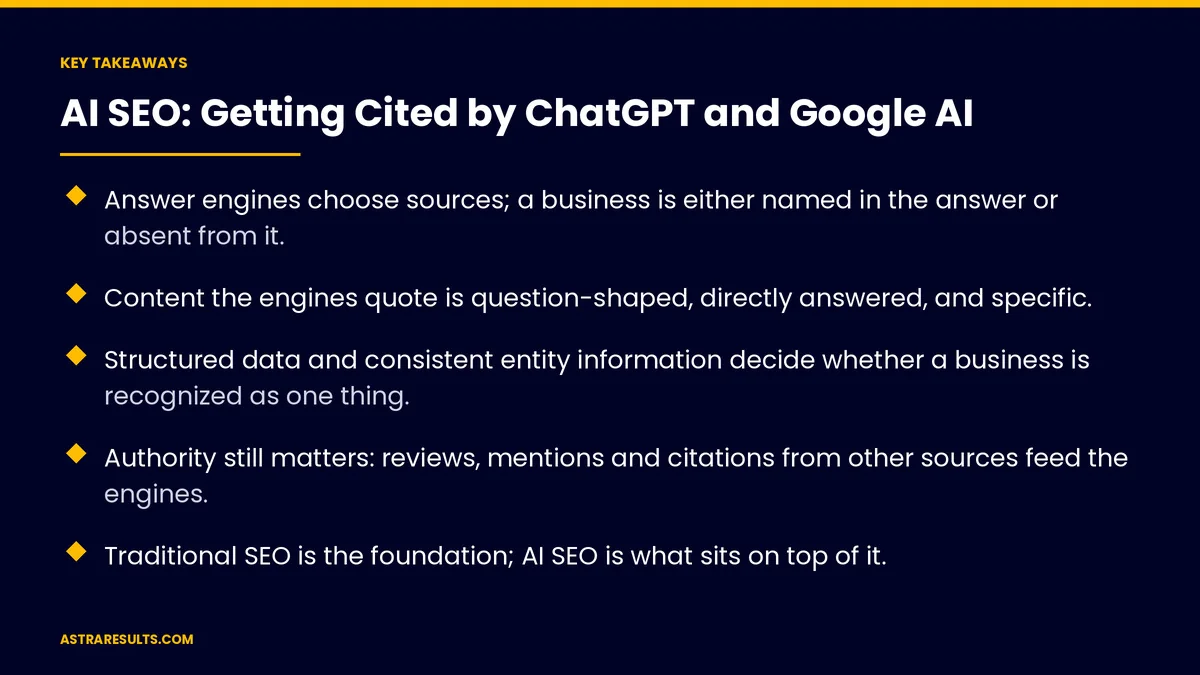
Key Takeaways
- Answer engines choose sources; a business is either named in the answer or absent from it.
- Content the engines quote is question-shaped, directly answered, and specific.
- Structured data and consistent entity information decide whether a business is recognized as one thing.
- Authority still matters: reviews, mentions and citations from other sources feed the engines.
- Traditional SEO is the foundation; AI SEO is what sits on top of it.
- Measure citations, mentions and AI-referred traffic, not just rankings.
Published: September 4, 2026 | Reading Time: ~13 minutes | Category: AI SEO
AI SEO is the work of becoming a source the answer engines choose. It overlaps with traditional SEO and differs from it in ways that matter. This is the complete guide: how the engines select sources, what content they can quote, why structured data and entity consistency decide whether a business is recognized, and how to measure citations. The sentence to carry out of this: being cited beats ranking third.
Guidance for owners and operators. Nothing here is legal advice. How AI systems select and present sources changes frequently; specifics below describe patterns observed as of this writing and should be re-verified periodically.
In This Playbook
- How do answer engines choose their sources?
- Traditional SEO is the floor
- Question-shaped content
- Structured data: telling machines what things are
- Entity consistency: being recognized as one thing
- Content the engines can trust
- Where this intersects paid
- Measuring AI SEO
- Common mistakes
- Getting started: the first quarter
How do answer engines choose their sources?
Understanding the selection process is the whole strategy.
- The question comes in. A buyer asks an assistant for a recommendation, a comparison, an explanation or a local option.
- The engine retrieves. It searches, pulls a set of candidate sources, and reads them. Which sources it pulls depends on relevance, authority signals and whether the content can be parsed cleanly.
- The engine synthesizes. It assembles an answer, and it names or links the sources it drew from. A source that gave a clear, quotable answer to the exact question is more likely to be named than one that buried it.
- The buyer reads one answer. With two to five sources named. Everyone else is invisible for that query.
- What this means. The competition is not for position ten versus position three. It is for being among the handful the engine trusted enough to quote, explored in the shift in search behavior.
Traditional SEO is the floor
AI SEO does not replace the fundamentals. It depends on them.
- Crawlability and indexing. The engines retrieve from what search indexes contain. A page that is not indexed cannot be cited.
- Technical health. Fast, mobile-ready, clean markup. Content that is hard to parse is skipped.
- Authority. Links, mentions, reviews and brand presence still determine which sources are trusted enough to retrieve in the first place.
- Relevance. The page has to be about the thing the buyer asked about, in language the buyer uses.
- The relationship. A site that ranks well for a topic is more likely to be retrieved. A site that is retrieved and also gives a quotable answer is more likely to be cited. The second step is where AI SEO adds its work.
Question-shaped content
The engines answer questions. Content shaped as answers to questions is what they quote.
- Headings as questions. "How long does an AI intake deployment take?" rather than "Deployment timeline." The heading matches the query; the engine sees the match.
- The direct answer first. The first sentence or two under the heading answer the question plainly. Then the nuance. An engine quoting the first sentences of a section gets a complete answer, not a wind-up.
- Specific, not general. "Typically four to six weeks, with the intake questions and rules written in the first two" gets quoted. "It depends on your needs" does not.
- The FAQ block. Six or more real questions buyers ask, each answered completely in a paragraph, marked up so machines can read them as question-answer pairs.
- One idea per section. Engines lift sections. A section that covers three ideas gets quoted for none of them.
Structured data: telling machines what things are
Structured data is how a page tells a machine what it is about, in a format the machine can parse without guessing. The vocabulary is maintained at schema.org, and Google documents which types produce rich results (Schema.org, Structured data guidelines).
- Article schema. Headline, author, publisher, date, word count. Establishes what the page is.
- FAQ schema. Each question and answer as a pair. The engines read these directly.
- Organization and LocalBusiness schema. Name, address, phone, hours, service area, the same on every page. Establishes who the business is.
- Service and product schema where applicable. What the business offers, described so a machine can match it to a query.
- Why it matters more now. Search engines used structured data for rich results. Answer engines use it to decide whether the content is trustworthy and what entity it belongs to. A page without it is guesswork to the machine.
Entity consistency: being recognized as one thing
An answer engine has to believe that the business on the website, the business on the map profile, the business in the reviews and the business mentioned in an article are all the same business.
- The signals. Identical name, address and phone everywhere. The same description of what the business does. The same links between the site and every profile. Consistent categories.
- What breaks it. A different phone on the map profile. An old address on a directory. A name variant on social. Each inconsistency makes the machine less confident, and less confident means less likely to name.
- The audit. Every surface where the business appears, checked against a single source of truth, detailed in coherence across surfaces.
- Reviews as entity signals. Recent, answered reviews under the exact business name reinforce that the entity is real and active.
- Mentions elsewhere. Being named in other credible sources — local press, industry sites, partner pages — tells the engine the business is a known entity, not just a website.
Content the engines can trust
The engines are increasingly good at recognizing content written for machines rather than people.
- Original, specific, experienced. Content that says something only a business that does the work could say: the real process, the real timelines, the real trade-offs.
- Claims that can be verified. Numbers with sources. Statements a reader could check. The engines cross-reference; content that contradicts other sources gets discounted.
- No keyword stuffing, no filler. Content padded to a word count reads as padded. The engines quote the dense parts and skip the rest, if they retrieve the page at all.
- Authorship. A named author or a named team, with a presence the engine can verify.
- Freshness. Dated, updated, and accurate to the date. Stale advice gets passed over for current advice.
Where this intersects paid
The answer engines are becoming advertising surfaces too.
- Ads inside answers. Placements are appearing inside AI assistant conversations, sold on intent expressed in the conversation.
- Organic and paid together. A business cited in the answer and also present in the ad is present twice at the moment of decision.
- The budget question. How to allocate across search ads, ads inside AI assistants and the content that earns organic citations, examined in attribution across channels. Each surface is measured separately or the blended number hides which one works.
Measuring AI SEO
Rankings do not capture this. New numbers do.
- Citations. How often the business is named or linked in AI answers to the queries that matter, tested directly and periodically.
- Mentions without links. The engine names the business but does not link. Still a citation; tracked separately.
- AI-referred traffic. Visits arriving from assistant interfaces, identifiable in analytics where the referrer is passed.
- Branded search lift. Buyers who read the business's name in an answer and then search for it.
- Leads and customers who say "the AI recommended you." Captured at intake with the source question.
- The test set. Twenty to fifty real buyer questions, run against the major assistants monthly, with the business's presence recorded. Rising presence in that set is the metric.
Common mistakes
- Writing for the engine only. Content that reads as machine-bait gets recognized as machine-bait.
- Skipping the fundamentals. Un-indexed, slow or thin pages cannot be cited regardless of shape.
- Inconsistent entity data. The business is three slightly different things to the machine.
- Vague answers. "It depends" is never quoted.
- Measuring rankings alone. Rankings can hold while citations fall, or the reverse, according to inputs versus outputs.
Getting started: the first quarter
Days 1–30: foundation and audit
Technical SEO health confirmed. Every surface audited for entity consistency and corrected to one source of truth. Structured data added or fixed on every page. The test set of real buyer questions built and baselined against the major assistants.
Days 31–60: reshape the content
Existing high-value pages reworked with question-shaped headings, direct first answers and FAQ blocks. New pages written for the questions the test set shows are unanswered. Authorship and dates made explicit.
Days 61–90: authority and measurement
Reviews solicited and answered under the exact business name. Mentions pursued in credible local and industry sources. The test set re-run. Citations, AI-referred traffic and "the AI recommended you" intake answers reported alongside rankings.
Where Astra fits in
Astra Results Marketing builds on the SEO fundamentals first, then reshapes content into the form answer engines quote: question-shaped headings, direct answers, specific claims, FAQ blocks with schema, and consistent entity data across every surface. Measurement runs on a test set of real buyer questions against the major assistants, alongside AI-referred traffic and intake answers, not on rankings alone.
Every article Astra produces is built to this standard, including this one. Engagements begin with an entity and citation audit through our AI SEO team.
Related reading
Frequently asked questions
What is AI SEO and how is it different from regular SEO?
AI SEO is the work of becoming a source that answer engines like ChatGPT and Google's AI features choose to quote. Traditional SEO gets a page indexed, technically healthy, authoritative and relevant, which determines whether the engine retrieves it. AI SEO shapes that content so the engine quotes it: question-shaped headings, direct first answers, specific claims, structured data and consistent entity information. The first is the floor; the second sits on top.
How do answer engines decide which businesses to name?
They retrieve candidate sources based on relevance, authority and how cleanly the content parses, read them, synthesize an answer, and name the two to five sources they drew from. A source that answered the exact question clearly and quotably is more likely to be named than one that buried the answer. Everyone not named is invisible for that query, so the competition is for being among the trusted handful.
What does question-shaped content look like?
Headings phrased as the questions buyers ask, a direct answer in the first sentence or two under each heading, specific rather than general claims — "typically four to six weeks" rather than "it depends" — one idea per section, and an FAQ block of six or more real questions answered completely and marked up as question-answer pairs so machines can read them.
Why does entity consistency matter?
Because the engine has to believe that the website, the map profile, the reviews and the mentions in other sources all describe the same business. Identical name, address and phone everywhere, the same description, the same links and categories build that confidence. A different phone on the map profile or an old address on a directory reduces it, and a less confident machine is less likely to name the business.
How is AI SEO measured?
With a test set of twenty to fifty real buyer questions run against the major assistants monthly, recording whether the business is named or linked. Alongside it: mentions without links, AI-referred traffic where the referrer is passed, branded search lift, and leads who say at intake that an AI recommended the business. Rankings can hold while citations fall, so rankings alone miss it.
What are the common mistakes?
Writing machine-bait that the engines now recognize as such; skipping fundamentals so pages are un-indexed, slow or thin; inconsistent entity data that makes the business three slightly different things to the machine; vague answers that are never quoted; and measuring rankings alone. The content the engines trust is original, specific, experienced, verifiable, authored and current.
READY TO BE THE SOURCE THE ANSWER NAMES? Astra Results Marketing builds AI SEO on the fundamentals: entity consistency across every surface, question-shaped content with direct answers and schema, and a citation test set measured monthly. Astra Results Marketing · 1101 Brickell Ave, Miami, FL 33131 · +1 (786) 321-2866 · [email protected] Find us on Google · Yelp ▸ CALL (786) 321-2866 · ▸ REQUEST YOUR CONSULTATION