Rated 5 star on

Paid, Organic and AI: Budgeting Across Three Surfaces
Quick answer
The three surfaces do different jobs and should not be judged on one metric. Paid buys immediate presence and stops when the spending stops. Organic and AI presence are earned, compound slowly, and cannot be switched on for a quarter. A defensible split funds the surface where buyers are deciding, not the one you understand best.
For twenty years the search budget question had two answers: pay for ads, or earn rankings. Most businesses did some of both and argued about the ratio. A third surface has now arrived — the answer engines that name a handful of businesses and send the rest nowhere — and the old split does not account for it.
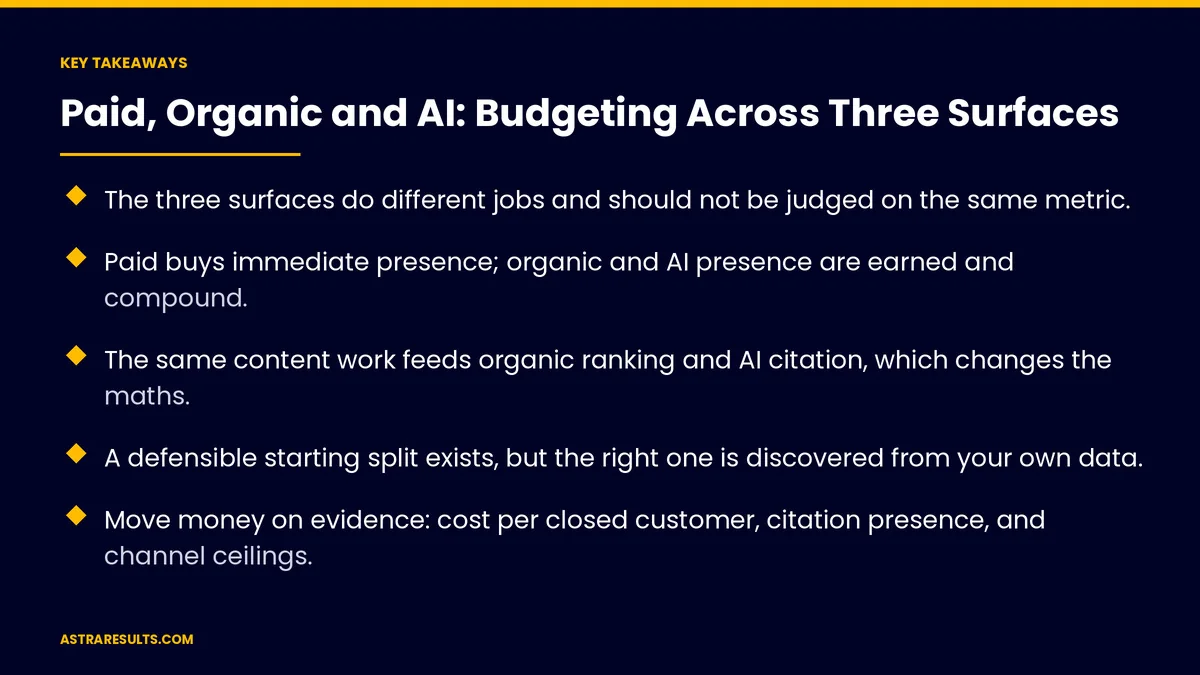
Key Takeaways
- The three surfaces do different jobs and should not be judged on the same metric.
- Paid buys immediate presence; organic and AI presence are earned and compound.
- The same content work feeds organic ranking and AI citation, which changes the maths.
- A defensible starting split exists, but the right one is discovered from your own data.
- Move money on evidence: cost per closed customer, citation presence, and channel ceilings.
- Nobody has precise attribution across all three, and pretending otherwise is the real risk.
Published: September 19, 2026 | Reading Time: ~12 minutes | Category: Budgeting
This piece is about how to divide money across all three without pretending to a precision nobody has. What each surface does, where they overlap, what a defensible starting split looks like, and which signals should move money between them. The short version: fund the surface where your buyers are deciding, not the one you understand best.
Guidance for owners and operators. Nothing here is financial advice. Search and AI systems change frequently; the patterns described reflect conditions as of this writing and should be re-verified.
In This Playbook
- What each surface actually does
- Where they overlap
- A defensible starting split
- The signals that should move money
- The attribution problem, stated plainly
- Common budgeting mistakes
- Getting started: the first quarter
- How this is done at Astra
What each surface actually does
- Paid search. Buys presence at the moment of intent, immediately, for as long as the money lasts. Turns off when the budget does, laid out in what search advertising buys.
- Organic search. Earns presence that persists without per-click cost, slowly, and continues producing after the spending stops. Increasingly concentrated in commercial-intent queries as informational ones move to answers, explored in what changed in SEO.
- AI answers. A handful of businesses get named; everyone else is absent from that conversation. Presence is earned through content structure, entity consistency and authority, laid out in getting cited.
- The emerging fourth. Paid placements inside AI assistants, which is a real surface now but early enough that budget should be experimental rather than structural.
- The key difference. Paid is a tap. Organic and AI are assets. Budgeting them identically is the first mistake.
Where they overlap
The overlap is why the budget question is not three separate decisions.
- Content serves two surfaces. A page written to rank is also the page an answer engine retrieves and quotes. The work is largely shared, so the marginal cost of the second surface is low once the first is being done properly.
- Technical work serves all three. Site speed, structure and schema affect ranking, citation and landing page performance for paid traffic alike.
- Entity consistency serves everything. Accurate, matching business information improves local ranking, AI recognition and ad landing experience.
- Reviews serve everything. Local ranking, AI trust signals, and conversion rate on paid traffic.
- The practical implication. A dollar spent on the shared foundation is worth more than a dollar spent on any single surface, and it should be funded first.
A defensible starting split
Not a formula, a starting point to be corrected by evidence.
- For a business that needs customers this quarter. The majority to paid, a meaningful minority to the shared foundation, and the rest to content that serves organic and AI. Paid pays the bills while the assets are built.
- For a business with established organic presence. Less to paid, more to maintaining and extending the asset, because the cost per customer from organic is far lower once it exists.
- For a business in a category where buyers ask assistants. A larger share to content structure and entity work, because absence from answers is invisible and therefore easy to ignore until it is large.
- For a business with a hard ceiling in paid. When impression share for buying terms is already high, additional paid budget buys worse traffic, and the money belongs in the other surfaces.
- The one rule. Never fund only the surface that produces this month. That is how businesses end up renting their entire demand.
The signals that should move money
- Cost per closed customer by surface. The primary signal, computed with the business's own data rather than platform reports, according to attribution across channels.
- The paid ceiling. High impression share on buying terms means paid is saturated. More budget there is the worst available option.
- Organic trajectory. Commercial-intent organic customers rising means the asset is working, and it justifies continued funding through the slow period.
- Citation presence. A tested set of real buyer questions run against the major assistants, monthly. Rising presence is progress; falling presence is a warning that arrives before revenue does.
- Competitive movement. A competitor appearing consistently in answers where the business does not is a signal to fund that surface before the gap widens.
- Seasonality. Paid flexes with demand cycles; organic and AI work continues regardless, because stopping the content during a slow quarter costs the next busy one.
The attribution problem, stated plainly
- Nobody has clean attribution across all three. A buyer who read an AI answer, searched the brand, clicked an ad and called cannot be cleanly credited.
- What to do instead of pretending. Capture the source question at intake. Watch branded search volume as a proxy for awareness built elsewhere. Use holdout tests where the budget allows. Accept directional evidence.
- The trap to avoid. Funding only what is cleanly measurable, which systematically overfunds paid and starves the surfaces that produce the compounding.
- The discipline that helps. One definition of a customer, one place the numbers live, and a monthly review that looks at all three together rather than three separate vendor reports.
Common budgeting mistakes
- Paying for presence that is already earned. Heavy brand-term bidding when the business already ranks first organically for its own name, without testing whether the ads are incremental.
- Stopping content in a slow quarter. The channel that takes months to work is the one cut first, which guarantees it never works.
- Funding AI visibility as a separate project. It is largely the same content and technical work as organic; treating it as a new line item double-counts the cost.
- Treating paid as permanent. A business whose entire demand stops the day the card declines has a fragility problem, not a marketing strategy.
- Judging all three on the same timeline. Paid is judged in weeks, organic and AI in quarters. Applying one timeline to all three kills the slow ones.
Getting started: the first quarter
Days 1–30: measure what exists
Cost per closed customer computed by surface with the business's own data. Impression share on buying terms checked for a paid ceiling. Citation presence baselined against a set of real buyer questions. The shared foundation — technical health, entity consistency, reviews — audited.
Days 31–60: fund the foundation and rebalance
The shared work funded first because it serves all three. Paid budget trimmed where it is saturated and moved to the surfaces with headroom. Content work targeted at commercial-intent queries that also answer buyer questions.
Days 61–90: read the signals
Cost per closed customer by surface recomputed. Citation presence re-tested. Organic commercial-intent customers compared to the baseline. One budget decision made on that evidence, and the review cadence set for the next quarter.
How this is done at Astra
Astra Results Marketing funds the shared foundation first — technical health, entity consistency, reviews and content that serves organic ranking and AI citation together — because a dollar there works on all three surfaces. Paid is sized to what it can buy efficiently, and trimmed when impression share shows it is saturated rather than pushed.
Because one team runs all three, the monthly review compares them on the same definitions rather than reconciling three vendor reports, and the attribution limits are stated plainly rather than papered over. Engagements begin with a surface-by-surface allocation review through our AI SEO team.
Related reading
Frequently asked questions
How are the three surfaces different?
Paid buys presence at the moment of intent, immediately, and stops when the budget does. Organic earns presence that persists without per-click cost and keeps producing after spending stops, increasingly concentrated in commercial-intent queries. AI answers name a handful of businesses and leave everyone else absent from that conversation, with presence earned through content structure, entity consistency and authority. Paid is a tap; the other two are assets.
Why can't organic and AI be budgeted separately?
Because the work overlaps heavily. A page written to rank is also the page an answer engine retrieves and quotes. Technical health, entity consistency and reviews serve ranking, citation and paid landing experience alike. Funding AI visibility as a separate project double-counts the cost, and a dollar spent on the shared foundation is worth more than one spent on any single surface.
What does a reasonable starting split look like?
For a business needing customers this quarter, the majority to paid with a meaningful minority to the shared foundation and content, because paid pays the bills while assets are built. For one with established organic presence, less to paid. Where impression share on buying terms is already high, paid is saturated and money belongs elsewhere. The one rule: never fund only the surface that produces this month.
Which signals should move budget?
Cost per closed customer by surface, computed with the business's own data rather than platform reports. Impression share on buying terms, which reveals a paid ceiling. Organic commercial-intent customers rising, which justifies continued funding through the slow period. Citation presence tested monthly against real buyer questions, where a fall warns before revenue does. And competitors appearing in answers where the business does not.
How should attribution be handled across three surfaces?
Nobody can cleanly credit a buyer who read an AI answer, searched the brand, clicked an ad and called. Capture the source question at intake, watch branded search volume as an awareness proxy, run holdout tests where budget allows, and accept directional evidence. The real risk is funding only what is cleanly measurable, which systematically overfunds paid and starves the compounding surfaces.
What is the most common budgeting mistake?
Cutting content in a slow quarter. The channel that takes months to work is the first one cut, which guarantees it never works. Close behind: bidding heavily on brand terms the business already ranks first for without testing incrementality, treating paid as permanent so demand stops the day the card declines, and judging all three on the same timeline when paid is judged in weeks and the others in quarters.
READY TO FUND THE SURFACE WHERE YOUR BUYERS DECIDE? Astra Results Marketing funds the shared foundation first, sizes paid to what it can buy efficiently, tests citation presence monthly, and reviews all three surfaces on one set of definitions. Astra Results Marketing · 1101 Brickell Ave, Miami, FL 33131 · +1 (786) 321-2866 · [email protected] Find us on Google · Yelp ▸ CALL (786) 321-2866 · ▸ REQUEST YOUR CONSULTATION