Rated 5 star on

SEO for Growth Companies: The 2026 Playbook
Quick answer
Answer engines have taken a share of informational searches permanently, while commercial intent still clicks through to a website. Technical health is the floor: a page that is slow or unindexed cannot rank or be cited. Above it, one page per real intent beats fifty keyword variations, and authority still decides who gets retrieved.
SEO has been declared dead every year for a decade and is now having its most consequential change. Answer engines handle a growing share of the questions that used to produce clicks, so some traffic is gone permanently. What has not changed is that businesses still get found, and being findable still rewards the same things.
Key Takeaways
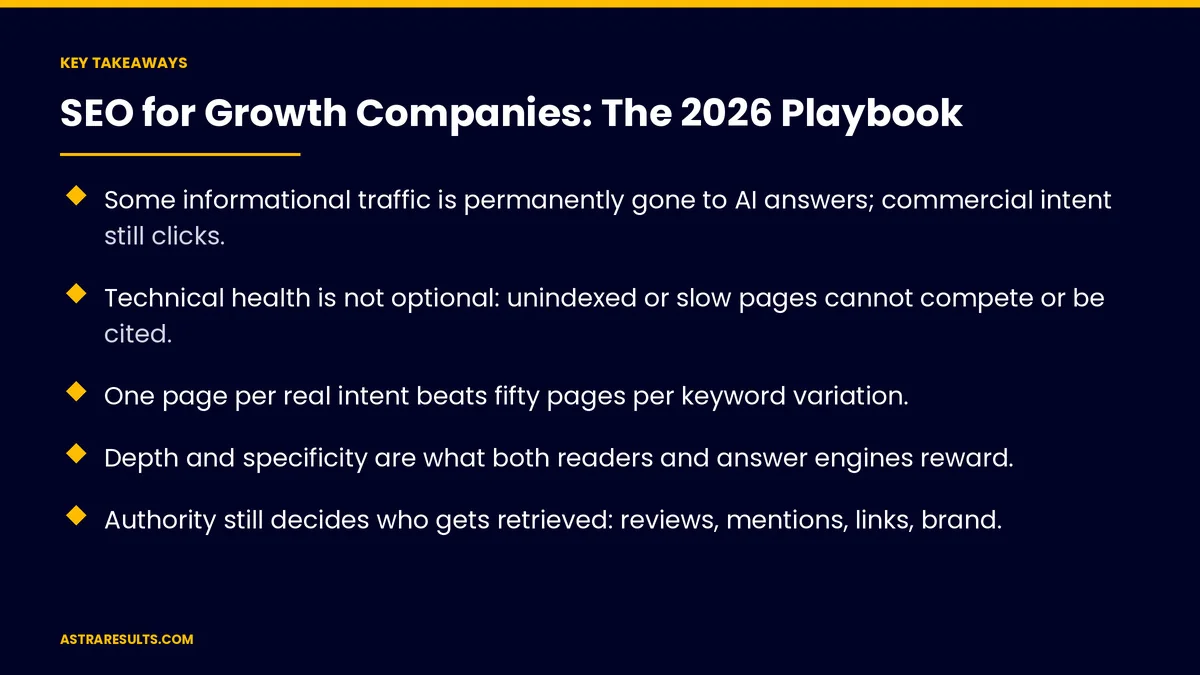
- Some informational traffic is permanently gone to AI answers; commercial intent still clicks.
- Technical health is not optional: unindexed or slow pages cannot compete or be cited.
- One page per real intent beats fifty pages per keyword variation.
- Depth and specificity are what both readers and answer engines reward.
- Authority still decides who gets retrieved: reviews, mentions, links, brand.
- Judge SEO on customers and citations, on a timeline of quarters rather than weeks.
Published: September 22, 2026 | Reading Time: ~14 minutes | Category: SEO
This playbook is what SEO looks like now, written for a company that needs customers rather than a chart. What still works, what stopped working, what timelines are honest, and how to judge whether it is paying. Stated simply: the goal was never traffic; it was being the business that gets found.
Guidance for owners and operators. Nothing here is legal advice. Search systems change frequently; the patterns below reflect conditions as of this writing and should be re-verified periodically.
In This Playbook
- What actually changed
- Technical health: the part that is not optional
- Intent, not keywords
- Depth over volume
- Authority: still the gate
- Local, where it applies
- Timelines that are honest
- Measuring it properly
- Where SEO budgets get wasted
- Getting started: the first quarter
What actually changed
- Informational queries now often end without a click. Someone asking how something works frequently gets the answer in the results page or from an assistant. Traffic to explainer content has fallen for many businesses and is not coming back.
- Commercial intent still clicks. Someone choosing a provider, comparing options or ready to buy still visits sites, because they need to evaluate a specific business, see proof and make contact.
- Being cited became a second goal. The answer engines name sources. A business can now win the query without the visit, if it is the named source, set out in AI SEO.
- What did not change. Search engines still need to crawl, parse and trust a site before anything else happens.
- The strategic implication. Stop measuring SEO by total sessions. Measure it by commercial visits, citations and customers.
Technical health: the part that is not optional
None of the rest matters if the machine cannot read the site. Google's documentation on crawling, indexing and page experience is the primary reference (Google Search Central, Core Web Vitals).
- Crawlable and indexed. Pages that should rank are in the index; pages that should not — staging, filters, duplicates, thin tag pages — are not.
- Fast on a phone. The majority of visits are mobile. A slow page loses both visitors and ranking.
- One canonical version. One URL per page, one domain version, no accidental duplicates competing with each other.
- Clean structure. A logical hierarchy where important pages are reachable in a few clicks, with internal links that describe what they point to.
- Structured data. Organization, LocalBusiness, Article, FAQ and Service markup so machines know what things are, the case for which sits in structured data for answer engines.
- The audit rhythm. Quarterly, plus immediately after any site change. Redesigns break SEO more than anything else.
Intent, not keywords
The shift that separates modern SEO from the 2015 version.
- One page per intent. All the ways people ask the same thing belong on one strong page, not on twenty thin ones targeting variations.
- Four intents, four page types. Someone learning needs an explainer. Someone comparing needs a comparison. Someone choosing needs a service page with proof. Someone ready needs a contact path with no friction.
- Match the page to the moment. A comparison query landing on a sales page bounces. A buying query landing on a blog post bounces.
- Where the money is. Commercial and transactional intent — the comparison, the choosing, the local "near me" — is where clicks survived and customers live.
- The informational question. Explainer content still matters for authority and citations, but it should be written knowing much of it will be read as an AI answer rather than a visit.
Depth over volume
The publishing strategy that stopped working, and what replaced it.
- What stopped working. Fifty short posts on slight variations of a topic. Machines recognize thin content, and readers leave it.
- What works. One thorough page that answers the question completely, with the specifics only someone who does the work would know: real timelines, real trade-offs, real numbers, real exceptions.
- The specificity test. Could a competitor have written this sentence without changing a word? If yes, it adds nothing.
- Updating beats publishing. An existing page that ranks, refreshed with current information, usually outperforms a new page on the same topic.
- The FAQ layer. Real questions with complete answers, marked up, because that is what gets quoted.
- The uncomfortable implication. A smaller number of good pages beats a content calendar measured in volume.
Authority: still the gate
Content quality decides what happens after retrieval. Authority decides whether retrieval happens.
- Reviews. Recent, plentiful, answered, under the exact business name. Among the strongest signals for any local or service business.
- Mentions. Being named in credible places — local press, industry publications, partner sites, associations — with or without a link.
- Links. Still count, still earned rather than bought. The ones that matter come from sites a human would trust.
- Brand searches. People searching the business by name is a trust signal to the engines and a byproduct of every other channel working.
- Consistency. The same name, address and phone everywhere, so the engine is confident it is one entity.
- What to avoid. Purchased links, private networks, directory spam. The risk is not theoretical, and cleanup costs more than the shortcut saved.
Local, where it applies
For any business with a service area, local is most of the opportunity.
- The business profile. Complete, accurate, categorized correctly, with real photos and current hours — the highest-leverage local asset, laid out in the business profile discipline.
- Location and service-area pages. One per genuine location or served area, with content specific to it. Not templated pages with the city name swapped.
- Reviews by location. Solicited and answered locally, because a business with reviews concentrated at one location looks thin at the others.
- Proximity is a factor nobody controls. Rankings vary by where the searcher stands. A business cannot rank everywhere, which is why service-area strategy has to be honest.
Timelines that are honest
The most common source of broken SEO relationships.
- Weeks. Technical fixes, business profile improvements, existing pages updated. Real movement is possible here.
- Two to four months. New pages beginning to rank for less competitive terms. First meaningful traffic changes.
- Six to twelve months. Competitive commercial terms, authority accumulating, citations appearing in AI answers.
- Beyond a year. The compounding that makes SEO worth it: a library of pages producing customers without ongoing spend.
- What accelerates it. An established domain, existing authority, less competition, and fixing something badly broken.
- What no one can accelerate. A new domain competing against ten-year-old competitors in a dense market. Anyone promising otherwise is selling.
Measuring it properly
- Customers from organic, by page and by intent type, according to attribution by channel.
- Commercial-intent visits, separated from informational, so the metric that matters is not diluted by explainer traffic that never converts.
- Citations in AI answers, tracked with a test set of real buyer questions.
- Conversion rate by landing page, which reveals that traffic is not the problem.
- Rankings as a diagnostic, in the appendix, for the terms that produce customers.
- Total sessions, deprioritized. It was always a weak proxy and is now actively misleading.
Where SEO budgets get wasted
- Publishing volume. Content calendars measured in posts per month rather than pages that convert.
- Chasing high-volume keywords with no commercial intent.
- Ignoring technical debt while adding content on top of it.
- Templated location pages that no engine and no reader distinguishes.
- Rebuilding the site without SEO in the room, losing years of accumulated equity in a weekend.
- Judging at week six. The channel compounds; evaluating it on a paid-search timeline guarantees cancelling it just before it works.
Getting started: the first quarter
Days 1–30: technical and intent audit
Crawl and index health fixed. Speed addressed. Structured data added. Every existing page mapped to an intent, with duplicates and thin pages consolidated or removed. The commercial-intent keyword set defined.
Days 31–60: depth and local
The highest-value commercial pages rewritten with real specifics and FAQ blocks. The business profile completed. Reviews solicited and answered. Internal linking corrected.
Days 61–90: authority and measurement
Mentions pursued in credible local and industry sources. The AI citation test set built and baselined. Reporting switched to customers from organic, commercial visits and citations, with rankings moved to the appendix.
How Astra does SEO
Astra Results Marketing fixes technical health before adding anything, maps every page to a real intent rather than a keyword, and consolidates thin pages instead of publishing more of them. Content is written with the specifics only a business that does the work would know, and marked up so answer engines can quote it.
Timelines are stated directly at the start, including when a competitive term is out of reach for a new domain. Reporting leads with customers from organic and citations, not sessions. Engagements begin with a technical and intent audit through our search engine optimization team.
Related reading
Frequently asked questions
Is SEO still worth doing in 2026?
Yes, with a changed target. Informational queries increasingly end without a click, so explainer traffic has fallen permanently for many businesses. Commercial intent still clicks, because someone choosing a provider needs to evaluate a specific business and make contact. And being named as a source in an AI answer is now a second way to win the query. Measure commercial visits, citations and customers rather than total sessions.
What technical work is genuinely required?
Pages that should rank being indexed and pages that should not being excluded; fast loading on mobile, where most visits happen; one canonical URL per page with no accidental duplicates; a logical structure where important pages are a few clicks deep with descriptive internal links; and structured data so machines know what things are. Audited quarterly and immediately after any site change, because redesigns break SEO more than anything else.
Why does intent matter more than keywords?
Because all the ways people ask the same thing belong on one strong page rather than twenty thin ones. Four intents need four page types: learning needs an explainer, comparing needs a comparison, choosing needs a service page with proof, ready needs a frictionless contact path. A comparison query landing on a sales page bounces, and so does a buying query landing on a blog post.
Should a business publish more content?
Usually less, better. Fifty short posts on slight variations stopped working; machines recognize thin content and readers leave it. One thorough page with the specifics only someone who does the work would know — real timelines, trade-offs, numbers and exceptions — outperforms them. The test is whether a competitor could have written the sentence without changing a word. And updating a page that already ranks beats publishing a new one.
How long does SEO take?
Technical fixes, profile improvements and page updates can move within weeks. New pages begin ranking for less competitive terms in two to four months. Competitive commercial terms and AI citations take six to twelve. The compounding that makes it worthwhile arrives beyond a year. A new domain competing with ten-year-old sites in a dense market cannot be accelerated, and anyone promising otherwise is selling.
What should be measured?
Customers from organic by page and intent type, commercial-intent visits separated from informational so the number is not diluted, citations in AI answers tracked against a test set of real buyer questions, and conversion rate by landing page — which usually reveals traffic was not the problem. Rankings belong in the appendix as a diagnostic for terms that produce customers. Total sessions is now actively misleading.
READY TO BE THE BUSINESS THAT GETS FOUND? Astra Results Marketing fixes technical health first, maps pages to real intent, writes the depth that readers and answer engines reward, and reports customers and citations rather than sessions. Astra Results Marketing · 1101 Brickell Ave, Miami, FL 33131 · +1 (786) 321-2866 · [email protected] Find us on Google · Yelp ▸ CALL (786) 321-2866 · ▸ REQUEST YOUR CONSULTATION