Rated 5 star on

Brickell Insurance & Risk Advisory Marketing
Quick answer
A Brickell insurance agency should sell advisory judgment, not quotes. Plain coverage education wins the relationship because most clients do not know what their policies do. Storm-season content should focus on preparation and coverage review, never fear. Commercial lines and claims advocacy set the agency apart. Astra measures retention and renewals over leads.
Insurance is South Florida's hardest financial conversation. Property risk here is elevated, premiums have moved in ways that alarm homeowners and business owners alike, coverage documents are written to be defensible rather than understandable. Most clients discover what they bought only at a claim.
Key Takeaways
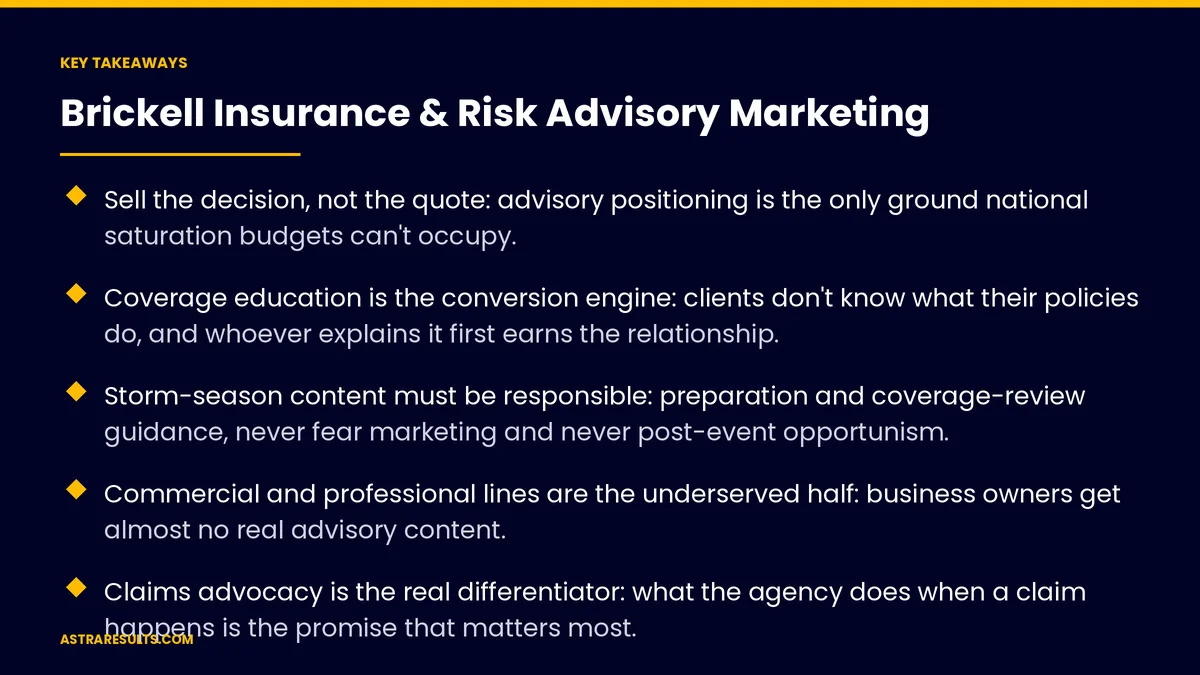
- Sell the decision, not the quote: advisory positioning is the only ground national saturation budgets can't occupy.
- Coverage education is the conversion engine: clients don't know what their policies do, and whoever explains it first earns the relationship.
- Storm-season content must be responsible: preparation and coverage-review guidance, never fear marketing and never post-event opportunism.
- Commercial and professional lines are the underserved half: business owners get almost no real advisory content.
- Claims advocacy is the real differentiator: what the agency does when a claim happens is the promise that matters most.
- Measure retention and renewal: this is a renewal business, so retention rate and multi-policy depth outrank lead volume entirely.
Published: October 3, 2026 | Reading Time: ~11 minutes | Category: Financial Services · Brickell
Meanwhile the category's marketing is dominated by one message, the quote, delivered by national brands with saturation budgets and by comparison sites optimized to capture intent rather than to advise. An independent agency or risk advisory practice in Brickell cannot win that auction and shouldn't try.
What it can do is occupy the ground the quote machine structurally cannot: the decision itself. The kicker states it: coverage is a decision.
The strategic consequence is a positioning inversion. Quote marketing sells price and speed on a commodity assumption. Advisory marketing sells judgment about risk: what a client owns, what could go wrong, what the policy would and wouldn't do about it, and what trade-offs are worth making.
That reframe also happens to be the plain one in this region, where the cheapest policy is frequently the one that fails at the moment of need. Nothing here is legal, tax, or insurance advice. Nothing here is a recommendation about any policy, carrier, or coverage.
Insurance marketing and advertising are governed by Florida Department of Financial Services requirements, licensing rules, carrier and appointment agreements, and, where financial products are involved, extra regulatory frameworks that only your counsel and compliance can apply. Every asset requires review before publication.
In This Playbook
- Advisory Positioning Against the Quote Machine
- Coverage Education as the Engine
- Storm Season, Handled Responsibly
- Commercial and Professional Lines
- Claims Advocacy Is the Differentiator
- The Bilingual and Cross-Border Layer
- Channels
- What should a Brickell insurance agency measure?
- A 90-Day Build
Advisory Positioning Against the Quote Machine
The strategic reframe.
What the category's marketing is. Price, speed, and switching, an auction dominated by national advertisers and lead aggregators whose economics depend on volume rather than fit.
Why competing there fails. An independent practice can't outspend saturation advertising and can't out-cheap a carrier's direct channel, and the clients who arrive on price leave on price, which is the discount-cohort problem Astra documents across verticals.
What advisory positioning looks like. Content that helps a client understand what she owns and what she's exposed to. Replacement cost versus market value, what a deductible structure means in practice, what exclusions typically apply, what an umbrella policy does, why coverage limits chosen years ago may no longer match reality.
The proof mechanism. The comparison-framework play Astra uses in every high-consideration market. Publish the questions a client should ask any agent including this one, and the client who learned to evaluate coverage from your content evaluates every competitor with your framework.
The candid concession. For simple, low-exposure situations, a direct carrier purchase is a reasonable choice. Saying so is what makes the advisory claim credible for the situations where it matters, per the steelman discipline.
Coverage Education as the Engine
The content that does the work.
The knowledge gap, stated plainly. Most clients cannot describe their own coverage, don't know what their policy excludes, and have never had anyone walk them through it. That makes plain-language education both a real service and the highest-converting asset in the category.
The topics that matter here. How property coverage components generally fit together, what flood coverage is and why it's typically separate, the concepts behind deductibles that vary by peril type, what "replacement cost" and "actual cash value" mean for a real claim, how condominium coverage interacts with association policies (a confusing and regionally critical topic).
What an umbrella policy covers, all at general educational level, with the standing note that specifics depend on the policy, the carrier, and the client's situation, which is precisely why a review conversation exists.
The annual-review frame. The most valuable recurring content in this vertical is the coverage-review prompt (what changed this year (a renovation, a new business activity, a teen driver, a rising property value) and why it matters) because it converts education into a conversation without a syllable of urgency.
The AI-answer dividend. These are exactly the questions people now ask assistants. The answer layer cites pages that answer them, which almost nobody in this category publishes.
Storm Season, Handled Responsibly
The region's defining risk conversation, and its clearest ethical test.
What's legitimate and valuable. Pre-season preparation content (documentation and inventory practices, understanding your deductible structure before you need it, what to have accessible, how the claims process generally works), the note that coverage changes may be restricted once a storm is named, a real and widely misunderstood timing reality, and post-event practical guidance on documentation and next steps.
What's banned. Fear creative, countdown urgency tied to forecasts, and any post-event marketing that resembles chasing, the no-tragedy-marketing absolute Astra established, which applies with equal force to an insurance practice as to a personal-injury firm.
Why restraint pays here. A community recovering from a storm remembers precisely which firms helped and which advertised. This vertical's business is renewal, meaning the reputational clock runs far longer than any campaign.
The practice's own contingency. Publishing how clients reach the agency when systems are down, how claims get initiated. What the agency does in the first days is the operational honesty Astra keeps finding to be the most differentiating content in storm-exposed markets.
Commercial and Professional Lines
The underserved half of the market.
The gap. Business owners receive almost no real advisory content. The category speaks to them in the same quote language it uses for auto insurance, while their actual exposures are specific and poorly understood.
The content that converts. What general liability does and doesn't cover, why property and business-interruption coverage matter differently for a restaurant than for an office, what professional liability means for the region's medical and legal practices, cyber exposure for firms holding client data, and the coverage questions that surface during a lease negotiation or a business sale.
The Brickell-specific lanes. Condo and HOA-adjacent commercial exposure, hospitality and restaurant risk, professional practices needing malpractice and cyber coverage, international businesses with cross-border operations, and marine and yacht coverage, a real regional specialty adjacent to the maritime practice Astra mapped.
The referral adjacency. CPAs, business attorneys, RIAs, and lenders encounter coverage gaps constantly and refer when someone is useful, the professional-web discipline applied.
Claims Advocacy Is the Differentiator
The promise that matters, and the one most agencies never articulate.
The client's real question. Not "what does this cost" but "what happens when I need it". Almost nobody answers it in marketing.
What to publish. How the agency supports a claim (what it does, what the client does, what the carrier does), what documentation helps, what realistic timelines look like, and what the agency's role is when a claim is disputed: stated factually, with no promises about outcomes, which carriers and adjusters determine.
Why it converts. It's the difference between an intermediary and an advocate. It's the single most persuasive thing an independent practice can say against a direct-purchase alternative.
The real limits. An agency cannot guarantee a claim outcome, and saying so plainly while describing exactly what advocacy involves is more credible than any implied assurance.
The retention consequence. Claims experience drives renewal more than price does. That makes advocacy both the marketing message and the operational priority.
The Bilingual and Cross-Border Layer
Spanish and Portuguese natively per the chain rule. This corridor's business owners and property owners frequently conduct financial matters in their first language. Coverage decisions are exactly the conversation where comprehension determines whether a client is properly protected. The compliance layer per the reviewed-in-every-language rule. Translated insurance marketing is still regulated marketing, and disclosures must render accurately in each language.
The international-owner lane. Foreign nationals owning South Florida property face specific coverage and structure questions, served at general level with routing to legal and tax counsel per the cross-border rigor standard Astra set, teach why the question matters, never the answer.
Channels
Search carries the education library under named-advisor authorship (the coverage explainers, the annual-review prompt, the storm-preparation content, the commercial-lines pages, and the claims-advocacy walkthrough) earning the AI citations this market generates ("does homeowners insurance cover flood," "what is replacement cost coverage," "¿qué cubre el seguro de condominio?") through the entity work our AI SEO service builds.
Paid runs narrow and deliberately away from the quote auction, behind the negatives fortress. "Cheap insurance" and quote-comparison intent excluded wholesale (the category's largest waste for an advisory practice), aggregator and lead-vendor terms out, claims-attorney intent routed correctly, jobs and licensing traffic filtered. The profile carries languages and service lines plainly. Reviews run never-gated.
Matter unusually much here, since claims experiences generate the most credible reviews in the category. The professional web runs with communication-back and no steering arrangements beyond what disclosure rules permit. Community and business-association presence runs participation-over-promotion, with pre-season preparation seminars as real service.
What should a Brickell insurance agency measure?
The dashboard, because this is a renewal business:
- Retention and renewal rate as the flagship, read by cohort and by acquisition source — since price-acquired clients renew worse, which the data will show plainly
- Multi-policy depth per household or business, the clearest advisory-relationship signal
- The annual-review completion rate, which is simultaneously a service metric and the strongest retention driver available
- Claims-experience satisfaction where the practice tracks it, since claims drive renewal more than premium does
- The professional-web ledger by relationship
- Qualified-conversation quality rather than lead volume, because aggregator leads inflate counts and depress economics
- Commercial-versus-personal mix against the practice's stated strategy
- Language cohorts read separately
- Client lifetime value against acquisition cost on the ledger standard, read on renewal years rather than quote counts
A 90-Day Build
Days 1–30: Position and define
- The advisory positioning documented with the quote-auction exit decided explicitly
- The coverage-education topic map built with compliance review standards set
- The storm-season content rules written (permitted preparation content, banned fear and chasing creative)
- The claims-advocacy description drafted factually with no outcome implications
- Measurement instrumented for retention, multi-policy depth, and review completion
Days 31–60: The library live
Coverage explainers, the annual-review prompt, and commercial-lines pages published under named-advisor authorship in English and native Spanish with each version reviewed; the claims-advocacy walkthrough live. The agency's own storm-contingency communication published; paid restructured away from quote intent behind the fortress.
Days 61–90: Web and reads
- The CPA, attorney, RIA, and lender web engaged with the forwardable coverage-gap explainers
- Pre-season preparation seminars scheduled as service
- AI-answer accuracy checked in both languages
- First clear reads — retention by source, multi-policy depth, review completion, qualified-conversation quality — and next quarter's spend allocated from renewal economics rather than lead counts
How Astra Builds Insurance and Risk Practices
Astra Results Marketing builds insurance and risk advisory marketing on the decision rather than the quote: coverage education as the conversion engine, storm season handled responsibly and never opportunistically, commercial and professional lines served where the category leaves a gap, claims advocacy articulated as the promise that matters, and everything measured on retention, renewal, and multi-policy depth.
Engagements begin with a positioning, education, and retention audit through our business consulting team.
Related reading
Frequently asked questions
How do we compete with national brands and comparison sites?
By leaving their auction. They sell price and speed on a commodity assumption, and you cannot outspend or out-cheap them. Occupy the decision instead (what a client owns, what she's exposed to, what her policy would do) and publish the questions she should ask any agent including you. Add the candid concession that simple, low-exposure situations are fine to buy direct. It's what makes your advisory claim credible where it matters.
What content actually converts in this category?
Coverage education and the annual-review prompt. Most clients can't describe their own policies, so plain-language explanation of how coverage components fit together. A yearly nudge about what changed in their life that their coverage may not reflect, converts education into conversation without any urgency mechanics. These are also precisely the questions people now ask AI assistants, and almost nobody in this category has published real answers.
How should we handle hurricane season without fear marketing?
Publish preparation and process, never alarm: documentation practices, understanding deductible structures before you need them, how claims generally work, and the plain timing reality that coverage changes may be restricted once a storm is named. Then publish your own contingency, how clients reach you when systems are down. And never advertise into the aftermath. A community remembers exactly which firms helped and which chased, and this is a renewal business with a long memory.
Why emphasize claims advocacy in marketing?
Because it answers the client's real question, not what it costs but what happens when I need it, and almost no competitor addresses it. Describe factually what the agency does during a claim, what documentation helps, what timelines look like. What happens if a claim is disputed, with no outcome promises since carriers and adjusters decide those. Claims experience drives renewal more than premium does, which makes advocacy both the message and the operational priority.
Is commercial lines worth building content for?
It's the underserved half of the market. Business owners get quote language aimed at auto insurance while their actual exposures (business interruption, professional liability, cyber, lease-driven requirements) go unexplained. Publish real advisory content for the region's specific lanes, and cultivate the CPA, attorney, and lender relationships that encounter coverage gaps constantly and refer whoever is useful.
What should we measure instead of leads?
Retention and renewal rate by cohort and acquisition source, multi-policy depth per client, annual-review completion, and claims-experience satisfaction, with lifetime value against acquisition cost read on renewal years. Aggregator leads inflate volume and depress economics, and price-acquired clients renew worse. The cohort comparison ends that debate arithmetically rather than philosophically.
Ready to Sell the Decision Instead of the Quote? Astra Results Marketing builds insurance and risk advisory marketing on coverage education, responsible storm-season content, commercial-lines depth, and claims advocacy articulated plainly. Measured on retention, renewal, and multi-policy depth. Start with a positioning, education, and retention audit for your practice. ▸ CALL (786) 321-2866 · ▸ REQUEST YOUR CONSULTATION