Rated 5 star on


The South Florida Professional Practice Marketing Bible
Quick answer
The South Florida Professional Practice Marketing Bible is Astra's consolidated reference for legal, medical, dental and aesthetic practices. It treats each corridor as its own market and Spanish as a core requirement. It sets fixed ethics and a channel priority order. It shows where practices lose revenue and how one ledger measures it.
This is the consolidated reference. Across more than a hundred playbooks, Astra has worked through South Florida corridor by corridor and vertical by vertical (Brickell's towers, Coral Gables' establishment, Miami Beach's international flow, Pinecrest's households, Westchester's neighborhoods, Aventura's high-rises) and through the legal, medical, dental, and aesthetic practices that operate in each.
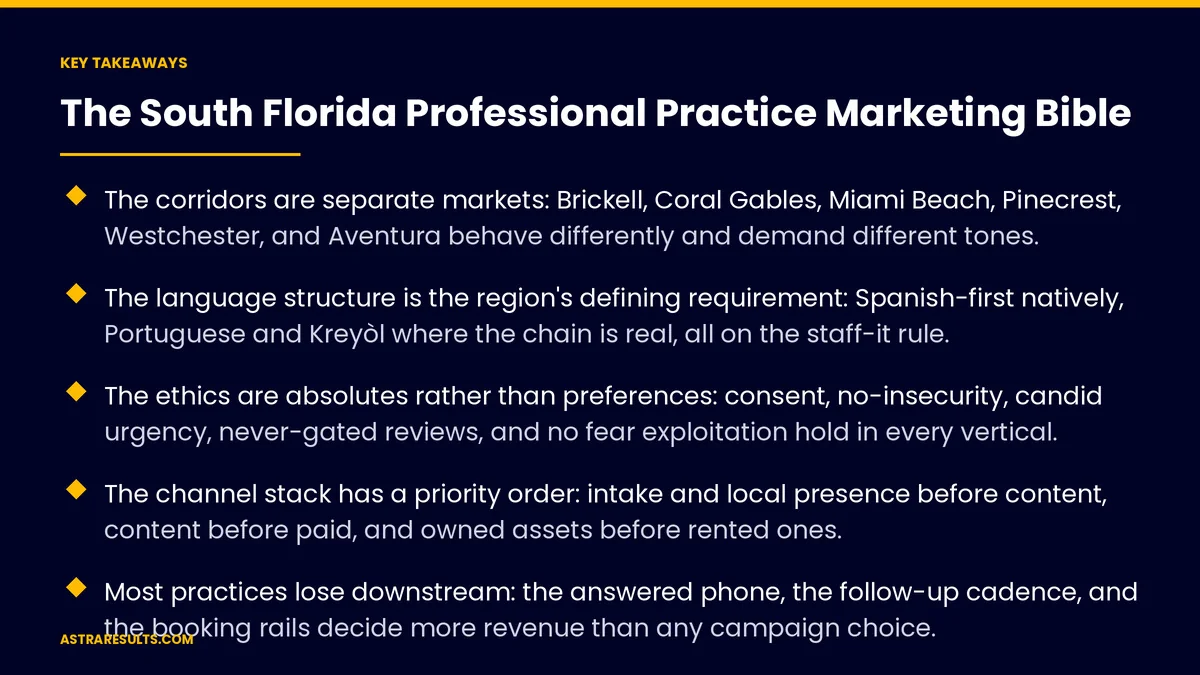
Key Takeaways
- The corridors are separate markets: Brickell, Coral Gables, Miami Beach, Pinecrest, Westchester, and Aventura behave differently and demand different tones.
- The language structure is the region's defining requirement: Spanish-first natively, Portuguese and Kreyòl where the chain is real, all on the staff-it rule.
- The ethics are absolutes rather than preferences: consent, no-insecurity, candid urgency, never-gated reviews, and no fear exploitation hold in every vertical.
- The channel stack has a priority order: intake and local presence before content, content before paid, and owned assets before rented ones.
- Most practices lose downstream: the answered phone, the follow-up cadence, and the booking rails decide more revenue than any campaign choice.
- One ledger governs: cost per kept consult or signed case by source and language, read on retention and household clocks.
Published: October 24, 2026 | Reading Time: ~22 minutes | Category: Pillar · South Florida
What emerged is not a collection of tactics but a doctrine. A set of market truths, ethical absolutes, operational standards, and measurement disciplines that hold across every practice type in this region because they follow from what South Florida is.
This piece assembles that doctrine in one place.
It is deliberately structural rather than clever: the corridor map, the language structure, the vertical differences that matter, the ethics that never bend, the channel stack in priority order, the intake and conversion layer where most practices lose, the seasonality this region uniquely runs on, and the ledger that turns every argument into an observation.
The kicker states the intent: the whole doctrine, one place.
Marketing guidance for licensed practices only. Nothing here is legal, medical, or dental advice; candidacy, clinical judgment, legal strategy, and every professional statement belong to the licensed practitioners in your practice. Florida Bar advertising rules, medical and dental board advertising rules, and applicable federal and state law govern every asset a practice publishes. Compliance review precedes publication, always.
In This Playbook
- Part One: The Region
- Part Two: The Language Architecture
- Part Three: The Verticals
- Part Four: The Ethics That Never Bend
- Part Five: The Channel Stack, In Priority Order
- Part Six: Where Practices Actually Lose
- Part Seven: Seasonality
- Part Eight: The Ledger
- Part Nine: The Twelve-Month Build
Part One: The Region
Why the region needs its own doctrine. South Florida is not a generic Sun Belt metro with better weather. It is a international market where most residents speak a language other than English at home, where wealth arrives from three continents, where a large share of professional-services demand comes from people who chose this place deliberately.
Where the seasonal calendar inverts the national pattern. Every discipline in Astra bends around those facts.
The corridor map. These are separate markets, and a single "Miami" page serves none of them:
- Brickell and downtown: the tower economy — young professionals, finance and legal firms, lunch-hour logistics, and the professional-services register Astra opened with. Convenience is measured in elevator minutes.
- Coral Gables: the establishment corridor — verification-heavy, multigenerational, discreet, with wealth-management and high-asset family law among its signature practices.
- Miami Beach and the islands: the international corridor — real destination flow, medical tourism, trilingual demand, and the seasonal swing at its most extreme.
- Coconut Grove: the village register — walkable, wellness-adjacent, community-first.
- Pinecrest, Palmetto Bay, and the south corridors: the household economy — families who settle and stay, school-gate referral networks, and the multigenerational ledger that compounds for decades.
- Westchester, Kendall, and the western neighborhoods: dense Spanish-first communities where local presence and native-language service decide the market.
- Aventura, Sunny Isles, and the north: high-rise density with strong Russian-speaking, Brazilian, and Latin American communities — the language structure at its most layered.
The regional practice rule. Geo pages are written plainly per the architecture standard. Real drive times, real corridors served, no overclaimed radius, because in a region this segmented an inflated service map reads as a chain and this market notices immediately.
Part Two: The Language Architecture
The region's defining requirement. More than any other factor, language capability determines which practices win which patients and clients here. The discipline is unforgiving because the promise is verified at the first phone call.
The chain rule per the foundational standard. A language claimed is a language answered on the phone, spoken in the consultation, present at consent or engagement, and available in the documents that matter. Half-service is worse than no service, because it fails people at the moment they finally reached out.
Native creation, never translation per the method: content written by native speakers in the register the community uses. This region's Spanish is its own (Cuban, Colombian, Venezuelan, Argentine, Nicaraguan, Puerto Rican, and Dominican registers coexisting, per the nationality-communities map) and content translated from English reads as imported in a single paragraph.
Beyond Spanish, on the staff-it-or-don't-say-it rule. Portuguese for the region's substantial Brazilian communities, Haitian Kreyòl as a major regional language, and the community languages each corridor carries, built one at a time, completely, with qualified interpretation covering everything else to the standard your compliance counsel sets.
Every language, one truth. Services, prices, policies, credentials, and promises identical in substance across every language version, governed by a single claims inventory and audited on calendar, because families compare versions and divergence reads as deception even when it's drift.
Part Three: The Verticals
The doctrine holds across practice types; the specifics differ. Where a full playbook exists, it's linked.
Legal. Personal injury runs on protective clock education, 24/7 bilingual intake, and cost-per-signed-case discipline, with car accident as its largest lane. Immigration runs on the calm tone, the notario flagship, and communities served as themselves. Family law runs on the thinking-about-it funnel, child-centered absolutes, and a sacred safety layer, with high-asset practice adding discretion structure.
Maritime, IP and trademark, and bankruptcy each carry their own tone, with practice-area architecture and Local Services Ads as shared infrastructure.
Medical and dental. Dermatology runs surveillance culture, urgent-access promises, and the firewall-with-a-bridge where cosmetic exists. Family and cosmetic dentistry runs the household ledger and the softer firewall. Veneers and smile design run the candor doctrine. Full-arch implant work runs financing dignity. Sedation dentistry runs the fear-aware tone that shaped Astra's whole approach to anxious patients.
Aesthetic and surgical.
- Plastic surgery runs verification precision, the comparison consult, and revision dignity
- Non-surgical aesthetics runs supervision transparency and the plan model
- Body contouring, facial rejuvenation, hair restoration, and laser and energy work each carry specific candor requirements
- The gallery doctrine plus short-form strategy govern all imagery and social
The cross-vertical constant. In every one of these, the consultation is the product, the E-E-A-T and YMYL standard governs content, and the practitioner's name and credentials carry the authority no brand voice can substitute for.
Part Four: The Ethics That Never Bend
These are absolutes, not preferences. Every playbook in Astra holds them, and the failure analysis documents what happens when practices trade them for short-term lift.
1. Consent governs every image and clip: medium-specific, platform-specific, revocable, documented, with minors never in public galleries.
2. No manufactured insecurity: market the procedure or the service, never a flaw, per the standing rule.
3. No fake urgency: real deadlines taught plainly, manufactured countdowns never, per the honest-urgency line.
4. No fear exploitation, the calm register in every vertical where people arrive frightened.
5. Reviews are never gated, solicit broadly and plainly or not at all, per the standard.
6. Credentials stated exactly: never inflated, never borrowed by adjacency, per the precision rule.
7. No outcome promises in any professional vertical. Candor is the product.
8. Competitors steelmanned, never named, the discipline that protects credibility while making the case.
9. No astroturfing, no runners, no pay-for-referral, clean hands stated publicly.
10. Participation over promotion in every community, education when invited, nothing sold from a folding table.
Part Five: The Channel Stack, In Priority Order
Sequence matters more than selection. Practices that buy attention before fixing capture waste most of it.
First: intake and local presence. The profile accurate and maintained, hours real, languages candid. Intake staffed to the demand clock with the never-voicemail standard; booking available without a phone call per the two-rails rule.
Second: owned content and authority. The concern-and-question library under named-practitioner authorship per the E-E-A-T standard, corridor pages written plainly, the case library or case-study framework built under doctrine, and the AI-answer layer that increasingly decides who gets cited when patients and clients ask assistants first.
Third: paid, behind a fortress. Search economics understood before scaling, the negative-keyword fortress built and maintained (this is where most local spend leaks), Local Services Ads with dispute hygiene where eligible. Landing pages built for trust assembly rather than friction removal.
Fourth: video and social, with restraint. Practitioner-led video for humanization, and short-form under the teach-don't-tease doctrine, with platforms treated as rented and owned assets as the destination.
Fifth: referral and community webs. Professional referral relationships served with communication-back and zero steering economics. Community presence under the participation rules; and the high-net-worth quiet channels that operate on advisors rather than ads.
Part Six: Where Practices Actually Lose
The failure analysis is required reading beside this section, because the pattern is consistent: the break is downstream of the ad. The unanswered phone during spend hours. The consultation nobody followed up. The booking flow that demands a call from a generation that won't make one. The forms nobody tested on a phone.
The Spanish-speaking caller who reached an English voicemail. The reschedule policy that punished a hurricane cancellation. None of these appear in campaign reporting. Together they waste more spend in this region than every targeting mistake combined.
The corollary is the region's most useful operational insight: in South Florida, operations are marketing. The answered phone, the plain photo standard, the humane reschedule, the bilingual instruction sheet, the same-week urgent slot. These are the marketing, and the campaign is what tells people it exists.
Part Seven: Seasonality
This region runs on a calendar the national playbooks get wrong.
Season, roughly November through April. Population swells, demand rises across every vertical, and capacity planning decides how much of it converts. Aesthetic and surgical practices see their recovery-friendly window here. Professional-services demand tracks the arriving population.
Summer. The residents' season: lower competitive noise, better booking availability, and the right window for series treatments, deferred procedures, and the relationship-building that the busy months crowd out.
Hurricane season, June through November. An operational reality that deserves published contingency communication: how appointments are rescheduled, how patients and clients reach the practice when systems are down, how records and prescriptions stay accessible. Almost nobody publishes this, and the practice that does earns trust that no campaign buys.
The international flow. medical tourism and destination surgical work run on their own cycles, governed by the honest-destination doctrine: preliminary virtual consults, exams deciding, aftercare published before booking, and never a compressed timeline to fit a flight.
Part Eight: The Ledger
One measurement discipline governs everything above, per the cost-per-case standard and the four-stage funnel.
The flagship number. Cost per kept consultation or signed case, by source and by language, because inquiries and bookings both flatter channels that produce no-shows and price shoppers.
The cohort layer. Retention and 12-to-24-month value by acquisition source, which settles the discount debate arithmetically rather than philosophically.
The household and generational layer. In family-facing practices, household depth (members, generations, tenure) is the real balance sheet.
The language layer. A per-language profit-and-loss read rather than one blurred "bilingual" line, because each language is a separate market with its own economics.
The governance layer. Consent-record completeness, claim-consistency audits across languages, intake-clock compliance, and the trust-standard audit, reported as first-class metrics, because these are the failures that cost the most and show up last.
Part Nine: The Twelve-Month Build
Months 1–2: Diagnose and instrument
Source-of-truth intake questions live; the four-stage funnel built; call-log answer rates pulled against spend hours; cohort retention assembled; the trust-standard audit run; the language gate assessed on the evidence. No new campaigns yet.
Months 3–4: Fix capture
Intake staffed to the demand clock with after-hours coverage. Booking-first shipped beside a staffed phone rail; forms tested on phones; the follow-up cadence documented and running; profile and corridor pages corrected to candid geography.
Months 5–7: Build owned authority
The concern-and-question library published under named-practitioner authorship in English and native Spanish. The case library or case-study framework built under doctrine with consent infrastructure complete; the second language built completely if the gate passed. AI-answer accuracy checked on the questions your market asks.
Months 8–9: Scale paid deliberately
The negatives fortress built; landing pages constructed for trust assembly. Local Services Ads live where eligible. Spend allocated from the ledger rather than from opinion.
Months 10–11: Add video, social, and webs
Practitioner video in the plain tone; short-form under the teach-don't-tease doctrine with consent and DM rails set; the professional referral web engaged with communication-back; community participation begun under the rules.
- Month 12: Read and reallocate. Cost per kept consult by source and language
- Cohort value at 12 months
- Household depth where relevant
- The governance audits completed — and next year's plan built from the ledger, with the hurricane-season and summer windows planned in advance rather than absorbed
How Astra Builds South Florida Practices
Astra Results Marketing builds practices in this region on the doctrine assembled above. Corridors served plainly, languages built completely, ethics held as absolutes, the channel stack sequenced so capture precedes attention, operations treated as marketing, the region's real calendar planned for, and one ledger governing every decision.
Engagements begin with a diagnostic (funnel, language, trust, and ledger) through our business consulting team.
Related reading
Frequently asked questions
We're a small practice. Where do we start?
With capture, not campaigns. Fix the answered phone during whatever hours you promote, add booking that doesn't require a call, document a follow-up cadence, and correct your profile and geography to the truth. Then instrument cost per kept consult by source. Practices that start here frequently discover their existing marketing was working and their operations were losing it, which is a much cheaper problem to solve than the one they thought they had.
How important is Spanish really, if our current patients speak English?
Your current patients are a selection effect: an English-only chain filters the market before you ever see it, in a region where most households speak another language. Build Spanish natively end to end (content, phone, consultation, documents) and measure it as its own market with its own profit-and-loss. If Portuguese or Kreyòl matches your corridor, build it next, one at a time, completely.
Should we run ads before or after building content?
After capture and alongside owned content, never before either: paid traffic amplifies whatever your intake and landing experience already do, so a practice with an unanswered phone is paying to lose faster. Build the profile, the intake rails, and the core question library first; then scale paid behind a real negative-keyword fortress with the ledger deciding allocation.
How do we compete with the practices running aggressive discount promotions?
By comparing cohorts publicly to yourself and privately to them. Promotion-acquired patients churn structurally and depress the pricing your plan model depends on. The 24-month value gap is usually decisive. Hold price integrity, publish framework pricing, build the plan relationship, and let the ledger justify the patience. The discount operator's churn is a structural feature, not a temporary advantage.
What's the biggest mistake practices make with imagery and reviews?
Shortcuts that trade credibility for lift: filtered or unlabeled before-and-afters, missing consent records, borrowed results, and gated review requests. Every one costs more than it earns with the researched patient who converts best. Publish your photo standards and consent policy plainly, solicit reviews plainly and broadly, and treat the standards themselves as conversion assets, because in this market they are.
How should we handle hurricane season?
As published operations rather than an annual scramble. State how appointments are rescheduled, how patients and clients reach the practice when systems are down, how records and prescriptions stay accessible, and when rescheduling is the professional call. Almost no practice communicates this, so the one that does earns disproportionate trust. The humane reschedule policy pays for itself in referrals every single season.
Does AI search change any of this?
It raises the value of the plain owned library and lowers the value of thin pages. Assistants increasingly answer the questions patients and clients used to type into search. They cite pages that answer them (cost explainers, candidacy candor, deadline education, process walkthroughs) under identifiable practitioner authorship. The doctrine doesn't change. The payoff for following it gets larger, and the penalty for vague marketing copy gets faster.
What single report should our practice review monthly?
One page: cost per kept consultation or signed case by source and language. Bookings, kept, and started as separate stages; retention and cohort value; household depth where relevant. The governance checks (consent completeness, claim consistency across languages, intake-clock compliance). If that page exists and gets read, most of the failures documented across Astra become visible before they compound.
Ready to Run the Whole Doctrine? Astra Results Marketing builds South Florida practices on corridors served plainly, languages built completely, ethics held as absolutes, capture before attention, and one ledger governing every decision. Start with a funnel, language, trust, and ledger diagnostic for your practice. ▸ CALL (786) 321-2866 · ▸ REQUEST YOUR CONSULTATION