 Rated 5 star on


How Long SEO Takes, by Starting Point
Quick answer
Google says SEO usually takes four months to a year to show benefit, and your starting point sets the pace. Brand-new sites take longest. Technical fixes on established sites can work sooner. Local search often moves faster. Watch impressions and indexing first. Nobody can guarantee rankings by a set date.
"How long until we see results?" is the first question most owners ask about SEO. Google's own guidance says that in most cases it takes four months to a year to make improvements and see the benefit. Within that range, timing depends on where you start.
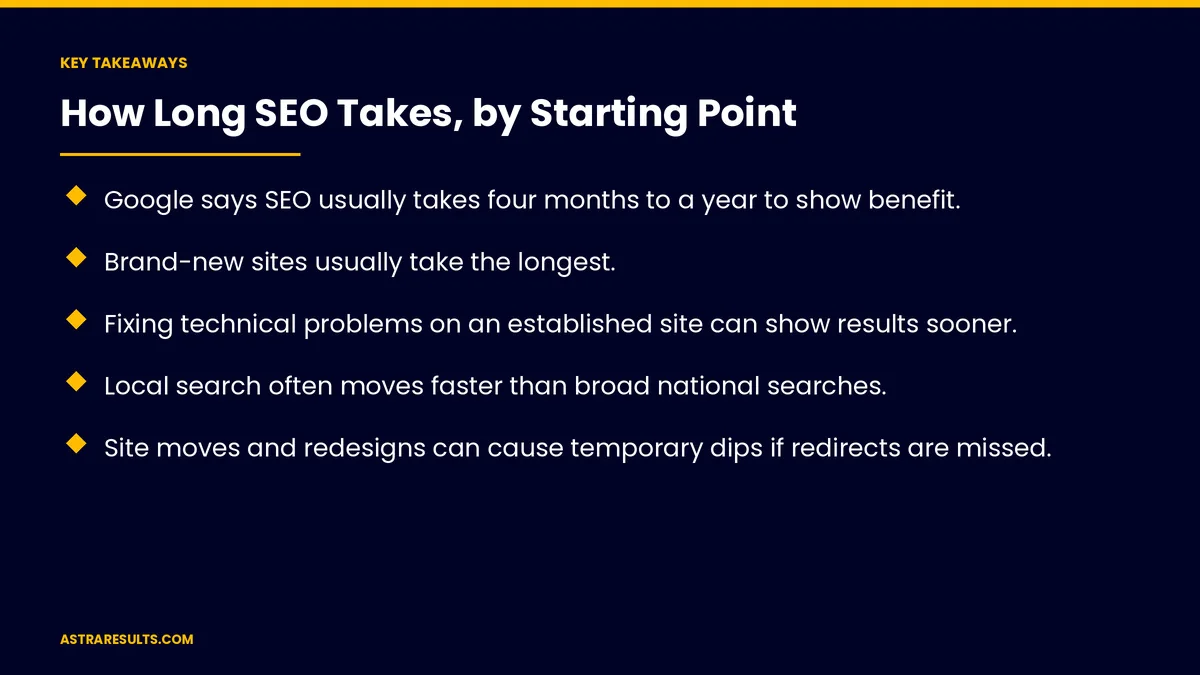
Key Takeaways
- Google says SEO usually takes four months to a year to show benefit.
- Brand-new sites usually take the longest.
- Fixing technical problems on an established site can show results sooner.
- Local search often moves faster than broad national searches.
- Site moves and redesigns can cause temporary dips if redirects are missed.
- Watch early signs, like impressions and indexing, before leads catch up.
Published: October 1, 2026 | Reading Time: ~8 minutes | Category: Search Engine Optimization
This guide covers how long SEO takes by starting point: new sites, existing sites with technical problems, established sites adding services, local search, site moves and redesigns, recoveries, competition, early signs of progress, a typical first year and what to measure. Put plainly: expect months, not weeks, and watch early signs while leads build.
In This Playbook
- Why is SEO slowest on a brand-new site?
- Existing sites with technical problems
- Established sites adding services
- Does local SEO show results faster?
- Site moves and redesigns
- Recoveries
- Competition
- Early signs of progress
- A typical first year
- What to measure
- The first three months
Why is SEO slowest on a brand-new site?
Usually the slowest. Search engines need time to find and trust a new site.
Foundations first. Clear pages, fast loading and accurate business details.
Early wins. Your business name and very specific searches.
Ads in the meantime. As weighed in PPC vs SEO.
Existing sites with technical problems
Can move faster. Once problems are fixed and pages are re-crawled.
Common fixes. Pages blocked from search, slow loading and broken links.
Structure matters. As covered in site architecture for multi-location businesses.
Established sites adding services
Often faster. Existing trust carries over.
New pages need substance. Real details and direct answers, as covered in question-shaped headings.
Does local SEO show results faster?
Often faster than broad searches. For nearby customers.
A complete Google Business Profile. As covered in Google Business Profile for Miami practices.
Reviews and consistent details. Build steadily.
Statewide reach. As in AI SEO for Florida businesses.
Site moves and redesigns
Temporary dips are common. Even when done well.
Redirects matter most. Every old page pointed to its new home.
Plan before launch. As weighed in redesign vs rebuild, with the right web design partner.
Recoveries
After spam or penalties. Cleanup first, then waiting.
Months, not weeks. Trust rebuilds slowly.
Avoid the shortcuts that caused it. As covered in what SEO costs.
Competition
Crowded markets take longer. More businesses competing for the same searches.
Specific searches first. Services, places and questions others overlook.
Links take time. As covered in backlinks in 2026.
Early signs of progress
Pages indexed. Search engines include them.
Impressions. You appear more often in results.
Specific rankings. Long, detailed searches first.
AI mentions. As covered in the future of search.
A typical first year
Months one to three. Audit, technical fixes and key page improvements.
Months four to six. New content, local work and early ranking gains.
Months seven to twelve. Growing visibility and leads, if the work continues.
No guarantees. Google warns against anyone promising top rankings.
What to measure
Leads from search. Calls, forms and bookings.
Impressions and clicks. Month over month.
Pages indexed. And technical errors fixed.
Rankings for target searches. Especially local and specific ones.
Revenue tied to search, as covered in website KPIs.
The first three months
Month one: find your starting point
Audit the site, list technical problems, check indexing and record leads from search as a baseline.
Month two: fix and build
Fix technical issues, improve key pages and complete your Google Business Profile.
Month three: watch early signs
Track indexing, impressions and specific rankings, and set expectations for leads in the months ahead.
How Astra sets SEO timelines
Astra Results Marketing sets realistic SEO timelines based on where you start. We audit first, fix what's slowing you down, watch early signs of progress and report leads as they build, without promising rankings no one can guarantee.
Engagements begin with an SEO audit through our search engine optimization team.
Related reading
Frequently asked questions
How long does SEO take to work?
Google says it usually takes four months to a year to make improvements and see the benefit, depending on your starting point.
Why do new sites take longer?
Search engines need time to find and trust them, and they start without links or history.
Can technical fixes work faster?
Often, on established sites, once problems are fixed and search engines re-crawl the pages.
Is local SEO faster?
Often faster than broad searches, especially with a complete Google Business Profile and steady reviews.
What early signs show SEO is working?
More pages indexed, rising impressions, rankings for specific searches and AI mentions.
Can anyone guarantee results by a certain date?
No. Google warns against anyone promising top rankings.
Want a realistic SEO timeline for your business? Astra Results Marketing audits where you start, fixes what's slowing you down and reports early signs and leads as results build. ▸ CALL (786) 321-2866 · ▸ REQUEST YOUR CONSULTATION





