 Rated 5 star on


Logistics Vision: Damage Detection at the Dock
Quick answer
Computer vision at the dock photographs every pallet on arrival and flags likely visible damage such as crushed boxes, torn wrap and wet spots. A person confirms each flag before it becomes a claim. Time-stamped images tied to shipment details show when damage happened. Train the system on your own freight, and aim cameras at freight.
A pallet arrives with a crushed corner. Nobody notices until a customer calls three days later, and by then nobody can prove whether it was damaged in transit, on the dock or in the warehouse. The claim stalls, and the cost lands on you. Computer vision at the dock can photograph every shipment, flag visible damage and keep the proof.
Key Takeaways
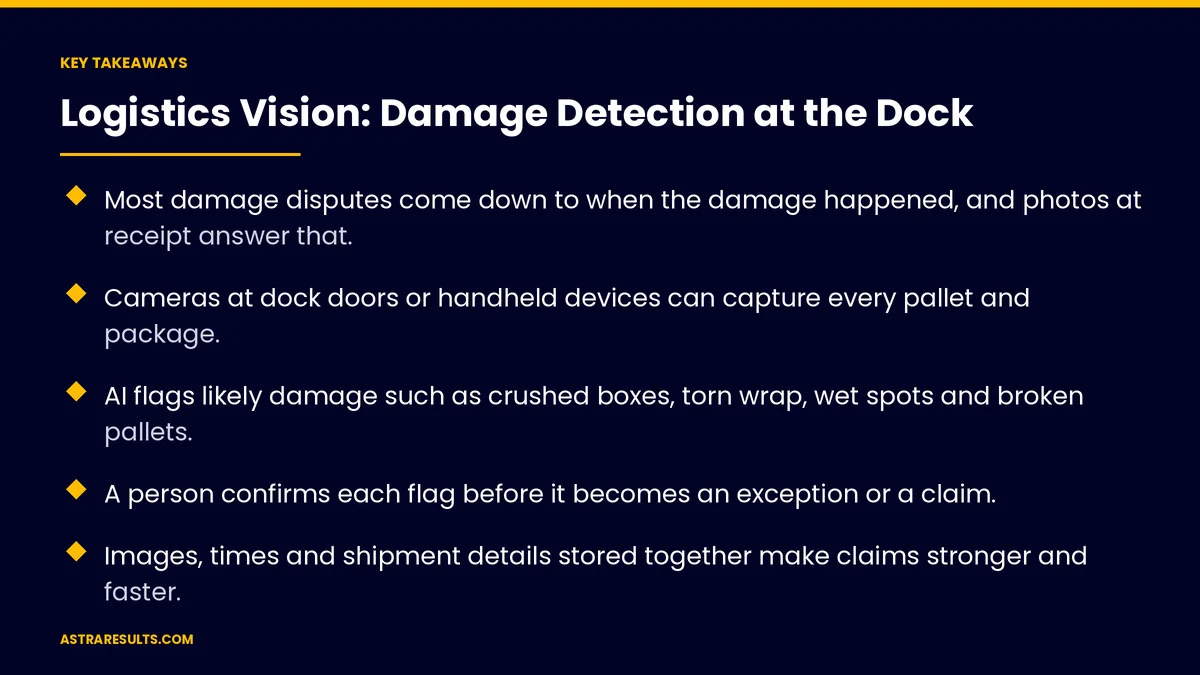
- Most damage disputes come down to when the damage happened, and photos at receipt answer that.
- Cameras at dock doors or handheld devices can capture every pallet and package.
- AI flags likely damage such as crushed boxes, torn wrap, wet spots and broken pallets.
- A person confirms each flag before it becomes an exception or a claim.
- Images, times and shipment details stored together make claims stronger and faster.
- Train and test on your own freight, lighting and packaging, and point cameras at freight, not people.
Published: October 16, 2026 | Reading Time: ~9 minutes | Category: Computer Vision
This guide covers how warehouses, distributors and carriers use computer vision for damage detection: what cameras capture, how the system flags problems, why a person still confirms them, how records support claims and how to roll it out. Put plainly: photograph every shipment at the door, flag what looks wrong, and keep the proof attached to the shipment.
In This Playbook
- Why damage at the dock is expensive
- What the system does
- People confirm, software flags
- Building proof for claims
- Accuracy in real conditions
- Privacy on the dock
- Connecting to your systems
- Dock numbers to watch
- The first three months
Why damage at the dock is expensive
Unclear timing. Without proof, nobody can show whether damage happened before, during or after delivery.
Late discovery. Damage found days later is harder to claim and harder to prevent.
Manual checks get skipped. At busy docks, careful inspection is the first thing to slip.
Disputes cost time. Calls, emails and back-and-forth with carriers, customers and insurers.
Logistics data connects. Damage records feed the same planning that improves routes and loads, as covered in logistics ML.
What the system does
Captures images. Fixed cameras at dock doors, or handheld phones and tablets, photograph freight as it moves.
Reads labels. Barcodes and shipping labels link each image to the right shipment.
Flags likely damage. Crushed or dented boxes, torn wrap, holes, wet spots, leaning loads and broken pallets.
Sends flags to a person. A dock worker or supervisor confirms or dismisses each flag.
Records everything. Images, time, dock door and shipment details stored together.
The basics of computer vision are covered in teaching software to see your operation.
People confirm, software flags
Flags, not verdicts. The system points out what looks wrong; a person decides.
Fast confirmation. One tap to confirm or dismiss, with the photo on screen.
Notes on the spot. Add a comment, extra photos or the driver's acknowledgment.
Learning from decisions. Confirmed and dismissed flags help improve the system over time.
Building proof for claims
Time-stamped images. Photos at receipt show the condition when freight arrived.
Linked to the shipment. Each image is tied to the bill of lading, order or tracking number.
Noted at delivery. Record exceptions at the moment of receipt, when they carry the most weight.
Easy to share. Send the evidence to carriers, customers or insurers in a few clicks.
Rules vary. Claim deadlines and liability depend on the transport mode and your contracts. Check yours, and act quickly.
Accuracy in real conditions
Train on your freight. Your packaging, pallets and products look different from generic examples.
Light the dock. Shadows, glare and night shifts affect what cameras can see. Good lighting helps more than complex software.
Balance false alarms. Too many flags and workers ignore them; too few and damage slips through. Tune the threshold with your team.
Limits of the camera. Vision sees outside damage. It won't see a broken item inside an undamaged box.
Start with a pilot. One dock door or one receiving shift first, following AI pilots that fail safely.
Privacy on the dock
Point cameras at freight. Aim at pallets and packages, not faces.
Blur people when needed. If workers appear in images, blur faces before storing them.
Tell your team. Explain what cameras capture and why.
The full guidance is in privacy in computer vision.
Connecting to your systems
Warehouse and transport systems. Damage records attached to receipts, orders and shipments.
Claims and customer service. Evidence available to the people handling disputes.
Plan the data first. Which system owns shipment records and how images link to them, as covered in planning an integration.
Dock numbers to watch
Damage caught at receipt. Compared with damage found later.
Claim success rate. Claims paid or accepted, before and after.
Time to resolve disputes. Days from report to resolution.
Inspection time per load. Faster with automatic capture than manual checks.
Flag accuracy. Confirmed versus dismissed flags, by damage type.
The first three months
Days 1–30: plan the pilot
Pick one dock door or receiving shift. Record current damage rates, claim results and dispute times. Choose camera positions, improve lighting and decide how images link to shipments.
Days 31–60: capture and confirm
Start capturing every shipment. Flag likely damage and have a person confirm each flag. Collect examples of your own freight to improve accuracy, and blur any people in images.
Days 61–90: measure and expand
Compare damage caught at receipt, claim success and dispute times with the baseline. Tune flag thresholds with the dock team, connect records to your systems and plan the next doors.
How Astra builds dock vision
Astra Results Marketing builds computer vision for docks that catches damage when freight arrives. We set up cameras and lighting, link images to shipments, flag likely damage for people to confirm, and store time-stamped proof that supports claims.
We train on your freight, point cameras at cargo instead of people, and connect records to your warehouse and claims processes. Engagements begin with a dock and claims review through our computer vision team.
Related reading
Frequently asked questions
What can computer vision detect at a loading dock?
Visible outside damage such as crushed or dented boxes, torn wrap, holes, wet spots, leaning loads and broken pallets, plus labels and barcodes that link images to shipments.
Does it replace dock workers' inspections?
No. It flags likely damage and captures images automatically, and a person confirms or dismisses each flag. It makes inspection faster and more consistent.
How does it help with damage claims?
Time-stamped images linked to each shipment show the condition of freight on arrival, which helps settle when damage happened and supports claims with carriers, customers and insurers.
Can it see damage inside a box?
No. Cameras see the outside of packages. Internal damage still needs opening and checking when outside signs or customer reports suggest a problem.
What affects accuracy?
Lighting, camera position and how well the system has learned your own packaging and freight. Start with a pilot and tune flag thresholds with the dock team.
What about workers' privacy?
Aim cameras at freight, blur faces if people appear in images, and tell your team what the cameras capture and why.
Ready to catch damage at the door instead of days later? Astra Results Marketing sets up dock cameras that photograph every shipment, flag likely damage for your team to confirm and keep time-stamped proof linked to each shipment for faster, stronger claims. ▸ CALL (786) 321-2866 · ▸ REQUEST YOUR CONSULTATION





