Rated 5 star on


AI Pilots That Fail Safely: Scope and Rollback
Quick answer
A pilot that fails safely is one a business can afford to run several of. Blast radius is the first design decision: what this can damage if it is wrong. Run it alongside the existing process rather than in place of it, build the rollback before the launch, name who holds the kill switch, and write stop criteria in advance.
Most advice about AI pilots concerns how to make them succeed. The more useful question is what happens when one does not, because a meaningful share will not, and the difference between a company that keeps trying and one that gives up after a bad experience is usually how much the failure cost.
Key Takeaways
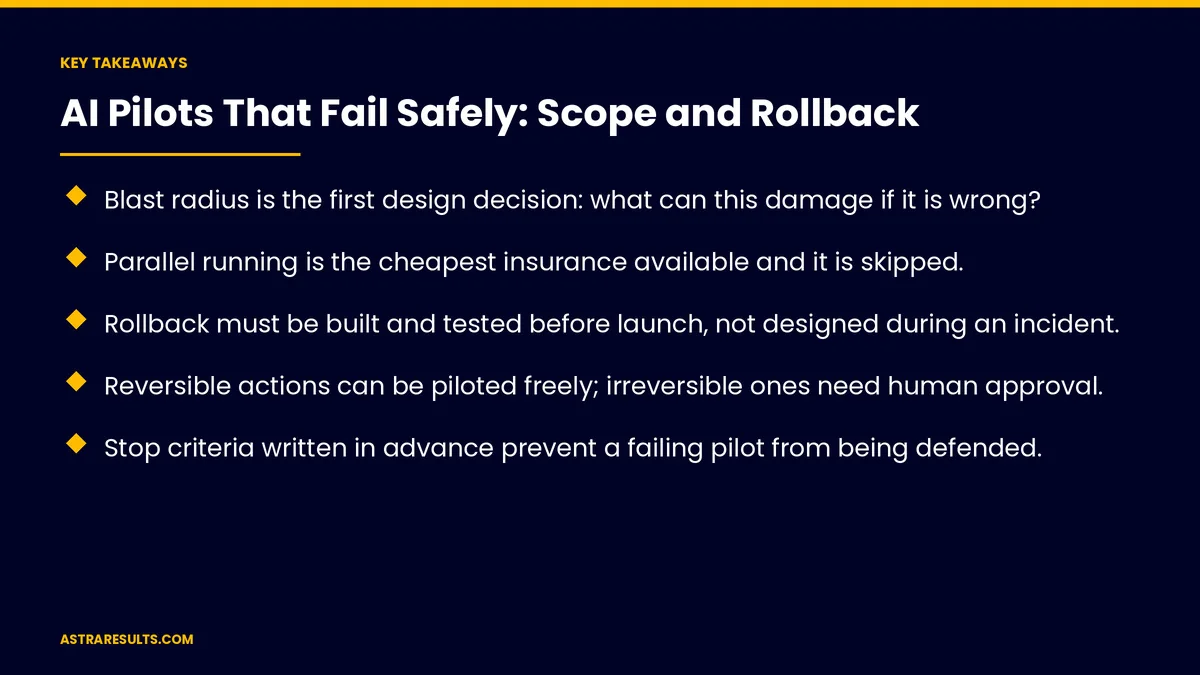
- Blast radius is the first design decision: what can this damage if it is wrong?
- Parallel running is the cheapest insurance available and it is skipped.
- Rollback must be built and tested before launch, not designed during an incident.
- Reversible actions can be piloted freely; irreversible ones need human approval.
- Stop criteria written in advance prevent a failing pilot from being defended.
- A pilot that cannot fail safely is not a pilot; it is a deployment.
Published: September 4, 2026 | Reading Time: ~12 minutes | Category: AI Pilots
A pilot designed to fail safely is a pilot a business can run several of. This piece covers that design: limiting what a failure can touch, running alongside the existing process rather than replacing it, building the undo before the launch, and deciding in advance what stopping looks like. Stated simply: design the exit before the launch, because you will need one at least once.
Guidance for owners and operators. Nothing here is legal or technical advice. Systems touching customer, employee, financial or regulated data carry obligations that vary by jurisdiction and should be reviewed with counsel before any pilot.
In This Playbook
- Blast radius: what a failure can touch
- Parallel running: the cheapest insurance
- Rollback: build it before you need it
- The kill switch and who holds it
- Reversible and irreversible actions
- Stop criteria, written in advance
- What a safe pilot looks like, assembled
- A three-month sequence
- How does Astra scope a pilot that can fail safely?
Blast radius: what a failure can touch
- The first question. If this system is wrong every time for a week, what is the damage?
- The dimensions. How many customers see it. Whether money moves. Whether a record is changed permanently. Whether a regulator or a contract is implicated. Whether anything is sent outside the company.
- Low blast radius. Internal classification, drafting for human review, summarizing, prioritizing a queue. Wrong output wastes a little time.
- High blast radius. Anything customer-facing without review, anything that moves money, anything that deletes or overwrites, anything that sends communications, anything touching regulated records.
- The design rule. First pilots go in the low-radius category, and capability earns its way toward the higher one, as set out in graduated release.
- The uncomfortable version. If a business cannot find a low-radius candidate worth automating, it is not ready to pilot, it is ready to document its processes.
Parallel running: the cheapest insurance
- What it means. The new system runs on the same work as the existing process, and a person compares the two, while the existing process remains authoritative.
- Why it beats a phased rollout. A phased rollout is still live. Parallel running produces real evidence with zero exposure.
- How long. Long enough to see the normal distribution of cases, which means at least one full cycle of whatever the process is — a billing cycle, a month, a season if the work is seasonal.
- What it reveals. Not whether the system works on the easy cases, which was never in doubt, but what share of real cases fall outside what it handles.
- The cost. Duplicated effort for a period, which is precisely the insurance premium.
- When to skip it. When the output is purely advisory and nobody acts on it yet — reading a queue, producing a draft nobody sends.
Rollback: build it before you need it
- The failure mode. A system is switched off during an incident and the business discovers that switching it off does not undo what it did.
- What rollback requires. Knowing what changed, being able to reverse it, and being able to reconstruct the prior state.
- For record changes. The previous value retained, so a field can be restored. A system that overwrites without keeping history cannot be rolled back, only corrected by hand.
- For communications sent. Not reversible. This is why sending is a high-radius action and belongs behind approval in a pilot.
- For money moved. Not reversible without cost. Same conclusion.
- The test before launch. Actually perform a rollback in a test environment and time it. An untested rollback plan is a document, not a capability, as covered in testing before it touches anything.
The kill switch and who holds it
- What it is. A single action that stops the system taking further action, without requiring the vendor or a developer.
- Who can use it. More than one person, including someone who is not on holiday in August.
- What it should not require. A support ticket, a phone call to another time zone, or knowledge of a password nobody wrote down.
- Tested before launch. By the people who would use it, not by the team that built it.
- The documented consequence. What happens to work in progress when it is pulled — queued items, partially completed tasks, pending approvals.
- The cultural point. A team that knows how to stop something is more willing to try it, which is the underrated reason to build this first.
Reversible and irreversible actions
- The distinction that organizes a pilot. Some actions can be undone; others cannot.
- Reversible. Setting a field, creating a task, adding a tag, drafting a document, classifying an item, scheduling something that has not happened.
- Irreversible. Sending an email, posting a message, making a payment, deleting a record, submitting to an external system, telling a customer something.
- The design implication. Reversible actions can be automated in a pilot. Irreversible ones are prepared by the system and executed by a person until the system has earned trust, as detailed in what software decides alone.
- The common shortcut that causes incidents. Automating a send because the drafts looked good for two weeks.
- The graduated path. Prepare only, then prepare with one-click approval, then automate the subset with the highest confidence and lowest consequence, then widen.
Stop criteria, written in advance
- Why they must be written first. Once a project has a budget, a sponsor and momentum, stopping it becomes a political act rather than an evidence-based one.
- What to write. The specific numbers at which the pilot stops — an error rate above a threshold, adoption below a level, exception rate above a share, or any incident of a defined severity.
- Who decides. A named person, before the pilot starts, with authority to stop it without convening a committee.
- The time limit. Every pilot has an end date at which it is evaluated, rather than drifting into production by default.
- The dignified stop. A pilot that stops on its criteria is a successful experiment, and framing it that way is what allows the next one. A pilot that is quietly defended for six months poisons the appetite for all of them.
- The measurement it requires. A baseline recorded before the pilot, or the criteria cannot be applied, as explored in measuring automation properly.
What a safe pilot looks like, assembled
- One process. Not a department, not a platform.
- One team. Small enough to talk to daily.
- Low blast radius. Internal or advisory, or reversible with tested rollback.
- Parallel for a full cycle. With a person comparing outputs.
- Baseline recorded. Before anything changes.
- Rollback tested. In advance, by the people who would use it.
- Stop criteria written. With a named decision-maker and an end date.
- A weekly review. Of what it got wrong, which is where the learning is.
A three-month sequence
Days 1–30: design the failure
The candidate process chosen for low blast radius. Reversible and irreversible actions separated. Rollback designed and tested. Kill switch built and demonstrated to the people who hold it. Stop criteria, decision-maker and end date agreed. Baseline recorded.
Days 31–60: parallel run
The system operating on real work with the existing process authoritative. Daily comparison for the first two weeks, weekly after. Exceptions logged with their causes.
Days 61–90: decide
The stop criteria applied against the evidence. Expand to a narrow live subset, adjust and continue in parallel, or stop and record what was learned. All three are acceptable outcomes.
How does Astra scope a pilot that can fail safely?
Astra Results Marketing designs the exit before the launch: blast radius assessed, irreversible actions kept behind human approval, rollback built and tested by the people who would use it, and a kill switch demonstrated rather than documented.
Stop criteria, a named decision-maker and an end date are agreed before the pilot begins, so stopping remains an evidence decision rather than a political one — and a pilot that stops on its criteria is reported as a successful experiment. Engagements begin with a pilot design review through our business consulting team.
Related reading
Frequently asked questions
What does "blast radius" mean for an AI pilot?
What a failure can touch if the system is wrong every time for a week. The dimensions are how many customers see it, whether money moves, whether records change permanently, whether a regulator or contract is implicated, and whether anything leaves the company. Low-radius work — internal classification, drafting for review, summarizing, queue prioritization — is where first pilots belong.
Why run in parallel rather than phasing a rollout?
Because a phased rollout is still live, while parallel running produces real evidence with zero exposure: the new system processes the same work, a person compares outputs, and the existing process stays authoritative. It should run at least one full cycle of the process, because what it reveals is not whether the system handles easy cases but what share of real cases fall outside what it handles.
What does rollback actually require?
Knowing what changed, being able to reverse it, and being able to reconstruct the prior state — which means retaining previous values, because a system that overwrites without history can only be corrected by hand. It also has to be tested and timed in advance, by performing an actual rollback. An untested rollback plan is a document, not a capability.
Which actions can be automated in a pilot?
Reversible ones: setting a field, creating a task, adding a tag, drafting a document, classifying an item, scheduling something that has not happened. Irreversible actions — sending an email, posting a message, moving money, deleting a record, submitting externally, telling a customer something — are prepared by the system and executed by a person until trust is earned. The common shortcut causing incidents is automating a send because drafts looked good for two weeks.
Who should hold the kill switch?
More than one person, including someone not away in August, and it should require no support ticket, no call to another time zone and no password nobody wrote down. It must be tested before launch by the people who would use it rather than by the team that built it, with the consequences for work in progress documented. A team that knows how to stop something is more willing to try it.
Why write stop criteria before starting?
Because once a project has a budget, a sponsor and momentum, stopping becomes a political act rather than an evidence-based one. Write the specific numbers — error rate, adoption level, exception share, or any incident of defined severity — name the person with authority to stop it, and set an end date. A pilot that stops on its criteria is a successful experiment; one quietly defended for six months poisons the appetite for all of them.
READY TO RUN A PILOT YOU CAN AFFORD TO LOSE? Astra Results Marketing assesses blast radius first, keeps irreversible actions behind approval, tests rollback with the people who would use it, and agrees stop criteria before anything launches. Astra Results Marketing · 1101 Brickell Ave, Miami, FL 33131 · +1 (786) 321-2866 · [email protected] Find us on Google · Yelp ▸ CALL (786) 321-2866 · ▸ REQUEST YOUR CONSULTATION