 Rated 5 star on

Logistics ML: Route and Load Optimization
Quick answer
Machine learning improves route and load planning by sharpening the estimates an optimizer runs on, not by building routes itself. Predict travel time and stop duration first, since manual planning handles them worst. Dispatchers review and approve the plans. Start with one depot or lane and measure cost per stop, on-time delivery and truck fill.
Every morning a dispatcher builds routes from a list of stops, a set of trucks and experience. The plan looks fine at 7 a.m. By noon, a stop ran long, traffic closed a road and a customer wasn't ready. Routes fail less because the math is wrong than because the inputs were guesses. That's where machine learning helps most.
Key Takeaways
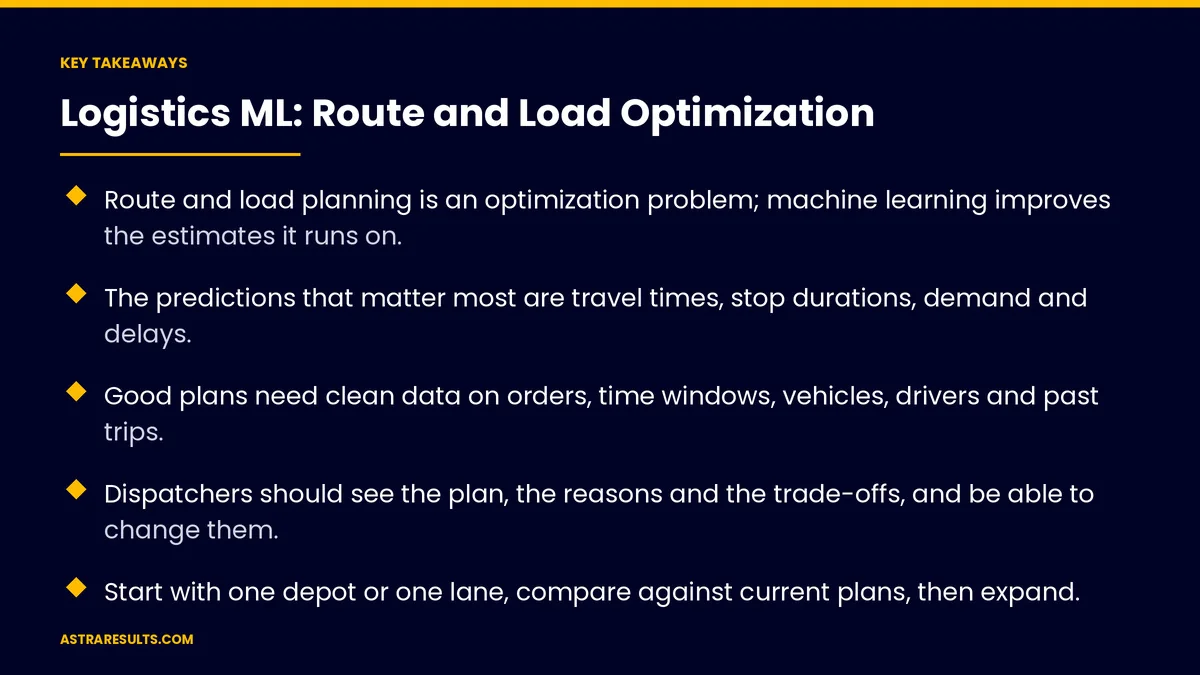
- Route and load planning is an optimization problem; machine learning improves the estimates it runs on.
- The predictions that matter most are travel times, stop durations, demand and delays.
- Good plans need clean data on orders, time windows, vehicles, drivers and past trips.
- Dispatchers should see the plan, the reasons and the trade-offs, and be able to change them.
- Start with one depot or one lane, compare against current plans, then expand.
- Measure cost per stop, on-time delivery, truck fill and empty miles.
Published: October 14, 2026 | Reading Time: ~11 minutes | Category: Machine Learning & Analytics
This guide explains how machine learning and optimization work together for routes and loads. It covers what to predict, which data you need, how dispatchers stay in control and what to measure. Put plainly: machine learning makes the estimates better, the optimizer turns them into a plan, and the dispatcher makes the final call.
In This Playbook
- Two tools, two jobs
- What to predict
- Route optimization
- Load optimization
- The data you need
- Keeping dispatchers in charge
- Start small and prove it
- Measuring the results
- The first three months
- What does Astra build for route and load planning?
Two tools, two jobs
Optimization builds the plan. Given stops, time windows, trucks and rules, an optimizer finds routes and load assignments that meet the rules at the lowest cost. This is a well-established field of operations research.
Machine learning improves the inputs. The optimizer needs travel times, how long each stop takes, how much freight is coming and where delays happen. Learning from your history makes those numbers more accurate than fixed averages.
Better inputs, better plans. A perfect optimizer working from guesses still produces routes that fall apart by noon.
Neither replaces the dispatcher. People know things the data doesn't: a customer who always runs late, a driver who knows a building, a road closed this week. The basics of how models learn are covered in machine learning for operators.
What to predict
Travel time by time of day. Not distance divided by an average speed, but how long each leg takes at the hour you'll drive it.
Stop duration. How long each delivery or pickup really takes, by customer, location type and load size. Some stops are five minutes; some are forty.
Demand. How much freight will move on each lane or in each zone, by day and season, so capacity is ready before it's needed.
Delays and no-shows. Which customers, docks and time slots tend to run late or not be ready.
Arrival times. Updated estimates during the day, so customers and dispatchers know when trucks will really arrive.
Route optimization
The rules come first. Time windows, truck capacity, driver hours, vehicle types, loading equipment, and which stops need which truck.
The goal is set by you. Fewest miles, fewest trucks, most on-time deliveries, lowest total cost, or a balance of these.
Plans adjust during the day. When a stop runs long or a new order arrives, the plan can be updated for the remaining stops.
Respect the hard limits. Driver hours and safety rules are never traded away for a shorter route.
Show the trade-offs. "Adding this stop to Route 3 saves a truck but makes two deliveries 20 minutes later." The dispatcher decides.
Load optimization
Fill the trucks. Combining shipments so trucks leave fuller, measured by weight and space, not just stops.
Load in delivery order. Freight for the first stop goes on last, so drivers don't unload half the truck at every stop.
Consolidate where it pays. Grouping small shipments on the same lane instead of sending partly empty trucks. This also feeds the capacity offers in outbound by lane.
Reduce empty miles. Plan return loads and backhauls so trucks earn on the way back too.
Respect the cargo. Weight limits, stacking rules, temperature needs and hazardous materials rules are constraints, not suggestions.
The data you need
Orders. Origin, destination, weight, dimensions, time windows and special handling.
Vehicles and drivers. Capacity, equipment, start locations, shifts and driver hours.
Trip history. GPS and telematics records of actual routes, arrival times and stop durations. This is what the predictions learn from.
Customer details. Dock hours, access rules and known issues by location.
Clean and connected. Order, telematics and dispatch systems must share the same customer and location records. That groundwork is covered in the foundation every AI project needs, and the connections in API integration.
Keeping dispatchers in charge
Suggest, don't dictate. The system proposes routes; dispatchers review, adjust and approve.
Explain the plan. Show why stops were grouped and what each change would cost.
Make overrides easy. A dispatcher should be able to move a stop in seconds, and the system should recalculate.
Learn from overrides. When dispatchers often change the same thing, the model or the rules are missing something.
Train the team. Dispatchers trust tools they understand and helped shape.
Start small and prove it
One depot or one lane. Pick a manageable area with good data.
Run side by side. Compare the system's plans with the dispatcher's plans for a few weeks before relying on them.
Measure against today. Miles, trucks used, on-time rate and overtime, compared with the same weeks last month.
Then expand. Add depots, lanes and features once results hold. The approach matches AI pilots that fail safely.
Measuring the results
Cost per stop or per delivery. The clearest single number for route efficiency.
Miles and hours per route. Including overtime.
On-time delivery rate. By customer and time window.
Truck fill. Average use of weight and space capacity.
Empty miles. The share of miles driven without freight.
Prediction accuracy. How close travel time, stop duration and arrival estimates are to reality.
Dispatcher overrides. How often plans are changed, and why.
The first three months
Days 1–30: data and baseline
Pick one depot or lane. Gather orders, vehicles, driver hours and several months of trip history. Clean customer and location records. Record today's cost per stop, miles, on-time rate and truck fill as the baseline.
Days 31–60: predict and plan
Build predictions for travel time and stop duration from your history. Set up the optimizer with your rules and goals. Run its plans side by side with the dispatcher's, and review differences together.
Days 61–90: adopt and measure
Let dispatchers use the system's plans with easy overrides. Track cost per stop, on-time rate, truck fill and overrides against the baseline. Fix what overrides reveal, then plan the next depot or lane.
What does Astra build for route and load planning?
Astra Results Marketing builds route and load planning that combines machine learning and optimization. We learn travel times, stop durations and demand from your own trip history, feed them to an optimizer set to your rules and goals, and give dispatchers clear plans they can adjust.
We start with one depot or lane, run side by side with your current plans, and measure cost per stop, on-time delivery and truck fill against a baseline before expanding. Engagements begin with a data and operations review through our machine learning and advanced analytics team.
Related reading
Frequently asked questions
Is route optimization machine learning?
Not exactly. Building the routes is an optimization problem from operations research. Machine learning improves the estimates the optimizer uses, such as travel times, stop durations and demand, which makes the resulting plans more reliable.
What should we predict first?
Travel time by time of day and stop duration by customer and location. These are usually the weakest inputs in manual planning, and improving them makes routes hold up better through the day.
What data do we need?
Order details with time windows, vehicle and driver information including hours, and several months of GPS or telematics trip history showing actual routes, arrival times and stop durations.
Will this replace our dispatchers?
No. The system proposes plans and shows the trade-offs; dispatchers review, adjust and approve them. Their overrides also help improve the predictions and rules over time.
How do we prove it works?
Start with one depot or lane, run the system's plans side by side with your current plans for a few weeks, and compare cost per stop, miles, on-time rate and truck fill against a recorded baseline.
Can it help fill trucks as well as plan routes?
Yes. Load optimization combines shipments to improve weight and space use, loads freight in delivery order, plans backhauls to reduce empty miles, and respects weight, stacking, temperature and hazardous materials rules.
Ready for routes that still hold up at noon? Astra Results Marketing learns travel times, stop durations and demand from your own trip history, feeds them to an optimizer built around your rules, and gives dispatchers clear plans they control, measured against your current baseline. ▸ CALL (786) 321-2866 · ▸ REQUEST YOUR CONSULTATION





