Rated 5 star on


Miami Destination Cosmetic Surgery Marketing
Quick answer
A Miami practice should market destination cosmetic surgery by publishing its recovery protocol, not a travel package. The patient stays in Miami for a set minimum of recovery days. A competent caregiver must be present. Flying clearance is the surgeon's call. Revision and complication policy is published upfront. Astra measures completed recoveries and unplanned returns.
The destination surgical patient is not buying a trip. She is buying an operation that happens to require travel. The difference between those two framings determines whether a practice builds a durable out-of-area referral base or accumulates the cases that end up on complaint forums.
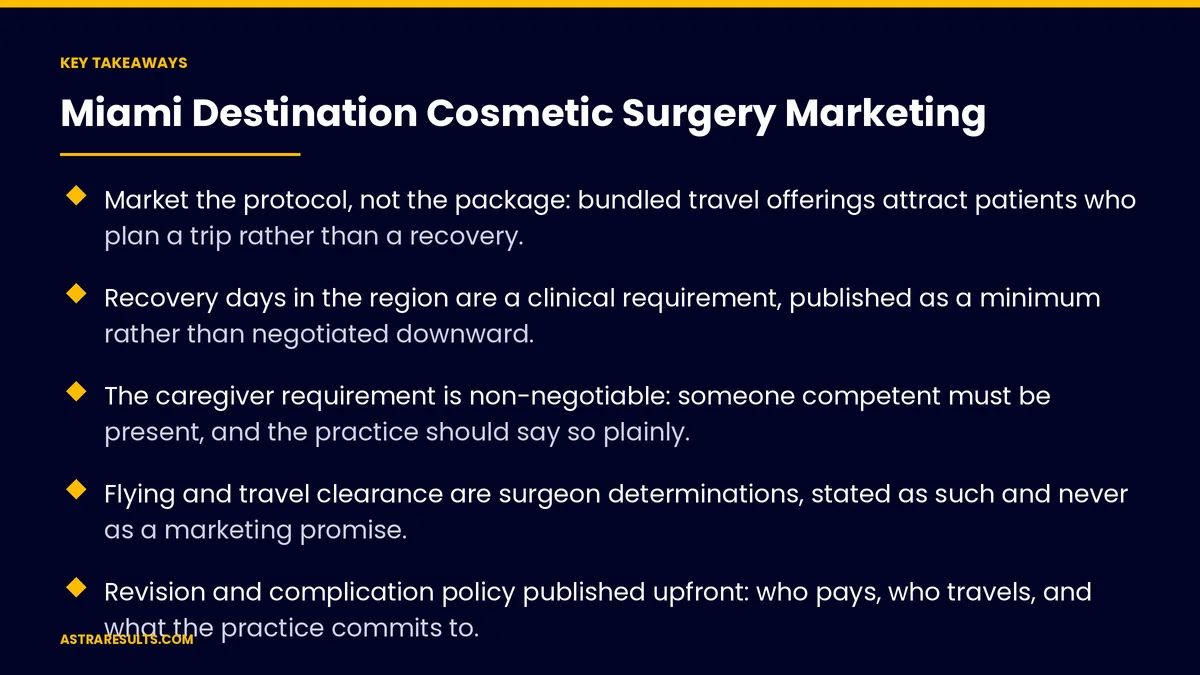
Key Takeaways
- Market the protocol, not the package: bundled travel offerings attract patients who plan a trip rather than a recovery.
- Recovery days in the region are a clinical requirement, published as a minimum rather than negotiated downward.
- The caregiver requirement is non-negotiable: someone competent must be present, and the practice should say so plainly.
- Flying and travel clearance are surgeon determinations, stated as such and never as a marketing promise.
- Revision and complication policy published upfront: who pays, who travels, and what the practice commits to.
- Measure completed recoveries and unplanned returns, never volume of out-of-area inquiries.
Published: October 16, 2026 | Reading Time: ~11 minutes | Category: Plastic Surgery · Miami
Practices that market packages (surgery plus hotel plus transport plus a recovery-house night, priced as a bundle) are describing a vacation with a procedure inside it. They attract patients who plan accordingly.
Practices that market a protocol (this is what the operation requires, here is the recovery time it needs in this city, here is who must be with you, here is what happens if something goes wrong) attract patients who arrive prepared and leave healed. The kicker states it: not a package, a protocol.
This is the surgical-specific companion to the library's international pipeline and destination doctrine pieces. Where those addressed the pipeline and the ethics, this one addresses the operational specifics of travel and recovery for surgical cases, where the stakes are highest and the shortcuts most tempting. Marketing guidance for licensed practices only. Nothing here is medical advice.
Candidacy, surgical planning, recovery timelines, travel clearance, and every clinical statement belong to your surgeons. Compliance review precedes publication of every asset.
In This Playbook
- Why Packages Are the Wrong Frame
- Recovery Days Are Clinical
- The Caregiver Requirement
- Flying, Clearance, and Activity
- Revision and Complication Policy, Published
- The Content That Earns These Cases
- Channels and Language
- Measurement
- A 90-Day Build
Why Packages Are the Wrong Frame
The positioning error that produces the category's worst outcomes.
What a package communicates. That the components are interchangeable, that the price is the point, that the timeline is fixed. That the practice is coordinating a trip. All of which recruit the patient who books flights before she has been examined.
What it obscures. That recovery duration is clinical rather than logistical, that candidacy may change the plan entirely. That the operation's requirements govern the itinerary rather than the reverse.
The commercial consequence. Package-driven positioning attracts price comparison against operators who bundle more cheaply, a race the responsible practice cannot and should not win, per the anti-deal logic Astra holds.
The protocol alternative. Publish the operation's requirements (minimum days in region, caregiver requirement, accommodation standards, follow-up schedule, activity restrictions, and what the practice will and will not agree to) and let the patient arrange her own travel around them.
The referral effect. Patients who complete a protocol-based journey become the most credible referral source this category has, because they can describe a process rather than a deal.
Recovery Days Are Clinical
The requirement everything else hangs on.
The rule. The number of days a patient must remain in the region after surgery is a determination the surgeon makes per procedure and per patient, published as a minimum in marketing content and never negotiated downward to accommodate a return flight, the safety-over-schedule absolute Astra holds everywhere.
Why the candor converts. The patient comparing practices sees one that says "fly home in three days" and one that explains why the requirement is longer. The sophisticated patient reads the second as competence, per the advise-against economics Astra documents in every high-stakes vertical.
What must be published alongside it. The follow-up appointments that occur during those days, what the surgeon is checking for, what symptoms warrant immediate contact, and the plain statement that the requirement may extend if recovery indicates it.
The extension provision. What happens, clinically and financially, if the patient must stay longer, settled before booking rather than negotiated in a hotel room, since scope surprises are this category's most reliable source of disputes.
The Caregiver Requirement
The condition most likely to be quietly waived, and the one that shouldn't be.
The rule. For surgical cases, a competent adult must be present for the immediate post-operative period (able to assist, monitor, transport, and recognize when to call). The practice's requirements should be stated plainly rather than left as an assumption.
What to publish. Who qualifies, what the caregiver's role involves, how long they need to be present. What the practice does when a patient arrives without one.
The plain decline. A patient who cannot arrange a caregiver is a patient whose case should be reconsidered rather than accommodated with a workaround, because the alternative is a patient alone in a hotel room with a complication.
The caregiver as an audience. Content addressed to the person traveling with the patient (what to expect, what to watch for, when to call, how to help) is useful, almost never produced, and improves outcomes, exactly as the caregiver-content pattern works in every specialty where someone else administers care.
The recovery-accommodation question. Whether the practice recommends, partners with, or has any interest in recovery facilities is a disclosure question, and any compensated arrangement is a counsel question before it is a marketing one.
Flying, Clearance, and Activity
The clinical statements that must stay clinical.
Flying after surgery. Whether and when a patient may fly is a surgeon's determination influenced by procedure, individual recovery, and risk factors, stated in marketing as "your surgeon determines this" rather than as a number, because a published timeline becomes a promise a patient will hold the practice to.
The risk education, plainly. Content may explain at general educational level that travel after surgery carries considerations the surgeon evaluates, and that the practice's protocol accounts for them, without either alarming the reader or minimizing the question.
Activity and return-to-work. Ranges rather than dates, individualized by the surgeon, and never framed as a schedule the practice can compress.
The clearance conversation. Publishing that the practice conducts a pre-departure evaluation and will advise against travel if recovery indicates it is both a safety statement and a differentiator. It sets the expectation that makes the conversation possible if it becomes necessary.
Revision and Complication Policy, Published
The commitment that separates serious practices from the rest.
What to publish before booking.
- What the practice's revision policy is
- Who bears surgical, facility, and anesthesia costs in a revision scenario
- Whether travel is the patient's responsibility
- What the practice does if a complication develops after the patient has returned home
- How it coordinates with a provider in her home region
- How quickly it responds across time zones
Why publishing it converts. This is precisely the question the sophisticated out-of-area patient is trying to answer and cannot find answered anywhere. So the practice that states its policy plainly earns the case, while silence reads as evasion to exactly the patient worth having.
The real limits. A practice cannot promise outcomes, cannot guarantee no complications, and cannot substitute for local emergency care, and saying all three plainly is more credible than any assurance. The home-provider arrangement per the pipeline standard: where continuity is required, the provider who will deliver it should be identified and communicating before surgery rather than located during a crisis.
The Content That Earns These Cases
What the out-of-area surgical patient is researching.
Verification first. Board certification and hospital affiliations stated exactly and verifiably, with the adjacency line respected (proximity to institutions is geography, not credential) per the precision standard. The protocol page itself, which is this playbook's central asset: minimum days, caregiver requirement, follow-up schedule, flying and activity handling, extension provisions, and revision policy, one page that answers what nobody else answers.
Candidacy candor. Who this operation suits, who it doesn't, and what conditions or situations make travel-based surgery inappropriate. The filter that does the screening front-desk staff otherwise absorb.
The gallery under full doctrine. consented, unretouched, honestly labeled with timelines shown, and no insecurity leverage anywhere. Framework pricing with inclusions and exclusions named, per the transparency standard, and no bundled travel pricing, which reintroduces the package frame this playbook exists to reject.
The AI-answer layer. "how long do I need to stay after," "when can I fly," "who pays for revision" are exactly the questions assistants now field, and the practice with candid answers gets cited through the entity work our AI SEO service builds.
Channels and Language
Search carries the protocol and verification content under named-surgeon authorship. Surgeon video does unusual work here, because a surgeon explaining a recovery requirement in her own voice is the clearest possible demonstration that the protocol is clinical rather than commercial.
Paid runs behind the negatives fortress with medical-tourism package, cheapest-surgery, and travel-deal intent excluded wholesale, the category's largest and most dangerous waste, and no urgency creative. Reviews run never-gated, with the note that out-of-area reviews carry disproportionate weight in this category precisely because prospective patients are trying to assess process rather than result.
Referral flow runs physician-to-physician rather than through compensated intermediaries, which is a counsel question per the pipeline standard. Spanish and Portuguese natively per the chain rule. Consent, post-operative instructions, and the symptom-reporting call are comprehension-critical, and the staff-it rule governs everything beyond.
Measurement
The dashboard, per the case-level standard, built around completion rather than acquisition:
- Protocol-compliance rate — cases where the published minimum recovery days, caregiver requirement, and follow-up schedule were fully met. As the flagship, with a target of one hundred percent and any exception reviewed rather than normalized
- Unplanned return and complication-management performance tracked internally for care quality and never converted into marketing claims
- The decline count and reasons, logged as a quality signal
- Consult-to-surgery conversion for out-of-area cases read separately from local, since blending them hides the honest-screening effect
- Extension events and how they were handled financially
- The caregiver-content engagement
- Coordination hours per out-of-area case against realized value, since these cases consume disproportionate staff time and the economics should be known rather than assumed
- Language cohorts
- Cost per completed out-of-area case rather than per inquiry
A 90-Day Build
Days 1–30: Write the protocol
Minimum recovery days set per procedure by the surgeons and documented. Caregiver requirements defined including what happens without one; extension provisions written clinically and financially; revision and complication policy drafted with counsel. Flying and activity language reviewed so nothing reads as a promise.
Days 31–60: Publish it
The protocol page live under surgeon authorship in English, native Spanish, and Portuguese; verification content precise. Candidacy candor published as the filter it is; framework pricing published without bundled travel; caregiver-facing content built; gallery brought under full doctrine.
Days 61–90: Screen and measure
- Out-of-area inquiry handling rebuilt around the protocol (remote consult informs, exam decides, protocol governs)
- Paid restructured with package and travel-deal intent excluded
- Physician-to-physician referral outreach begun
- Protocol-compliance and coordination-hour tracking live
- First clear reads with out-of-area conversion read separately — and the decline count treated as evidence the screening works
How Astra Builds Destination Surgical Practices
Astra Results Marketing builds destination surgical marketing on the protocol rather than the package. Recovery days published as clinical minimums, caregiver requirements stated plainly and not waived, flying and activity kept as surgeon determinations, revision and complication policy published before booking. Everything measured on protocol compliance and completed recoveries rather than out-of-area inquiry volume.
Engagements begin with a protocol, policy, and screening audit through our business consulting team.
Related reading
Frequently asked questions
Why not offer a travel-and-recovery package?
Because a package tells the patient the components are interchangeable, the price is the point. The timeline is fixed, which recruits exactly the person who books flights before being examined. It also puts you in price comparison against operators who bundle more cheaply, a race you shouldn't win. Publish the operation's requirements instead and let the patient arrange travel around them. The patients who complete a protocol become your most credible referral source.
How do we handle a patient who wants to fly home sooner than we recommend?
You don't negotiate a clinical requirement. Publish the minimum recovery days as a minimum, explain what the surgeon is checking for during those days, state that the requirement may extend if recovery indicates it, and settle the financial side of an extension before booking. The patient comparing you against a practice promising three days will read your explanation as competence. The one who won't accept it is the case you don't want.
Is the caregiver requirement really non-negotiable?
Treat it that way. A competent adult present for the immediate post-operative period (able to assist, monitor, transport, and recognize when to call) is a clinical condition, not a preference. The alternative is a patient alone in a hotel room with a complication. Publish who qualifies and what the role involves, produce content addressed to the caregiver, and reconsider cases where one can't be arranged rather than engineering a workaround.
What should we say about when patients can fly?
That their surgeon determines it. Any published number becomes a promise patients will hold you to. The determination depends on procedure, individual recovery, and risk factors. Explain at general educational level that post-surgical travel carries considerations the surgeon evaluates, describe your pre-departure clearance step, and state plainly that you will advise against travel if recovery indicates it.
Should we publish our revision policy?
Yes, it's the question sophisticated out-of-area patients are trying to answer and can't find answered anywhere. That makes silence read as evasion. State what your policy is, who bears surgical, facility, and anesthesia costs, whose responsibility travel is, what happens if a complication develops after she's home. How you coordinate with a provider in her region. Also state the real limits. No outcome guarantees, no promise of no complications, no substitute for local emergency care.
What should we measure for these cases?
Protocol-compliance rate first (cases where published recovery days, caregiver requirement, and follow-up were fully met) targeting one hundred percent, with exceptions reviewed rather than normalized. Then unplanned returns, decline count and reasons, out-of-area conversion read separately from local, and coordination hours against realized value. If that last number shows the effort exceeding the return, scaling back is a legitimate conclusion and far cheaper than learning it from a case that went badly.
Ready to Market the Protocol Instead of the Package? Astra Results Marketing builds destination surgical marketing on published recovery minimums, non-negotiable caregiver requirements, surgeon-governed clearance, and revision policy stated before booking. Start with a protocol, policy, and screening audit for your practice. ▸ CALL (786) 321-2866 · ▸ REQUEST YOUR CONSULTATION