Rated 5 star on


Professional Referral Systems for Practices
Quick answer
A practice builds a referral system by treating referrals as a managed channel. It names its sources, tracks them in a ledger and assigns an owner. The core habit is prompt report-back to each referrer. Forwardable explainers and candid referrals out build trust. Any paid arrangement goes to counsel first.
Across every vertical Astra has mapped (surgical, dental, legal, advisory, specialty medicine) the same finding recurs: referrals are the largest channel and the least managed one. Practices that can describe their paid campaigns in detail often cannot name the twelve people who send them most of their best work.
Key Takeaways
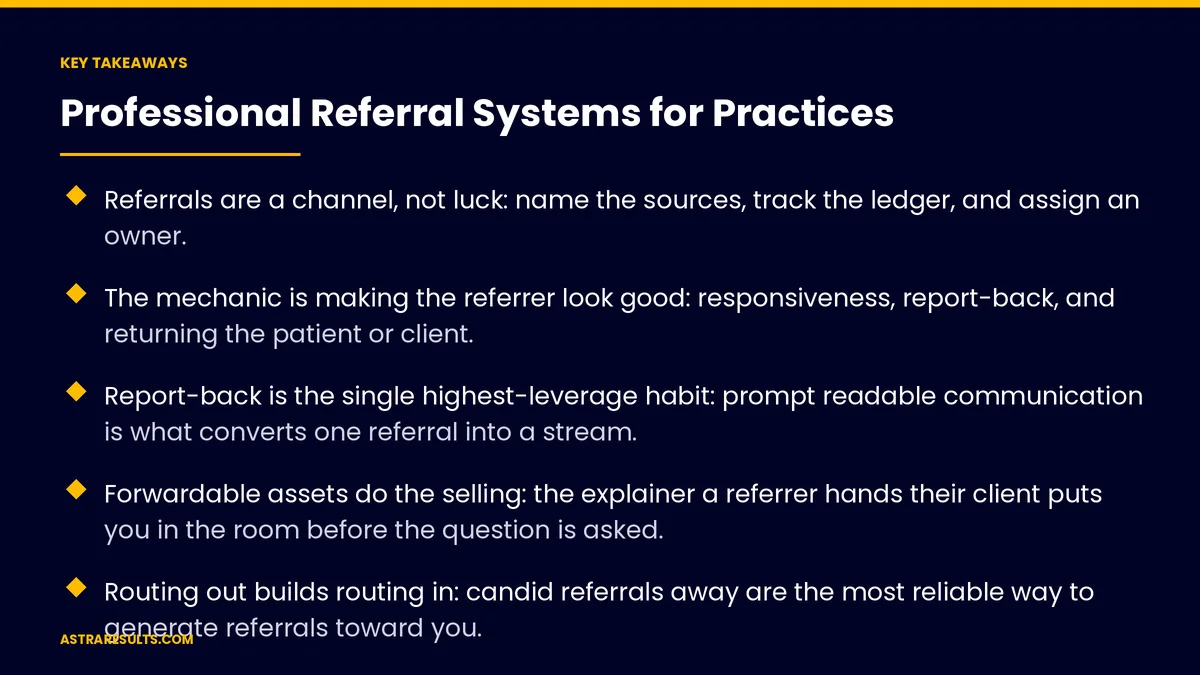
- Referrals are a channel, not luck: name the sources, track the ledger, and assign an owner.
- The mechanic is making the referrer look good: responsiveness, report-back, and returning the patient or client.
- Report-back is the single highest-leverage habit: prompt readable communication is what converts one referral into a stream.
- Forwardable assets do the selling: the explainer a referrer hands their client puts you in the room before the question is asked.
- Routing out builds routing in: candid referrals away are the most reliable way to generate referrals toward you.
- Clean hands, always: any compensated arrangement is a counsel question, and the best systems don't need one.
Published: October 20, 2026 | Reading Time: ~13 minutes | Category: Strategy · National
They cannot say which of those relationships grew or shrank last year, and have no mechanism for the one thing that determines whether a referral becomes a habit.
Meanwhile the same practices describe referrals as something that "happens organically," which is usually a polite way of saying nobody owns it.
This playbook treats referrals as what they are. A channel with an addressable mechanic, a measurable ledger, and failure modes as specific as any ad account's. The mechanic is not lunches, gifts, or golf. It is making the referring professional look good to the person they referred: which resolves into responsiveness, communication back, and correct routing.
Which explains why the practices that receive the most referrals are frequently the ones that also give the most away. The kicker states the thesis: build it, don't hope for it.
Nothing here is legal advice. Referral arrangements in professional services carry real regulatory weight (anti-kickback and self-referral law in healthcare, fee-sharing and referral-fee restrictions in law, disclosure requirements in financial services, and professional-conduct rules in every licensed field) so any arrangement involving compensation, gifts, or reciprocity commitments requires counsel's review before it exists.
Everything recommended below is designed to work without such arrangements, because the systems that need them are the ones that break.
In This Playbook
- Referrals Are a Channel
- The Ledger
- The Mechanic: Make the Referrer Look Good
- Report-Back Is the System
- Forwardable Assets
- Routing Out Builds Routing In
- Clean Hands and the Compliance Layer
- The Cadence and the Owner
- What belongs on a practice's referral-system dashboard?
- A 90-Day Build
Referrals Are a Channel
The reframe that makes the rest possible.
What "organic" means. Unowned, unmeasured, and vulnerable, a channel that can decline for a year before anyone notices, because nobody is looking.
What treating it as a channel requires.
- A named list of sources rather than a vague sense of them
- An owner inside the practice accountable for the relationships
- A ledger recording who sent what and when
- A cadence of contact that isn't triggered only by a dry quarter
The concentration risk nobody calculates. In most practices, a small number of relationships produce a large share of referrals. That means one retirement, one relocation, or one bad experience can remove a meaningful percentage of new business, a risk that's invisible without the ledger and obvious with it.
The asymmetry worth understanding. Referred clients and patients typically convert better, stay longer, and price-shop less than any other source. That means the channel with the best economics is the one receiving the least management attention in most practices, exactly the inversion the failure analysis documents.
The Ledger
The instrument the whole system runs on.
What it records. Every referral source by name (not "physician referral" but the specific physician, CPA, attorney, or advisor) with the matters or patients they sent, when, what happened to each. What the practice did in return.
Why named tracking changes behavior. An aggregate "referrals. 34" tells a practice nothing actionable, while a ledger showing that four sources sent nineteen of them and six formerly-active sources sent none this year produces a specific, obvious set of next actions.
The intake dependency. None of this exists without source-of-truth intake asked consistently with a specificity prompt (which physician, which advisor) which is why the measurement discipline Astra keeps returning to is a prerequisite rather than a companion.
The reciprocity column. Referrals sent out logged alongside referrals received, because that ratio is the single best predictor of a relationship's durability.
The review cadence. Read quarterly, acted on quarterly, and shared with whoever owns the relationships, since a ledger nobody reads is a spreadsheet.
The Mechanic: Make the Referrer Look Good
The insight that replaces relationship marketing with something that works.
What a referring professional is risking. Their own credibility. They told a patient or client to trust you, and the outcome reflects on them. That means their decision to refer again depends almost entirely on whether that bet paid off socially, not on whether you bought them lunch.
The three things that determine it. speed (the referred person was seen or contacted promptly, because a referral that waits three weeks embarrasses the referrer), communication back (the referrer knows what happened without having to ask), and return (the client or patient came back to them rather than being absorbed, per the lanes-respected discipline Astra holds everywhere).
What doesn't determine it. Gifts, events, and hospitality: which are pleasant, occasionally appropriate, frequently regulated, and almost never the reason a professional refers a second time.
The corollary that saves practices money. The budget for referral development is better spent on the operational capacity to answer quickly and report back than on anything that looks like marketing.
Report-Back Is the System
The highest-leverage habit in the entire playbook, and the one most practices perform worst.
What it is. A prompt, readable communication to the referring professional telling them what happened: the person was seen, this is the assessment or plan at the appropriate level of detail, here's what happens next, thank you.
Why it's decisive. Astra found the same gap in orthopedics, cardiology, physical therapy, and pain management. Most referring professionals receive either nothing or a document they won't read, so the practice that communicates clearly becomes the default choice by doing the one thing competitors skip.
The readability requirement. A referring physician scanning between patients needs the answer in the first two lines, not on page three of a formatted report. A CPA needs plain language rather than practice jargon.
The authorization boundary. Communication happens inside what the client or patient has authorized, which is stricter in some verticals than others and is a counsel question in all of them.
The non-progress case. Telling a referrer that their referred person isn't attending, isn't progressing, or declined care is uncomfortable and enormously trust-building. It proves the practice communicates when there's nothing flattering to report.
The measurement. Report-back turnaround tracked as a service metric, because it's the thing the relationship runs on.
Forwardable Assets
The content that does the persuading a referrer doesn't have time for.
The idea. A referring professional saying "you should see someone about this" is doing you a favor. A referring professional handing over a clear one-page explainer is doing the conversion.
What makes an asset forwardable. It answers the question the referred person has, it's written for them rather than for the professional, it reduces the dread or confusion that causes delay. It's easy to hand over, printed in the office or sent as a link.
The examples Astra has built across verticals. The what-a-first-visit-involves walkthrough, the what-physical-therapy-actually-is guide, the coverage-and-fee explainer, the co-management map, and the cross-border planning primer.
The distribution mechanic. Assets must physically or digitally reach the referring office, be restocked, and be easy to find, which is unglamorous logistics that determines whether the asset exists in practice or only on a server.
The measurement. Forwardable pull-through (inquiries that mention the piece, and referrer conversations it opened) because an asset nobody hands out is a content project rather than a referral system.
Routing Out Builds Routing In
The counterintuitive engine.
The principle. A practice that refers matters away plainly and promptly (because they're outside its focus, its capacity, or its competence) becomes the practice other professionals trust and reciprocate with, which Astra has documented from industrial injury to immigration to boutique law.
Why it works mechanically. Referring out shows judgment (you know your limits), generates goodwill in the specific form that gets returned, and produces the reputation that makes you the safe recommendation.
The refer-out map as content. Publishing what the practice doesn't do and who handles it is simultaneously patient-protective, credibility-building, and the most effective referral-generation asset most practices never build, the scope-honesty standard doing double duty.
The discipline. Route out generously without expectation, and log it, because the ledger's reciprocity column is where the pattern becomes visible and defensible internally.
Clean Hands and the Compliance Layer
The boundary that keeps a system durable.
The rule. Any arrangement in which value flows in exchange for referrals (fees, splits, gifts of consequence, guaranteed reciprocity, ownership arrangements that direct flow) is a counsel question before it is a marketing tactic. In several verticals it is prohibited outright. Healthcare practices face anti-kickback and self-referral frameworks. Lawyers face fee-sharing and referral-fee restrictions. Financial professionals face disclosure requirements.
Professional-conduct rules apply across the board.
The design principle. Build a system that works without compensation, because the practices whose referrals depend on economics lose them the moment a competitor pays more, while the practices whose referrals depend on performance keep them for decades. The steering-economics problem
Astra flags in every specialty: where a practice owns labs, imaging, therapy, or ancillary services, the referral web watches whether clinical reasoning follows ownership. Disclosure plus visible independence is the only durable answer.
The public position. Stating plainly how the practice handles referrals, including that it pays nothing for them, is a trust asset in networked markets where ambiguity ends relationships.
The Cadence and the Owner
The operating rhythm that keeps it alive.
The owner. One named person accountable for the referral channel: reading the ledger, noticing declines, scheduling contact, and ensuring report-back happens. Without an owner, the system degrades to whoever happens to remember.
The cadence.
- Quarterly ledger review with declines flagged
- Contact with top sources on a rhythm that isn't need-driven
- A specific outreach to lapsed sources, which is the single highest-yield action in most ledgers because lapsed relationships are warm and the reason for lapse is usually fixable
- An annual thank-you that costs nothing and is remembered
The new-relationship track. Identifying professionals whose clients need what the practice does, reaching them with real value (the forwardable, the useful explainer, the speaking contribution per the contribution-as-presence model), and being patient. This channel compounds on years rather than quarters.
The client-referral layer. Patients and clients refer too, and the mechanic is the same. Ask warmly, never incentivize in ways that create disclosure obligations, and make it easy, per the never-purchase-the-whisper rule.
What belongs on a practice's referral-system dashboard?
The dashboard: the ledger itself (referrals received by named source, by period, with trend; the reciprocity ratio) referrals sent out per source.
Report-back turnaround as the operational metric the system runs on. Forwardable pull-through; concentration risk (share of referrals from the top three and top ten sources, read as the exposure it is. Lapsed-source count and reactivation rate, the highest-yield action list in the practice. Referred-client economics compared against other sources on the ledger standard) conversion, retention, and value, which is where the channel's case gets made internally; and new-relationship pipeline by stage.
Reported quarterly, because relationship channels move on relationship clocks.
A 90-Day Build
Days 1–30: Name and instrument
Source-of-truth intake deployed with the specificity prompt. The ledger built with named sources and historical data reconstructed as far back as records allow. An owner assigned; concentration risk calculated; report-back turnaround measured against current practice, which is usually the moment the gap becomes undeniable.
Days 31–60: Fix the mechanic
Report-back standardized as a template and a turnaround commitment, including the non-progress case. Referral-intake speed prioritized so referred people are seen or contacted first; the refer-out map published; the first forwardable asset built, printed, and physically distributed to the top ten sources.
Days 61–90: Cadence and expansion
- Lapsed-source outreach executed with the reason-for-lapse asked
- Contact rhythm set for top sources
- The new-relationship track opened with two or three real value contacts rather than pitches
- Clean-hands position published
- The ledger reviewed with the owner, with next quarter's actions drawn from the declines and the lapses rather than from instinct
How Astra Builds Referral Systems
Astra Results Marketing builds referral development as a managed channel: the named ledger with concentration risk visible, report-back standardized as the mechanic the whole system runs on, forwardable assets built and distributed, routing out treated as the engine of routing in, compensation arrangements left to counsel and designed around, and a cadence with an owner, measured on the ledger, reciprocity, and referred-client economics.
Engagements begin with a referral-ledger and report-back audit through our business consulting team.
Related reading
Frequently asked questions
What's the single highest-return change we can make?
Report-back: a prompt, readable communication to the referring professional about what happened with the person they sent. Most referrers receive either nothing or a document they won't read, so doing this well makes you the default choice by doing what competitors skip. Include the uncomfortable cases (didn't attend, didn't progress, declined care) because communicating when there's nothing flattering to report is what proves the channel is real.
Isn't referral development just relationship-building over meals and events?
Hospitality is pleasant and occasionally appropriate, but it isn't the mechanic. A referring professional is risking their own credibility when they send someone to you. Their decision to do it again depends on whether that bet paid off socially. Were they seen quickly, did the referrer learn what happened, was the client returned rather than absorbed. Spend the budget on the capacity to do those three things rather than on anything that looks like marketing.
Should we pay for referrals or offer reciprocal arrangements?
Take that to counsel before it exists. Anti-kickback and self-referral law, legal fee-sharing rules, financial-services disclosure requirements, and professional-conduct standards all bear on it. In several verticals such arrangements are prohibited. Beyond the compliance question, there's a durability one. Referrals that depend on economics leave when someone pays more, while referrals that depend on performance last decades.
How do we build relationships with professionals who don't know us?
Slowly and with real value rather than pitches: a forwardable explainer that helps their clients, a speaking or writing contribution in a venue they attend, a candid referral sent their way, prompt help when they call with a question. This channel compounds on years, not quarters, which is exactly why practices that start it during a slow month and abandon it during a busy one never build it.
What does the ledger actually tell us that we don't already know?
Usually three uncomfortable things: that a handful of sources produce most of your referrals (concentration risk you hadn't quantified), that several formerly-active sources have sent nothing this year (a warm, fixable list you didn't know existed). That your report-back turnaround is worse than you assumed. Those three findings alone justify building it, and none of them are visible without named tracking.
How should we handle referring patients or clients away?
Generously, promptly, and logged. Refer out when a matter is outside your focus, capacity, or competence, publish a refer-out map so the judgment is visible, and record it in the ledger's reciprocity column. Routing out shows limits, generates the specific goodwill that gets returned, and makes you the safe recommendation. That is why the practices that give the most referrals away tend to receive the most.
Ready to Manage Your Largest Channel? Astra Results Marketing builds referral systems on the named ledger, standardized report-back, distributed forwardables, correct routing out, and a cadence with an owner. Measured on reciprocity and referred-client economics. Start with a referral-ledger and report-back audit for your practice. ▸ CALL (786) 321-2866 · ▸ REQUEST YOUR CONSULTATION