Rated 5 star on


Miami Medical Tourism: Aftercare Before Airfare
Quick answer
A Miami practice should build aftercare before marketing to international patients. Follow-up and complication pathways must be arrangeable, or the case is declined. A remote consultation informs, and the in-person exam decides. Language capability and records that travel home are clinical infrastructure. Broker arrangements go to counsel. Astra measures consult-to-treatment and continuity.
Miami is a natural destination for international patients, and the reasons are structural rather than promotional. Direct air access across Latin America and the Caribbean, a large clinical community with real depth, native Spanish and Portuguese capability across the professional workforce, and a city international families already visit for other reasons. Demand exists.
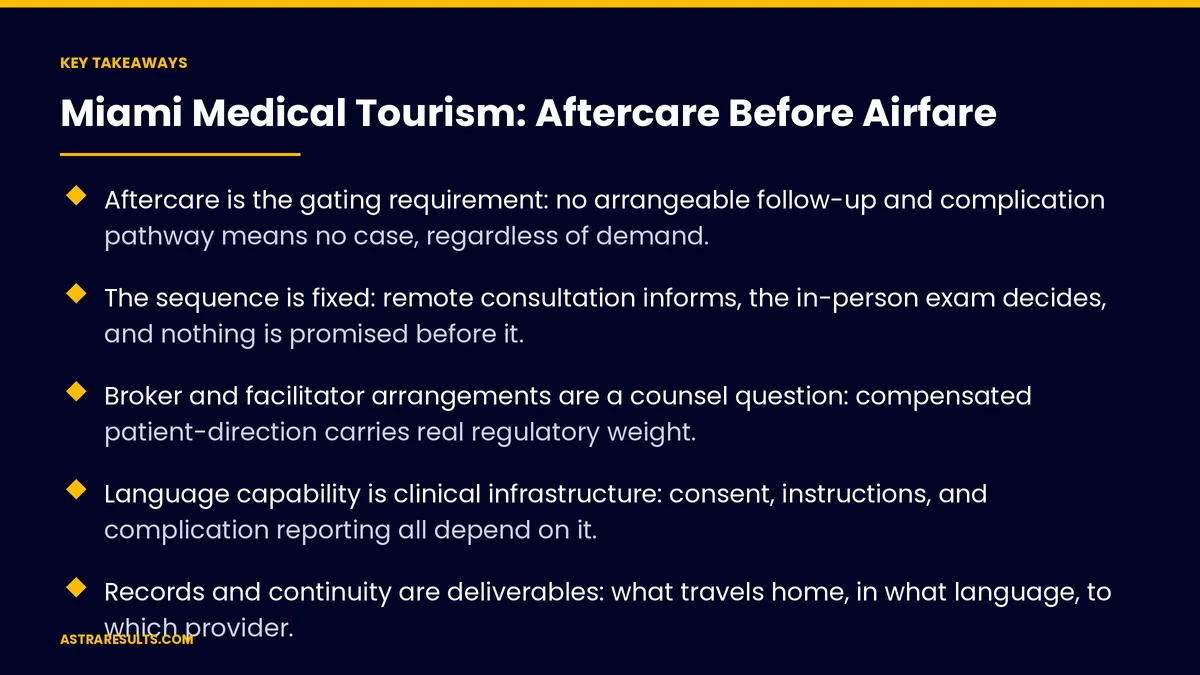
Key Takeaways
- Aftercare is the gating requirement: no arrangeable follow-up and complication pathway means no case, regardless of demand.
- The sequence is fixed: remote consultation informs, the in-person exam decides, and nothing is promised before it.
- Broker and facilitator arrangements are a counsel question: compensated patient-direction carries real regulatory weight.
- Language capability is clinical infrastructure: consent, instructions, and complication reporting all depend on it.
- Records and continuity are deliverables: what travels home, in what language, to which provider.
- Measure the pipeline, not the inquiries: consult-to-treatment, complication and continuity performance, and declines logged as quality signals.
Published: October 15, 2026 | Reading Time: ~13 minutes | Category: Strategy · International
What separates the practices that build a durable international pipeline from the ones that accumulate a series of difficult cases is not marketing reach. It is infrastructure, and specifically the willingness to solve the hardest problem first.
That problem is aftercare. A patient who flies in, is treated. Flies home is a patient whose follow-up, complication management, and continuity all happen somewhere the practice does not control. Every other question in this playbook (how to consult remotely, how to schedule, how to price, how to communicate) is downstream of it.
The practices that get this right treat aftercare as the gating requirement rather than a logistics detail, and decline cases they cannot support. The kicker states the doctrine Astra has held since the first destination piece: aftercare before airfare.
Marketing guidance for licensed practices only. Nothing here is medical, dental, or legal advice. Candidacy, treatment planning, and every clinical statement belong to your providers. Cross-border care raises licensure, telehealth, liability, records, and payment questions that vary by jurisdiction and require your counsel's review.
Any arrangement involving facilitators, agencies, or referral compensation is a legal question before it is a marketing tactic.
In This Playbook
- Aftercare Is the Gating Requirement
- The Sequence: Remote Informs, the Exam Decides
- Brokers, Facilitators, and Clean Hands
- Language Is Clinical Infrastructure
- Records, Continuity, and the Home-Country Provider
- The Content That Actually Converts
- Which Practices Should Build This
- How should a Miami practice measure its international patients?
- A 12-Month Build
Aftercare Is the Gating Requirement
The problem that determines whether a practice should do this at all.
What has to be settled before a case is accepted.
- Who provides follow-up and on what schedule
- What happens if a complication develops after the patient has left the region
- Whether a qualified provider in the patient's home country has agreed to participate in continuity where the treatment requires it
- How the patient reaches the treating practice and how quickly someone responds across time zones
- How records and instructions travel
- What the practice will do — clinically and financially — if the patient needs to return
The standard Astra holds without exception, established in the destination doctrine and reinforced in every arc since: aftercare published before booking, not discussed after.
The decline as policy, not failure. Cases where aftercare cannot be arranged get declined, and publishing that the practice declines them is a credibility asset, the advise-against economics Astra documents everywhere apply with unusual force to an audience that has encountered the opposite.
Why this is also the commercial answer. The international cases that go badly generate the reviews, complaints, and reputational damage that end a pipeline, and nearly all of them trace to aftercare that was assumed rather than arranged.
The Sequence: Remote Informs, the Exam Decides
The clinical order that governs the entire funnel.
Step one: the remote consultation. Useful for understanding goals, reviewing history, discussing what's plausible, explaining process and timelines, and determining whether an in-person evaluation is worth a trip.
What it cannot do. Establish candidacy, confirm a plan, or produce a quote presented as a commitment, because the photos-help-exams-decide principle Astra holds is a clinical reality rather than a caution. Step two — the in-person examination, which decides, and which may change or cancel the plan.
The plain disclosure that makes it work. The patient is told before booking travel that the exam may change the recommendation. What happens if it does, including the financial arrangement, which is where most international disappointments originate. The compression refusal, restated: no clinical timeline compressed to fit a trip, ever.
No plan built backward from a return flight, the standing safety-over-schedule rule.
The telehealth licensure question. Whether and how a provider may consult with a patient located in another country is a legal question for counsel, and the answer shapes what the remote step can be.
Brokers, Facilitators, and Clean Hands
The commercial layer that carries the most risk.
The landscape. An industry of medical-tourism facilitators, agencies, coordinators, and referral platforms exists. Many of them operate on commission or per-patient compensation.
The rule this playbook holds. Any arrangement in which value flows in exchange for patient direction is a counsel question before it is a marketing decision: implicating anti-kickback and self-referral frameworks, fee-splitting prohibitions in some professions, state law, and the practice's own professional conduct rules, with the analysis varying by structure and jurisdiction.
The design principle. Build a pipeline that works without compensated intermediaries, because a pipeline dependent on paid referral flow is both a compliance exposure and a commercial fragility. It leaves when someone pays more, exactly as the referral-durability logic predicts.
What works instead. The physician-to-physician relationship. Colleagues abroad who refer because the practice communicates well, reports back, returns patients for their ongoing care, and handles complications plainly. That web is slow to build, difficult to copy, and durable for decades.
The transparency position. Publishing how the practice handles international referrals, including that it pays nothing for them, is a trust asset with the sophisticated patient and the referring physician alike.
Language Is Clinical Infrastructure
Not a marketing feature.
Where comprehension determines safety. Informed consent, pre-operative instructions, medication guidance, warning signs that warrant contact, and the complication-reporting conversation that may happen by phone from another country at an inconvenient hour. A patient who cannot fully understand any of those is a patient at higher risk.
That is why the chain rule and the staff-it discipline apply at their strictest here.
What the chain must cover for this cohort. Inquiry response, the remote consult, the exam and consent conversation, written instructions that travel home, the after-hours contact path, and the records that go to a provider abroad.
The regional reality. Spanish and Portuguese are baseline for this market's inbound flow, with the register variation across countries mattering more in consent conversations than in marketing copy. Additional languages on the two-tier architecture with qualified medical interpretation engineered rather than improvised, and labeled plainly, because a patient discovering the gap mid-journey is the worst possible moment.
Records, Continuity, and the Home-Country Provider
The deliverables that make a case complete.
What travels home. The operative or treatment record, imaging where relevant, medication and instruction documents, the follow-up schedule, and the practice's contact pathway. In the patient's language, in a format a provider abroad can use.
The home-country provider relationship. Where continuity is clinically required, the practice identifies and communicates with the provider who will deliver it before treatment, rather than hoping one exists, which is the single most-skipped step in international care and the one that turns a manageable complication into an emergency.
The privacy and cross-border data question. Transmitting records internationally raises privacy and data-transfer questions your counsel must address, per the privacy-first standard Astra holds.
The financial clarity. What the quoted price includes, what it doesn't, what a complication or revision would cost, what happens if the patient needs to extend her stay. How payment works across borders, published before booking, because scope surprises are the category's most reliable source of disputes.
The Content That Actually Converts
What an international patient is looking for, and what the market gives her instead.
What she gets from most sources. Price comparisons, package framing, and outcome imagery. That is why the sophisticated patient in this cohort is looking for reasons to trust rather than reasons to book.
What converts her.
- The precision-verification content Astra requires — credentials and hospital affiliations stated exactly and verifiably, with the adjacency line respected
- The process and timeline published plainly including total time in region
- The aftercare structure described in detail
- The candidacy candor that says who this is and isn't appropriate for
- Framework pricing with the inclusions and exclusions named
The gallery under full doctrine. consented, unretouched, honestly labeled, with international representation real rather than assembled.
The tone. Unhurried and non-promotional: no urgency, no package language, no insecurity leverage, and no implied famous clientele per the society line.
The AI-answer layer. This cohort's research questions (recovery time, flying afterward, what happens if something goes wrong) are increasingly answered by assistants. The practice whose candid content exists gets cited through the entity work our AI SEO service builds.
Which Practices Should Build This
The plain filter.
Well suited
Practices with real sub-specialty depth, the clinical and operational capacity to manage complications remotely, existing physician relationships abroad or the patience to build them, native language capability end to end, and the financial structure to absorb a revision or an extended stay without renegotiating with a distressed patient.
Not suited, and this is most practices
Those seeking volume, those whose aftercare plan is "the patient can call us," those without the language chain, and those whose interest is driven by price arbitrage, which is the wrong-patient acquisition failure at international scale, and considerably more consequential.
The staged alternative
Serve the seasonal and visitor cohorts properly first, since that infrastructure is most of what an international pipeline requires and the risk is lower while it's being built.
The capacity note
International cases consume disproportionate coordination time, and a practice that adds them without adding capacity degrades service for the resident base that sustains it.
How should a Miami practice measure its international patients?
The dashboard, per the case-level standard, built around quality rather than volume:
- Remote-consult-to-exam and exam-to-treatment conversion, read separately because the second is where candid candidacy shows up
- The decline count and reasons, logged as a quality signal rather than lost revenue
- Aftercare-plan completion for every accepted case as a clinical-governance metric with a hard target of one hundred percent
- Complication and continuity performance — response times across time zones, home-country provider engagement, and unplanned-return rate — tracked internally for care quality and never converted into marketing claims
- The physician-referral ledger abroad by relationship, per the referral-systems discipline
- Records-delivery completeness and language accuracy
- The financial-dispute count, which is the clear read on whether pricing was published clearly enough
- Coordination hours per case against realized value
- Cost per accepted case rather than per inquiry, since inquiry volume in this category is dominated by people the practice should decline
A 12-Month Build
Q1 — Infrastructure and rules.
- The aftercare structure designed with clinical leadership and written as policy including the decline criteria
- Counsel engaged on telehealth licensure, cross-border records, payment, liability, and any intermediary question
- The language chain audited end to end and gaps closed or the cohort deferred
- Financial terms drafted with inclusions, exclusions, and revision provisions
Q2 — Content and sequence.
- The verification, process, timeline, aftercare, and framework-pricing content published under named-provider authorship in English, native Spanish, and Portuguese
- The remote-consult format built with its explicit limits stated
- The candidacy-candor page live
- The gallery brought under full doctrine with real representation
Q3: Relationships, not intermediaries
Physician-to-physician outreach begun where the practice has real colleagues or credible introductions; the home-country continuity process tested on real cases; coordination staffing added before volume rather than after. Measurement instrumented for the pipeline metrics above.
Q4 — Read and decide.
- Conversion, decline, aftercare-completion, and coordination-hour data reviewed plainly
- The physician ledger assessed
- A real decision made about whether to expand, hold, or exit. Because a practice that finds the coordination cost exceeds the value has learned something worth more than the cases it didn't take
How Astra Builds International Pipelines
Astra Results Marketing builds international patient pipelines infrastructure-first: aftercare arranged and published before any case is accepted, the remote-informs-exam-decides sequence held without exception, compensated intermediaries left to counsel and designed around, language treated as clinical infrastructure across the full chain, records and home-country continuity handled as deliverables. The whole pipeline measured on accepted-case quality rather than inquiry volume.
Engagements begin with an aftercare, language-chain, and pipeline audit through our business consulting team.
Related reading
Frequently asked questions
What's the first thing to build?
The aftercare structure, before any marketing exists: who provides follow-up, what happens if a complication develops after the patient flies home, which provider abroad participates in continuity where it's required, how the patient reaches you across time zones. What you'll do clinically and financially if she needs to return. Publish it before booking. Cases where that can't be arranged get declined. Publishing that you decline them is a credibility asset with exactly the patient worth having.
Can we quote a price from photographs and a video consult?
You can discuss ranges and process. You can't establish candidacy or commit to a plan. The remote consult informs and the in-person exam decides. The patient needs to know before she buys a ticket that the exam may change the recommendation, along with what happens financially if it does. Most international disappointments trace to a quote treated as a commitment.
Should we work with medical-tourism facilitators or agencies?
Take any compensated arrangement to counsel before it exists. Patient-direction in exchange for value implicates anti-kickback and self-referral frameworks, fee-splitting rules in some professions, and your own conduct standards, with the analysis depending on structure and jurisdiction. Beyond compliance, there's fragility: a pipeline built on paid referral flow leaves when someone pays more. Build physician-to-physician relationships instead. They're slower and far more durable.
How important is language capability for this cohort?
It's clinical infrastructure rather than marketing: consent, pre-operative instructions, medication guidance, warning signs, and the complication call that may come from another country at 2 a.m. all depend on comprehension. Run the whole chain natively (inquiry, consult, exam and consent, written instructions, after-hours contact, and records) and if a gap exists, close it before accepting the cohort rather than after.
What's the most-skipped step in international care?
Identifying and communicating with the home-country provider who will handle continuity before treatment rather than hoping one exists. That single omission is what turns a manageable complication into an emergency. It's why aftercare-plan completion should be tracked as a governance metric with a target of one hundred percent of accepted cases.
How do we know if this is worth building?
Measure accepted-case quality rather than inquiry volume. Exam-to-treatment conversion, decline reasons, aftercare completion, unplanned-return rate, and coordination hours per case against realized value. International cases consume disproportionate coordination time, so if that ledger shows the cost exceeding the value, exiting is a legitimate and useful conclusion, and considerably cheaper than learning it from a case that went badly.
Ready to Build the Pipeline Infrastructure-First? Astra Results Marketing builds international patient pipelines on aftercare published before booking, the exam-decides sequence, physician relationships instead of paid intermediaries, and language treated as clinical infrastructure. Start with an aftercare, language-chain, and pipeline audit for your practice. ▸ CALL (786) 321-2866 · ▸ REQUEST YOUR CONSULTATION