 Rated 5 star on

Off-the-Shelf First: How to Test It Fairly
Quick answer
Test off-the-shelf AI fairly by defining the job, success measures and a baseline before the trial starts. Use real cases from your business, including the hard ones. Set each tool up properly with your content and give them the same cases. Run it for two to four weeks. Decide with rules set in advance.
Before building custom AI, most businesses should try ready-made tools first. They're cheaper, faster to start and maintained by someone else. But many trials are unfair: a polished demo flatters a weak tool, or a rushed test sinks a good one.
Key Takeaways
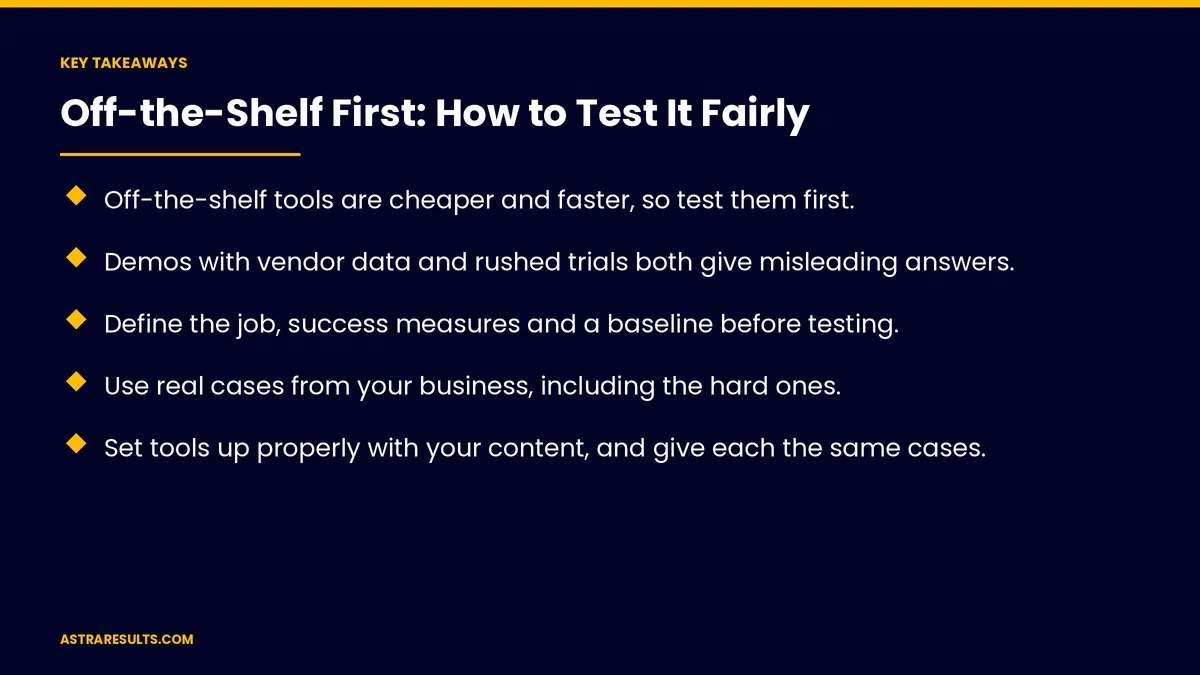
- Off-the-shelf tools are cheaper and faster, so test them first.
- Demos with vendor data and rushed trials both give misleading answers.
- Define the job, success measures and a baseline before testing.
- Use real cases from your business, including the hard ones.
- Set tools up properly with your content, and give each the same cases.
- Set decision rules in advance: adopt, adjust or build custom.
Published: October 25, 2026 | Reading Time: ~9 minutes | Category: Industry-Specific AI
This guide covers unfair tests to avoid, defining the job, setting a baseline, choosing real cases, proper setup, running and comparing trials, fit beyond accuracy and decision rules. Put plainly: test with your data, your hard cases and rules you set before the trial starts.
For why generic tools often struggle, see why generic AI fails on specific workflows.
In This Playbook
- Why start with off-the-shelf
- Why are vendor demos an unfair AI test?
- Define the job
- Set a baseline
- Choose real cases
- Set tools up properly
- How long should an AI tool trial run?
- Compare fairly
- Check fit beyond accuracy
- Set decision rules in advance
- Record the results
- What to measure
- The first three months
Why start with off-the-shelf
Lower cost. Subscriptions instead of builds.
Faster start. Days or weeks, not months.
Someone else maintains it. Updates and fixes included.
Custom when needed. As weighed in is custom AI right for your size.
Why are vendor demos an unfair AI test?
Vendor demos. Their data, their best cases.
No setup. Testing a tool before giving it your content or settings.
Only easy cases. Hard ones are where tools differ.
No baseline. No way to know whether results are better.
Too short. A day isn't enough to judge.
One opinion. A single person's impression.
Define the job
One specific task. "Draft replies to warranty claims," not "help support."
Examples. Support drafts and onboarding guides, as in SaaS GenAI.
Success measures. Accuracy, time saved and review time.
What good looks like. Examples of a correct result.
Set a baseline
How it works today. Time per case, error rate and cost.
Your best people. Their results are the standard to beat.
Choose real cases
A real sample. Recent cases from your business.
Include the hard ones. Exceptions and unusual requests.
Known answers. So results can be scored.
Accuracy matters most where errors are costly, as covered in hallucinations.
Set tools up properly
Your content. Policies, documents and examples loaded in.
Your settings. Configured as you would use it.
Integrations where allowed. Even basic ones for the trial.
How long should an AI tool trial run?
Two to four weeks. Long enough to see real patterns.
Real users. The people who'd use it daily.
Track every case. Correct, partly correct or wrong.
Compare fairly
Same cases for every tool. Apples to apples.
Score without knowing the tool. Where possible, remove names from results.
Several reviewers. Not one opinion.
Check fit beyond accuracy
Integrations. Does it connect to your systems?
Security and data terms. How your data is used and stored, as covered in GenAI security.
Admin effort. Who maintains settings and content.
Cost at full use. Not just the trial price.
Set decision rules in advance
Adopt. It meets the success measures.
Adjust. Close, with configuration or light custom work.
Build custom. It falls short on the hard cases that matter most, as covered in industry-specific AI.
Who builds it is weighed in in-house vs partner.
Record the results
What was tested. Tools, cases and settings.
What happened. Scores, time and costs.
Why you decided. So the decision can be revisited.
Pilot discipline is covered in AI pilots that fail safely.
What to measure
Accuracy on real cases. Against the baseline.
Time saved. Net of review.
Hard-case performance. Exceptions and unusual requests.
User adoption. During the trial.
Total cost. At full use.
The first three months
Days 1–30: prepare
Define the job, success measures and baseline, collect real cases with known answers and set decision rules.
Days 31–60: test
Set up each tool with your content, run a two-to-four-week trial with real users and score results fairly.
Days 61–90: decide
Compare against the baseline and fit factors, decide to adopt, adjust or build custom and record why.
How Astra runs fair AI tests
Astra Results Marketing helps businesses test off-the-shelf AI fairly before building custom. We define the job and baseline, use your real and hard cases, set tools up properly, score results fairly and help you decide with clear rules.
Engagements begin with a tool evaluation plan through our industry-specific AI team.
Related reading
Frequently asked questions
Should we try off-the-shelf AI before building custom?
Usually, yes. It's cheaper and faster, and a fair test shows whether it's enough.
What makes an AI trial unfair?
Vendor demos, no setup, only easy cases, no baseline, too little time and a single person's opinion.
How long should a trial run?
Two to four weeks, with real users and real cases.
Which cases should we test?
A real sample from your business with known answers, including hard cases and exceptions.
What besides accuracy matters?
Integrations, security and data terms, admin effort and cost at full use.
How do we decide what to do next?
Use rules set in advance: adopt if it meets the measures, adjust if it's close, build custom if it fails the hard cases that matter.
Ready to test AI tools before committing? Astra Results Marketing runs fair trials of off-the-shelf AI with your data and hard cases, compares tools fairly and helps you decide to adopt, adjust or build custom. ▸ CALL (786) 321-2866 · ▸ REQUEST YOUR CONSULTATION





